E-invoicing readiness in the UAE means one thing: your business can generate, validate, and transmit a structured electronic invoice through an Accredited Service Provider before your mandatory deadline hits. PDFs and scanned documents will not qualify. The rollout runs in phases from a voluntary pilot on July 1, 2026, through mandatory go-live dates stretching into late 2027, and the single most urgent action right now is confirming your revenue band, then shortlisting an Accredited Service Provider before your appointment window closes.
TL;DR:
- Businesses above AED 50 million in revenue must appoint an Accredited Service Provider by July 31, 2026, and go live with e-invoicing by January 1, 2027.
- The UAE’s decentralized model requires direct validation and reporting by Accredited Service Providers, with invoices in structured data format, not PDFs or scanned images.
- Preparing involves cleaning master data, adapting ERP systems for compliance, rebuilding internal controls, and conducting full-chain testing with dedicated project ownership.
- Selecting an ASP requires verifying accreditation, integration support, security standards, and establishing clear milestones for onboarding and testing.
- Non-compliance penalties include per-invoice fines and recurring penalties, emphasizing the need for real-time transmission monitoring and accurate records.
Table of Contents
- What does e-invoicing mean for UAE businesses?
- When is the deadline for e-invoicing in the UAE?
- How does the UAE’s e-invoicing technical model work?
- Is my business ready for e-invoicing? A practical checklist
- How do you choose and onboard an Accredited Service Provider?
- What are the penalties for non-compliance?
- Singleclic’s implementation playbook for UAE e-invoicing
- Governance and success metrics that actually matter
- How Singleclic helps you get e-invoicing ready
- Sources
- FAQ
What does e-invoicing mean for UAE businesses?
An e-invoice under UAE law is a structured electronic data file, not a document that merely looks like an invoice. The Federal Tax Authority is explicit that unstructured formats, PDFs, scanned images, Word files, and email attachments, do not qualify as compliant e-invoices, because structured data is what allows machines to validate, exchange, and report a transaction without manual re-entry.
The scope covers business-to-business and business-to-government transactions. Business-to-consumer sales are currently excluded from the electronic invoicing requirements, which means retail point-of-sale systems are not initially subject to this compliance.
The payoff for finance teams is real. Structured data means VAT returns can eventually pre-populate from transmitted invoices, refund cycles shorten because tax authorities trust machine-validated data, and internal controls improve since every invoice passes through a consistent validation layer before it reaches a counterparty. That is the operational case for treating UAE e-invoicing readiness as a finance transformation project, not just a tax filing update.
When is the deadline for e-invoicing in the UAE?
The rollout follows a phased schedule set out in Ministerial Decision No. 244 of 2025, and the dates split into two distinct categories: when you must appoint a service provider, and when you must actually be live.
The voluntary pilot opens July 1, 2026. Businesses with revenue at or above AED 50,000,000 must appoint an Accredited Service Provider by July 31, 2026, and go live by January 1, 2027. Smaller taxable businesses get more runway: appointment by March 31, 2027, and implementation by July 1, 2027. Government entities follow last, with a live date of October 1, 2027.
The trap most finance teams fall into is treating appointment and implementation as one milestone. They are not. Appointing an Accredited Service Provider is an administrative and contractual step. Getting your ERP producing valid, transmittable invoices is an entirely separate engineering effort, and it usually takes far longer than procurement expects. Build your project plan around both dates independently, with the appointment deadline treated as a hard checkpoint, not the finish line.
How does the UAE’s e-invoicing technical model work?
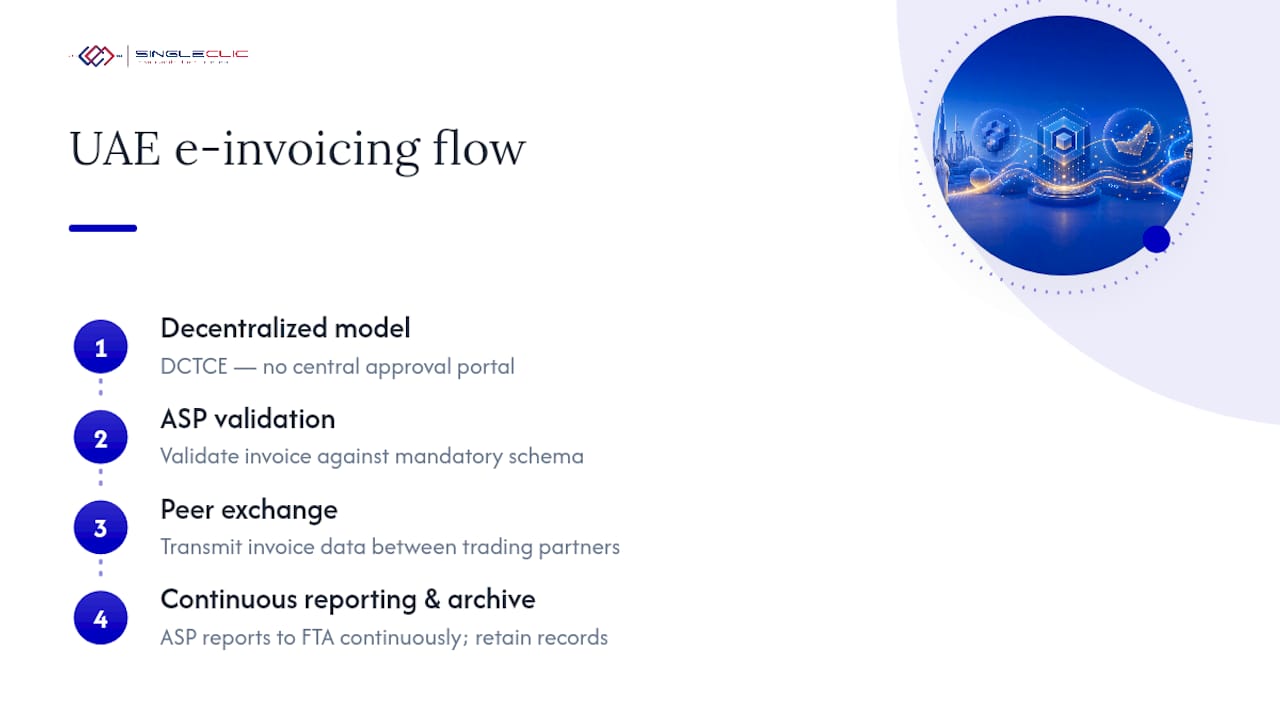
The UAE has adopted a Decentralized Continuous Transaction Control and Exchange model, known as DCTCE. In plain terms, invoices don’t route through a single central government portal for approval before they’re sent. Instead, Accredited Service Providers validate and exchange invoice data directly between trading partners, then report the resulting data to the Federal Tax Authority continuously, rather than in a single batch submission.
Accredited Service Providers carry the operational weight in this model. They validate invoice structure against the mandatory schema, transmit the data between buyer and seller systems, report transaction status back to both parties, and retain records to meet retention obligations. FTA Decision No. 4 of 2026 requires that electronic records stay complete, legible, and accessible to the tax authority on request, which makes your ASP’s archiving architecture a due diligence item, not an afterthought.
The exchange framework aligns with OpenPeppol, the international interoperability network already used across parts of Europe and Asia. Field-level requirements sit in the PINT-AE data dictionary, detailed in the UAE Electronic Invoicing Guidelines V1.1, which lists mandatory fields, examples, and a readiness checklist your ERP team should treat as a working reference document through go-live.
Is my business ready for e-invoicing? A practical checklist
Readiness comes down to five workstreams, and most companies underestimate how much time master-data cleanup alone consumes.
- Clean and map your master data. Customer, supplier, and product records need to align with the Data Dictionary’s mandatory fields, things like tax registration numbers, address formats, and line-item classifications, before any payload will validate correctly.
- Adapt your ERP for structured output. Your Dynamics 365 or Odoo instance needs an adapter or API layer that produces compliant payloads, handles multi-currency transactions correctly, and applies the right timezone stamps on every document.
- Rebuild your operational controls. VAT calculation logic, credit-note issuance, and accounts payable/receivable reconciliation all need to reflect the new transmission flow, including automated exception handling when an invoice bounces back.
- Run full-chain testing, not partial testing. A payload isn’t validated just because your ERP generates it. It’s validated when your Accredited Service Provider confirms it, transmits it, and the counterparty acknowledges receipt. Rejection handling and compliant credit-note cycles both need dedicated user acceptance testing before go-live.
- Assign program governance using a practical marketing automation checklist to maintain discipline across milestones. Someone owns the milestone tracker. Someone owns regulatory change monitoring. Without named owners, appointment deadlines slip quietly until they become emergencies.
Pro Tip: Treat your first 50 test invoices as a diagnostic tool, not a formality. Most field-mapping errors surface in the first batch, and catching them there is far cheaper than catching them during your live cutover week.
Teams using Singleclic’s ERP implementation checklist as a base template tend to catch mapping gaps earlier, simply because the checklist forces a field-by-field review before testing starts.
How do you choose and onboard an Accredited Service Provider?
Selecting an Accredited Service Provider is a procurement decision with technical consequences, so treat it with the same rigor you’d apply to choosing an ERP vendor.
- Confirm the provider’s accreditation status directly against the Ministry of Finance’s published list, and verify their Peppol connectivity credentials where interoperability is required.
- Ask for the specific integration patterns they support: API-based, file-based, or middleware, and confirm which one matches your ERP’s existing architecture.
- Request their standard service-level agreement, including incident response times, data retention policies, and security certifications relevant to financial data handling.
- Ask for actual user acceptance testing evidence: sample payloads they’ve processed, how they handle rejections, and what a resubmission cycle looks like end to end.
- Negotiate exit and portability terms upfront. If the relationship ends, your invoice archive and connectivity setup need to migrate cleanly, not get stranded with a single vendor.
Once you sign, structure onboarding around distinct milestones: formal appointment, integration build and test, a full-transaction pilot, rejection resolution, and finally, production cutover. Each milestone needs a clear go or no-go decision point rather than a soft target date.
What are the penalties for non-compliance?
Cabinet Decision No. 106 of 2025 sets out administrative penalties for e-invoicing violations, including per-invoice fines and recurring monthly penalties for businesses that fail to appoint a provider or transmit invoices as required.
Build monitoring before you need it: transmission logs that flag failed submissions in real time, a reconciliation dashboard comparing issued invoices against confirmed transmissions, and SLA alerts tied to your provider agreement. The most common failure pattern isn’t a missed deadline. It’s a business that appears compliant on paper but is quietly running a PDF-based pilot with incomplete field mappings, discovering the gap only when transmission volumes scale up.
Singleclic’s implementation playbook for UAE e-invoicing
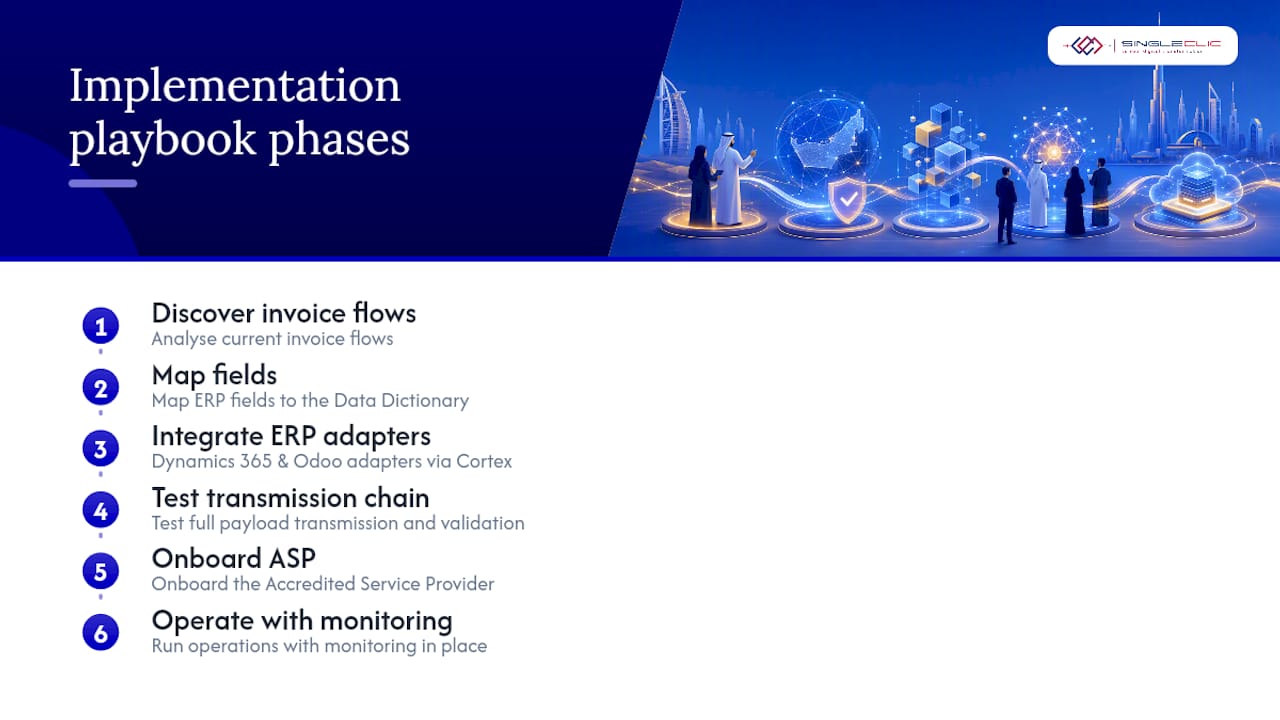
Singleclic runs enterprise e-invoicing readiness through six phases: discover current invoice flows, map fields against the Data Dictionary, integrate ERP adapters, test the full transmission chain, onboard the chosen Accredited Service Provider, and operate with monitoring in place.
Cortex, Singleclic’s low-code and BPM platform, generates structured payloads through configurable templates that transform ERP fields into PINT-AE-compliant data, with fallback logic if a transmission fails validation. Dynamics 365 and Odoo adapters built on this foundation carry over Singleclic’s UAE PASS integration experience, which shortens the authentication and connectivity work most enterprise deployments underestimate. UAT checklists and sample field mappings from prior deployments help new clients skip weeks of trial and error.
Governance and success metrics that actually matter
Appoint a named regulatory-change owner who reports readiness status to the executive board monthly, not quarterly. Measure progress by completed end-to-end transmissions and resolved rejection cycles, never by how many meetings happened. Check the Ministry of Finance’s eInvoicing portal regularly; guidance has already evolved once with the V1.1 release, and it will again.
— Tamer Badr
How Singleclic helps you get e-invoicing ready
Singleclic is the alternative to piecing together e-invoicing compliance through a patchwork of consultants and manual ERP fixes. Our advantage is depth: over a decade of Dynamics 365 and Odoo implementation experience across the UAE and wider MENA region, combined with Cortex, our Arabic-enabled low-code platform, which maps invoice fields to the PINT-AE data dictionary without custom code for every ERP change.
If your business sits above the AED 50,000,000 threshold, your appointment window closes fast. Singleclic’s ERP and D365 implementation team can assess your current invoice architecture, identify mapping gaps against the Data Dictionary, and build the adapter layer your Accredited Service Provider needs to validate payloads correctly. For businesses running Odoo, IBM BAW, or a mixed legacy stack, our full services overview covers the integration and automation work required for a clean cutover. Request a readiness assessment and get a concrete milestone plan before your next deadline arrives.
Sources
- Ministerial Decision No. 244 of 2025 on The Implementation of the Electronic Invoicing System
- UAE e-Invoicing — Federal Tax Authority
FAQ
Is an e-invoice mandatory in the UAE?
Yes, for business-to-business and business-to-government transactions, following a phased mandatory rollout that starts with large taxable businesses on January 1, 2027. Business-to-consumer transactions are excluded under current legislation.
What is the deadline for e-invoicing in the UAE?
Deadlines are phased by business size. Large businesses with revenue at or above AED 50,000,000 must appoint a provider by July 31, 2026, and go live by January 1, 2027; smaller businesses follow by July 1, 2027, and government entities by October 1, 2027.
Who is eligible for e-invoicing in the UAE?
Any business conducting B2B or B2G transactions falls within scope. The revenue threshold of AED 50,000,000 determines the appointment and implementation deadlines. Government entities have a separate implementation date.
What are the FTA e-invoicing guidelines for the UAE?
The Federal Tax Authority requires invoices to be issued, exchanged, and reported electronically in a structured data format. PDFs, scanned documents, and email attachments do not meet this definition, even if they contain identical invoice information.
How can Singleclic help with UAE e-invoicing readiness?
Singleclic supports UAE businesses through ERP integration for Dynamics 365 and Odoo, plus Cortex-based payload mapping that aligns invoice data with the PINT-AE data dictionary. Current service details and engagement options are available through Singleclic’s services page.