Enterprise modernization delivers measurable gains in agility, cost reduction, and innovation capacity — and the evidence is no longer theoretical. A Forrester TEI commissioned by Microsoft found that modernizing applications on Azure PaaS produced 228% ROI over three years with a 15-month payback period. Leaders who treat modernization as a one-time migration project consistently underperform those who run it as a continuous value-realization program. Expect to see technical results within 15–90 days of a well-scoped pilot, and meaningful business ROI within 6–18 months at enterprise scale.
Three immediate takeaways for busy leaders:
- Financial ROI: Infrastructure cost reductions and faster application development are achievable within the first modernization cycle, per the Forrester TEI findings above.
- Developer velocity: Teams freed from maintaining brittle legacy code ship features faster, reduce mean time to recover (MTTR), and spend more time on revenue-generating work.
- Operational resilience: Modernized architectures built on cloud-native services and microservices recover faster from failures, scale on demand, and carry far less hidden technical debt.
Key takeaways
Enterprise modernization delivers measurable financial, operational, and competitive returns when it is treated as a value-realization program rather than a migration project.
| Point | Details |
|---|---|
| ROI benchmark | Forrester TEI found 228% ROI over three years with a 15-month payback for Azure PaaS modernization. |
| Start with retire | Decommissioning unused applications before migration reduces cost, complexity, and integration risk immediately. |
| Pilot sizing | Run technical pilots over 15–90 days; expect business ROI evidence within 6–18 months at enterprise scale. |
| Gen AI acceleration | McKinsey case examples show gen AI can cut modernization timelines by 40–50% and reduce remediation costs by roughly 40%. |
| Singleclic’s role | Singleclic delivers ERP, CRM, and Cortex low-code modernization across KSA, UAE, and Egypt for enterprises ready to act. |
Table of Contents
- What enterprise application modernization actually means
- Why modernization is a board-level priority right now
- What specific benefits should you expect from modernization?
- Which modernization strategy is right for each application?
- How to plan, govern, and deliver modernization programs
- How to measure modernization success: KPIs, timelines, and ROI
- What are the biggest risks in modernization, and how do you mitigate them?
- How generative AI changes the modernization cost and time equation
- When should you start, and what are the first three steps?
- Industry-specific benefits: where modernization pays off fastest
- How modernization reshapes organizational culture and workforce
- Integration challenges after modernization: what leaders underestimate
- What actually works in practice
- How Singleclic accelerates your modernization program
- Sources
What enterprise application modernization actually means
Application modernization is the process of updating legacy software systems, platforms, and operating models to align IT architecture with current and future business goals. LeanIX defines it as aligning IT architecture to business outcomes through activities such as replatforming, refactoring, modularization, and cloud-native adoption. The scope goes beyond moving code: it covers the application estate, the underlying data architecture, the delivery operating model, and the governance structures that sustain change over time.
The most common modernization types, each with a one-line explanation:
- Rehost (lift-and-shift): Move the application to a new infrastructure environment with no code changes. Fast, but captures limited business value.
- Replatform: Move to a new platform with minor optimizations. Captures some cloud economics without full refactoring.
- Refactor: Restructure existing code to improve maintainability without changing external behavior.
- Rearchitect: Redesign the application’s architecture, often breaking a monolith into microservices.
- Rebuild: Rewrite the application from scratch using modern technology while preserving its scope.
- Replace: Retire the custom application and adopt a commercial off-the-shelf (COTS) or SaaS product.
- Retire: Decommission applications that no longer deliver business value.
The contrast that matters most in practice: a pure lift-and-shift of a monolithic ERP to cloud infrastructure often increases operational complexity and cost because the underlying technical debt travels with it. A replatform or rearchitect approach, by contrast, removes that debt and unlocks cloud-native capabilities like auto-scaling, managed services, and API-first integration. The difference shows up directly in the cost-of-change metric, not in the go-live event.
Why modernization is a board-level priority right now
The urgency is driven by converging pressures, not a single trend. According to TechTarget’s executive survey synthesis, the leading drivers for transformation initiatives are improved customer experience (40% of respondents), improved efficiency (38%), business process transformation (38%), and IT modernization itself (35%). These are not aspirational goals — they are the criteria boards use to evaluate technology investment.
The specific drivers accelerating modernization decisions today:
- AI readiness: Generative AI and agentic automation require clean, API-accessible data and modular architectures. Legacy monoliths block both.
- Cloud cost control: Unoptimized workloads running on cloud infrastructure without application modernization routinely produce higher bills than on-premise equivalents.
- Technical debt accumulation: Unaddressed technical debt compounds annually, consuming developer capacity and slowing every new feature.
- Regulatory pressure: Data residency, privacy regulations, and sector-specific compliance mandates (financial services, healthcare) require architecture changes that legacy systems cannot accommodate.
- M&A integration: Acquiring or merging organizations cannot integrate systems built on incompatible legacy stacks without modernization.
- Talent retention: Engineers leave organizations where they spend the majority of their time maintaining outdated systems rather than building new capabilities.
- Customer experience gaps: Legacy front-ends and disconnected data pipelines prevent the real-time personalization customers now expect.
Thoughtworks’ enterprise modernization survey found that roughly 54% of senior decision-makers cite modernization among the most critical factors for future success. That gap between urgency and execution is where most organizations lose competitive ground.
Replatforming the highest-cost applications first can recover that margin within 12–18 months, creating a self-funding modernization program.
What specific benefits should you expect from modernization?
The most impactful benefit categories are agility, cost reduction, security and compliance, developer productivity, customer experience, and AI/innovation readiness. Each carries measurable KPIs that belong in your program dashboard.
| Benefit category | What it means in practice | Example KPIs to track |
|---|---|---|
| Business agility | Faster response to market changes; new features deployed in days, not quarters | Time-to-market for new features; deployment frequency |
| Infrastructure cost reduction | Fewer servers, managed services replacing custom ops, right-sized cloud spend | Infrastructure cost per transaction; cloud spend as % of revenue |
| Developer productivity | Less time on maintenance, more on new capability; faster onboarding | Deployment frequency; change failure rate; developer satisfaction score |
| Security and compliance | Modern platforms with built-in security controls, audit trails, and patch management | Mean time to patch; compliance audit pass rate; security incident frequency |
| Customer experience | Real-time data access, faster response times, consistent omnichannel experience | NPS; customer effort score; API response latency |
| AI and innovation readiness | Clean data, API-first architecture, and modular services enable AI use cases | Number of AI use cases in production; data pipeline latency |
| Operational resilience | Faster recovery from failures; reduced blast radius of incidents | MTTR; system availability (uptime %); incident frequency |
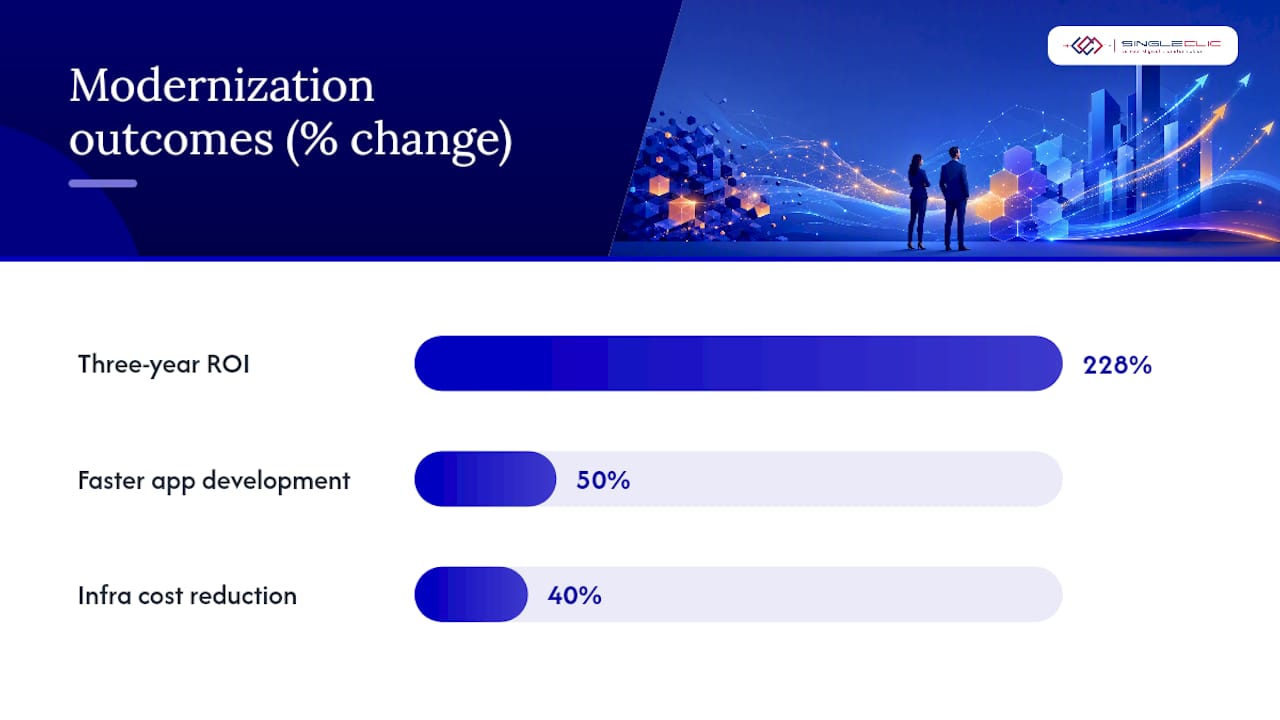
228% ROI over three years with a 15-month payback period. That is the result a Forrester TEI study found for organizations modernizing on Azure PaaS, alongside a 40% reduction in infrastructure costs and 50% faster application development. These figures give CFOs and CTOs a concrete benchmark for building board-level business cases.
IDC research cited in the Kyndryl modernization study corroborates the pattern: organizations using proven modernization methodologies report large multi-year ROI figures and short payback periods across sectors. The consistency across independent studies is what makes these benchmarks credible in a board conversation.
For the CFO and CIO to track together, the short list of measurable outcomes includes reduction in infrastructure and licensing costs, deployment frequency improvement, mean time to recover from incidents, developer time allocation shift from maintenance to new features, customer-facing latency and availability improvements, and reduction in compliance findings per audit cycle.
Which modernization strategy is right for each application?
Choose your strategy based on three variables: business value of the application, risk of change, and speed to value. The 7 R’s framework gives you a structured way to assign each application in your portfolio to the right path. Software rationalization guidance recommends treating portfolio rationalization as the prerequisite step before any migration or refactoring begins.
| Strategy | Core benefit | Key trade-off | Best used when |
|---|---|---|---|
| Retain | Zero disruption, no cost | No value gain; debt persists | Application is stable, low-cost, and non-strategic |
| Rehost | Fast, low risk | Minimal value; cloud costs may rise | Speed is critical; refactoring budget is unavailable |
| Replatform | Cloud economics with limited rework | Partial value; some technical debt remains | Application is stable but needs managed services |
| Refactor | Improved maintainability and performance | Moderate effort; requires skilled engineers | High-value app with manageable codebase complexity |
| Rearchitect | Full cloud-native benefits; microservices agility | High effort, high risk, longest timeline | Core business system with high change frequency |
| Rebuild | Clean slate; modern stack | Highest cost and time; knowledge transfer risk | Application is beyond repair; business logic is well-documented |
| Replace | Fastest to modern capability | Vendor dependency; data migration complexity | COTS/SaaS product exists that covers most requirements |
| Retire | Immediate cost and complexity reduction | Requires decommissioning governance | Application has no active users or duplicates another system |
Prioritization checklist for each application:
- Does this application sit on a critical business process or a peripheral one?
- What is the annual total cost of ownership (TCO), including maintenance labor?
- How frequently does the application need to change to meet business demand?
- What is the risk of data loss or service disruption during migration?
- Does a viable COTS or SaaS replacement exist at lower TCO?
- Is the codebase documented well enough to refactor or rebuild safely?
A practical sequencing example for a mid-size program: retire unused applications first (immediate cost reduction, zero risk). Rehost non-critical workloads to establish cloud operations capability, then replatform or refactor the two or three highest-TCO applications that sit on core business processes. Reserve rearchitect and rebuild for the applications where change frequency is highest and the current architecture is the primary constraint on delivery speed. This approach generates early wins that fund the harder work. You can find incremental workflow modernization tactics in this guide to modernizing legacy workflows without replacing every system.
How to plan, govern, and deliver modernization programs
Treat modernization as a value-realization system, not a set of implementation milestones. The Detecon CIO playbook makes this argument directly: retiring unnecessary systems is often the most underrated lever, and organizations that measure success by go-live events consistently miss the financial outcomes they projected.
Step-by-step governance checklist:
- Assess the application portfolio. Catalog every application by business criticality, TCO, technical health score, and change frequency. Use tools like LeanIX or ServiceNow ITAM to automate discovery where possible.
- Prioritize by value and risk. Score each application against the 7 R’s checklist above. Identify the top 10–15% of applications that drive 60–70% of your maintenance cost or change-request backlog.
- Define measurable outcomes before you start. Assign target KPIs to each modernization workstream before the first sprint. If you cannot name the KPI, the workstream lacks a business case.
- Run a bounded pilot. Select one or two high-value, moderate-risk applications. Run a 30–90 day technical pilot with a dedicated squad. Measure actual cost, velocity, and quality outcomes against the baseline.
- Scale with a factory model. Once the pilot validates the approach, replicate the squad model across the portfolio. Standardize tooling, CI/CD pipelines, and deployment patterns to reduce per-application effort.
- Measure and report continuously. Publish a modernization dashboard to the CIO, CFO, and business sponsors monthly. Tie every metric to the original business case.
Roles and accountability: The program needs a named executive sponsor (CIO or CTO), a modernization program director, application owners for each workstream, a platform engineering team owning the target architecture, and a change management lead. Without a dedicated change management lead, adoption failures in the business layer will erode technical gains.
Delivery patterns that reduce risk: trunk-based development with feature flags lets teams deploy continuously without exposing incomplete features to production. CI/CD pipelines with automated testing gates catch regressions before they reach users. Both patterns are prerequisites for the deployment frequency improvements that appear in modernization ROI models.
Change management is where most programs underestimate effort. Engage business process owners in the design phase, not just the UAT phase.
Pro Tip: Sequence your retire decisions before your rehost decisions. Every application you decommission reduces the surface area of your migration, lowers your cloud bill from day one, and removes a dependency that would otherwise complicate every subsequent workstream. Most programs skip this step and pay for it in integration complexity later.
How to measure modernization success: KPIs, timelines, and ROI
Use business KPIs (cost, time-to-market, revenue impact) alongside technical KPIs (deployment frequency, MTTR) to build a complete picture. Technical metrics tell you the program is working; business metrics tell the CFO it was worth the investment.
Sample KPI dashboard:
- Infrastructure cost per transaction (target: 20–40% reduction)
- Deployment frequency (target: move from monthly to weekly or daily)
- Mean time to recover from incidents (target: reduce by 50%+)
- Change failure rate (target: below 5%)
- Developer time on maintenance vs. new features (target: shift ratio from 70/30 to 40/60)
- Time-to-market for new features (target: 30–50% reduction)
- Application availability/uptime (target: 99.9%+)
- Compliance audit findings per cycle (target: year-over-year reduction)
Mini ROI worked example: Assume a mid-size enterprise with $8M annual infrastructure and application maintenance spend. Combined annual benefit: $3.6M. Payback period: approximately 8 months after go-live. Three-year net benefit: roughly $8.3M against $2.5M invested. These numbers are conservative relative to the Forrester TEI benchmark of 228% ROI, which makes them defensible in a CFO conversation.
Pilot sizing and evaluation windows: Run technical pilots over 15–90 days to validate architecture decisions and measure velocity improvements. Business ROI evaluation requires 6–18 months at scale to capture the full cost and revenue impact. Never present pilot-phase technical metrics as proof of enterprise-scale business ROI.
For practical cost reduction levers to layer into your ROI model, this IT cost reduction guide for CIOs covers specific tactics that complement a modernization program.
What are the biggest risks in modernization, and how do you mitigate them?
The main failure modes are technical debt migration, data loss during migration, cost overruns, and change resistance. Each is predictable and manageable with the right controls.
- Technical debt migration: Moving applications to cloud without cleaning the codebase transfers the debt to a more expensive environment. Mitigation: complete a technical health assessment before selecting the modernization path; never rehost an application that scores below your minimum health threshold.
- Data loss or corruption during migration: Schema changes, ETL errors, and cutover timing failures are the most common causes. Mitigation: run parallel environments during cutover, validate data integrity with automated reconciliation scripts, and maintain rollback capability for at least 30 days post-migration.
- Cost overruns: Scope creep, underestimated integration complexity, and unplanned downtime are the primary drivers. Mitigation: fix scope at the workstream level, not the program level; use time-boxed sprints with explicit scope gates; track actual vs. planned spend weekly.
- Change resistance: Business users who were not involved in design reject new systems or work around them. Mitigation: embed business process owners in the delivery squad from sprint one; run change impact assessments before go-live; measure adoption, not just deployment.
- Integration failures post-modernization: Modernized applications that cannot connect to remaining legacy systems create data silos. Mitigation: define the integration architecture before starting any workstream; use API gateways and event-driven patterns to decouple systems. The common challenges in cloud migration article covers the integration failure patterns in detail.
- Security gaps during transition: Hybrid environments with partially migrated workloads create attack surface. Mitigation: apply zero-trust network policies from day one of the pilot; never run a hybrid environment longer than the minimum required transition period.
A common failure pattern: a large retailer rehosted its order management system to cloud infrastructure without refactoring, expecting immediate cost savings. The lesson: rehost only when the application’s resource consumption profile is already efficient. Otherwise, replatform or refactor first.
How generative AI changes the modernization cost and time equation
McKinsey’s analysis of AI applied to IT modernization found that generative AI and automation approaches can accelerate modernization timelines by roughly 40–50% and reduce tech-debt remediation costs by around 40% in the case examples they analyzed. These are case-based findings, not universal guarantees, but the directional signal is consistent across the examples McKinsey reviewed.
The mechanism is specific: AI-assisted tools can automate code analysis, generate migration scripts, produce test cases, and reverse-engineer undocumented legacy logic. For very large legacy systems, this removes what practitioners call “digital dark matter” — the undocumented business rules embedded in decades-old COBOL or PL/SQL that no living engineer fully understands. Automated reverse engineering surfaces that logic, making it possible to refactor or rebuild without the knowledge-transfer risk that normally makes large legacy programs prohibitively expensive.
Gartner’s strategic data and analytics predictions reinforce the direction: modernization is increasingly about enabling AI-ready data architectures, not just moving workloads. Organizations that modernize without building clean data pipelines and API-accessible data layers will find themselves running a second modernization program within three years to enable the AI use cases they skipped the first time.
Six-step pilot checklist for applying gen AI in modernization:
- Select a bounded legacy workstream with well-defined inputs and outputs (a single service or module, not an entire application).
- Run AI-assisted code analysis to surface undocumented logic and generate a dependency map.
- Use AI code generation to produce a refactored or translated version of the module.
- Apply automated test generation to build a regression suite against the original behavior.
- Run the original and AI-generated versions in parallel for 30 days, comparing outputs.
- Measure actual time and cost against the baseline estimate for manual refactoring; use the delta to calibrate your program-level AI acceleration assumption.
When should you start, and what are the first three steps?
Waiting for a “perfect” modernization plan is the most expensive decision most organizations make.
Three-step immediate action plan for the next 30–90 days:
- Run a portfolio diagnostic (days 1–30). Catalog your top 30 applications by TCO, change frequency, and business criticality. Score each against the 7 R’s checklist. Identify the five applications with the highest combined TCO and lowest technical health score.
- Build the business case for the top three (days 30–60). Use the ROI model framework above. Assign a named business sponsor to each workstream. Get CFO alignment on the financial targets before committing to delivery.
- Launch a bounded pilot (days 60–90). Select the single highest-value, moderate-risk application from your top three. Stand up a dedicated squad with a platform engineer, two application engineers, a business analyst, and a change management lead. Measure velocity, cost, and quality from sprint one.
First-30-day diagnostic checklist:
- Total infrastructure and licensing spend by application (identify top 20% by cost)
- Developer time allocation: maintenance vs. new features (survey your engineering leads)
- Deployment cadence: how often does each critical application ship changes?
- Incident frequency and MTTR by application (identify the highest-risk systems)
- Compliance exposure: which applications carry open audit findings or unpatched vulnerabilities?
- Integration map: which applications have the most point-to-point integrations (highest coupling risk)?
For leaders in the Middle East, this enterprise agility guide maps how modernization outcomes translate into organizational responsiveness in MENA market conditions.
Industry-specific benefits: where modernization pays off fastest
The advantages of enterprise modernization are not uniform across sectors. The industries where the ROI case is strongest tend to share two characteristics: high transaction volumes that amplify efficiency gains, and regulatory environments that make technical debt a compliance liability, not just a cost problem.
Healthcare: Modernized systems enable real-time clinical data access, reduce manual reconciliation between disparate systems, and support the API integrations required for interoperability mandates. Organizations like Emirates Health Services have used ERP and workflow modernization to reduce administrative processing time and improve patient data accuracy across facilities.
Financial services: Banks and insurance companies carry some of the oldest legacy estates in any industry. Modernization here typically targets core banking platforms, payment processing pipelines, and regulatory reporting systems. The compliance driver alone justifies the investment: legacy systems that cannot produce audit-ready data on demand create regulatory exposure that dwarfs the cost of modernization. QNB and AlBaraka are among the institutions that have pursued modernization programs to address exactly this exposure.
Construction and real estate: Project-based businesses benefit most from ERP modernization that connects procurement, project accounting, and contract management in a single data model. Disconnected spreadsheet-based processes in these sectors routinely produce cost overruns that a modernized ERP would catch in real time.
Government and public sector: The driver here is service delivery speed and citizen experience, combined with the need to integrate across agencies without replacing every system. Low-code platforms that sit above legacy systems and orchestrate workflows across them are particularly effective in this context, because they deliver modernization benefits without requiring full system replacement.
Telecom: High-volume billing, provisioning, and customer management systems in telecom are among the most expensive legacy estates to maintain. Replatforming or replacing BSS/OSS stacks unlocks the real-time data access that enables personalized offers and reduces churn.
How modernization reshapes organizational culture and workforce
The technical benefits of modernization are well-documented. The cultural impact is less often discussed, and it is frequently what determines whether the technical investment holds its value.

Modernization changes how teams work, not just what tools they use. Moving from a quarterly release cycle to continuous deployment requires engineers to think differently about testing, monitoring, and rollback. It requires product managers to prioritize differently. It requires business stakeholders to engage with delivery teams more frequently and with shorter feedback loops. None of that happens automatically when you replatform an application.
The organizations that extract the most value from modernization treat workforce transformation as a parallel workstream, not an afterthought. That means upskilling engineers in cloud-native development, DevOps practices, and platform engineering. It means retraining business analysts to work in agile delivery models. It means giving middle managers the data literacy to engage with the KPI dashboards that modernization programs produce.
There is also a talent acquisition dimension. Engineers who want to work on modern stacks will not stay in organizations where legacy maintenance consumes most of their time. Modernization is, in part, a talent retention strategy. The organizations that communicate this clearly to their engineering teams during the program see higher engagement and lower attrition than those that frame modernization purely as a cost-reduction exercise.
One practical implication: build a skills inventory before you start. Know which capabilities your current team has, which you need to hire, and which you need to develop through training or partnerships. A modernization program that outpaces your team’s ability to operate the new environment creates a different kind of technical debt.
Integration challenges after modernization: what leaders underestimate
Post-modernization integration is where programs most often stall. The assumption that modernizing one application automatically improves its connections to the rest of the estate is wrong. In practice, a newly modernized application sitting next to legacy systems it cannot communicate with cleanly creates a new class of integration debt.
The most common integration challenges after modernization:
Point-to-point integration proliferation: Legacy estates often have hundreds of direct system-to-system connections built over decades. Modernizing one system without addressing its integration topology leaves those connections intact, and they become fragile as the modernized system evolves.
Data format and schema mismatches: A refactored application may produce data in a different format or schema than the legacy systems consuming it. Without an integration layer that handles transformation, downstream systems break.
Authentication and identity management gaps: Modern applications use OAuth 2.0 and API keys; legacy systems may rely on IP whitelisting or proprietary authentication schemes. Bridging these requires an API gateway or identity federation layer.
Event-driven vs. batch processing mismatches: A modernized application built on event-driven architecture cannot natively communicate with a legacy system that expects nightly batch files. Adapters or message queues are required.
The proven mitigation strategy is to define the integration architecture before starting any modernization workstream. An API gateway layer, an event bus (Apache Kafka or Azure Service Bus are common choices), and a canonical data model for shared entities give you the foundation to modernize applications incrementally without breaking their connections to the rest of the estate. This is precisely where a low-code platform like Cortex adds value: it sits above existing systems, orchestrates workflows across them, and handles integration logic without requiring changes to the underlying applications.
For a detailed treatment of the integration failure patterns most teams encounter, this cloud migration challenges guide covers the specific scenarios and mitigations.
What actually works in practice
The most consistent pattern across successful modernization programs is that the teams who win start with a ruthless retire-and-rationalize pass before touching a single line of migration code. Every application you decommission is a dependency you never have to integrate, a license you stop paying, and a security surface you eliminate. Most organizations skip this step because it requires political will to kill systems that someone built and someone else still defends. That reluctance is expensive.
The second pattern: pilot the highest-value, highest-visibility application first, not the easiest one. Easy pilots produce easy results that do not move the CFO. A well-executed pilot on a system that genuinely matters to the business builds the organizational confidence and executive sponsorship that sustains a multi-year program.
Cortex, Singleclic’s low-code and BPM platform, has proven particularly effective as a rapid integration layer in programs where full system replacement is not feasible in the near term. It connects approvals, ERP data, CRM workflows, and legacy systems through a single orchestration layer, delivering modernization benefits on top of existing infrastructure while the deeper migration work proceeds in parallel.
How Singleclic accelerates your modernization program
Singleclic delivers end-to-end enterprise modernization across ERP, CRM, and process automation, with 10+ years of delivery experience and 70+ consultants across KSA, UAE, and Egypt. For organizations ready to move from legacy systems to modern, connected operations, Singleclic’s approach combines Microsoft Dynamics 365 ERP and CRM implementation, Odoo deployment for construction and real estate, and Cortex low-code for rapid workflow automation and integration.
Credibility proof points:
- 100+ enterprise clients across healthcare, banking, telecom, construction, and government, including Emirates Health Services, Dubai Healthcare City, QNB, AlBaraka, and Emaar Misr.
- Sector-specific depth in the industries where modernization ROI is highest: financial services, healthcare, real estate, and government.
- Cortex low-code platform for organizations that need modernization benefits without full system replacement, connecting legacy systems, ERP, CRM, and approval workflows in a single orchestration layer.
If you are ready to build the business case or launch a pilot, explore Singleclic’s business process automation capabilities or contact the team directly to scope a 30-day portfolio diagnostic.