A working technology adoption checklist sequences six moves: assess, engage, plan, pilot, measure, sustain. Skip a step and you get expensive software nobody opens. Follow it, and you get a rollout with named owners, real usage data, and outcomes leadership can point to.
Here’s the top-line version:
- Assess current workflows, data flows, and technical debt before you shop for tools
- Engage an executive sponsor and recruit champions, including skeptics
- Plan communications, role-based training, and vendor evaluation criteria
- Pilot with a defined cohort, success metrics, and a decision gate
- Measure outcomes like time saved and error reduction, not just logins
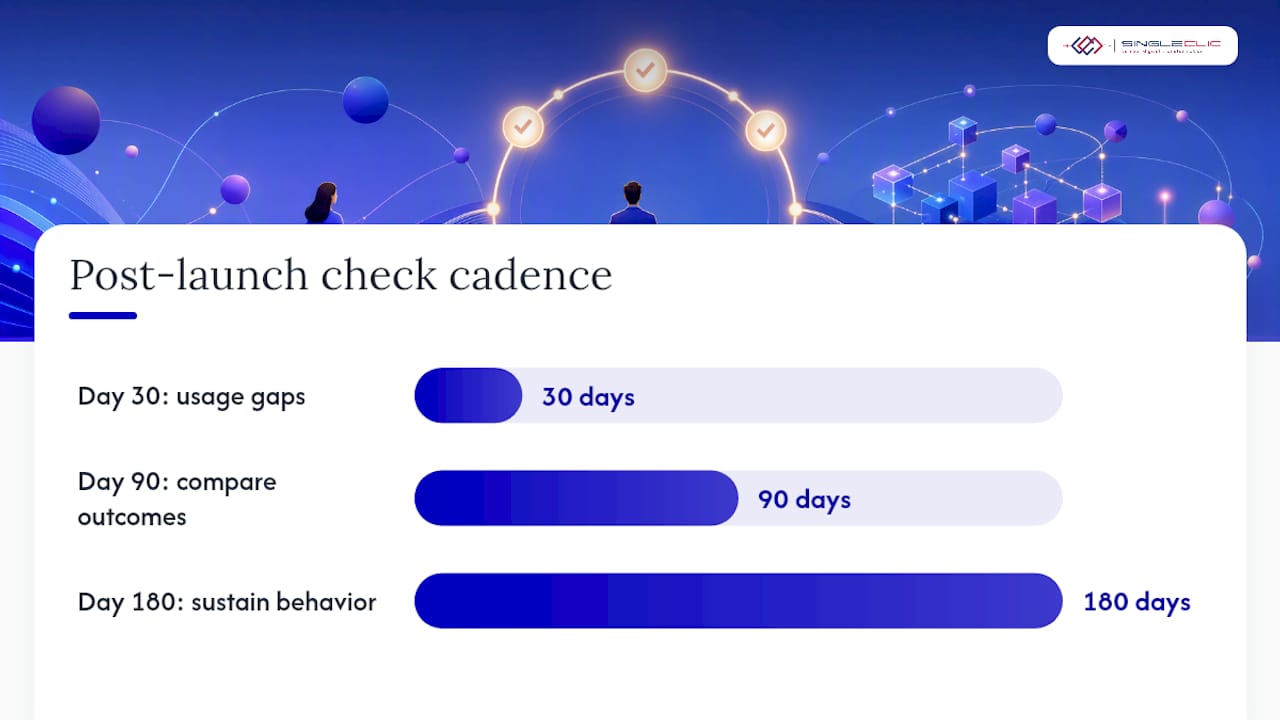
- Sustain with a 30/90/180 review cadence and a RACI for ongoing ownership
Pro Tip: Turn this into a shared spreadsheet with columns for owner, baseline metric, target metric, and status. It becomes your single source of truth from kickoff to rollout, and it’s the template referenced throughout this guide.
Key Takeaways
A technology adoption checklist succeeds when leadership sponsorship, staged piloting, and outcome-based measurement replace activity tracking and one-time training events.
| Point | Details |
|---|---|
| Audit before you buy | Map data flows, technical debt, and security posture before evaluating any vendor. |
| Recruit skeptics, not just fans | Pilot cohorts that include doubters surface real edge cases and build credibility. |
| Track outcomes, not activity | Measure time saved and error reduction instead of logins and training completions. |
| Use a 30/90/180 cadence | Assign an owner to check progress at each milestone after launch. |
| Singleclic maps checklist to delivery | Readiness audits, pilot design, and Cortex integration turn checklist items into working systems. |
Table of Contents
- Prepare: audit current state and make the business case
- Engage: secure executive sponsorship and build an army of ambassadors
- Plan: communications, training, and change-ready processes
- Pilot and iterate: test assumptions fast with feedback loops
- Measure and sustain: outcome metrics and a 30/90/180 checklist
- What to include in your checklist template
- How Singleclic helps enterprise teams turn the checklist into delivery
- Sources
Prepare: audit current state and make the business case
Before anyone signs a purchase order, run an honest audit. Root, a part of Accenture, frames technology adoption as a people problem first — and you cannot fix a people problem you haven’t diagnosed.
Your audit checklist should cover:
- Software inventory: what’s licensed, what’s actually used, what’s shadow IT
- Data flows: where information originates, where it breaks, where it duplicates
- Process maps: the real workflow, not the one in the training manual
- Technical debt: integrations held together by scripts nobody remembers writing
- Security posture: who has access, and whether that access is justified
Sensussoft’s framework recommends inventorying systems and calculating technical debt before evaluating any new platform, precisely because vendors sell against your stated pain, not your actual one.
Quantify the problem in numbers a CFO respects: hours lost to manual reconciliation, error rates on a specific process, revenue tied to a broken handoff. This phase should produce three deliverables:
- A current-state map showing where friction actually lives
- A RACI chart naming who owns the go/no-go decision
- Baseline metrics you’ll compare against after launch
Budget for this phase like a project, not an afterthought. Underfunding change management, including communications and training, is one of the more common reasons programs stall before they scale.
Engage: secure executive sponsorship and build an army of ambassadors
No checklist survives without a sponsor who does more than send a kickoff email. A real commitment includes budget authority, the power to remove blockers, and a willingness to publicly back the initiative when adoption gets uncomfortable in month two.
Champions come next, and they matter almost as much. Pick peer-level employees, not just enthusiastic managers, and give them a simple role: surface friction early, model the new workflow, and answer the questions people won’t ask their boss.
Map your stakeholders before you launch anything, as demonstrated in this case study on streamlining HR processes that highlights observation of existing workflows and selecting technology to solve day-to-day problems:
- End-users who need the tool to actually make their day easier
- IT and security teams responsible for integration and data protection
- Legal and HR covering compliance and workforce impact
- Operations leaders who own the processes being changed
Pro Tip: Recruit at least one visible skeptic into your champion group. A practitioner-led approach to adoption strategy argues that piloting with doubters, not just fans, surfaces edge cases enthusiasts miss and builds credibility once the skeptic converts.
Plan: communications, training, and change-ready processes
A rollout plan without a communications timeline is just hope with a launch date. Build a messaging hierarchy: an executive message on why now, a team-level brief on what changes day-to-day, and a living FAQ that gets updated as real questions come in.
Training works best broken into stages:
- Role-based curricula tied to the three or four tasks each team actually performs
- Just-in-time microlearning delivered at the point of need, not a single onboarding day
- Job aids: one-page references people can screenshot and keep open
Before automating anything, redesign the process itself. Digitizing a broken workflow just makes the breakage faster and harder to unwind. Reviewing your digital innovation workflow against actual friction points, not assumed ones, prevents this.
Your vendor evaluation checklist should confirm:
- Integration and API compatibility with existing systems
- Security and compliance certifications relevant to your sector
- Realistic support and implementation timelines, not sales-deck promises
Pilot and iterate: test assumptions fast with feedback loops
Time-box the pilot. Define scope narrowly, choose success metrics up front, and select a cohort that includes both champions and skeptics.
- Set a fixed duration, four to eight weeks works for most enterprise tools
- Define what you’ll measure: task completion, not just login counts
- Build weekly touchpoints and at least one round of qualitative interviews
- Set a clear decision gate: scale, rework, or stop
Savvycom’s framework specifically warns that skipping structured pilot phases causes downstream failures once you’re locked into scaled deployment. The most common pilot mistake is scope creep, trying to test everything at once instead of one workflow deeply. The second is choosing only enthusiastic users, which tells you nothing about resistance you’ll face at scale.
Measure and sustain: outcome metrics and a 30/90/180 checklist
Activity metrics, logins, training completions, module views, tell you people showed up. Outcome metrics tell you whether anything actually improved. Track time saved per task, error rate change, licensed-versus-active users, and cost or revenue impact.
Run this cadence after launch:
- Day 30: Check early usage patterns and flag training gaps with your change manager
- Day 90: Compare outcome metrics against your baseline; escalate any stalled metric to the executive sponsor
- Day 180: Confirm sustained behavior change and fold lessons into governance
Industry checklists consistently favor outcome-focused KPIs, operational efficiency, adoption rate, time-to-value, over activity counts, because activity can look healthy while the underlying process stays broken. Sustainment means continuous feedback loops and incremental feature releases, not a “go-live and forget” mindset. Reviewing what drives true business optimization after go-live keeps the program from quietly decaying.
What to include in your checklist template
Your working template needs these fields at minimum: item, owner, success criteria, baseline metric, target metric, pilot cohort, due date, status, and notes.
Example rows might look like:
- Data migration: Owner = IT lead; Success criteria = zero data-loss incidents; Status = in progress
- Training module launch: Owner = change manager; Target metric = 90% role-based completion; Status = scheduled
- Champion assignment: Owner = department head; Success criteria = one champion per 15 users; Status = complete
For a point tool, keep the template to a single sheet. For an enterprise ERP rollout, split it by department and consolidate weekly. A 7-step digital transformation checklist can help structure that split for larger programs.
Store it somewhere with access controls and version history, a shared workspace beats an emailed spreadsheet every time, since live collaboration is what keeps the checklist from going stale by week three.
How Singleclic helps enterprise teams turn the checklist into delivery
Singleclic maps each phase of this checklist to actual delivery work: readiness audits, pilot design, change management, system integration, and outcome measurement. For organizations running Microsoft Dynamics 365 or Odoo implementations, that mapping matters because ERP and CRM rollouts fail more often from adoption gaps than from software defects.

Our low-code platform, Cortex, connects approvals, ERP, CRM, and legacy data so adoption doesn’t stall on integration friction, a common pilot killer. Built with a full Arabic interface and on-premise deployment, it supports banks, government agencies, and enterprises across the region who need workflow automation without months of custom development.
Singleclic has delivered over 10 years of regional projects for clients including Emirates Health Services, Dubai Healthcare City, QNB, and Emaar Misr.
Pro Tip: Ask any implementation partner for a sample RACI chart from a past project before you sign anything. If they can’t produce one, that’s a signal about how they’ll run your rollout.
Author perspective: common mistakes we see
The mistake that kills momentum fastest is skipping the pilot entirely, jumping straight from purchase to full rollout because the demo looked convincing. The second is treating training as a single event instead of an ongoing curriculum. The third, and most damaging, is measuring logins when you should be measuring whether anyone’s actual workday got shorter. The checklist above exists to catch all three before they cost you a budget cycle.
If you need help executing this checklist
Singleclic runs a focused first-30-day engagement: a readiness audit, stakeholder RACI, and a pilot plan built around your specific workflow gaps, not a generic template. That gives your team a working roadmap before you commit to a full rollout.
If your next project involves ERP or CRM adoption specifically, start with our guide on what Microsoft Dynamics 365 delivers for connected operations and reach out to scope your readiness audit.
Sources
- Technology Adoption | Root, a part of Accenture
- Digital Transformation Checklist 2026 | Complete Framework | Sensussoft
- Digital Transformation Checklist: 6 Phases For 2026 (+ KPIs)
FAQ
What is a technology adoption checklist?
It’s a structured sequence of steps, typically audit, sponsorship, planning, pilot, measurement, and sustainment, that guides an organization through introducing new software while managing the human side of change.
How long should a technology adoption pilot run?
Most enterprise pilots run four to eight weeks, long enough to gather real usage data and qualitative feedback without delaying a scale decision indefinitely.
What’s the difference between activity metrics and outcome metrics?
Activity metrics count usage, logins, training completions, module views. Outcome metrics measure business impact, time saved per task, error reduction, and cost or revenue change.
Who should own the technology adoption checklist?
A named change manager or program sponsor should own it, supported by a RACI chart that clarifies who decides, who executes, and who’s consulted at each phase.
Why do technology adoption programs fail even with good software?
Most failures trace back to skipped pilots, one-time training treated as sufficient, or measurement that tracks activity instead of whether the underlying workflow actually improved.