Executive sponsorship, a well-chosen pilot, defined governance, an integration-first platform, trained builders, tracked KPIs, clear guardrails, and a scale plan: those eight moves separate low-code programs that stall from ones that spread across a business. Skip any one of them and adoption typically plateaus after the first pilot, no matter how good the platform is.
Here’s the checklist, in the order it actually needs to happen:
- Executive sponsorship — without a named owner at the VP or C-level, funding and priority evaporate after quarter one.
- Pick one pilot, not five — a single, well-scoped use case builds proof faster than a portfolio of half-finished experiments.
- Define governance before scaling — approval gates and ownership rules are far easier to write early than to retrofit onto forty live apps.
- Choose an integration-first platform — a tool that can’t talk to your ERP or CRM just creates a new island of data.
- Train your builders properly — citizen developers need more than a login; they need a curriculum.
- Measure KPIs from day one — reuse rate, time to value, and defect rate tell you whether to scale or stop.
- Set guardrails, not roadblocks — lightweight rules for internal tools, formal review for anything customer-facing.
- Plan the scale path early — decide what “enterprise-wide” looks like before you’re three pilots deep.
Pro Tip: Book a 30-minute meeting this week with your CIO or COO to name a single executive sponsor and pick the one process that will serve as your pilot. Everything else on this list depends on getting that meeting done first.
Key Takeaways
Low-code adoption succeeds when executive sponsorship, a well-scoped pilot, and integration-first platform selection happen before scaling, not after.
| Point | Details |
|---|---|
| Secure sponsorship first | Name a VP-level or higher sponsor before choosing a platform or scoping a pilot. |
| Run one focused pilot | Six to twelve weeks, narrow scope, clear KPIs like time to value and reuse rate. |
| Govern proportionally to risk | Lightweight rules for internal tools, formal review for customer-facing apps. |
| Prioritize integration depth | Weight platform evaluation toward legacy system connectivity and security certifications. |
| Consider Cortex for MENA needs | Singleclic’s on-premise, Arabic-enabled platform fits regulated sectors needing data residency control. |
Table of Contents
- Low code adoption tips start with knowing what it actually delivers
- What breaks when low code scales without controls
- Step-by-step adoption playbook IT and business leaders can follow
- What should IT look for when choosing a low-code platform?
- How do you keep governance from becoming a bottleneck?
- How do you train citizen developers without lowering quality?
- How do you know when to scale a pilot to the whole enterprise?
- Which enterprise use cases should you try first?
- What has Singleclic learned deploying low code across MENA?
- Estimated timeline and cost considerations for pilot versus enterprise scale
- How do you get employees to actually use the new tools?
- Why executive sponsorship makes or breaks the program
- Data management and privacy considerations specific to low-code platforms
- Post-deployment support and continuous improvement mechanisms
- How to select and engage external low-code vendors or consultants
- The single priority technology leaders should get right
- How Singleclic and Cortex help enterprises adopt low code in MENA
- Frequently asked questions about low code adoption
- Sources
Low code adoption tips start with knowing what it actually delivers
Low-code platforms let business analysts and IT teams build applications through visual, model-driven design instead of hand-written code, covering everything from UI layout to data modeling, integrations, and deployment. The value proposition for enterprise leaders comes down to five measurable outcomes.
- Speed to delivery. A literature review and industry surveys summarized in an academic study found low-code development can run significantly faster than traditional coding approaches for comparable applications.
- Backlog reduction. When business teams can build their own approval forms or data-capture apps, IT stops being the bottleneck for every small request.
- Lower cost per feature. Fewer developer hours per app means IT budgets stretch further, especially for internal tools that never needed custom-built software in the first place.
- Tighter business-IT alignment. Visual, model-driven development gives both sides a shared language, which cuts the back-and-forth that usually stalls requirements gathering.
- Faster response to change. When a workflow needs a new approval step or a field changes on a form, a low-code change often ships in days rather than a full development sprint.
The significant delivery speed improvement isn’t hypothetical. It comes from comparing traditional software development cycles against visual, low-code builds of similar scope, and it’s the number CIOs most often cite when building the business case for a pilot.
Picture how this sits inside your architecture: your core systems (ERP, CRM, HR, finance) stay as the system of record, while low-code sits as a middle layer that builds the forms, workflows, and approvals that connect people to those systems without requiring a change request against the ERP itself. That’s the model behind how low-code improves business agility for enterprise teams that are tired of waiting months for a simple approval workflow.
What breaks when low code scales without controls
Every low-code success story has a shadow version where the same platform, deployed without discipline, becomes a liability. The risks are predictable, and so are the fixes.
- Vendor lock-in. Deep dependency on one vendor’s proprietary connectors makes migration expensive later. Mitigate by favoring platforms with open APIs and standard data export formats.
- Customization limits. Some platforms cap how far you can extend beyond drag-and-drop. Mitigate by confirming custom-code extensibility before you commit, not after you hit the wall.
- Fragmented platforms. Different departments quietly adopt different tools, and nobody can see the whole picture. Mitigate with a single approved platform list and a clear exception process.
- Governance sprawl. Too many approval layers kill the speed advantage that justified low-code in the first place. Mitigate with governance that’s proportional to risk, not identical for every app.
- Security and data risk. Citizen-built apps can expose sensitive data if nobody reviews connections and permissions. Mitigate with mandatory security review for any app touching customer or financial data.
- Undocumented apps. A builder leaves the company and nobody knows how their approval workflow works. Mitigate with mandatory documentation and a named owner for every published app.
A study on construction industry digitalization found the two most cited limitations across case studies were restricted customization and vendor lock-in, both of which organizations mitigated through shared component repositories and standard documentation practices.
Two failure patterns show up again and again in enterprise low-code rollouts. In the first, a department builds a dozen apps in six months with no central registry. When the platform license comes up for renewal, nobody in IT can say which apps are business-critical and which were abandoned. In the second, a citizen developer connects a form directly to a production database without a security review, and a routine audit later flags exposed customer records. Neither failure required bad technology. Both required missing governance.
Pro Tip: Require every published app to list an owner, a business purpose, and a review date before it goes live. That single rule prevents most of the sprawl problems enterprises run into after month six.
Step-by-step adoption playbook IT and business leaders can follow
Running a low-code pilot well isn’t complicated, but skipping steps is how most programs stall. Here’s the sequence that works, based on how enterprises that adopt successfully actually structure the work.
- Secure executive sponsorship first. Before choosing a platform, get a named sponsor at the VP level or higher who will defend the budget and priority for at least two quarters.
- Choose your adoption path. Enterprises typically follow one of three strategic paths: departmental acceleration (one team solves its own problem), cross-functional enablement (shared services build for multiple departments), or platform-driven scale (IT builds a governed platform from day one). Each requires a different governance model, so decide which one you’re actually running before you start.
- Select the pilot use case. Pick something small enough to finish in a few months but visible enough that a win gets noticed. Approval workflows, inspection forms, and procurement intake are common first choices because they touch real pain and have clear before/after metrics.
- Define governance up front, even if lightweight. Decide who approves what, what counts as customer-facing versus internal, and who owns the app after launch.
- Assign roles clearly. A business owner defines requirements and success criteria. A product owner manages the backlog and priorities. An IT platform steward handles environment setup, integrations, and technical standards. A security reviewer signs off before anything touches sensitive data or goes external.
- Build, test, and deploy the pilot. Keep the scope fixed. Resist the urge to add features mid-pilot just because the platform makes it easy.
- Measure results against defined KPIs. Time to value, reuse rate of components, defect rate, and reduction in IT backlog tickets are the four metrics that matter most.
- Decide: scale, iterate, or stop. Use the data, not enthusiasm, to make this call.
A typical pilot runs on this kind of timeline:
- Weeks 1 to 2: Requirements gathering, platform environment setup, and role assignment.
- Weeks 3 to 6: Build and internal testing, with weekly check-ins between the business owner and IT steward.
- Weeks 7 to 9: User acceptance testing and security review for anything touching sensitive data.
- Weeks 10 to 12: Production deployment, training for end users, and baseline KPI capture.
Track these metrics from week one, not after the fact:
- Time to value — how long from kickoff to the app being used in production.
- Reuse rate — how many components or templates from this pilot get used in the next app.
- Defect rate — how many post-launch fixes were needed in the first thirty days.
- IT backlog impact — how many tickets this app removed from the traditional development queue.
Enterprises that treat this as a governed rollout instead of a side project tend to see the pilot’s reusable components become the foundation for the next three or four apps, which is where the real time savings compound.
What should IT look for when choosing a low-code platform?
Platform choice matters less than most vendors want you to believe, but a handful of criteria are genuinely non-negotiable for enterprise use. Run every vendor, including Microsoft Power Platform, OutSystems, Mendix, Oracle APEX, Appian, and Cortex, against the same checklist.
- Integration depth and APIs. Can it connect natively to your ERP, CRM, and legacy systems, or does every integration require custom middleware?
- Deployment model. Does it offer cloud, on-premise, and hybrid options, or does it force you into a single deployment model regardless of your regulatory needs?
- Security and compliance certifications. Does it carry ISO or SOC certifications, and does it support role-based access control and audit logging out of the box?
- Extensibility. Can developers drop into custom code when the visual builder hits its limit, or are you stuck once you exceed the drag-and-drop ceiling?
- Multi-user collaboration. Can multiple builders work on the same app without overwriting each other’s changes?
- Scalability. Has the vendor demonstrated performance at enterprise transaction volumes, not just departmental pilots?
- Arabic and localization support. For MENA deployments, does the platform offer full right-to-left Arabic UI, not just translated labels?
- Vendor local presence and SLAs. Is there a support team in your region who can respond in your time zone, or are you routing every ticket through a global queue?
A simple scoring template works well here: rate each vendor 1 to 5 on every criterion above, then weight integration depth and security compliance at double value, since those two categories cause the most expensive regrets when underestimated. For regulated sectors in Saudi Arabia and the UAE, data residency requirements often eliminate cloud-only platforms outright, which is why on-premise or hybrid options deserve extra scrutiny during evaluation.
Pro Tip: Ask every vendor for a reference client running a production integration with your specific core system, whether that’s Dynamics 365, an Oracle database, or a legacy on-prem ERP. A demo proves the feature exists; a reference proves it works at scale.
For a deeper breakdown of how these criteria play out across major platforms, see Singleclic’s practical guide to enterprise low-code platforms.
How do you keep governance from becoming a bottleneck?
Governance exists to prevent sprawl and protect data, not to slow down every request to committee-level review. The trick is scaling the rules to the risk of the app.
- Business owner defines what the app should do and signs off on functional requirements.
- IT platform steward manages the technical environment, connector standards, and deployment pipeline.
- Security reviewer approves any app that touches customer data, payment information, or external-facing forms.
- Compliance officer signs off on anything subject to regulatory retention or audit requirements.
On the technical side, five controls matter most: environment separation between development, testing, and production; role-based access controls tied to your existing identity system; CI/CD-style promotion pipelines even for business apps; audit logging that captures who changed what and when; and encryption for data at rest and in transit, paired with a backup and disaster recovery plan that treats low-code apps as seriously as core systems.
The lightest version of this works for internal tools: a checklist, a named owner, and a thirty-day review after launch. Customer-facing apps need the full stack. A lean governance model that scales proportionally to risk, rather than applying the same heavy process to every app, is what keeps low-code programs fast without becoming reckless. For a fuller breakdown of the controls that matter most, see why security and governance are critical in low-code environments.
Pro Tip: Write your approval gates down in a one-page policy before the second app gets built. Retrofitting governance onto twenty live apps is far more painful than defining it while there’s still just one.
How do you train citizen developers without lowering quality?
Enablement is what turns a single pilot into a program. The training path that works best moves through five stages: platform fundamentals, governance and security awareness, integration basics, testing practices, and production support procedures. Skipping straight to “here’s the platform, go build” is how you end up with apps that fail the security review six weeks later.
- Discovery session — a half-day introduction to what low-code can and can’t do, aimed at both business and IT staff.
- Platform fundamentals — hands-on training in the specific tool your organization has standardized on.
- Governance and security basics — every builder should understand what they’re allowed to build without review and what triggers a security check.
- Integration training — how to connect to approved data sources without creating a shadow database.
- Testing and production support — what “done” looks like and who to call when something breaks after launch.
Incentives matter more than most IT leaders expect. Sponsored certification, dedicated time credit for building (rather than expecting it on top of a full workload), and public recognition for reused components all increase participation meaningfully. A citizen developer program that treats builders as a real constituency, not a side effect of the platform purchase, tends to produce far more reusable work.
A community of practice ties it together: shared templates, a component library everyone can browse before building from scratch, monthly office hours with IT, and an internal marketplace where teams can find and adapt what other departments already built. This is where the reuse rate metric from your pilot actually starts compounding.

How do you know when to scale a pilot to the whole enterprise?
Pilot selection is a risk decision disguised as a technology decision. The safest first pilots are processes with clear before-and-after metrics and low blast radius if something goes wrong. Approval workflows, field inspection forms, and procurement intake all fit that profile because they’re visible enough to prove value but contained enough that a mistake doesn’t touch customer-facing systems.
A realistic path from pilot to enterprise scale looks like this:
- Weeks 1 to 12: Run the pilot end to end, capturing baseline KPIs throughout.
- Quarter 2: Evaluate results against decision gates and expand to two or three adjacent use cases if the pilot cleared them.
- Quarter 3 to 4: Formalize governance for platform-wide use and open access to additional departments.
- Year two: Shift from project-based rollout to a standing internal platform team supporting ongoing requests.
Three decision gates determine whether you scale, iterate, or stop: a reuse threshold (are components from the pilot getting picked up elsewhere), integration stability (has the connection to core systems held up under real load without repeated failures), and performance targets (does the app meet the response time and uptime your business actually needs). Reports and case studies compiled in the construction-industry digitalization review point to the five-to-ten-times delivery speed advantage as one of the clearest signals that a pilot is ready to expand, provided the underlying integration held up without major rework.
Which enterprise use cases should you try first?
Not every process is a good low-code candidate. The best first-wave projects share two traits: they’re painful enough that people notice a fix, and they’re contained enough that a misstep doesn’t touch mission-critical data.
- Approvals and workflows — expense approvals, leave requests, and procurement sign-off chains. Typically integrates with HR and finance systems; watch for existing email-based approval habits that resist change.
- Field operations and inspections — safety checklists, asset inspections, and site reports captured on mobile devices. Usually needs offline capability and a sync process back to a central database.
- HR onboarding — new hire paperwork, equipment requests, and access provisioning. Often touches HR information systems and identity management, so plan the integration early.
- Procurement automation — purchase requisitions and vendor intake forms. Frequently connects to ERP purchasing modules, which makes data mapping the main technical risk.
- Custom ERP/CRM extensions — small forms or dashboards that extend Dynamics 365 or Odoo without a full module customization.
Quick wins like approval workflows build momentum fast. Strategic projects like ERP extensions take longer but deliver more durable value, so sequence one or two quick wins before tackling anything with heavier integration complexity.
What has Singleclic learned deploying low code across MENA?
Regional deployments come with constraints that generic playbooks skip over. Data residency requirements in Saudi Arabia and the UAE often rule out cloud-only platforms for banking, healthcare, and government clients outright, which is why on-premise and hybrid deployment options aren’t a nice-to-have here, they’re a prerequisite.
- Pilot timelines in the region typically run six to ten weeks for departmental use cases, with timelines similar to global experience, but integration with legacy on-prem systems can add additional discovery time upfront.
- Arabic localization needs go beyond translated labels. Right-to-left UI rendering, Arabic date and number formatting, and bilingual reporting are common requirements from day one, not later additions.
- Common integration patterns in KSA and UAE enterprise projects involve connecting low-code apps to on-premise ERP systems and legacy databases that were never designed with modern APIs in mind, which makes integration-first platform selection especially important.
Cortex, Singleclic’s own low-code and BPM platform, was built specifically around these constraints: full Arabic UI/UX, unlimited users, and on-premise deployment for regulated sectors like banking and government, along with runtime workflow changes that don’t require downtime. It’s a direct response to what regional clients kept asking for and couldn’t find in globally standardized platforms.
Pro Tip: If your organization operates under data residency requirements, confirm on-premise deployment capability before you fall in love with any platform’s feature list. It’s the constraint that eliminates options fastest.
Estimated timeline and cost considerations for pilot versus enterprise scale
A departmental pilot typically runs several weeks to a few months and costs far less than a full platform rollout, mainly because scope is deliberately narrow and the team is small. Enterprise-scale deployment is a different commitment entirely: expect twelve to eighteen months to move from a validated pilot to a governed, organization-wide platform with a dedicated internal team.
Cost drivers shift as you scale. In the pilot phase, licensing for a handful of users and a few weeks of implementation support dominate the budget. At enterprise scale, the biggest costs move to governance infrastructure, training programs across departments, and ongoing platform administration, not the software license itself. Organizations that skip budgeting for the governance and training layer are the ones who find scaling far more expensive than expected.
Total cost of ownership also depends heavily on deployment model. Cloud licensing tends to have lower upfront cost but higher recurring fees at volume. On-premise deployment carries higher initial infrastructure investment but can be more predictable long-term for organizations with strict data residency requirements, since you’re not paying escalating per-user cloud fees as adoption grows. Factor in integration costs separately. Connecting to a modern cloud ERP is usually straightforward; connecting to a fifteen-year-old on-premise system often requires custom connector work that isn’t reflected in a vendor’s list price.
Budget conservatively for the second year. Most of the real cost of a low-code program shows up after the first successful pilot, when demand from other departments outpaces what your initial governance model was built to handle.
How do you get employees to actually use the new tools?
Resistance to new low-code apps rarely comes from the technology itself. It comes from people who’ve seen previous “transformation” initiatives fail to change their day-to-day work. Overcoming that requires treating change management as seriously as the technical build.

Start by involving end users in requirements gathering, not just in testing after the app is built. People are far more likely to adopt a tool they had a hand in shaping. Communicate the “why” clearly: employees need to understand what problem the app solves for them specifically, not just for the organization’s efficiency metrics.
Identify champions within each department early. A respected peer demonstrating the new approval workflow carries more weight than an IT announcement email. Pair this with visible executive backing. When leadership uses the new tool themselves and references it in meetings, it signals that this isn’t optional or temporary.
Address the fear factor directly. Some employees worry that automation threatens their role. Frame low-code honestly: it removes repetitive manual work so people can spend time on judgment calls and exceptions, not on retyping data between systems. Provide a grace period where the old process stays available in parallel, then set a firm cutover date once adoption metrics show people have genuinely switched over. Measure adoption weekly during the first month, not just at the ninety-day mark, so you can catch stalling early and intervene with targeted training rather than waiting for a quarterly review to reveal a problem.
Why executive sponsorship makes or breaks the program
Every successful enterprise low-code program has one thing in common: a named executive who treats it as their priority, not a delegated side project. Without that person, budget gets reallocated the first time a competing initiative needs resources, and the pilot quietly dies in month four.
Securing sponsorship starts with framing the ask correctly. Don’t pitch “a new development platform.” Pitch a specific, measurable business outcome: reducing approval cycle time by a defined amount, or cutting the IT backlog by a set number of tickets. Executives fund outcomes, not tools.
Maintaining that support after the initial approval requires regular, concrete reporting. Monthly updates tied to the KPIs defined during pilot planning, such as time to value and reuse rate, keep the sponsor engaged with real progress instead of vague status updates. When a pilot hits a milestone, make sure the sponsor is the one who gets to announce it. Visible wins tied to their name make continued backing an easy decision.
Sponsors also need to understand their actual role: removing organizational obstacles, not managing the technical details. Set that expectation early so they know what “supporting the program” looks like day to day. When a departmental turf issue or a budget dispute threatens the pilot, that’s exactly when sponsorship earns its keep, and exactly when a passive sponsor reveals they were never really engaged in the first place.
Data management and privacy considerations specific to low-code platforms
Low-code platforms make it remarkably easy to connect to a data source, which is exactly why they create privacy risk faster than traditional development. A citizen developer can drag a connector onto a canvas and pull customer records into a form without necessarily understanding data classification rules.
Start with a data classification policy that’s simple enough for non-technical builders to follow: public, internal, confidential, and restricted, with clear rules about which platform connectors are approved for each category. Any app touching personally identifiable information, financial records, or health data should require a mandatory security review before publication, not after.
Access controls need to mirror your existing identity management system rather than creating a parallel set of platform-specific permissions that nobody centrally tracks. Encryption at rest and in transit should be a baseline requirement for any connector handling sensitive data, and audit logging needs to capture not just who built an app, but who has accessed the data flowing through it since launch.
For organizations in regulated sectors, on-premise or hybrid deployment often becomes a data governance requirement rather than a preference, since keeping sensitive data within a defined physical or network boundary simplifies compliance reporting considerably. Build data retention rules directly into your app templates so builders don’t have to make that call themselves.
Post-deployment support and continuous improvement mechanisms
Launch day isn’t the finish line. The apps that stay useful two years after deployment are the ones with a defined support model, not the ones left to run unattended until something breaks.
Assign a support owner for every production app, someone who fields questions, tracks bugs, and knows when a workflow needs adjustment as the business changes. For pilot-stage apps, this can be the same person who built it. At enterprise scale, this needs to be a formal help desk function integrated with your existing IT support process.
Build a feedback loop directly into the app where possible, even something as simple as a monthly check-in with the business owner to ask what’s working and what’s causing friction. Track defect rates and resolution times as an ongoing metric, not just during the initial thirty-day pilot window. A rising defect rate on an app that’s been stable for months is often an early signal that underlying data or business rules have shifted without anyone updating the app.
Schedule quarterly reviews for high-usage apps to check whether they still reflect current business processes. Low-code’s speed advantage cuts both ways: it’s just as easy to let outdated apps accumulate as it is to build new ones. A retirement process matters as much as a launch process. When an app’s usage drops or its purpose gets absorbed into a core system upgrade, decommission it deliberately rather than letting it linger as an unmaintained, unmonitored liability.
How to select and engage external low-code vendors or consultants
Most enterprises reach a point where internal capacity can’t keep pace with demand, and that’s when bringing in an external partner makes sense, whether for initial platform selection, a specific complex build, or ongoing managed support.
Start by defining exactly what you need help with. Platform selection and architecture guidance require a different partner than hands-on app-building capacity. Ask any prospective partner for reference clients running production integrations similar to yours, not just demo environments. A partner who can point to real deployments in your industry and your region carries far more credibility than one relying on generic case studies.
Confirm the partner’s certification and training credentials on the specific platforms you’re evaluating, and ask directly about their experience with your core systems, whether that’s Dynamics 365, Odoo, Oracle, or a legacy on-premise ERP. Integration expertise is where most low-code projects succeed or stall, and it’s the area generalist consultancies most often underestimate.
For organizations in Saudi Arabia, the UAE, or Egypt, local presence matters more than it might elsewhere. A partner with regional delivery teams can support Arabic localization requirements, navigate data residency rules, and provide support in your time zone rather than routing every issue through a distant help desk. Singleclic’s field-tested approach to enterprise implementation reflects exactly this kind of regional grounding, built from years of delivery work across the region’s regulated industries.
The single priority technology leaders should get right
If I had to name the one decision that predicts whether a low-code program scales or stalls, it’s clear ownership paired with integration standards, decided before the first app gets built. Everything else on this checklist, training, governance, KPIs, is easier to fix later than a platform full of orphaned apps with no owner and no consistent way of talking to your core systems.
Start there. Name an owner for every app before it launches, and require a documented integration pattern before any connector touches production data. The rest of the program gets meaningfully easier once that discipline is in place.
How Singleclic and Cortex help enterprises adopt low code in MENA
Most low-code platforms were built for markets where Arabic UI, on-premise deployment, and regional data residency were afterthoughts, not requirements. Singleclic built Cortex the other way around: full Arabic UI/UX, unlimited users, and on-premise deployment for banks and government entities from the start, with runtime workflow changes that don’t force downtime.
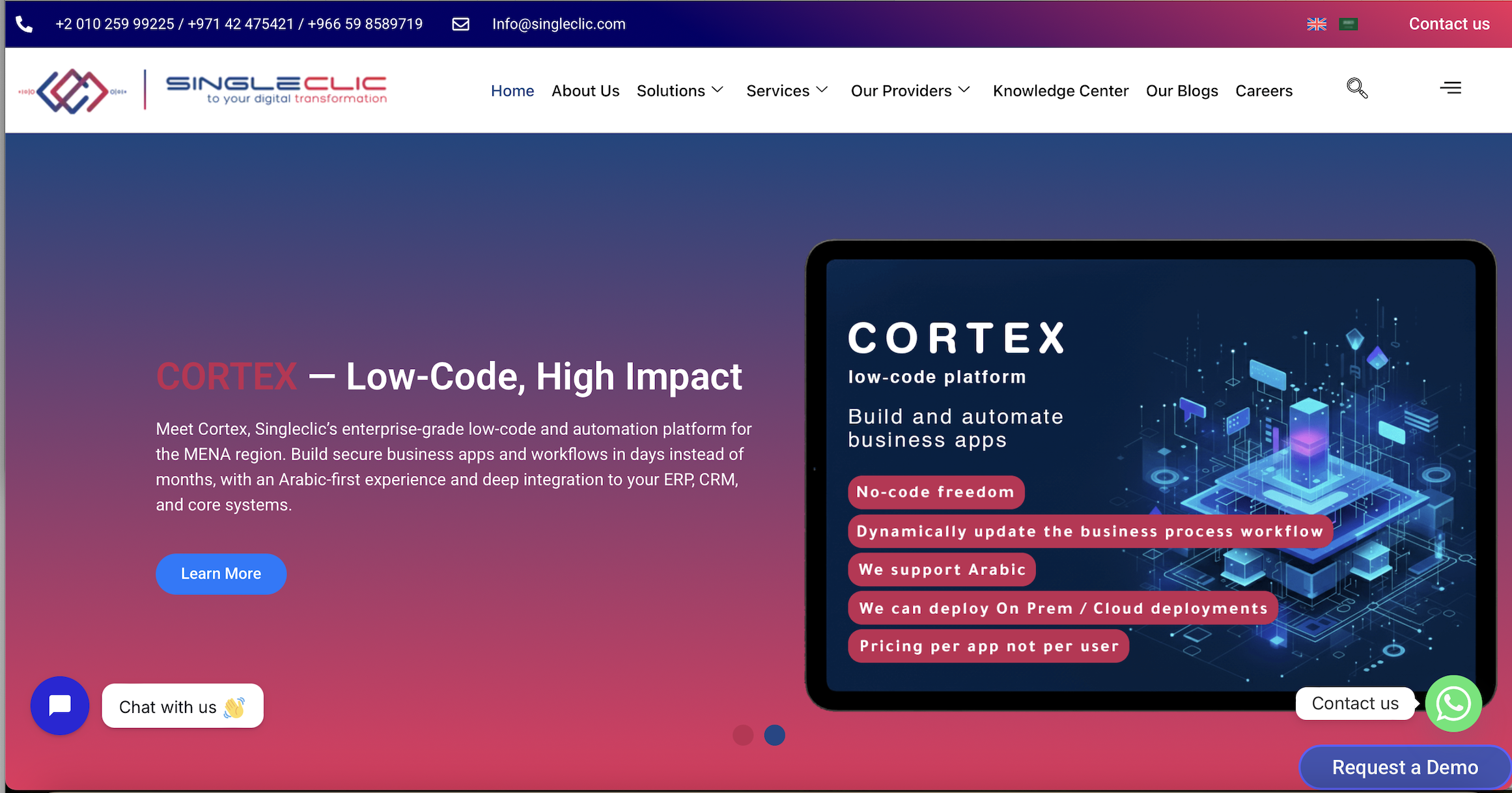
With more than ten years of delivery experience and over 100 enterprise clients across Saudi Arabia, the UAE, and Egypt, including regulated organizations in healthcare and banking, Singleclic brings governance frameworks and integration playbooks that come from actually running these programs, not just selling the platform. If you’re weighing platform options against a checklist like the one above, or you need help scoping a pilot that connects cleanly to your existing ERP or CRM, Singleclic’s business process automation guide for C-level leaders is a practical starting point for scoping the conversation. Reach out to discuss a pilot scoped to your specific integration and governance requirements.
Frequently asked questions about low code adoption
What is the fastest way to start low-code adoption in an enterprise?
Secure a named executive sponsor and pick one contained pilot use case, such as an approval workflow, that can launch within six to twelve weeks. Trying to run multiple pilots at once without a sponsor is the most common reason programs stall early.
How long does a low-code pilot typically take?
Most departmental pilots run six to twelve weeks from requirements gathering through production deployment. Enterprise-wide scaling after a successful pilot typically takes twelve to eighteen months to reach a governed, organization-wide platform.
What’s the biggest risk when scaling low-code across departments?
Governance sprawl and fragmented platform choices top the list. When different departments adopt different tools without central oversight, organizations lose visibility into which apps handle sensitive data and who owns them.
Do low-code platforms support Arabic and on-premise deployment for MENA enterprises?
Support varies significantly by vendor. Platforms like Cortex are built specifically with full Arabic UI/UX and on-premise deployment for regulated sectors, while many global platforms only offer translated labels rather than genuine right-to-left interface support.
How do you measure whether a low-code pilot is ready to scale?
Track reuse rate of components, integration stability with core systems, and performance against defined targets. If a pilot clears these three decision gates, it’s a strong candidate for expansion into adjacent use cases.