An offshore development center (ODC) is a dedicated overseas engineering unit that operates as a direct extension of your company’s product and delivery organization, not a rotating pool of contractors. It handles software development, QA, DevOps, and support under your product roadmap while a partner runs the operational layer: HR, payroll, office setup, and local legal compliance.
For UAE leaders, the decision comes down to four triggers. Pick an ODC if you have:
- A multi-year product roadmap that needs a stable, dedicated engineering team rather than short bursts of help
- A goal of building institutional knowledge offshore instead of renting hours from rotating contractors
- Cost optimization at scale across multiple hires, not a single urgent vacancy
- Regulatory, IP, or governance requirements sophisticated enough to need contractual structure, not informal freelancing
If two or more of these apply, your next move is choosing an operating model (managed ODC, build-operate-transfer, or captive) and validating it against UAE compliance requirements before you sign anything.
Key Takeaways
UAE companies get the most value from an offshore development center when they treat it as a dedicated product team with UAE-specific legal groundwork, not a cheaper version of staff augmentation.
| Point | Details |
|---|---|
| Match model to timeline | Choose managed ODC for speed, BOT for eventual ownership, captive for full control from day one. |
| Verify UAE compliance first | Confirm entity type, data residency, and sector rules with counsel before signing any ODC contract. |
| Govern with named owners | Assign a steering committee, product owner, and onshore point of contact before the team starts work. |
| Budget beyond salaries | Include recruitment, legal, security certification, and management fees in your cost model. |
| Consider Singleclic for regional execution | Singleclic offers managed ODC design, Cortex-enabled integrations, and UAE compliance experience for a structured assessment. |
Table of Contents
- What is an offshore development center, exactly?
- When should a UAE company choose an ODC?
- What are the main ODC operating models?
- What services does an ODC actually deliver?
- What are the real benefits and trade-offs of running an ODC?
- What UAE legal and compliance rules apply to an ODC?
- How do you set up an ODC step by step?
- How do you govern an ODC and measure its performance?
- What should ODC contracts cover for IP and security?
- What does an ODC cost, and how long does setup take?
- What are the biggest ODC risks and how do you mitigate them?
- Should you choose ODC, staff augmentation, or BOT?
- How does Singleclic help UAE organizations set up an ODC?
- Set up your ODC with a partner who knows UAE compliance
- Frequently asked questions
- Sources
What is an offshore development center, exactly?
An offshore development center is a long-term delivery model: a dedicated team, based in another country, that functions as an integrated unit inside your product organization rather than an external vendor taking tickets. Setup typically takes a few weeks to several months depending on the model and how ready your partner is, according to Innowise’s breakdown of the ODC model. That timeline matters because it separates an ODC from the faster, looser arrangement most UAE companies already know: staff augmentation.
The distinction is about who manages what. In staff augmentation, you hire individuals and manage them directly day to day. In an ODC, the provider typically owns the operational layer (HR, payroll, office, local legal compliance) while you steer product direction and output, according to JAFZA’s guidance on company formation. That difference shapes everything downstream, from how fast you can scale to how much institutional knowledge survives when someone leaves.
A working ODC typically covers:
- Software engineering across your core product stack
- QA and test automation
- DevOps and site reliability
- Business analysis and product management
- Support and maintenance
- Infrastructure and environment management
A viable starting team usually needs a tech lead, senior engineers, a QA lead, and a delivery or project manager. Fewer roles than that and you are running a contractor pod with an ODC label on it.
When should a UAE company choose an ODC?
The right trigger is rarely “we need more developers.” It is almost always a structural gap: a roadmap longer than a single project, or a skill set that is scarce and expensive to hire locally at the volume you need.
Watch for these signals:
- Your product roadmap spans more than a year, not just a single release.
- You need stable engineering capacity that survives beyond one project’s budget cycle
- The skills you need (specific ERP integrations, mobile payment security, healthcare interoperability standards) are scarce or costly to hire for locally
- Your cost-per-engineer at current UAE market rates is straining the budget for the scale you actually need
UAE-relevant examples where this plays out: a bank rolling out a mobile payments platform across GCC markets and needing sustained engineering capacity for two to three years; a healthcare group integrating multiple hospital systems into one platform, where domain knowledge has to accumulate rather than reset with every new contractor; or a real estate or construction group standardizing ERP across UAE and Saudi Arabia operations, where the same team needs to understand both markets over time.
If your need is a single skill gap for three months, staff augmentation or local hiring almost always wins on speed and simplicity. ODCs earn their cost when the horizon is long enough that continuity itself becomes the value.
What are the main ODC operating models?
Four models dominate how companies structure an ODC, and picking the wrong one is one of the more expensive mistakes UAE buyers make early.
A managed ODC is run day to day by the provider under your product direction. You get speed and lower administrative burden, but the provider retains more operational control than in a captive setup.
A build-operate-transfer (BOT) model has the vendor build the team and run operations, then hand over full legal and operational ownership to you on a phased timeline, according to TheNineHertz’s comparison of staff augmentation, ODC, and BOT. BOT and managed ODC are the two most commonly adapted structures in the market, each shifting operational responsibility differently depending on how much ownership you eventually want, per Emerline’s guide to offshore development centers.
A captive center is fully customer-owned from day one. You set up the legal entity, hire directly (often with local support), and carry full operational responsibility. It offers maximum control but the highest setup cost and the longest time to value.
Product-engineering ODCs sit closer to an R&D partnership: the team co-owns architecture and product decisions rather than just executing a backlog. This model suits companies building a core product, not maintaining internal tools.
| Model | Control | Cost profile | Speed to value | IP risk |
|---|---|---|---|---|
| Managed ODC | Medium | Lower upfront | Fast (weeks to a few months) | Medium, mitigated by contract |
| BOT | Low, rising to full over time | Medium, front loaded | Medium | Medium during build phase |
| Captive | Full | Highest upfront | Slow (months) | Lowest once operational |
| Product engineering | Shared | Medium to high | Medium | Medium, needs clear IP clauses |
UAE organizations usually pick managed ODC when they want to move fast without setting up a local entity. BOT tends to appeal to companies that want eventual full ownership but do not want to carry the setup risk themselves. Captive models suit banks and government-adjacent entities where data residency or ownership rules make anything less than full control unworkable.
What services does an ODC actually deliver?
An ODC is not just “extra developers.” A functioning one delivers full-cycle capability: application development, QA and test automation, DevOps and SRE, solution architecture, product management, business analysis, and ongoing support and maintenance.
The staffing pyramid matters more than headcount. A sustainable ODC needs a tech lead anchoring architecture decisions, senior engineers who can work with minimal oversight, a mid-level layer doing the bulk of feature work, junior engineers growing into the domain, and dedicated QA rather than developers testing their own code.
That mix should not stay static. As the team accumulates product and business-domain knowledge over successive quarters, the ratio typically shifts, with more mid-level and senior capacity replacing initial heavy oversight from your side, and the team taking on architecture decisions it would have escalated in month one.
What are the real benefits and trade-offs of running an ODC?
The upside is real, but so are the failure modes, and UAE companies that skip the second half of this list tend to relearn it the expensive way.
Benefits:
- Cost optimization at scale, with rate differences between offshore markets and onshore UAE hiring often material enough to fund a larger team for the same budget, per InApps’ comparison of ODC and staff augmentation costs
- Access to talent pools and specialized skills that are scarce or expensive locally
- Continuity and knowledge accumulation, since the same engineers stay on your product across releases
- Extended delivery hours when time zones are staggered well
Trade-offs and pitfalls:
- Cultural mismatch that shows up as miscommunication on priorities, not just accents on a call
- Attrition that resets institutional knowledge if the provider does not manage retention actively
- Hidden administrative costs (recruitment, compliance, tooling) that do not appear in the headline rate
- Governance overhead if you underinvest in steering structure early
Pro Tip: Treat your ODC as an integrated product unit from day one, not a vendor relationship. Put shared KPIs in the contract and run joint planning sessions, and invest in cultural onboarding early, because leaders consistently underestimate how much business-domain training an offshore team needs before it acts like a true extension of your team rather than a ticket queue.
Practitioner guidance is consistent on this point: ODCs fail most often when treated as generic outsourcing, and succeed when integrated as a dedicated unit with shared accountability, according to Acclime’s guidance on UAE business structures. For a deeper look at how ODCs balance savings against long-term alignment, see Singleclic’s analysis of the strategic impact of offshore development centers.
What UAE legal and compliance rules apply to an ODC?
None of the benefits above matter if the legal structure is wrong, and this is where UAE-specific detail actually changes your setup decisions rather than being boilerplate.
Before you sign a contract, verify with UAE counsel:
- Employment and visa rules for any UAE-based staff involved in oversight or coordination roles
- Whether a local mainland entity, a free zone entity such as JAFZA, or a fully offshore partner arrangement fits your ownership and tax goals, per JAFZA’s company formation guidance
- Tax and withholding responsibilities tied to cross-border payments to your ODC provider
- Contractual liability clauses that clearly assign risk if the provider’s entity, not yours, employs the offshore staff
Data protection deserves its own line item. If your ODC processes UAE customer or patient data, cross-border transfer rules and data residency requirements need to be checked against current UAE data protection regulations before any data leaves the country, not after the pilot starts. Cloud architecture choices interact directly with this; see Singleclic’s comparison of cloud versus on-premise ERP for MENA compliance for how residency requirements shape platform decisions.
Sector-specific rules add another layer. Banking and financial services ODCs face stricter data handling and audit requirements than a typical SaaS product team. Healthcare integrations touch patient data rules that vary by emirate and by whether the system connects to government health infrastructure. Government-adjacent integration work often mandates on-premise or UAE-hosted infrastructure outright, which rules out some managed ODC configurations entirely.
Consult UAE tax and employment counsel before finalizing any ODC structure. Free zone rules, mainland requirements, and sector regulations shift often enough that generic guidance, including this article, cannot substitute for advice scoped to your specific entity type and industry.
How do you set up an ODC step by step?
Setting up an ODC well is a sequence, not a single decision, and skipping steps is how six-month timelines become fourteen-month ones.
- Define objectives. Write down the product scope, target headcount, and the business outcome the ODC exists to deliver, not just “reduce costs.”
- Choose model and location. Decide between managed ODC, BOT, or captive, then shortlist locations based on skill availability, time zone overlap, and cost.
- Select a partner. Evaluate vendors against referenceable methodology, named case studies, and certifications, not just a sales deck. Third-party review platforms like Clutch can help validate claims before you sign.
- Handle legal and entity setup. Finalize the contract structure, confirm the UAE compliance items above, and set data processing terms in writing.
- Hire the core team. Fill the tech lead, senior engineer, and QA roles first. These are your knowledge anchors.
- Onboard for real, not just technically. Technical environment access is the easy part.
- Establish governance and tooling. Sprint cadence, reporting lines, and shared dashboards go live before the team writes production code.
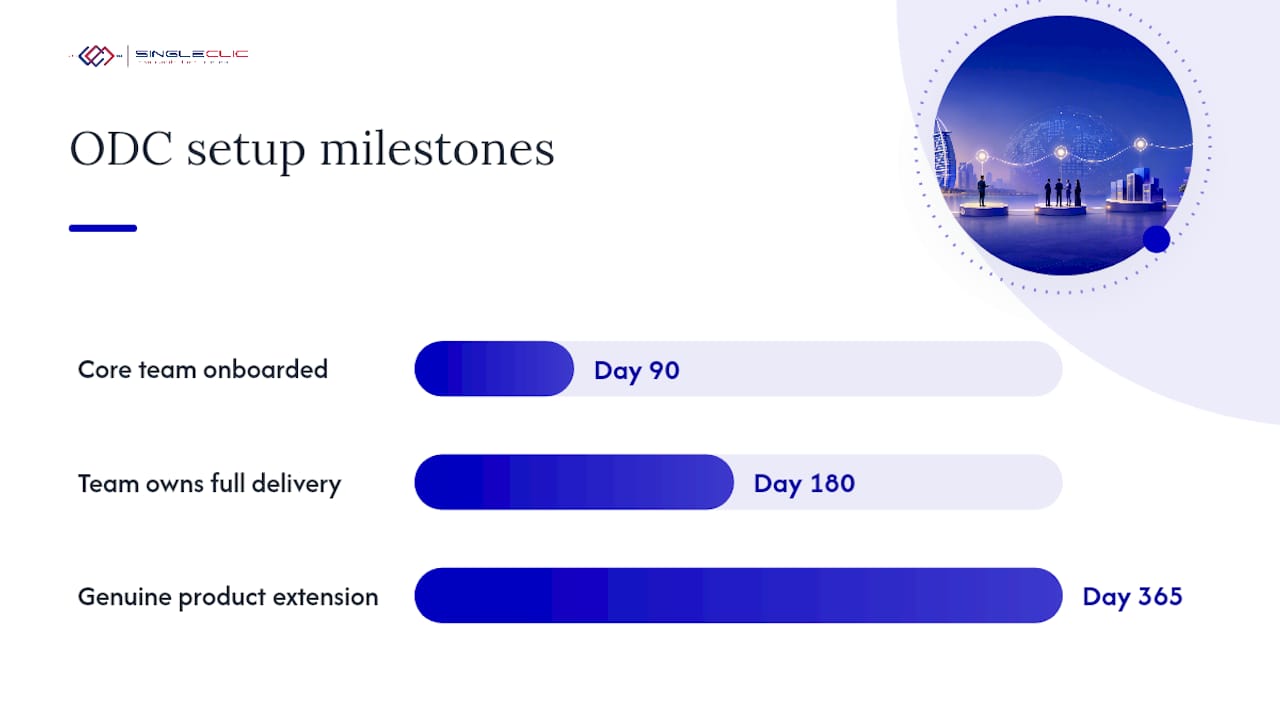
A realistic milestone view: by day 90, expect the core team hired and onboarded, with initial sprints running against a defined backlog. By day 180, the team should own full feature delivery with minimal escalation to your side, and initial governance metrics should show a stable trend. By day 365, the ODC should be functioning as a genuine extension of your product organization, with attrition, velocity, and quality metrics all tracked against baseline.
Onboarding should explicitly cover technical environment and security access provisioning, sprint cadence and ceremony alignment with your existing teams, and business-domain and cultural onboarding, not just tool logins.
Pro Tip: When shortlisting vendors, ask for a named enterprise reference in your sector, not a generic case study, and request their actual security certifications in writing before the RFP closes, not after the contract is signed. Vendor selection frameworks are covered in more depth in Singleclic’s guide to enterprise software selection for C-level leaders.
How do you govern an ODC and measure its performance?
Governance is what keeps an ODC from drifting into a black box six months after launch, and it needs named owners, not a shared inbox.
Typical governance structure includes a steering committee (your leadership plus the provider’s account lead) meeting monthly, a product owner on your side who owns the backlog, an onshore single point of contact who filters day-to-day questions, and a local operations manager on the provider’s side who owns delivery execution.
Reporting cadence usually follows three layers: weekly sprint reviews for delivery visibility, monthly steering committee meetings for budget and scope decisions, and quarterly roadmap syncs to keep the ODC’s work aligned with where the business is actually heading.
Track a focused KPI set rather than a dashboard nobody reads: velocity trends, defect leakage rate, cycle time from ticket to production, retention rate on the offshore team, mean time to restore for incidents, and SLA adherence. Operational KPIs (velocity, cycle time, SLA adherence) belong to the delivery manager. Strategic KPIs (retention, defect leakage trends over quarters) belong to the steering committee, because they signal whether the partnership is working, not just whether this sprint shipped. A structured governance framework is laid out further in Singleclic’s playbook for the governance setting process.
What should ODC contracts cover for IP and security?
Contract language is where good intentions turn into enforceable protection, or fail to.
Your contract checklist should cover: scope of work defined precisely enough to prevent disputes, explicit IP ownership assigning all code and documentation to you, transfer rights spelled out in detail if you are running a BOT arrangement, termination clauses with clear notice periods and transition support, data processing agreements matching UAE data protection requirements, and audit and inspection rights letting you verify security practices, not just take the provider’s word for it.
On the technical side, require: ISO 27001 certification or an equivalent security management standard, SOC 2 reporting where the provider handles sensitive customer data, encrypted endpoints and company-managed devices for anyone touching your codebase, detailed access logs, controlled CI/CD pipelines, and enforced code review policies before anything merges to production.
Pro Tip: Build a contractual right to conduct an independent security assessment before go-live, not just an annual audit clause buried on page 40. A pre-engagement assessment catches gaps while you still have leverage to demand fixes, rather than discovering them after your data is already flowing through their systems.
What does an ODC cost, and how long does setup take?
Cost conversations go sideways when they focus only on salary rates and ignore everything around them.
Primary cost drivers include: salaries and benefits for the offshore team, vendor management fees charged by the provider, office and facilities costs (even for remote-first setups, someone pays for tooling and infrastructure), recruitment and onboarding costs each time you scale, legal and entity setup fees, and security certification and tooling investment.
| Phase | Typical duration | Main cost focus |
|---|---|---|
| Pre-start | 4 weeks | Legal setup, vendor contracting, role definition |
| Ramp | 2 to 4 months | Recruitment, onboarding, initial tooling |
| Steady-state | Ongoing | Salaries, management fees, retention investment |
Region-specific rate differences and the resulting percent savings vary meaningfully by destination and role, and are worth modeling against your specific skill mix rather than assuming a flat discount, per InApps’ cost comparison of ODC and staff augmentation. Economies of scale tend to show up gradually. Unit costs per engineer typically improve as the team stabilizes and hiring processes mature, not in the first quarter.
Budget internally with a clear line between one-time setup costs (often treated as a project investment) and ongoing operating costs (salaries, management fees, tooling), since finance teams evaluating ROI need that split to model payback correctly. A structured approach to quantifying these tradeoffs is covered in Singleclic’s guide to digital cost-saving strategies.
What are the biggest ODC risks and how do you mitigate them?
Six risks account for most ODC failures worth worrying about: cultural misalignment (mitigate with structured onboarding and overlapping work hours, ideally 3 to 4 hours a day for synchronous rituals like sprint planning and architecture reviews), attrition (mitigate with retention-linked incentives written into the contract), IP leakage (mitigate with strict access controls and audit rights), hidden OPEX (mitigate by requiring a fully itemized cost breakdown upfront), governance drift (mitigate with the steering cadence outlined above), and vendor insolvency (mitigate with contractual contingency and transition clauses).

Watch for red flags that should trigger a serious re-evaluation: missed SLAs two cycles running, rising attrition without a clear explanation, or unclear ownership of specific product modules. Any one of these should prompt an immediate steering committee review, not a wait-and-see approach.
Insurance and contractual penalty clauses for missed SLAs are worth negotiating upfront, along with a documented contingency plan for provider transition if the relationship ends earlier than planned.
Should you choose ODC, staff augmentation, or BOT?
The three models differ on control, speed, cost profile, and long-term ownership, and picking the wrong one for your situation is more common than picking the wrong vendor.
Staff augmentation gives you direct control over individuals and the fastest time to hire, but you carry full management overhead and the arrangement is inherently short-term. An ODC trades some day-to-day control for a partner-managed operational layer and much stronger continuity, making it the better fit for multi-year products, according to AcquireX’s comparison of ODC and staff augmentation. BOT sits at the far end: lower control during the build phase, but a structured path to full ownership once the transfer completes.
| Business context | Best-fit model |
|---|---|
| Short-term skill gap, need someone in weeks | Staff augmentation |
| Multi-year product, want continuity without owning the entity | Managed ODC |
| Want a fully owned team eventually but not the setup burden now | BOT |
Before choosing, ask: How long is our actual roadmap? Do we want to own this team legally within two to three years, or never? Can we tolerate a partner managing HR and payroll, or does our sector require full internal control? The answers to those three questions eliminate two of the three models almost immediately.
How does Singleclic help UAE organizations set up an ODC?
Singleclic has spent over a decade delivering enterprise technology projects across the UAE, Saudi Arabia, and Egypt, with more than 70 consultants and engineers supporting clients including Emirates Health Services, Dubai Healthcare City, and Emaar Misr. That regional footprint informs how we structure ODC engagements, not just how we staff them.
Our relevant capabilities include:
- Managed offshoring services covering ODC design, staffing, and day-to-day operations
- Microsoft Dynamics 365 and Odoo implementation experience that lets an ODC team plug directly into your existing ERP and CRM environment
- Cortex, our Arabic-enabled, on-premise low-code platform, connecting ODC-built applications to legacy systems, approvals, and workflows without months of custom integration work
- Enterprise security and compliance experience across regulated sectors including banking, healthcare, and government
Across regional engagements, ODC teams integrated with an existing ERP platform through Cortex have consistently reached stable production delivery faster than teams built around custom point-to-point integrations. That pattern is one reason we structure new ODC engagements around Cortex connectivity from the start rather than treating integration as an afterthought.
If you are evaluating whether an ODC fits your roadmap, Singleclic offers a structured assessment covering model selection, a cost baseline, and a sample governance framework before you commit to a full build.
Lessons from regional delivery
I have watched UAE companies launch ODCs with strong technical plans and weak cultural onboarding, and the technical plan is never what fails first. As Tamer Badr at Singleclic, the lesson that changes execution priorities here is regulatory sensitivity: UAE data residency rules and sector compliance requirements shift faster than most offshore playbooks account for, so governance has to be built to adapt, not just to launch.
Set up your ODC with a partner who knows UAE compliance
Building an ODC without local compliance expertise means relearning UAE data residency and employment rules the hard way, mid-project. Singleclic runs ODC design and managed operations specifically for UAE and regional organizations, with Cortex-enabled integrations that connect your offshore team directly into existing ERP, CRM, and legacy systems from day one.
Our ODC services cover model selection (managed, BOT, or captive), full operational management, phased BOT transfer when full ownership is the end goal, and enterprise-grade security aligned with ISO 27001 practices. Where your ODC needs to plug into Microsoft Dynamics 365, our guide to connected ERP, CRM, and intelligent automation covers the integration groundwork in more detail.
Request an ODC assessment from Singleclic and get a roadmap, a cost model scoped to your team size, and a sample SLA structure before you commit to a model or a partner.
Frequently asked questions
What is the difference between an offshore development center and outsourcing?
Outsourcing typically hands off a defined project to a vendor with limited client oversight, while an ODC is a dedicated team you steer directly on product priorities even though the provider manages HR and operations. Outsourcing suits one-off projects; an ODC suits ongoing product development.
Is staff augmentation cheaper than an offshore development center?
Staff augmentation can look cheaper for short engagements since there is no setup overhead, but an ODC typically wins on total cost for multi-year work because it avoids repeated recruitment cycles and retains institutional knowledge, according to AcquireX’s comparison.
How long does it take to set up an ODC in a new location?
Setup commonly ranges from a few weeks to several months depending on the model chosen and how prepared your partner is, per Innowise’s ODC overview. A managed ODC moves faster than a captive center, which requires full entity setup.
Does a UAE company need a local entity to run an ODC?
It depends on the model. A managed ODC through a provider generally does not require you to set up your own local entity in the offshore location, while a captive model does. UAE-side considerations around free zone versus mainland structuring should be confirmed with counsel, referencing guidance such as JAFZA’s company formation resources.
What is a build-operate-transfer (BOT) model in offshore development?
BOT is a phased structure where the vendor builds and operates the team initially, then transfers full legal and operational ownership to the client over an agreed timeline, per TheNineHertz’s comparison of delivery models. It suits companies that want eventual full ownership without carrying the initial setup burden.
Sources
- JAFZA — company formation / business setup
- Complete Guide to Offshore Development Center — Emerline
- Staff augmentation vs dedicated ODC vs BOT — TheNineHertz