A service level agreement (SLA) in business process management is a documented commitment that says how fast, how well and how reliably a process step or service will be delivered, who is responsible, and what happens when the target is missed. In BPM the SLA is not a PDF that sits in a contract folder. It is a set of timers, priorities and escalation rules built into the workflow itself, so that a breach is visible while there is still time to prevent it.
This guide is written for UAE and wider MENA executives, CIOs, HR leaders and supply chain managers who need SLAs that hold up between departments, with vendors and inside regulated processes.
TL;DR
- A BPM SLA defines the service, the measurable target, the responsibilities, the reporting and the review cycle. It should be set at process-step level, not only for the whole case.
- An SLA is the promise; a KPI is the internal measure you use to see whether you will keep it.
- P1 to P4 priority levels turn one promise into several: UAE government examples resolve P1 incidents in 4 hours and P4 in 5 days.
- A four-hour SLA is only meaningful once you define when the clock starts, what pauses it and what counts as resolved.
- Automate monitoring: warn before the breach, escalate automatically and review targets on a fixed cycle.
Table of Contents
- What a service level agreement means in BPM
- What a BPM SLA should define
- SLA vs KPI: the question that confuses most teams
- P1, P2, P3 and P4: how priority levels shape targets
- What a four-hour SLA really means
- Setting service levels in the UAE context
- Monitoring SLAs, escalating breaches and reviewing targets
- Perspective: why SLAs fail, and what we do differently
- Use cases for BPM service level agreements
- How Singleclic helps
- SEO and content details
- FAQ
- Ready to put your SLAs into the workflow?
- Sources
What a service level agreement means in BPM
IBM describes an SLA as a formal agreement between a provider and a customer that specifies performance metrics, quality standards, responsibilities and remedies for non-performance, so that both parties share an understanding of successful delivery. That definition works for an external vendor and just as well for an internal department.
The UAE public sector uses the same idea internally. The Federal Authority for Government Human Resources defines a service level as the agreed standard of quantity, quality, discipline and cost, and an HR SLA as an agreement between the HR department as provider and its service users on the minimum service quality needed to meet business needs. If you run HR, procurement or finance as a shared service, you are already the provider in an SLA, whether or not you have written it down.
BPM adds something a static contract cannot: the process model. Every approval, hand-off and system task in a business process management design is a place where a timer can start and stop. That is why the SLA in BPM is more precise, and more enforceable, than a clause in a master agreement.
Three kinds of SLA you will meet
- External SLAs between your organization and a customer or a supplier, for example a managed service or a SaaS platform.
- Internal SLAs between departments, for example HR to line managers, IT to the business, or sales to marketing.
- Operational level agreements between teams that support a single external promise, for example the warehouse and the finance team behind a 48-hour delivery commitment.
Most BPM work concerns the second and third kinds. They are where delays hide, because nobody signed anything and nobody owns the clock.
What a BPM SLA should define
Guidance from higher-education shared services is a useful template for any provider-and-customer relationship. It says a service-level agreement should define the services and operating boundaries, the KPIs and target levels, the responsibilities of provider and customer, a complaint process and terms for regular review. FitSM, an IT service management standard family, adds typical contents such as service description, hours and exceptions, dependencies, support, targets, limitations, reporting, escalation, security, responsibilities and review.
Translated into a BPM checklist, a workable SLA contains:
- Service description and boundaries. What the service covers and what it does not. “Process purchase requests” is vague; “route purchase requests from submission to approved purchase order” is a boundary.
- Operating hours and exceptions. UAE organizations should state the working week, public holidays and Ramadan hours explicitly, because clocks that run through them produce false breaches.
- Targets per step. Response time, resolution time, availability or quality rate, each with a measurable threshold.
- Priority definitions. Who decides priority and by which criteria.
- Dependencies. What the provider needs from the customer, and from other systems, to meet the target.
- Responsibilities. A named owner on each side.
- Reporting. What is reported, how often and to whom.
- Escalation path. Who is alerted, when and with what authority.
- Remedies. Service credits, corrective action plans or management review.
- Review cycle. When targets are revisited.
Define objectives at step level
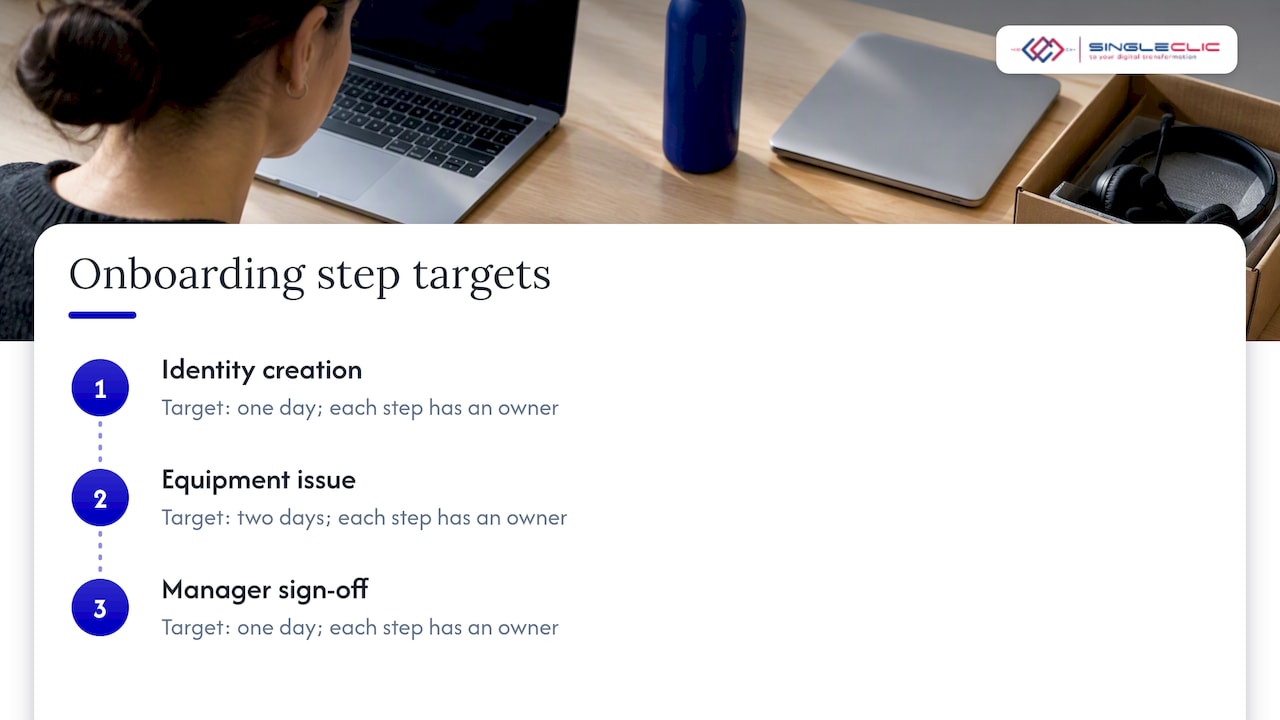
The most common design mistake is setting one target for the whole case, such as “onboarding completes in 10 days”. When it fails, nobody knows which hand-off caused it. Set a target for each step: identity creation in one day, equipment issue in two, manager sign-off in one. The overall promise is then the sum of commitments that each have an owner.
Involve the people who do the work. The EAB guidance recommends that SLA design draw on input from both staff and customers so that targets balance what is achievable with what customers expect. A target the team never agreed to is a target they will quietly route around.
SLA vs KPI: the question that confuses most teams
The difference is simple in principle. An SLA is a commitment made to a customer, internal or external, with consequences attached. A KPI is a measure your own team uses to track progress and efficiency. The SLA says “we will resolve a critical incident in 4 hours”. The KPIs tell you whether you are on course: queue length, average handling time, first-time resolution rate, percentage of cases reaching 75% of their time limit.
In practice a KPI often feeds an SLA. UAE federal outsourcing procedures, for instance, use the percentage of compliance with the level of service agreement as an operational performance indicator, measured through service reports, online measurement and supplier results. The SLA is the promise; compliance with it is the KPI that leadership watches.
| SLA | KPI | |
|---|---|---|
| Purpose | Commitment to a customer | Internal performance measure |
| Audience | Customer, provider, auditors | Process owners and management |
| Consequence | Credits, escalation, contract review | Management attention, improvement actions |
| Example | Resolve P1 incidents within 4 hours | Average P1 resolution time this month |
| Changes | Through formal review | Whenever the business needs a new lens |
If you are designing the KPI layer, our guide to the role of KPIs in digital projects covers how to choose measures that leaders can act on.
P1, P2, P3 and P4: how priority levels shape targets
Priority levels let one SLA carry different promises for different impact. A P1 is typically a full outage or a critical process stopped; a P4 is a minor issue or a request with a workaround. The labels vary (P1 or Severity 1), but the logic is constant: the more business impact, the shorter the clock.
UAE government services publish real numbers. The Telecommunications and Digital Government Regulatory Authority’s Disaster Recovery as a Service states 99.9% service availability, with P1 incidents resolved within 4 hours, P2 within 8 hours, P3 within 4 days and P4 within 5 days, each at a 99.0% compliance level. The federal government network FEDnet sets the same shape of resolution targets: 4 hours for Severity 1, 8 hours for Severity 2, 4 calendar days for Severity 3 and 5 calendar days for Severity 4.
| Priority | Typical meaning | Resolution target in the TDRA example |
|---|---|---|
| P1 | Critical service down | 4 hours |
| P2 | Major degradation | 8 hours |
| P3 | Limited impact | 4 days |
| P4 | Minor issue or request | 5 days |
Note the second number in the TDRA example: 99.0%. A target is not “every incident in 4 hours”. It is “99.0% of P1 incidents within 4 hours”. Stating the compliance level is what makes the SLA measurable and honest about the occasional exception.
Who sets the priority?
Put the classification rule in the agreement. Impact and urgency criteria should be written down, and the provider should be able to reclassify a ticket when the reported impact does not match the criteria. Without that, every ticket is a P1 and the priority scheme collapses.
What a four-hour SLA really means
“4-hour SLA” is among the most searched and least defined phrases in service contracts. It can mean four hours to respond, four hours to restore service or four hours to fully resolve, and the clock can run across nights and weekends or only in business hours.
FEDnet shows a precise version. For Severity 1 incidents, the resolution target is 4 hours from creation of the incident log, and time spent waiting for the government entity is not counted. That one sentence answers three questions: when the clock starts, what stops it and what it measures.
For any four-hour SLA you write, settle these points in the agreement:
- Start event. Ticket creation, first call, or acknowledgment?
- Stop event. Service restored, workaround in place or customer confirmed closure?
- Calendar. 24/7, or business hours only? Which weekend applies?
- Pause conditions. Waiting on the customer, waiting on a third-party vendor, scheduled maintenance.
- Response versus resolution. Many agreements need both. FEDnet’s published help desk target is a response-style one: 95% of calls answered within 30 seconds.
In a BPM engine, each of these becomes a configuration: a timer, a pause condition and a stop event. That is the practical advantage of modelling SLAs in the workflow rather than in a spreadsheet maintained after the fact.
Setting service levels in the UAE context
UAE organizations tend to operate against a mix of standards and regulators, and that shapes how SLAs are written.
- Standards alignment. Abu Dhabi’s Environment Agency states that its IT service management is based on ISO 20000 and ITIL v3. Vendors bidding for public work are expected to speak that language, so mapping your SLA structure to ITIL-style incident, request and change categories helps.
- Availability expectations. Infrastructure SLAs can be demanding: FEDnet lists 99.99% availability for resilient dual MPLS links between government entities and the Shared Government Data Centre. Business process SLAs are usually expressed in hours or days, not nines, but they depend on infrastructure that is.
- Remedies. FEDnet’s SLA table marks service credits for some service levels, and a breach results in a service credit issued to the TRA. Even where credits are modest, naming them sets expectations.
- Data and security. Regulated sectors such as banking, healthcare and government often require on-premise or sovereign deployment, so the SLA must cover who operates the environment. See our view on compliance by design for regulated industries and how BPM strengthens compliance and efficiency in MENA.
Monitoring SLAs, escalating breaches and reviewing targets
An SLA that is only reported after the month ends is an audit, not a control. Good BPM practice has three layers.
1. Live visibility
Every open case should show its remaining time against its SLA, by owner, queue and priority. Managers should see the cases at risk, not only the cases already late. Our article on how analytics and dashboards improve operational performance explains how to build that view, and the guide to automated dashboards for business analysts covers the mechanics.
2. Escalation before the breach
At Singleclic we configure warnings at a fraction of the threshold, commonly around 75%, so the case owner and then their manager are alerted while corrective action is still possible. A second trigger at the limit reassigns the task or notifies a senior approver. The thresholds are a design choice, so tune them to the process rather than copying ours.
3. Reporting and root cause
Providers should report on a regular rhythm. A UAE-based master SaaS framework published in 2026 expects monthly SLA reports with availability percentages, incident counts by priority and root cause analysis for any breaches. That is a sound template for internal SLAs too: three numbers and a root cause for each miss.
Governance matters as much as the report. An SLA governance playbook published in 2025 recommends joint reviews between Legal, Compliance, IT Operations and Vendor Management, and choosing a governance model during scoping before configuring templates to the organization’s own terminology and measurement standards. In our projects we add a fixed review, usually quarterly, because staffing, volumes and systems change and targets that were realistic in January can be wrong by June.
Perspective: why SLAs fail, and what we do differently
In our experience across banks, healthcare groups and government entities in the region, SLAs rarely fail because the target was wrong. They fail because nobody can see the clock. A hand-off sits in an inbox, a manager is on leave, the approval travels by email, and the breach is discovered a week later in a report.
We design SLAs in the process model first, and the contract second. Each step has an owner, a timer and an escalation rule, and the reporting is a by-product of the workflow rather than a separate exercise. When the process changes, the SLA changes with it. That is why we build on a platform where workflow changes can be made at runtime without downtime, and why we insist that every SLA is reviewed against actual data before it is renegotiated.
My advice to executives is to start small: pick one cross-department process that people complain about, define five step-level targets, measure for a quarter, and only then extend the approach.
— Tamer Badr
Use cases for BPM service level agreements
- HR service delivery. Onboarding, leave, letters and payroll queries with step-level targets between HR and line managers, in line with the HR SLA concept used across UAE government HR.
- Procurement and supply chain. Purchase request approval times, goods receipt matching and supplier invoice disputes, with escalations to category heads.
- Banking operations. Account opening, credit approvals and complaint handling where regulators expect traceable timelines.
- Healthcare administration. Insurance pre-approvals, referrals and claims where delays affect patient flow.
- Government services. Citizen requests and permits with published turnaround commitments by priority.
- IT and vendor management. Incident, change and request SLAs tied to P1 to P4 classes, with vendor reports reconciled to your own data.
How Singleclic helps
Singleclic has delivered digital projects across KSA, UAE and Egypt for over ten years, for organizations including Emirates Health Services, Dubai Healthcare City, QNB and Emaar Misr. Our BPM and automation work covers process design, SLA timers and escalations, integration with ERP and CRM, and dashboards for the people who own the targets. See our business process management approach and our guide to business process automation for C-level leaders.
For organizations that need Arabic interfaces, unlimited users and on-premise deployment, Cortex, our low-code and BPM platform, connects approvals, ERP, CRM, data, legacy systems and workflows in one place. SLA clocks, priorities and escalations are configured in the process, and changes can go live at runtime without downtime.
If you already run Microsoft Dynamics 365, we can also attach SLA tracking to your approvals and service processes through our Dynamics 365 services, or look at the full range on our services page. For a wider view of tool choices, read top BPM tools for C-level leaders.
SEO and content details
- SEO title: Service level agreements in BPM: how to define, measure and enforce them
- Slug: service-level-agreements-bpm
- Primary keyword: service level agreements bpm
- Secondary keywords: BPM SLA, SLA vs KPI, P1 P2 P3 P4 SLA, 4 hour SLA, workflow automation, Cortex low-code
- Pillar cluster: Business process management and workflow automation in MENA
- Related reading: Business process automation: the key to operational excellence, Compliance by design strategies for regulated industries
FAQ
What is an SLA in software services?
In software services, an SLA is the agreement that sets availability, support response and resolution targets, reporting and remedies for the platform or application you use. It typically includes uptime percentage, priority definitions and service credits. Read it alongside the data security and support terms, because they decide what happens when the target is missed.
What do P1, P2, P3 and P4 mean in an SLA?
They are priority classes that rank incidents by business impact. P1 is the most critical, such as a service outage, and P4 the least urgent. In the TDRA disaster recovery service, for example, resolution targets run from 4 hours for P1 to 5 days for P4.
What is the difference between an SLA and a KPI?
An SLA is a commitment made to a customer with consequences if it is missed. A KPI is an internal measure used to manage performance and spot problems early. Compliance with the SLA is often tracked as a KPI.
What does a 4-hour SLA mean?
It means a stated action, usually response or resolution, must happen within four hours of a defined start event. The agreement must say when the clock starts, what pauses it and whether it runs outside business hours. FEDnet’s Severity 1 target, for instance, runs from creation of the incident log and excludes time spent waiting for the entity.
How often should we review SLA targets?
Review them on a fixed cycle, commonly quarterly in our projects, and after any major change in volumes, staffing or systems. Use actual performance data and bring in Legal, Compliance, IT Operations and the business owner, so the numbers stay both achievable and meaningful.
Ready to put your SLAs into the workflow?
Tell us the process that causes the most delays and we will show you how its SLA, escalations and dashboards could run in Cortex or your existing Dynamics 365 environment. Talk to Singleclic about a scoping session for your UAE or Saudi operations.
Sources
- What is a service level agreement? (IBM)
- HR services accelerators guide (Federal Authority for Government Human Resources)
- Outsourcing governance procedures (Federal Authority for Government Human Resources)
- Creating and maintaining service-level agreements (EAB)
- Service level management (FitSM basics)
- FEDnet service catalog (UAE government)
- Disaster Recovery as a Service (TDRA)
- Scope brief (Environment Agency Abu Dhabi)
- Master SaaS framework (Danaos Projects)
- SLA governance framework playbook (FACIS)