TL;DR:
- KPIs link digital project activities to business value to improve decision-making and outcomes. Most organizations fail to fully realize digital transformation benefits due to relying on activity metrics rather than outcome metrics. Setting outcome-based KPIs before technology selection and assigning clear ownership helps avoid common pitfalls and aligns teams with strategic goals.
Key performance indicators (KPIs) are quantifiable measures that translate digital project activities into business value, guiding strategic decisions and performance optimization. The role of KPIs in digital projects goes far beyond tracking budgets and deadlines. They are the mechanism that connects what your technical teams build each day to the outcomes your board actually cares about. Yet 67% of organizations fail to achieve full value from digital transformation because they rely on project delivery metrics rather than business outcome metrics. That gap is not a technology problem. It is a measurement problem.
What KPIs are most relevant for digital transformation projects?
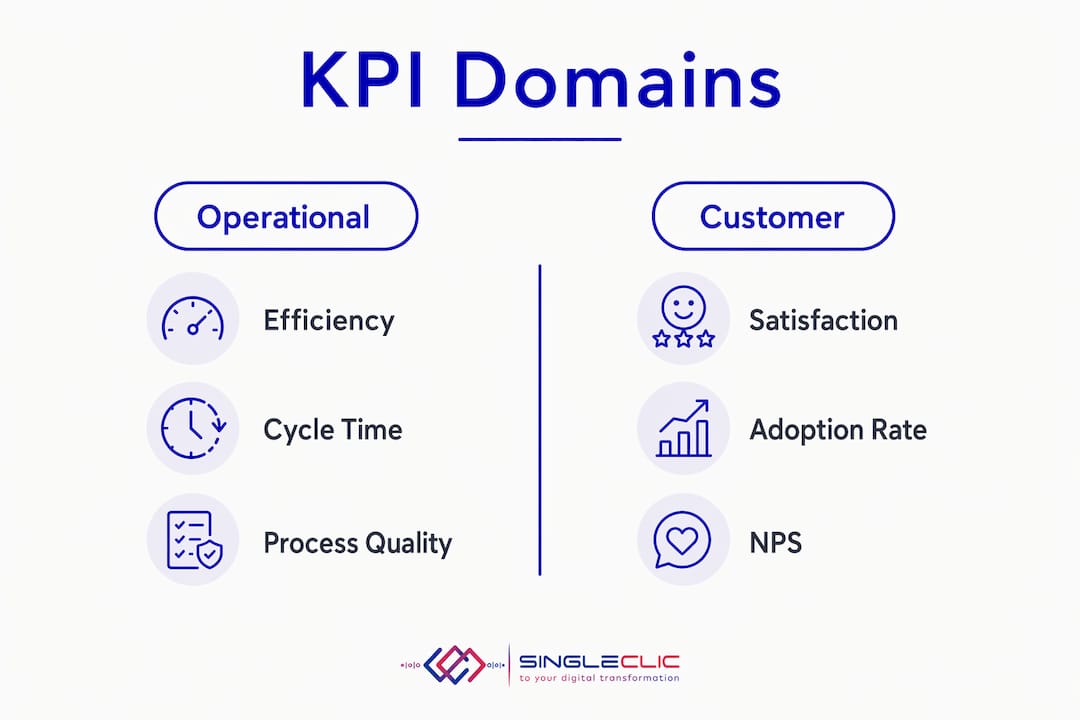
The importance of KPIs in digital transformation becomes clear when you organize them into four domains: operational, customer, financial, and innovation. Each domain captures a different dimension of project health, and ignoring any one of them creates blind spots.

Operational KPIs measure how efficiently your processes run after a digital change. Examples include cycle time, process automation rate, and system uptime. These tell you whether the technology is actually changing how work gets done.
Customer KPIs measure the experience your end users receive. Net Promoter Score, digital adoption rate, and customer satisfaction scores fall here. Adoption rate is particularly telling. A system nobody uses delivers zero value regardless of how well it was built.
Financial KPIs capture return on investment, cost per transaction, and total cost of ownership. Organizations that formally track financial transformation KPIs are 1.8x more likely to secure budget for future project phases. That finding shows that measurement itself becomes a funding tool.
Innovation KPIs track how quickly your organization learns and adapts. Time to deploy new features, experiment velocity, and the ratio of successful pilots to total initiatives belong here.
Beyond the four domains, the distinction between leading and lagging indicators shapes how you use KPIs in practice.
| KPI Type | Definition | Example | Review Cadence |
|---|---|---|---|
| Leading | Predicts future outcomes | Adoption rate, cycle time | Weekly |
| Lagging | Confirms past results | ROI, revenue impact | Monthly or quarterly |
| Operational | Measures process efficiency | System uptime, error rate | Weekly |
| Customer | Measures user experience | NPS, satisfaction score | Monthly |
Leading indicators such as adoption rates and cycle time predict lagging financial results 3–9 months before they appear in reports. That window is your opportunity to course-correct before a problem becomes a loss.
How do KPIs connect project activities to business outcomes?
KPIs serve as a communication layer between C-suite executives and technical teams, keeping focus on true business value rather than just activity. Without that layer, projects generate output without impact. Teams ship features. Executives see no revenue change. Nobody knows why.
The practical mechanism works like this. A business leader sets a goal: reduce customer onboarding time by 40%. The project manager translates that into a KPI: average days from contract signature to first login. The development team then knows exactly what to build and what “done” means. KPIs translate C-suite goals into daily technical team activities, preventing busywork disconnected from business value.
This alignment also prevents what practitioners call the “activity trap.” Teams can be fully occupied, hitting every sprint milestone, while the project drifts away from its original business purpose. KPIs in project management create a constant check against that drift. Every two weeks, you ask: did our work move the metric? If not, you adjust.
Pro Tip: Set your KPIs before you write a single line of code or configure a single workflow. The moment you define the metric first, your technology choices become subordinate to the outcome you need. That sequence change alone eliminates a significant category of project failure.
For project managers working across large enterprise digital programs, the alignment function of KPIs also simplifies stakeholder reporting. Instead of presenting Gantt charts and burn-down rates to executives, you present movement on three or four outcome metrics they already care about.
What are the common pitfalls in setting KPIs for digital projects?
The most damaging mistakes in setting KPIs for transformation are predictable, and most organizations repeat them.
-
Relying on milestone and budget metrics alone. Delivering on time and on budget does not mean the project delivered value. A system deployed on schedule that nobody adopts is a failed project. Milestone metrics measure activity. Outcome metrics measure impact. You need both, but most teams over-index on the former.
-
Setting KPI targets after technology selection. Setting KPIs only after technology selection risks artificially lowered targets that match vendor promises rather than actual business needs. When you let the tool define the target, you measure what the tool can do, not what your business requires. Define your targets first, then select the technology that can hit them.
-
Using static, legacy operational metrics. Many organizations use static metrics inherited from pre-digital operations, but digital transformation requires dynamic, outcome-based KPIs aligned with continuous reinvention. A metric designed for a paper-based process will not capture the value of an automated one.
-
Ignoring leading indicators. Teams that only track lagging metrics like quarterly revenue or annual cost savings cannot intervene in time. By the time the lagging metric signals a problem, months of project work have already gone in the wrong direction.
-
Treating KPIs as reporting tools rather than decision triggers. A KPI that doesn’t trigger action is noise. Every KPI on your dashboard should have a defined threshold: if this number drops below X, we do Y. Without that rule, KPIs become decoration.
Pro Tip: For each KPI you define, write one sentence that starts with “If this metric falls below [threshold], we will…” That sentence forces you to think through the decision before the crisis arrives. KPIs without pre-defined responses are just data.
Successful KPI programs avoid KPI theater by tying each metric explicitly to a ranked outcome, a customer value, an owned decision point, and a measurable trigger for stay, change, or stop decisions.
How can project managers implement KPIs to optimize performance?
Practical KPI implementation follows a clear sequence. The sequence matters as much as the metrics themselves.
- Define KPIs before the project starts. Collect baseline data on your target metrics before any technology goes live. Without a baseline, you cannot measure change. This step is the most commonly skipped and the most consequential.
- Balance leading and lagging indicators. A 60/40 balance between leading and lagging KPIs is effective. Leading indicators should be reviewed weekly. Lagging indicators belong in monthly or quarterly reviews. That cadence gives you early warning signals without drowning your team in reporting overhead.
- Assign ownership for every KPI. Each metric needs one named owner who is accountable for both the number and the response when it moves. Shared ownership means no ownership.
- Build dashboards that surface the right data automatically. Manual KPI collection creates reporting lag and human error. Integrating your KPIs with ERP, CRM, or BPM systems means the data updates in real time. You can read more about KPI use in ERP systems to understand how real-time data changes the quality of project decisions.
- Run structured KPI reviews at defined intervals. Weekly reviews cover leading indicators and flag emerging issues. Monthly reviews assess lagging outcomes and validate whether the project is on track to deliver its business case.
For teams measuring digital project ROI, embedding ROI discipline through aligned KPIs improves prioritization and accelerates data-driven decisions across design, development, and delivery phases.
| Review Type | Frequency | KPI Focus | Decision Trigger |
|---|---|---|---|
| Operational check | Weekly | Leading indicators | Adjust sprint priorities |
| Outcome review | Monthly | Lagging indicators | Escalate or reallocate resources |
| Strategic review | Quarterly | Financial and innovation KPIs | Continue, pivot, or stop |
| Stakeholder report | Monthly | Business outcome metrics | Secure next-phase budget |
For a deeper look at how to measure the financial returns of your digital programs, the C-level guide to digital ROI covers the methods and benchmarks that matter most at the executive level. You can also explore practical KPI measurement tools for digital environments to complement your internal tracking setup.
Key Takeaways
The most effective approach to KPIs in digital projects is to define outcome-based metrics before technology selection, balance leading and lagging indicators, and assign clear ownership so every metric triggers a decision.
| Point | Details |
|---|---|
| Define KPIs before technology selection | Setting targets first prevents artificially lowered benchmarks that match vendor promises. |
| Balance leading and lagging indicators | A 60/40 split, reviewed weekly and monthly respectively, gives early warning without reporting overload. |
| Assign one owner per KPI | Shared ownership produces no accountability; name one person responsible for each metric and its response. |
| Avoid static legacy metrics | Digital transformation requires dynamic, outcome-based KPIs, not metrics inherited from pre-digital operations. |
| Treat KPIs as decision triggers | Every KPI needs a pre-defined threshold and a response plan, or it adds no value to the project. |
What I’ve learned about KPIs after a decade of digital delivery
After working on digital transformation programs across healthcare, banking, and government sectors in the MENA region, I can tell you that the KPI conversation is almost always the hardest one to have. Not because the math is complex. Because it forces organizations to commit to a definition of success before they know exactly what the technology will do.
Most teams resist that commitment. They want to see the system first, then decide what to measure. That instinct produces exactly the outcome they fear: a project that delivers technically but fails commercially.
The shift I’ve seen work is treating KPIs as learning tools, not compliance checkboxes. When a metric moves unexpectedly, the right response is curiosity, not blame. Why did adoption drop in week three? What changed? That question, asked consistently, turns a KPI dashboard into a project intelligence system.
The next frontier is connecting those dashboards to AI-driven analysis. When your ERP and CRM data feeds directly into a model that flags anomalies and suggests responses, the gap between measurement and action shrinks to hours instead of weeks. That is where measuring digital project performance is heading, and the organizations that build that discipline now will have a significant advantage.
— Tamer Badr
How Singleclic supports KPI-driven digital projects
Singleclic delivers Microsoft Dynamics 365 ERP and CRM implementations, IBM BAW business process automation, and the Cortex low-code platform across KSA, UAE, and Egypt. Each engagement is built around outcome metrics from day one. Cortex connects approvals, ERP data, CRM workflows, and legacy systems into a single process layer, giving project managers real-time visibility into the KPIs that matter. For organizations that need a connected, measurable foundation for digital programs, Microsoft Dynamics 365 provides the integrated ERP, CRM, and automation backbone that makes KPI tracking automatic rather than manual.
FAQ
What is the role of KPIs in digital projects?
KPIs in digital projects translate strategic business goals into measurable targets that guide daily project decisions. They connect technical team output to the outcomes executives care about, preventing activity without impact.
How many KPIs should a digital project track?
Most digital projects perform best with 5–8 active KPIs, covering operational, customer, financial, and innovation dimensions. Tracking too many metrics dilutes focus and makes it harder to act on what matters.
What is the difference between leading and lagging KPIs?
Leading KPIs, such as adoption rate and cycle time, predict future financial results 3–9 months before they appear in reports. Lagging KPIs, such as ROI and revenue impact, confirm outcomes after the fact.
When should KPIs be defined in a digital project?
KPIs should be defined and baseline data collected before any technology is selected or configured. Setting targets after technology selection risks benchmarks that reflect vendor capabilities rather than actual business needs.
How do you know if a KPI is working?
A KPI is working if it triggers a specific decision when it crosses a defined threshold. If a metric changes and nobody acts on it, it is not functioning as a KPI. It is just data.