Healthcare claims automation in the UAE means replacing manual hand-offs between registration, coding, e-claim submission, payer adjudication, remittance and appeals with governed workflows, rules and AI-assisted checks. It does not replace your billing team or your regulator-mandated platforms. It makes sure each claim reaches them complete, coded correctly and on time. This guide explains what to automate, which Dubai rules shape the design, how the pieces connect, and how to plan and measure a rollout.
TL;DR
- Automate the repeatable steps first: eligibility checks, pre-authorization tracking, claim scrubbing, submission, remittance matching and denial routing. Keep coding exceptions, clinical disputes and high-value appeals with people.
- In Dubai, providers must submit e-claims by the 15th of the month after the service month, and payers must pay within 45 days of submission. Both deadlines carry a 0.03% daily delay fee, so timing is a design requirement.
- Your automation must produce data that conforms to the eClaimLink minimum dataset and XML schemas, and it must respect health data retention, backup and residency rules.
- Measure a baseline before you start: days to submit, first-pass acceptance, denial rate, rework hours and days in accounts receivable.
- Treat it as a process project first and a technology project second. A workflow layer that sits across your HIS, ERP and payer connections is usually more durable than a point tool.
Table of Contents
- What claims automation covers from eligibility to appeal
- The UAE rules that shape the design
- What to automate and where people stay in the loop
- Integration: where claims automation succeeds or fails
- Privacy, retention and residency
- Benefits you can measure
- Use cases for UAE providers and payers
- How to plan and run the implementation
- Our perspective
- How Singleclic helps
- Article details
- FAQ
- Sources
What claims automation covers from eligibility to appeal
A claim is not one event. It is a chain, and delays or errors at any link become denials, rework or late-submission fees later. A complete automation scope usually follows this path:
- Eligibility and coverage check at registration or booking: is the policy active, what is the network tier, what co-pay or deductible applies.
- Pre-authorization: requesting, tracking and attaching approvals to the right encounter, with reminders when a response is overdue.
- Charge capture and coding: making sure every service performed is billed and coded to the standards the payer expects.
- Claim scrubbing: rule-based checks for missing fields, mismatched diagnosis and procedure codes, duplicate lines and absent authorizations before anything leaves your system.
- Submission: packaging the claim in the required schema and sending it through the e-claim platform inside the deadline.
- Adjudication tracking: monitoring payer status and flagging claims that stall.
- Remittance and reconciliation: matching payments and remittance advice to claims and posting them to finance.
- Denial management and appeals: classifying the denial reason, routing it to the right owner, attaching evidence and tracking the resubmission window.
Most UAE providers already have some of these steps digital. The gap is usually between them: a coder emails a billing officer, a spreadsheet tracks rejected claims, and finance reconciles by hand. Automation closes those gaps.
The UAE rules that shape the design
The UAE does not have one national claims rulebook. Emirates and their health authorities set their own e-claim and data requirements, so the first design question is where your facilities operate. Dubai has the most clearly published rules, and they illustrate what a compliant workflow has to handle.
Dubai timelines and delay fees
Under a Dubai Health Insurance Law standards notice, providers must submit e-claims to the payer or third-party administrator by the 15th of the month following the service month. If a provider submits late, the payer may receive a delay fee of 0.03% per day on the original net claimed amount. The same notice requires payers to pay and post remittance advice within 45 calendar days of submission, with a matching 0.03% daily fee that providers may receive for late payment.
This changes what “good” automation looks like. A submission queue that simply processes claims in order is not enough. You need:
- A service-month cut-off dashboard that shows every unsubmitted encounter and its blocking reason well before the 15th.
- Aging timers that start at submission and alert your revenue cycle team as day 45 approaches, so late-payment entitlements are documented rather than discovered.
- Automatic escalation when a claim is blocked by a missing authorization or coding query.
Data standards and eClaimLink
Dubai insurers must keep datasets in conformity with the eClaimLink minimum dataset and its XML schema definitions. For providers, the practical consequence is that your claim data must be structured to that schema from the moment of capture, not reformatted at the end. Validation rules at the point of entry, such as mandatory fields, code-set checks and authorization numbers, prevent most schema rejections.
If you also operate in Abu Dhabi or the Northern Emirates, confirm the current e-claim platform, code sets and submission rules with the relevant health authority before you fix your integration design. Build the rules layer so that each emirate’s requirements are configuration, not code.
What to automate and where people stay in the loop
Not every step suits every technology. A simple way to decide is to match the task type to the tool.
| Step | Best-fit approach | Human review needed? |
|---|---|---|
| Eligibility verification | System integration, rules | Only when coverage is unclear |
| Pre-authorization tracking | Workflow with timers and reminders | For clinical queries from the payer |
| Document collection | Workflow, document capture | When records are incomplete |
| Claim scrubbing | Rules engine | For rule overrides |
| Code suggestion | AI-assisted, with confidence scores | Yes, certified coder approves low-confidence cases |
| Submission and status tracking | Integration, scheduled jobs | Exceptions only |
| Remittance matching | Rules, RPA where no API exists | Unmatched or partial payments |
| Denial triage | AI classification plus rules routing | Disputed or high-value denials |
| Appeals | Workflow with templates | Yes, clinical and financial sign-off |
Rules engines first
Rules do the heaviest lifting at the lowest risk. Payer-specific edits, code pair checks and authorization requirements are explicit and testable. A rules engine gives you an audit trail of why a claim was held or released, which matters when a payer or auditor asks.
RPA as a bridge, not a destination
Robotic process automation fits where a portal has no usable interface, for example copying status from a payer screen. It is fragile when portals change, so treat it as a bridge until a proper integration exists.
AI where judgment is statistical
AI helps with reading unstructured documents, suggesting codes from clinical notes, predicting which claims are likely to be denied and grouping denial reasons. Keep a person accountable for the final code and for any clinical statement in an appeal. Ask any vendor to show measured results on your own claim mix, not generic accuracy figures.
Integration: where claims automation succeeds or fails
Claims automation touches at least four systems, and the connections matter more than any single tool:
- Hospital or clinic information system (HIS/EMR): source of encounters, diagnoses, procedures and clinical documents.
- ERP and finance: receivables, revenue recognition, cash posting and write-offs.
- Payer and TPA channels: the e-claim platform and any payer portals.
- Health information exchanges and regulator systems: for example, Dubai providers deal with platforms such as NABIDH under DHA requirements.
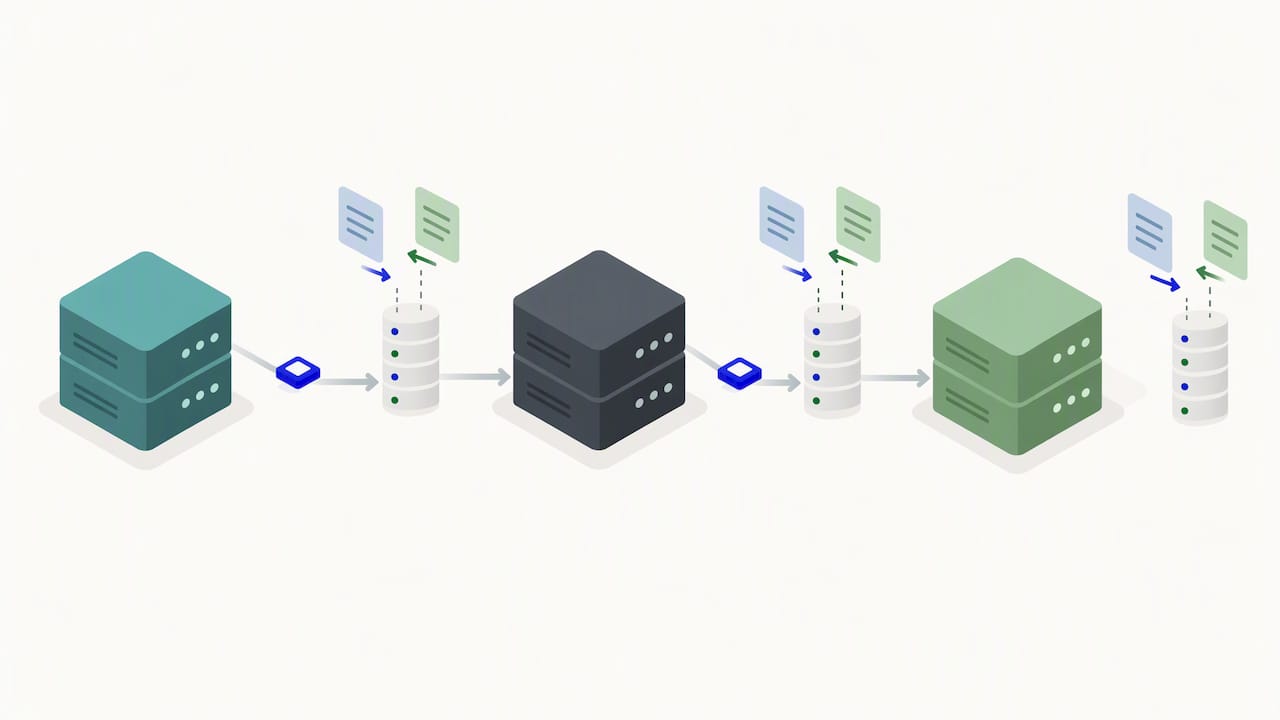
A workflow layer in the middle orchestrates the process: it listens for a completed encounter, runs eligibility and scrubbing, creates tasks when something is missing, submits, then tracks status and posts payments back to finance. If your finance system is Microsoft Dynamics 365, the posting and reconciliation side is straightforward to connect; our Dynamics 365 UAE localization guide covers what to prepare on the finance and IT side.
Two integration habits save months. First, define one claim identifier that follows the encounter across every system. Second, log every message sent and received, so a disputed claim can be reconstructed in minutes.
Privacy, retention and residency
Claims carry diagnoses and procedures, so they are health data. At federal level, Federal Law No. 2 of 2019 on ICT in health fields governs the privacy, security and integrity of health data. Dubai adds specific operational requirements. Providers must retain beneficiary medical records for at least 25 years from the last procedure or the expiry of the last policy, whichever is later, and backups must run at least every 24 hours. The same directive requires secure disposal in line with DESC ISR v3.1, with destruction documented, logged and audited.
What this means for your automation design:
- Store claim attachments and logs on infrastructure that meets your residency obligations. For regulated entities, on-premise or in-country hosting is often the simplest answer.
- Build retention schedules into the workflow platform, not into a separate spreadsheet.
- Restrict access by role: a coder does not need the same view as a collections officer.
- Log reads, edits and deletions so you can evidence the destruction and access audits the directive expects.
For deeper reading, see our notes on the 25-year retention and data residency roadmap, healthcare data security practices and why data privacy is an executive topic.
Benefits you can measure
Avoid vague promises of efficiency. Pick metrics you can pull from your current systems today, then compare after go-live. The ones that matter most:
- Days from service to submission. Directly tied to the Dubai 15th-of-month deadline and delay exposure.
- First-pass acceptance rate: the share of claims accepted without rejection on first submission.
- Denial rate by reason: coding, authorization, eligibility, documentation, timely filing.
- Rework hours per 1,000 claims: how much staff time goes to fixing and resubmitting.
- Days in accounts receivable and the share of claims past 45 days.
- Appeal recovery rate: the value recovered against the value appealed.
The public conversation about scale gives context. One video on Dubai’s health-insurance claim volumes cites 49.6 million claims processed in 2025, which shows why even small per-claim gains add up, but treat your own baseline as the only number that counts. Vendor claims of large percentage reductions in administrative burden are marketing until they are reproduced on your data.
Use cases for UAE providers and payers
Multi-facility hospital group. Encounters from several clinics flow into one workflow. The scrubber applies payer-specific edits, and a cut-off dashboard shows each facility’s unsubmitted claims by service month.
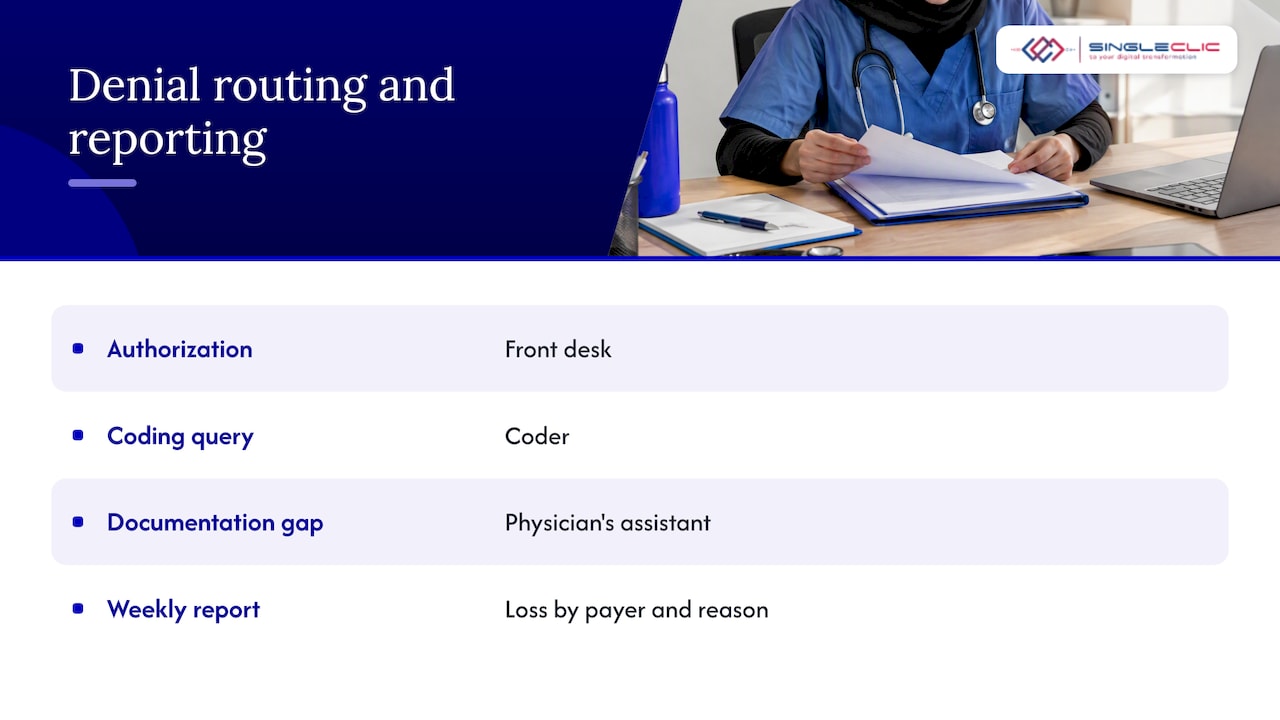
Specialty clinic with high denial rates. Denials are classified automatically and routed: authorization issues to the front desk, coding queries to the coder, documentation gaps to the physician’s assistant. Weekly reports show which payer and reason drive the loss.
Insurer or TPA. Incoming claims are validated against the minimum dataset, matched to policy rules, routed to adjudicators by complexity, and tracked against the 45-day payment window.
Government or semi-government health entity. Approvals, budget controls and audit trails are connected in one governed process, often on-premise. Our article on automation in the public sector shows how the same pattern applies.
How to plan and run the implementation
- Map the current process. Follow 50 real claims from registration to cash. Note every hand-off, spreadsheet and email.
- Set the baseline. Record the metrics above for at least three months of data, split by payer and facility.
- Pick the first slice. Choose one payer mix or one facility, and one problem: usually scrubbing and denial routing, because the payoff is visible fast.
- Define rules with the billing team. Your senior billers hold the knowledge. Write the rules down, test them on historical claims and measure how many denials they would have caught.
- Build integrations and logging before adding AI. Clean, structured data makes later AI far more reliable.
- Pilot and compare. Run the pilot for a full submission cycle so you cover a deadline, then compare against baseline.
- Scale and tune. Add payers, facilities and emirate-specific rules as configuration. Review denial reasons monthly and add rules that stop recurring ones.
Common failure points: automating a broken process, skipping the baseline so no ROI can be shown, ignoring change management for billing staff, and choosing a platform that cannot change rules without vendor tickets. A low-code workflow layer addresses the last one, since your team can adjust rules and routing without a software release; see our explainer on what low-code development is.
For ROI, add the recovered revenue (fewer denials, fewer write-offs), the avoided delay fees and the staff hours redirected to higher-value work, then subtract licenses, integration and support. Use your own volumes and average claim values.
Our perspective
We see claims as a workflow problem that happens to involve health data, not as a billing-software problem. Most delays we meet in healthcare and government projects sit in the hand-offs: an approval waiting in someone’s inbox, a document nobody knows is missing, a status checked by hand. Fixing those requires a layer that connects approvals, ERP, CRM, data and legacy systems, and that your own team can change when a payer changes a rule.
That is why we build around Cortex, our Arabic-enabled low-code and BPM platform, which supports on-premise deployment for regulated organizations and runtime workflow changes without downtime. For healthcare in the UAE, the combination of in-country control and the ability to adapt quickly is usually worth more than any single automation feature. Start small, measure honestly, and let the first result fund the next phase.
— Tamer Badr
How Singleclic helps
We work with healthcare and government organizations across the UAE, KSA and Egypt, and our client list includes Emirates Health Services and Dubai Healthcare City. For claims automation we typically combine:
- Workflow and BPM on Cortex or IBM BAW to orchestrate eligibility, scrubbing, submission, denial routing and appeals.
- ERP and finance integration with Microsoft Dynamics 365 or Odoo for posting, reconciliation and reporting.
- AI and analytics for denial-pattern analysis and document handling, with human approval at the points that need it.
- Secure deployment options, including on-premise, for organizations with strict residency requirements.
Explore our business process automation solutions, our AI and analytics work in healthcare and government or the full Singleclic services overview. If you want a claims process review and a baseline for your own facilities, talk to our team through singleclic.com.
Article details
- SEO title: Healthcare claims automation in the UAE: a practical guide
- Slug: healthcare-claims-automation-uae
- Primary keyword: healthcare claims automation UAE
- Secondary keywords: e-claims automation Dubai, healthcare revenue cycle automation, claims denial management, healthcare workflow automation, healthcare BPM UAE
- Pillar cluster: Business process automation, healthcare and government
- Related reading: Business process automation guide for C-level leaders, Banking process automation in the UAE
FAQ
Is claims automation allowed under UAE health data rules?
Yes, provided you meet the privacy, security and retention requirements. Federal Law No. 2 of 2019 governs health data, and Dubai adds record retention, backup and audit requirements. Design access control, logging and in-country hosting into the workflow from the start, and confirm emirate-specific rules with your regulator.
Does automation replace our billing and coding team?
No. It removes repetitive checks, status chasing and re-keying. Certified coders still approve uncertain codes, and clinical and financial staff still sign off on appeals. Most teams redirect time to denial prevention and payer follow-up.
What is the first process to automate?
Usually claim scrubbing and denial routing, because rules are explicit, results are measurable and the effect on first-pass acceptance shows within one or two submission cycles. Eligibility checks and remittance matching are good next steps.
How do Dubai deadlines affect the design?
Providers must submit by the 15th of the month after service, and payers must pay within 45 days of submission, each with a 0.03% daily delay fee. Your workflow should therefore include cut-off dashboards, aging timers and escalation rules, so missed deadlines are visible while they can still be fixed.
How long does a first implementation take?
It depends on your systems, payers and data quality, so we scope it after a process review rather than quoting a fixed duration. A single-facility pilot covering one full submission cycle is a sensible first milestone.
Sources
- Dubai Health Insurance Data Governance and Records directive (2025)
- Standards Notice 03/2019 under the Dubai Health Insurance Law
- ICT in the health sector: legislation and policies, UAE Government