The right real estate CRM UAE developers should adopt is not a standalone sales tool. It’s an ERP-integrated CRM with DLD/Oqood connectors and broker commission automation, because off-plan sales, escrow-linked payment plans, and multi-agency broker networks demand more than lead tracking. The rest of this guide covers how to evaluate platforms, what implementation actually costs and takes, and where Singleclic fits as a regional integrator.
TL;DR:
- Off-plan sales dominate Dubai’s residential market, requiring CRMs to support multi-year payment schedules, document generation, and default management, not just lead tracking.
- UAE-specific compliance, such as DLD/Oqood registration and Ejari, demands CRMs with native export formats, regulatory-aware workflows, and integrated document automation.
- Broker networks across multiple platforms require CRMs to automate lead capture, attribution, commission management, and support bilingual, mobile interfaces for field brokers.
- Selection should hinge on a platform’s ability to provide DLD/Oqood connectors, ERP integration, and proven UAE project references, not just feature checklists.
- Implementation timelines range from six weeks for small brokerages to up to nine months for enterprise-scale ERP-connected projects, with costs driven by customization, data migration, and integration complexity.
Table of Contents
- What UAE real estate developers and broker networks actually need from a CRM
- Which platform category actually fits your operation
- How to choose the right CRM: evaluation criteria and vendor questions
- What implementation actually takes: timeline, cost, and integration steps
- Why regional implementation experience matters more than feature checklists
- Strategic recommendations for UAE real estate leaders
- How Singleclic helps you get from evaluation to a working CRM
- Sources and further UAE-specific reading
What UAE real estate developers and broker networks actually need from a CRM
Dubai’s residential market runs on off-plan sales, and that single fact changes what a CRM has to do. A 2026 developer-focused roundup puts off-plan transactions at a majority share of recent residential activity, which means most of the deals your sales team closes will not have a finished unit behind them. The CRM has to track a buyer from reservation through a multi-year instalment schedule to handover, not just to signature.
That lifecycle creates specific technical demands most generic sales CRMs never anticipated. A reservation form has to capture buyer KYC data, link to a specific unit and payment plan, and generate documents that match Dubai Land Department formats. Instalment schedules need automated reminders, partial-payment reconciliation, and a clean handoff to finance when a buyer defaults or requests restructuring. None of this is exotic in isolation, but stitching it together inside a tool built for generic sales pipelines usually means custom workarounds that break the first time a process changes.
Oqood and Ejari compliance is the second constraint that trips up otherwise capable systems. Oqood registration requires developers to submit off-plan sale contracts in specific formats tied to DLD’s registry, and a CRM that can’t export data in a compatible structure forces manual re-entry, which is exactly where errors and delays creep into a deal. Ejari, the rental contract registration system used across Dubai, matters less for pure sales-side developers but becomes relevant fast for any organization that also manages leasing or post-handover rental pools. Keyper’s UAE-focused platform illustrates what buyers should expect here: Ejari-aligned document formats, automated rent collection flows, and tenant onboarding built specifically for this regulatory environment, rather than bolted on after the fact.
Broker distribution is the third pressure point, and it’s often underestimated during procurement. Most developers sell a meaningful share of inventory through external broker networks rather than direct sales teams, and those brokers work across Property Finder, Bayut, and Dubai’s own listing portals simultaneously. A widely discussed account of UAE market challenges points to fragmented lead sources, delayed broker responses, and disconnected client data as the recurring operational pain points developers report. Your CRM needs to:
- Capture leads automatically from multiple portal APIs without manual re-entry
- Track lead source and attribution across a broker’s entire pipeline
- Automate commission calculation and payout tracking by broker and by deal stage
- Support a bilingual, mobile-first interface brokers will actually use in the field
- Give sales leadership visibility into broker performance without chasing spreadsheets
Scale changes the answer too. A boutique agency selling resale units for a handful of clients has very different needs than a master developer running twelve active projects with construction milestones tied to payment releases. The agency needs speed and a low learning curve. The developer needs the CRM talking to project accounting, general ledger postings, and construction-linked billing, which is where CRM stops being a standalone decision and becomes an ERP integration question.
Which platform category actually fits your operation
UAE real estate software splits into five practical categories, and picking the wrong one is usually a mismatch of scale rather than a bad product choice.
- Entry-level agent CRMs and field apps. These are fast to deploy, inexpensive, and good at what individual agents and small brokerages need most: contact management, basic lead capture, and mobile access. They almost never have native DLD export formats or ERP hooks, so once a firm starts handling off-plan reservations at volume, the gaps show up quickly.
- Developer sales suites with built-in ERP+CRM modules. Purpose-built for off-plan sales, these handle payment plan configuration, instalment tracking, and DLD-aligned document generation as core features rather than add-ons. The AZDAN roundup lists platforms like Yardi and Property-xRM in this category specifically because they were designed around off-plan accounting from the start, not adapted from generic sales software.
- Enterprise CRM platforms in the Dynamics 365 class. These give large developers deep ERP integration, workflow automation, and the ability to manage multi-project portfolios with construction-linked billing and consolidated financial reporting. The tradeoff is a longer implementation and a real need for an integrator who understands both the platform and UAE-specific compliance requirements.
- Modular open platforms in the Odoo style. These offer strong cost flexibility because you license and configure only the modules you need, then extend with custom development as the business grows. For mid-market developers who want ERP-grade capability without enterprise licensing costs, this is often the most pragmatic starting point.
- Local integrators and custom connector specialists. No off-the-shelf platform ships with a finished DLD connector out of the box. Somebody has to build and maintain that integration, along with Arabic UI work and on-premise deployment where data residency rules apply, and that’s a services layer sitting on top of whichever platform you pick.
Pro Tip: Don’t evaluate platforms on feature lists alone. Ask each vendor to demonstrate an actual DLD or Oqood document export from a live sandbox. If they can’t show it, they haven’t built it yet, and you’ll be the pilot project.
The category choice usually comes down to one honest question: are you running a sales operation, or are you running a development business that happens to need sales tools? The second answer almost always points toward ERP-integrated CRM, even if the upfront cost looks steeper.
How to choose the right CRM: evaluation criteria and vendor questions
Start with a technical checklist before you look at a single demo. Every UAE real estate CRM decision should get tested against the same core requirements, and skipping this step is how firms end up locked into platforms that need six months of workarounds before go-live.
Technical checklist:
- Does the platform have a working DLD/Oqood connector, or does one need to be built from scratch?
- Can it integrate with your existing general ledger and finance system for payment reconciliation?
- Does it support instalment and payment plan tracking natively, not through a spreadsheet export?
- Is there a genuine Arabic UI, or is Arabic support limited to a translated label set?
- Where is data hosted, and does that meet your organization’s residency requirements?
- What SLA does the vendor or integrator commit to for uptime and support response?
Commercial terms deserve equal scrutiny. Licensing models vary widely between per-user subscription and enterprise site licenses, and the sticker price rarely reflects total cost of ownership once customization, data migration, and training get added. One detailed breakdown of CRM implementation costs is worth reviewing before you sign anything, because hidden customization fees are the single most common budget overrun in these projects.
When you get vendors or integrators in the room, ask direct questions rather than accepting a generic pitch deck:
- “Show me a UAE project where you built a DLD connector. What did that integration actually involve?”
- “Walk me through your data migration approach for an existing broker and buyer database.”
- “Can I speak with a reference client who runs a comparable off-plan sales volume?”
- “What happens to my data and workflows if we need to change integrators later?”
A vendor with no UAE reference project, no mention of DLD or Oqood in their pitch, and no clear answer on Arabic UI is a red flag, not a minor gap. A significant share of Dubai’s residential transactions run through off-plan structures according to the AZDAN roundup, so a platform that can’t speak fluently about DLD workflows is telling you it wasn’t built for this market. Vague timelines and a reluctance to name past UAE clients are the second most common warning sign; a serious integrator will have both.
For a broader vendor-neutral comparison framework, Singleclic’s CRM selection guide for KSA and UAE leaders walks through additional scoring criteria worth applying alongside this checklist.
What implementation actually takes: timeline, cost, and integration steps
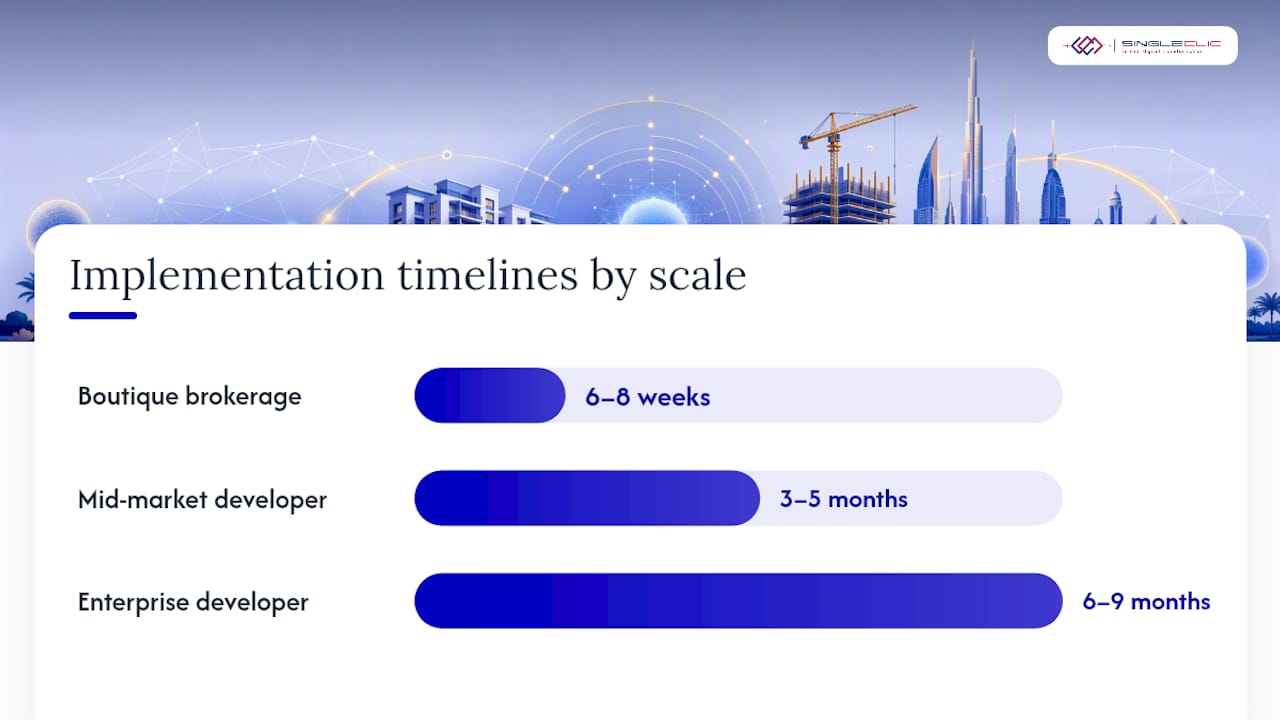
Timeline expectations vary by scale, and vendors who promise the same delivery window regardless of project size are underselling the complexity of DLD integration work. A boutique brokerage CRM rollout can realistically go live in six to eight weeks. A mid-market developer project with payment plan automation and portal feeds typically runs three to five months. Enterprise developer deployments with full ERP integration, multi-project accounting, and DLD connector development often take six to nine months, according to phase estimates in Singleclic’s UAE implementation guide.
Cost drivers follow a predictable pattern across projects of every size:
- Platform licensing (per-user or enterprise tier)
- Customization for UAE-specific workflows and document formats
- DLD/Oqood connector development, which one integration guide estimates at four to eight weeks of scoped connector work plus a sandbox validation cycle with the registrar’s API
- Data migration from legacy spreadsheets or an older CRM
- Training, change management, and post-launch support
| Project scale | Typical timeline | Primary cost drivers |
|---|---|---|
| Boutique brokerage | 6 to 8 weeks | Licensing, basic customization, training |
| Mid-market developer | 3 to 5 months | Payment plan automation, portal integrations, migration |
| Enterprise developer | 6 to 9 months | ERP integration, DLD connector build, multi-project accounting |
Before full rollout, run a pilot scoped to one project or one broker network rather than attempting an organization-wide switch on day one. Define success metrics up front, ideally conversion rate uplift and a measurable drop in manual document handling, and stage the rollout so brokers and sales teams adopt the system in phases instead of all at once. Your integration checklist should cover ERP and general ledger connections, payment gateway links, DLD/Oqood export formats, Ejari exports where leasing applies, portal lead feeds, ID verification, and broker mobile app access, all validated in a sandbox before go-live.
Why regional implementation experience matters more than feature checklists
Singleclic has spent over a decade delivering ERP and CRM projects across the UAE, Saudi Arabia, and Egypt, and that regional footprint shows up in the details that generic CRM vendors miss: how DLD document formats actually get structured, how broker commission rules vary by developer, how Arabic UI needs to work for a sales team that switches between English and Arabic within the same call.

Founder and industry voice Tamer Badr has written extensively on CRM adoption and Dynamics 365 implementation patterns specific to this market, arguing consistently that off-plan-heavy developers need integrators fluent in both the software and the regulatory workflow, not just one or the other.
Singleclic’s regional credentials include:
- Microsoft Dynamics 365 integrator status and Odoo Silver Partner certification
- IBM BAW specialization for business process automation in regulated environments
- A client portfolio spanning healthcare, banking, telecom, and government sectors including Emirates Health Services and Dubai Healthcare City
- Cortex, an Arabic-enabled, on-premise low-code platform built for MENA enterprises that need runtime workflow changes and deep legacy system integration without downtime
That combination of ERP depth, Arabic-first design, and on-premise deployment capability is exactly what DLD-linked, developer-scale CRM projects require.
Strategic recommendations for UAE real estate leaders
Prioritize ERP integration and DLD readiness before anything else if you’re running developer-scale off-plan sales. A CRM that looks polished in a demo but can’t reconcile a payment plan against your general ledger will cost you more in year two than it saved you in year one.
Start with a broker-focused pilot covering lead capture through reservation, not a company-wide rollout. Broker adoption improves faster when commission automation and mobile access ship in the pilot itself rather than getting pushed to “phase two.” Measure conversion uplift and the drop in manual paperwork as your primary KPIs. Everything else is secondary.
— Tamer Badr
How Singleclic helps you get from evaluation to a working CRM
Singleclic is the direct path to a working ERP-integrated CRM for UAE real estate, without the trial-and-error of discovering mid-project that your chosen platform can’t talk to DLD or your finance system. Where the platform categories above each solve part of the puzzle, Singleclic’s teams in the UAE, Saudi Arabia, and Egypt build the connectors, Arabic UI, and payment-plan logic that turn a generic Dynamics 365 or Odoo deployment into something that actually fits an off-plan sales business.
Whether you’re a boutique brokerage weighing a fast rollout or a master developer planning a nine-month ERP-linked deployment, Singleclic maps its Dynamics 365, Odoo, Cortex low-code, and IBM BAW capabilities directly to the checklist covered above, including DLD connector work and broker commission automation. The next step is a scoping workshop where we walk through your current sales process, broker structure, and payment plan complexity before recommending a platform and timeline. Start by reviewing what Dynamics 365 offers connected real estate operations and request a scoping conversation from there.
Sources and further UAE-specific reading
- Top CRM for Real Estate Developers in UAE (AZDAN)
- Real Estate Software Solutions for Dubai & UAE (Keyper)