Yes: enterprises with fragmented ERP/CRM systems, slow approval chains, or compliance-heavy workflows should move to a low-code BPM platform now, not next fiscal year. Low-code business process automation lets IT teams orchestrate multi-step transactions across enterprise systems while cutting manual effort and error rates, according to IBM. Gartner has also tracked strong sustained growth in the low-code development technologies market, which means the vendor risk that scared off early adopters has largely faded.
Here’s what should drive your next move:
- Low-code visual builders let citizen developers build and adjust workflows without waiting on scarce developer cycles, according to Microsoft.
- Faster process changes reduce the IT backlog that usually blocks new automation requests for months.
- Your next step: run a scoped, 6 to 12 week pilot on one high-value process using the evaluation checklist below, before committing to a platform-wide rollout.
Key Takeaways
Low-code BPM platforms succeed when governance, integration depth, and deployment model are decided before the pilot, not adjusted after it.
| Point | Details |
|---|---|
| Verdict | Enterprises with integration or compliance needs should pilot a low-code BPM platform on one high-value process now. |
| Governance first | Set up a CoE and training path before scaling past your first pilot to avoid shadow IT. |
| Evaluate on fit, not features | Prioritize deployment model, integration depth, and security posture over a vendor’s feature list. |
| Pilot with metrics | Measure cycle time, error rate, and cost per transaction over a 6 to 12 week pilot. |
| Regional fit | Singleclic’s Cortex offers on-premise deployment, a full Arabic UI, and unlimited users for regulated enterprise projects. |
Table of Contents
- What is a low-code BPM platform, and how does it differ from BPA and RPA?
- What business benefits does low-code BPM deliver for decision-makers?
- What technical capabilities should you require from a low-code BPM platform?
- How do you evaluate and choose the right low-code BPM platform?
- What should you plan for during implementation, and what typically goes wrong?
- Where does Singleclic’s Cortex fit for enterprise deployments in the region?
- What challenges come with low-code BPM, and how do you manage them?
- How do you scale BPM solutions built on low-code platforms without losing control?
- Why practical evaluation beats feature checklists
- Get a Cortex pilot scoped for your organization
- Sources
What is a low-code BPM platform, and how does it differ from BPA and RPA?
A low-code BPM platform is software that lets you design, automate, and continuously improve end-to-end business processes using visual modeling tools instead of hand-written code. It combines process orchestration, integration, and runtime governance in one environment, so a process owner can map a workflow, connect it to backend systems, and adjust it later without a full development cycle.
Business process management (BPM) and business process automation (BPA) get used interchangeably, but they aren’t the same thing. BPA automates a specific, repeatable transaction. BPM is the broader discipline of modeling, analyzing, and continuously improving how work moves across an organization, according to Red Hat. Robotic process automation (RPA), meanwhile, mimics user actions on existing interfaces rather than orchestrating the underlying process logic, which makes it brittle when a screen layout changes.
Here’s where each approach earns its place:
- Choose low-code BPM when you need durable process orchestration across multiple systems with built-in governance and audit trails.
- Choose RPA for narrow, high-volume tasks on legacy interfaces with no API access.
- Choose custom development only when your process logic is so specialized that no visual composer can model it, which is rarer than most IT teams assume.
For most mid-market and enterprise workflows, from procurement approvals to patient intake, low-code BPM is the architecture that scales without turning every change request into a development ticket.
What business benefits does low-code BPM deliver for decision-makers?
The case for low-code BPM rests on four measurable outcomes: less manual effort, faster delivery, tighter governance, and better operational consistency.
- Reduced manual effort and error rates. Automating multi-step transactions across enterprise systems cuts the human handling that introduces mistakes and delay, a pattern IBM’s automation research documents across industries handling large transaction volumes.
- Faster delivery cycles. Visual builders let business analysts and IT collaborate directly on a workflow instead of routing every tweak through a full software release, shrinking the gap between a process idea and a working version.
- Lower IT backlog. When business users can safely build and adjust their own workflows, the queue of small automation requests that piles up in most IT departments starts to shrink instead of grow.
- Governance and compliance built in. Version control, audit logs, and approval trails come standard in mature platforms, which matters enormously the moment a regulator or internal auditor asks how a decision was made.
Gartner’s market growth forecast for low-code technologies reflects exactly this pattern: enterprises are shifting budget toward platforms that shorten time-to-value rather than lengthen it.
Pro Tip: Track cycle time and error rate on your current manual process before you pilot anything. Without a baseline, you cannot prove the automation actually worked, and executives will want that number in the first review.
Business agility follows naturally. A pricing rule change, a new approval threshold, or a regulatory update becomes a workflow edit instead of a multi-week development project. Customer-facing teams feel this fastest: claims processing, loan approvals, and patient scheduling all tighten up when the underlying workflow logic can be adjusted in days rather than quarters.
What technical capabilities should you require from a low-code BPM platform?
Procurement teams often get sold on a slick drag-and-drop demo and skip the architecture questions that matter six months into deployment. A platform capable of running enterprise-grade automated workflow tools needs to check five categories before it earns a contract.
- Process design standards. Support for BPMN and DMN notation ensures your process models are portable and readable by both business analysts and developers, not locked into a proprietary diagram format.
- Integration depth. API-first connectors and prebuilt adapters for ERP, CRM, and identity systems determine how much custom glue code your team writes later.
- Runtime reliability. Transaction integrity, horizontal scalability, and built-in observability separate a platform that survives Black Friday-scale traffic from one that buckles.
- Governance controls. Role-based access control, mandatory approvals, audit logging, and version control are non-negotiable the moment more than one team touches the platform.
- Extensibility and AI readiness. Custom-code hooks, SDKs, and support for process mining or AI agents let the platform grow past its out-of-the-box templates as your automation maturity increases.
Vendor platforms across the market, from Power Platform to enterprise automation suites, generally combine these five categories in different proportions, according to Salesforce’s overview of business process automation. The differentiator is rarely the feature checklist itself. It’s how deeply the connectors integrate with the specific ERP and CRM stack you already run, and whether the runtime can handle your transaction volume without a re-architecture eighteen months in.
How do you evaluate and choose the right low-code BPM platform?
A structured evaluation beats a feature-by-feature spreadsheet comparison every time, because most vendors score similarly on paper. What separates a good fit from an expensive mistake is how the platform performs against your actual constraints.
Rank these criteria in order before you take a single vendor call:
- Fit for process complexity. A simple approval chain needs less than a multi-branch claims adjudication workflow with parallel reviewers.
- Deployment model. Cloud, on-premise, or hybrid, decided by your data residency and regulatory obligations, not vendor preference.
- Integration depth. How many of your existing systems does the platform connect to natively versus through custom middleware?
- Security and compliance posture. Encryption standards, role-based access, and audit logging need to match your industry’s regulatory bar.
- Support and local presence. A vendor with regional implementation experience resolves issues faster than one running support from a different time zone and language.
During demos and RFPs, ask vendors these questions directly, and treat vague answers as a warning sign:
- Does the platform offer a native Arabic UI, and is it a full localization or a translated overlay?
- Is on-premise deployment genuinely supported, or is it “cloud-only with a private instance” marketing?
- What is the full list of prebuilt ERP and CRM adapters, and which require custom connectors?
- What SLA applies to runtime uptime, and what is the incident response process?
- Where is data stored, and what encryption standards apply at rest and in transit?
- How are updates and patches delivered, and does that process risk workflow downtime?
Sizing and cost hinge on four variables: the number of citizen developer versus professional developer seats you need, monthly transaction volume, integration complexity, and whether licensing is per-user, per-process, or consumption-based. Predefining the integration contract, meaning the APIs, data model, and SLAs, before your pilot starts prevents costly rework once you try to scale.
For the pilot itself, pick one high-value process with a clear pain point, define success metrics upfront (cycle time reduction, error rate, cost per transaction), and run it for six to twelve weeks before committing to a wider rollout.
What should you plan for during implementation, and what typically goes wrong?
Most low-code BPM rollouts don’t fail on the technology. They fail on sequencing, governance, and change management, three things that rarely show up in a vendor’s sales deck.

Start with integration sequencing. Map dependencies between your ERP, CRM, and identity systems before writing a single workflow, since a platform that connects beautifully to your CRM but fights your ERP will surface that problem mid-project, not during the demo. Our guide on low-code automation steps for business workflows walks through this sequencing in more depth.
Governance needs a home before scale, not after. A Center of Excellence (CoE) that sets guardrails, reviews new workflows, and trains citizen developers is what separates controlled growth from shadow IT sprawl, a risk MIT Sloan flags directly when discussing citizen development adoption. Our governance framework for scalable process automation covers what that CoE structure should look like in practice.
Plan around these milestones and risks:
- Pilot scoping (weeks 1 to 2): select the process, define metrics, confirm stakeholder sponsorship.
- Integration sprint (weeks 3 to 6): connect the pilot workflow to source systems, test data flow.
- Governance setup (parallel track): draft approval rules, access roles, and training materials.
- Scale-up (months 3 to 6): extend to adjacent processes once pilot metrics hit target.
For regulated sectors, especially banking, healthcare, and government, data residency and on-premise requirements often decide the platform before any feature comparison even starts.
Pro Tip: Assign a single business owner to the pilot, not a committee. Workflows designed by committee tend to accumulate exception handling for every possible edge case, which is exactly what kills a pilot’s timeline.
Where does Singleclic’s Cortex fit for enterprise deployments in the region?
Singleclic has spent more than a decade delivering ERP, CRM, and automation projects across Saudi Arabia, the UAE, and Egypt, working as a Microsoft Dynamics 365 integrator, Odoo Silver Partner, and IBM BAW specialist. That combination matters because it means the same team handling your low-code BPM rollout also understands the ERP and CRM systems it needs to talk to.
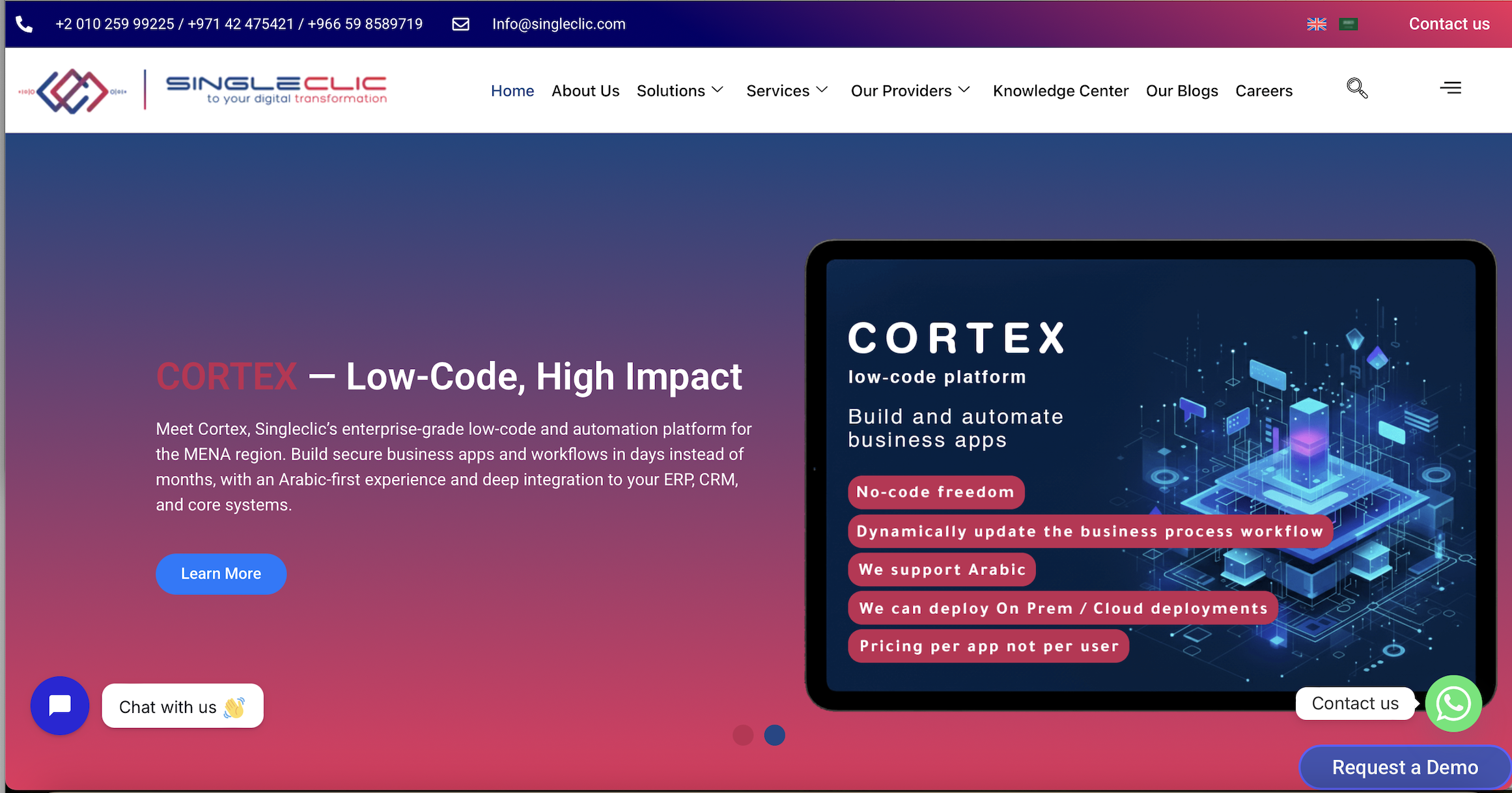
Cortex, Singleclic’s own low-code and BPM platform, was built specifically for enterprises that can’t compromise on deployment model or language. It connects approvals, ERP, CRM, data, and legacy systems into a single workflow layer, and it supports:
- A full Arabic UI and UX, not a translated overlay
- On-premise deployment for banks, healthcare providers, and government bodies with strict data residency rules
- Unlimited users, so licensing doesn’t punish growth
- Runtime workflow changes without downtime, and deep integration with existing enterprise systems
Singleclic has applied this approach across healthcare, banking, and government engagements in the region, where regulatory and integration demands rule out generic cloud-only tools. A Cortex pilot typically starts with one process, cycle time and error rate as success metrics, and a defined path to scale once those numbers hold.
| Consideration | Why it matters for enterprise buyers |
|---|---|
| Deployment model | On-premise support removes the data residency objection that stalls regulated projects |
| Language and UX | Full Arabic UI avoids the adoption drag of a translated overlay |
| Licensing | Unlimited users means cost doesn’t scale against adoption success |
What challenges come with low-code BPM, and how do you manage them?
Low-code doesn’t mean risk-free, and the platforms that oversell “no governance needed” are usually the ones that create the biggest cleanup job later.
Shadow IT and process sprawl. When every department can build its own workflow, you can end up with a dozen slightly different versions of the same approval chain. The fix isn’t restricting access. It’s the CoE and training model MIT Sloan recommends: clear guardrails plus real training, not just a login.
Integration complexity underestimated at the demo stage. Vendor demos connect to clean sandbox data. Your legacy ERP with a decade of customizations is a different problem. Predefine the integration contract before the pilot, as covered above, rather than discovering gaps mid-build.
Platform lock-in. Some low-code tools generate proprietary code that’s hard to migrate away from. Ask vendors directly how workflows are stored and whether BPMN-standard exports are available.
Citizen developer skill gaps. Not every business analyst should build production workflows unsupervised. Tiered permissions, where simple tasks are open and complex integrations require certified builders, solve this without slowing everyone down.
Vendor and market volatility. With Gartner tracking continued market growth, new entrants and consolidation are both likely. Favor vendors with regional support and a multi-year track record over the newest feature set.
How do you scale BPM solutions built on low-code platforms without losing control?
Scaling a single successful pilot into an organization-wide automation practice is where most low-code initiatives either compound their early wins or quietly stall.
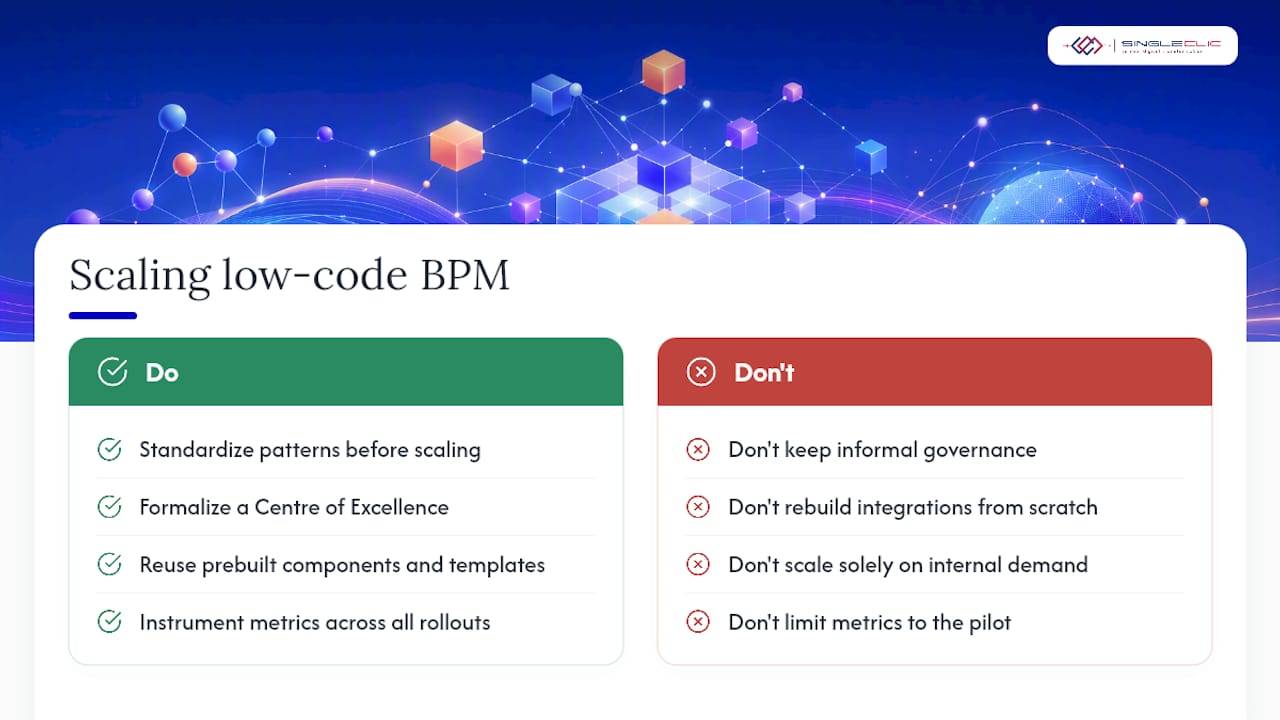
Standardize before you multiply. Once your pilot process proves out, document the patterns that worked, naming conventions, approval structures, error handling, so the next ten workflows don’t each reinvent the wheel. This is also the point to formalize your CoE if you haven’t already, since informal governance that worked for one pilot rarely survives contact with fifteen concurrent projects.
Reuse ready-made components wherever possible. IBM’s guidance on business automation points to prebuilt templates and AI-enabled orchestration as a way to cut implementation time on each new workflow, rather than building every integration from scratch.
Instrument everything. Cycle time, error rate, and cost per transaction shouldn’t be pilot-only metrics. Carry them into every subsequent rollout so you can prove the platform is compounding value rather than just adding workflow count. Our piece on improving business processes with automated workflows covers the operational metrics worth tracking at scale.
Finally, keep integration depth ahead of workflow count. It’s tempting to greenlight every department’s automation request once the platform proves itself, but each new integration point is a new dependency to maintain. Sequence scale-up around your architecture’s actual capacity, not around internal demand alone.
Why practical evaluation beats feature checklists
Most low-code BPM coverage online treats the category as a feature comparison exercise: count the connectors, tally the templates, pick the platform with the longest list. That approach misses what actually determines success, which is whether the platform fits your deployment constraints and whether your organization has the governance discipline to use it well.
The conventional advice to “start small and scale fast” is half right. Starting small is correct. Scaling fast without a CoE in place is how a promising pilot turns into an ungoverned mess of duplicate workflows within a year. The research on citizen development is consistent on this point: governance isn’t a bureaucratic add-on, it’s the mechanism that lets speed and control coexist.
What I’d tell any enterprise leader evaluating this space: rank deployment model and integration depth above feature breadth, because a beautiful visual builder that can’t reach your core ERP or satisfy your data residency rules is not a shortcut, it’s a rebuild waiting to happen. For regulated sectors in this region specifically, that usually narrows the real options faster than any RFP scorecard.
— Tamer Badr
Get a Cortex pilot scoped for your organization
If your enterprise is weighing a low-code BPM platform against the cost and delay of custom development, Cortex gives you a path that skips both extremes: on-premise deployment where regulation demands it, a full Arabic UI instead of a bolted-on translation layer, and unlimited users so your licensing costs don’t punish adoption success.
Singleclic has built this specifically for enterprises in construction, real estate, healthcare, banking, telecom, and government across Saudi Arabia, the UAE, and Egypt, where deep ERP and CRM integration isn’t optional and data residency rules are non-negotiable. If your process runs through Microsoft Dynamics 365 or Odoo already, our guide to connected ERP, CRM, and intelligent automation shows how Cortex plugs into that stack directly. Start by scoping a single high-value process for a pilot, then request a Cortex walkthrough from Singleclic’s team to define the integration contract and success metrics before you commit to a wider rollout. Explore the full business process automation guide for C-level leaders to map out that first conversation.
Sources
For technical grounding on platform capabilities, see IBM’s business automation overview and Microsoft’s low-code BPM page. For governance and market strategy, MIT Sloan and Gartner provide the deeper context. Red Hat clarifies the BPA versus BPM distinction referenced earlier.
- IBM — Business process automation
- MIT Sloan — Why companies are turning to citizen developers
- Gartner — low-code market growth forecast
Recommended
- Why Your Organization Should Adopt Low-Code in 2025 | Singleclic
- The Best Low‑Code Platforms for Enterprise Impact: A Practical Guide for Decision‑Makers | Singleclic
- How Low-Code Improves Business Agility and Faster Decision-Making | Singleclic
- Low-Code, High Impact: Why Enterprise Teams Are Making It a Strategic Priority | Singleclic