For enterprises that must keep proprietary data auditable and inside the corporate perimeter, a private GPT for enterprise deployment, whether on-premise or in a private VPC with retrieval-augmented generation and customer-managed keys, is the recommended approach over public AI APIs. Three signals confirm this is the right call: the data involved is regulated or competitively sensitive, your industry carries strict audit or SLA obligations, and your usage volume is steady enough to justify dedicated infrastructure.
If none of those three apply yet, a public API with strong contractual controls may be enough for now. If two or more apply, start scoping a private deployment.
Before committing budget, take these steps:
- Classify your data (PII, financials, IP) and map which categories cannot legally leave your infrastructure.
- Run a 4 to 8 week pilot on one use case, such as internal knowledge search, before scaling.
- Confirm you can staff 0.5 to 1 full-time engineer for the first year of operations.
- Decide your deployment pattern (on-prem, private cloud, or hybrid) before you shortlist vendors, not after.
Key Takeaways
A private GPT for enterprise succeeds when governance controls, RAG-grounded retrieval, and integration with existing ERP or CRM workflows are designed in from the first pilot, not added after launch.
| Point | Details |
|---|---|
| Choose architecture by data sensitivity | On-premise or hybrid fits regulated data; private cloud suits faster pilots with lower compliance friction. |
| RAG reduces hallucination risk | Grounding responses in your own document store cuts down on invented answers, though retrieval quality still matters. |
| Budget for people, not just hardware | Plan 0.5 to 1 FTE of engineering effort in year one for monitoring and maintenance. |
| Governance artifacts speed procurement | DPIA, SOC 2 mapping, and audit log specs shorten security review cycles. |
| Singleclic delivers pilot to production | Cortex connects private GPT outputs to on-premise, Arabic-enabled ERP and CRM workflows across the region. |
Table of Contents
- What is a private GPT for enterprise, and how does it differ from a public API?
- Which deployment architecture fits your enterprise: on-prem, cloud, or hybrid?
- What security and governance controls does procurement require?
- How do you build the technical implementation checklist for a pilot?
- How much does a private GPT deployment cost compared to a cloud API?
- What does it take to operate a private GPT in production?
- What business outcomes and KPIs should CIOs expect?
- What does regional deployment experience actually look like?
- What compliance rules apply to private GPT deployments?
- What data privacy and residency issues matter most for enterprises?
- How should you evaluate vendors for a private GPT solution?
- Can you customize or fine-tune a private GPT for your business?
- How do you benchmark performance and plan for scale?
- What procurement mistakes should you watch for?
- How Singleclic helps you deploy a private GPT for enterprise
- Frequently asked questions
- Sources
What is a private GPT for enterprise, and how does it differ from a public API?
A private GPT for enterprise is a large language model deployment where the model, the knowledge layer feeding it, and the governance controls wrapped around it all sit inside infrastructure your organization owns or contractually controls. That is a meaningfully different animal than calling a public API endpoint, and the difference is not just where the servers sit.
Three components make up a genuine private GPT stack:
- The model layer. An open-weight or licensed model running on infrastructure you control, whether that is on-premise hardware, a private VPC, or a colocation facility.
- The knowledge layer. This is where retrieval-augmented generation, or RAG, comes in. Instead of relying purely on what the model learned during training, RAG retrieves relevant documents from your own vector database at query time and feeds them into the model’s context window. That grounding is what separates a private GPT that answers from your actual contracts, tickets, or policy manuals from one that guesses based on generic training data.
- The governance layer. Identity, access control, audit logging, and encryption wrapped around both the model and the knowledge layer.
RAG matters more than most procurement documents give it credit for. A base model without retrieval will hallucinate confidently when asked about your specific pricing tiers or your latest compliance policy, because it never saw that data during training. Ground the same model in your own document store through RAG, and hallucination rates drop sharply because the model is now summarizing retrieved text rather than inventing an answer from statistical memory. It is not a complete fix. Retrieval quality, chunking strategy, and embedding freshness all affect how well it works, which is why the engineering behind RAG deserves real attention rather than being treated as a plug-in.
The operational differences from public APIs show up in three places. Data residency is the first: with a public API, your prompts and retrieved context typically transit through a third-party’s infrastructure, even if the vendor promises not to train on your data. A private deployment keeps that data inside your network boundary. Second is SLA control: you set your own uptime targets, your own patching windows, and your own incident response process, rather than inheriting a vendor’s status page. Third is cost predictability. Public APIs bill per token, which scales unpredictably with usage; private infrastructure shifts the economics toward fixed capital and operating costs, a trade-off BentoML’s on-prem deployment guidance describes as trading control for upfront capital and added operational complexity.
Which deployment architecture fits your enterprise: on-prem, cloud, or hybrid?
Choosing a deployment pattern is really about matching four constraints: how sensitive your data is, what your compliance regime demands, what your cost profile looks like, and whether your team can actually operate the thing once it is live. Get this wrong and you either overpay for capability you don’t need or under-provision for governance requirements you can’t skip.
On-premise deployment puts everything, model, vector database, and orchestration layer, inside your own data center. Banks and government agencies in regulated markets tend to land here because it satisfies data residency rules with no ambiguity. The tradeoff is real: you need hardware procurement lead time, GPU capacity planning, and an internal team capable of running production ML infrastructure.
Private cloud (VPC) deployment runs the same stack inside a cloud provider’s virtual private cloud, isolated from other tenants but managed with cloud tooling. This is often the fastest path to a working pilot since you avoid hardware procurement, but you still need to negotiate data processing agreements and confirm the provider’s region-locking meets your residency requirements. AWS Marketplace lists containerized options such as PrivateGPT deployable on Amazon EKS, which bundles single sign-on, RAG pipelines, and usage analytics as a packaged starting point for this pattern.
Hybrid deployment splits workloads: sensitive inference stays on-prem or in a private VPC, while less sensitive or heavier reasoning tasks route to a commercial API. This pattern has become common practice specifically because it avoids the trap of scaling private hardware to handle occasional frontier-reasoning workloads that don’t justify permanent capacity.
Colocation sits between on-prem and cloud: you own the hardware but rent rack space and power from a data center operator. It suits enterprises that want capital control without building their own facility.
| Factor | On-premise | Private cloud (VPC) | Hybrid | Colocation |
|---|---|---|---|---|
| Data residency control | Full | High (region-dependent) | Full for sensitive data | Full |
| Capital expense | High | Low | Medium | Medium to high |
| Operational complexity | High | Low to medium | Medium | Medium |
| Time to first pilot | Slow | Fast | Medium | Slow |
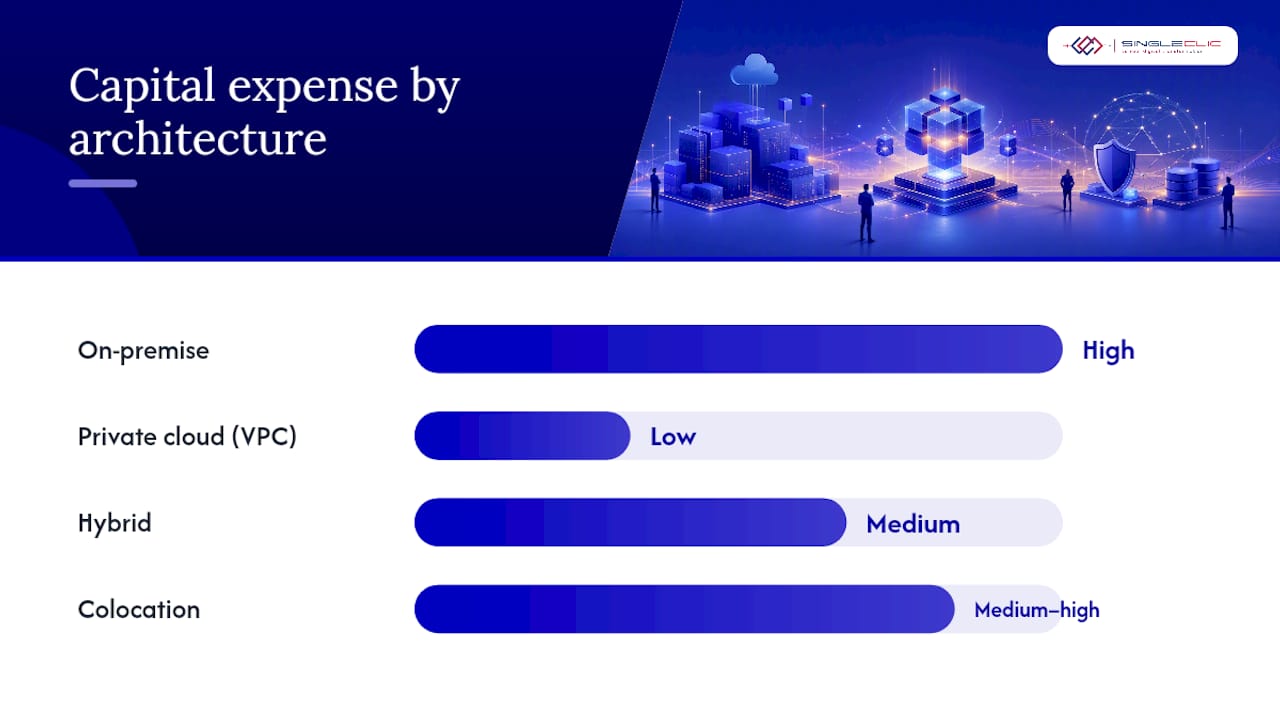
Pro Tip: Don’t pick an architecture before you’ve classified your data. Run the data classification exercise first, then let the sensitivity map dictate which pattern you shortlist, not the other way around.
What security and governance controls does procurement require?
Security review is where most private GPT projects either accelerate or stall for months. The gap usually isn’t technical capability, it’s that engineering teams build a working model pipeline and forget the governance artifacts a security team needs to sign off.
Start with identity and access:
- Single sign-on (SSO) integrated with your existing identity provider, so private GPT access follows the same authentication policy as every other enterprise system.
- SCIM provisioning to automate user onboarding and, critically, deprovisioning when employees leave.
- Role-based access control (RBAC) so that finance staff, legal teams, and developers see only the knowledge sources and model capabilities relevant to their role.
Audit logging is the next non-negotiable. Every query, every retrieved document, and every model response should be logged with timestamp, user identity, and the specific knowledge sources touched. Retention of a reasonable duration is generally advised for most regulated industries, though your specific compliance regime may require longer. Tamper-evident logs, ones that can be cryptographically verified as unaltered, matter more here than most teams initially budget for, because auditors will ask.
Encryption needs to cover data at rest, data in transit, and increasingly, customer-managed keys (CMK) for the encryption itself. CMK means your organization, not the vendor, holds the keys that decrypt your data, which matters enormously if you’re ever required to prove data cannot be accessed without your explicit authorization. This has become close to a hard requirement in the financial services and healthcare procurement processes we see across the region.

None of this is optional insurance. The global average cost of a data breach reached $4.88 million, and that figure covers detection, containment, and reputational fallout, not just the direct incident cost. Every governance control listed above exists specifically to keep an AI deployment from becoming the next line item in that statistic.
For procurement, three artifacts shorten the review cycle dramatically:
- A Data Protection Impact Assessment (DPIA) scoped specifically to the AI system, since self-hosted deployments keep data inside your perimeter and make this documentation considerably easier to produce, as Datanorth’s infrastructure guidance on self-hosted LLMs notes.
- SOC 2 and ISO 27001 control mapping, showing exactly which technical control satisfies which audit requirement.
- Airgap deployment notes, documenting whether and how the system can run fully disconnected from the internet for the highest-sensitivity environments.
How do you build the technical implementation checklist for a pilot?
A private GPT pilot fails less often on model quality and more often on integration debt nobody scoped upfront. Here is the sequence that keeps a pilot from sprawling into an open-ended research project.
- Wire up identity first. Connect SSO and RBAC before you connect any data source. Retrofitting access control after users already have unrestricted access is far harder than building it in from day one.
- Scope your data connectors. Identify which systems feed the knowledge layer, SharePoint, Confluence, your ERP, ticketing systems, and build ingestion pipelines for each. Pick a vector database (options range from open-source choices like pgvector to managed enterprise offerings) based on your existing data infrastructure rather than defaulting to whatever a vendor demo used.
- Engineer the RAG pipeline deliberately. Chunking strategy (how documents get split before embedding), embedding model choice, and a freshness policy for re-indexing updated documents all directly affect answer quality. Treat this as core engineering work, not a configuration checkbox.
- Decide your model runtime. Quantization and inference runtime choice, tools like vLLM or TensorRT-LLM, are the levers your team will use to fit larger models into available GPU memory without buying more hardware than necessary. Budget engineering time for this in your first sprint, not your third.
- Set your update cadence. Decide upfront how often the base model gets refreshed and how you’ll validate that an update doesn’t regress performance on your specific use cases.
- Build monitoring before go-live, not after. Track retrieval accuracy, response latency, and flagged hallucinations from day one so you have a baseline before scaling usage.
- Write the runbook. Document who gets paged when inference latency spikes, how to roll back a bad model update, and how backups of the vector store get restored.
Pro Tip: Treat your RAG pipeline’s chunking strategy as a living configuration, not a one-time setup. Teams that revisit chunk size and overlap after the first month of real usage consistently see better retrieval accuracy than teams that set it once and never touch it.
An opinionated deployment kit can shortcut steps one through four considerably. The llm-onprem-deployment-kit on GitHub bundles Terraform and Helm configurations, airgap runbooks, and compliance mappings to SOC 2 and ISO 27001, which is a reasonable starting reference even if your team ultimately builds custom tooling on top.
How much does a private GPT deployment cost compared to a cloud API?
The build versus buy decision comes down to a straightforward capital versus operating expense trade-off, and the answer depends almost entirely on your query volume and data sensitivity, not on which option is inherently “better.”
Cloud APIs win on capital expense. There’s no hardware to procure, no data center footprint, and you pay per token consumed. For sporadic or unpredictable workloads, this remains the more economical path, and it’s also the faster route to a working proof of concept.
Private, self-hosted infrastructure wins as volume climbs and stays steady. Once your organization is running steady, consistent daily query volumes, the cost dynamics favor owned or leased GPU infrastructure over commercial APIs. There’s no universal token-per-day threshold that applies to every organization, since GPU pricing, model size, and your existing infrastructure all shift the math, but the pattern holds directionally: steady, high-volume, predictable workloads favor self-hosting, while spiky or low-volume workloads favor the API.
The cost line teams consistently underbudget is people. Running a self-hosted model in production is not “set it up once and walk away.” Most organizations need to budget 0.5 to 1 full-time engineer through the first year purely for monitoring, patching, retrieval tuning, and incident response. That headcount cost rarely appears in the initial hardware quote, and it’s the single most common reason self-hosting projects run over their first-year budget.
Other hidden costs worth planning for upfront:
- GPU capacity headroom for usage spikes, not just average load.
- Vector database licensing or managed-service fees, separate from the model infrastructure itself.
- Ongoing embedding re-indexing costs as your document corpus grows.
- Security review and compliance audit cycles, which recur, not a one-time expense.
The hybrid pattern exists precisely to manage this tension: keep steady, sensitive workloads on owned infrastructure while routing occasional heavy-reasoning tasks to a commercial API rather than over-provisioning hardware for peak demand you rarely see.
What does it take to operate a private GPT in production?
Getting a pilot working is the easy half. Running a private GPT reliably at production scale, month after month, is where governance and operations converge, and it’s where most of the ongoing engineering effort actually goes.
- Plan autoscaling and queuing deliberately. Inference workloads spike unpredictably around business hours and reporting deadlines. A queuing layer in front of your inference endpoints prevents a burst of requests from timing out users instead of just processing them a few seconds slower.
- Roll out model updates through canary deployment. Route a small percentage of traffic to the updated model, compare output quality and latency against the previous version, and only promote it to full traffic once you’re confident it hasn’t regressed on your specific use cases.
- Instrument observability from the start. Distributed tracing standards like OpenTelemetry let you trace a single query from ingestion through retrieval through model inference, which is invaluable when debugging why a specific answer came back wrong or slow.
- Maintain audit logs as a living compliance artifact, not a box you checked during the initial security review. Auditors will periodically ask for evidence, and stale logging configurations are a common finding in follow-up audits.
- Build disaster recovery for both the model and the vector store. Losing your vector database without a recent backup means re-ingesting and re-embedding your entire document corpus, which can take days depending on volume. Treat it with the same backup discipline you’d apply to a production database, because that’s exactly what it is.
Drift is the quiet risk here. A model that performed well at launch can degrade in perceived quality as your underlying documents change and the retrieval index falls out of sync. Scheduled re-indexing and periodic sampling of real user queries against expected answers catch this before users start complaining.
What business outcomes and KPIs should CIOs expect?
The use cases that consistently justify a private GPT budget share one trait: they touch proprietary or sensitive information that a public API either can’t access or shouldn’t.
- Internal knowledge base search. Employees query policy manuals, contracts, or technical documentation in natural language instead of digging through folder structures.
- Helpdesk and IT support deflection. A private GPT trained on internal ticketing history resolves common requests without a human agent touching them.
- Contract review and summarization. Legal teams get first-pass summaries of vendor contracts or compliance documents, flagging clauses that need human attention.
- Developer assistants. Internal coding copilots trained on your own codebase and internal libraries, rather than public repositories.
- Low-code workflow integration. Connecting private GPT outputs directly into approval chains and ERP or CRM workflows, so a document summary or an extracted data point triggers the next business process step automatically.
A regional healthcare provider piloting internal knowledge search, for instance, typically measures success not by how clever the answers sound but by how many support tickets never get filed because the employee found the answer themselves.
The KPIs that make a business case defensible in front of a finance committee: time saved per employee interaction, helpdesk deflection rate, cycle time reduction on document-heavy processes like contract review, and reduction in compliance incidents tied to manual data handling errors.
| Point | Details |
|---|---|
| Governance and business KPIs together | Pilots should track auditability and data residency alongside time saved and deflection rate. |
| Contract review speed | Legal teams get faster first-pass summaries, reducing manual review cycle time. |
| Workflow integration | Connecting outputs to ERP or CRM approval chains turns a summary into an automated next step. |
What does regional deployment experience actually look like?
Most private GPT guidance gets written from a Silicon Valley vantage point, assuming English-only interfaces and infrastructure that assumes reliable cloud connectivity everywhere. That framing breaks down fast for banks and government agencies across Saudi Arabia and the UAE, where Arabic-language support and on-premise deployment aren’t preferences, they’re procurement requirements.
Singleclic has spent over 10 years delivering enterprise technology projects across KSA, UAE, and Egypt, with more than 70 consultants and engineers on the ground and over 100 enterprise clients including Emirates Health Services, Dubai Healthcare City, QNB, and AlBaraka. That regional delivery experience shapes how we think about private GPT projects differently than a generic global playbook would.
Cortex, Singleclic’s own low-code and business process automation platform, was built specifically as an on-premise, Arabic-enabled platform for MENA enterprises. It runs unlimited users on-premise, supports runtime workflow changes without downtime, and integrates directly with existing ERP and CRM systems, which matters enormously when a private GPT’s outputs need to trigger an actual approval workflow rather than just display an answer in a chat window.
The gap between a working private GPT demo and a system a bank’s compliance team will actually approve is almost always the integration layer, not the model. Getting Arabic-language retrieval, on-premise governance, and existing ERP workflows to work together is where regional deployment experience earns its value.
A typical engagement follows three phases: a pilot scoped to one high-value use case over 4 to 8 weeks, a delivery phase that builds out the production RAG pipeline and governance controls, and a managed operations phase where Singleclic’s team handles ongoing monitoring and model updates. Enterprises considering this path can review our approach to secure on-premise agentic AI for more detail on how sovereignty and control shape the architecture from day one.
What compliance rules apply to private GPT deployments?
Compliance requirements for a private GPT depend entirely on your industry and your data’s geography, and treating them as a generic checkbox is where most projects run into trouble during security review.
For enterprises handling EU citizen data, GDPR requires you to document your legal basis for processing, honor data subject access requests, and in most cases complete a Data Protection Impact Assessment before deploying an AI system that processes personal data at scale. Self-hosted deployments simplify this considerably because the processing never leaves your defined perimeter, which is exactly the argument Datanorth’s self-hosting guidance makes for why DPIAs are easier to complete on private infrastructure.
Healthcare organizations handling patient data under HIPAA in US-linked contexts, or equivalent regional health data protection frameworks, need business associate style guarantees that a vendor (or your own infrastructure team) will not expose protected health information to unauthorized parties, including the AI vendor’s own training pipeline.
Financial services face the toughest layered requirements: data residency rules that may mandate data never leave a specific jurisdiction, alongside SOC 2 or ISO 27001 control frameworks that auditors expect mapped explicitly to your AI system’s architecture, not just your general IT environment.
The common thread across every regime: whichever framework applies to your industry, map its specific requirements to concrete technical controls, encryption, access logging, data residency, before you sign a vendor contract, not after a security review flags the gap.
What data privacy and residency issues matter most for enterprises?
Data residency questions get more complicated for AI systems than for traditional software, because the question isn’t just “where does the data sit” but “where does the data go during inference.”
Every time a query touches a public API, that prompt and any retrieved context travels to the vendor’s infrastructure, potentially across borders, even when the vendor contractually promises not to retain or train on it. For regulated industries, that transit itself can violate residency requirements, regardless of retention policy. A private deployment, whether on-premise or in a region-locked private VPC, keeps that transit inside a boundary you control and can prove.
The unique enterprise wrinkle is that residency requirements often apply not just to the original data but to derived data, model outputs, embeddings, and cached retrieval results, all of which can contain fragments of the original sensitive information. Your data governance policy needs to explicitly cover these derived artifacts, not just the source documents feeding the system.
Multinational enterprises face an added layer: different subsidiaries may operate under different residency rules simultaneously. A single global private GPT deployment sometimes needs region-specific data partitions so that a query from a UAE-based team never routes through infrastructure that doesn’t meet UAE-relevant residency expectations. This is precisely where hybrid architectures earn their complexity: partitioning by region rather than deploying one global instance.
How should you evaluate vendors for a private GPT solution?
Vendor evaluation for private GPT deployments needs a different scorecard than typical enterprise software procurement, because the risk profile of an AI system that touches sensitive data is fundamentally different from a standard SaaS tool.
Start with deployment flexibility: can the vendor genuinely support on-premise or airgapped deployment, or is “private” marketing language for a single-tenant cloud instance that still routes through the vendor’s infrastructure? Ask for architecture diagrams, not just a feature list.
Governance capability matters as much as model quality. Does the platform natively support SSO, RBAC, and tamper-evident audit logging, or will your team need to build that layer separately? Vendors offering packaged stacks, such as the containerized PrivateGPT option on AWS Marketplace with built-in SSO and RAG pipelines, can shorten this evaluation considerably compared to assembling components yourself.
Check the compliance evidence trail: does the vendor provide SOC 2 or ISO 27001 mappings out of the box, or will your compliance team need to build that mapping from scratch after deployment? Mapping AI-specific controls, customer-managed key support, policy enforcement at the API gateway, tamper-evident logging, directly to procurement language shortens vendor evaluation cycles considerably, since it removes ambiguity during security review.
Finally, weigh regional fit: does the vendor have real delivery experience in your market, language support for your operating languages, and existing integrations with the ERP or CRM systems you already run? A globally polished demo that has never touched Arabic-language retrieval or a regional banking core system is a different risk than one with proven regional delivery history.
Can you customize or fine-tune a private GPT for your business?
Customization for enterprise private GPT deployments happens at three layers, and most organizations get more value from the first two than from full fine-tuning.
The first and highest-leverage layer is RAG customization: connecting the model to your own document stores, contracts, tickets, policy manuals, so answers are grounded in your actual business context rather than generic training data. This requires no model retraining at all, just solid data pipeline engineering, and it delivers the majority of the perceived “custom GPT for business” value most enterprises are actually after.
The second layer is prompt and system-instruction customization: shaping how the model behaves, its tone, its refusal boundaries, its output format, through carefully engineered system prompts rather than retraining. This is fast to iterate on and costs little beyond engineering time.
The third and most resource-intensive layer is actual fine-tuning, adjusting the model’s weights on your own labeled data. This makes sense when you need the model to reliably follow a highly specific format, understand deep domain jargon that general training data underrepresents, or perform a narrow task at a consistency level prompting alone won’t reach. Fine-tuning demands labeled training data, GPU compute, and evaluation rigor most enterprises underestimate on a first attempt.
Most enterprise private GPT deployments never need the third layer. Solid RAG engineering combined with well-tuned system prompts covers the vast majority of business use cases without the added complexity and ongoing maintenance burden of a fine-tuned model.
How do you benchmark performance and plan for scale?
Enterprise workloads stress a private GPT differently than a demo environment ever will, and benchmarking needs to reflect real usage patterns, not synthetic test queries run once during procurement.
Latency under concurrent load is the first metric that matters. A model that responds in two seconds to a single test query can behave very differently when fifty employees query it simultaneously during peak business hours. Load testing with realistic concurrent user counts, not just single-query benchmarks, is the only way to know your actual production ceiling.
Retrieval accuracy needs its own benchmark, separate from raw model quality. Track how often the RAG pipeline surfaces the correct source document for a given query, since a technically fast model grounded in the wrong retrieved context still produces a wrong answer, just quickly.
Scalability planning comes down to GPU capacity headroom. Static capacity sized for average load will buckle during predictable spikes, month-end reporting, open enrollment periods, or regulatory filing deadlines. Quantization and inference runtime choice, tools like vLLM or TensorRT-LLM, let engineering teams fit larger models into existing GPU memory constraints rather than defaulting to buying more hardware every time usage grows.

Budget a recurring benchmarking cadence, not a one-time procurement test. Document corpus growth, model updates, and shifting query patterns all change performance characteristics over time, and the only way to catch degradation before users notice is to keep measuring after go-live, not just before it.
What procurement mistakes should you watch for?
The costliest mistakes I see in private GPT procurement happen before the contract is even signed, and they’re almost always about what got left out of the scope, not what went wrong in delivery.
Undercounting operational effort is the top one. Teams budget for hardware and licensing, then discover mid-project that nobody accounted for the 0.5 to 1 FTE of ongoing engineering time required to actually run the thing. Ask every vendor to state, in writing, what ongoing operational support their pricing includes and what it explicitly excludes.
RFP language deserves more precision than most templates provide. Require explicit language for tamper-evident audit logs, not just “logging capability.” Require customer-managed key support to be named specifically, not folded into a vague “enterprise-grade encryption” bullet. Vague RFP language produces vague vendor responses, and you’ll pay for that ambiguity during security review later.
Pro Tip: Before you scope a pilot, write down the three specific business KPIs and the two governance metrics that would make procurement sign off on scaling it. If you can’t name them before you start, the pilot has no finish line.
How Singleclic helps you deploy a private GPT for enterprise
Singleclic delivers private GPT projects the way regulated enterprises across Saudi Arabia and the UAE actually need them built: on-premise or hybrid, governed by real access controls, and connected to the ERP and CRM systems your teams already run. That last piece is where most private GPT vendors stop short. We don’t just hand you a model endpoint, we connect it to Cortex, our Arabic-enabled, on-premise low-code platform, so a document summary or an extracted answer can trigger an actual approval workflow instead of sitting isolated in a chat window.
If you’re a CIO or CISO evaluating whether to build this in-house or bring in a partner with regional delivery history, the typical path with Singleclic starts with a scoped pilot on one use case, moves into a production delivery phase covering the RAG pipeline and governance layer, and continues into managed operations once you’re live. Explore our approach on the on-premise AI compliance page, then request a consultation to scope your first pilot and get a realistic timeline for your specific compliance requirements.
Frequently asked questions
Is ChatGPT Enterprise actually private?
ChatGPT Enterprise offers stronger data controls than the consumer product, including a commitment not to train on your business data and encryption in transit and at rest. It still runs on the vendor’s shared cloud infrastructure rather than inside your own network perimeter, which is a meaningfully different privacy posture than a self-hosted private GPT for organizations with strict data residency requirements.
Does a truly private ChatGPT-style deployment exist?
Yes. Enterprises can deploy open-weight or licensed models on their own infrastructure, on-premise, in a private VPC, or through colocation, paired with a retrieval layer over internal documents. Packaged options like the PrivateGPT stack on AWS Marketplace demonstrate this is a mature, deployable pattern rather than a theoretical one.
What’s the difference between an enterprise AI version and a standard consumer AI tool?
Enterprise versions typically add SSO integration, role-based access control, audit logging, data processing agreements, and sometimes deployment flexibility. Standard consumer tools lack most of these governance layers and are unsuitable for regulated data handling regardless of vendor privacy promises.
How long does a private GPT pilot typically take?
A focused pilot on a single use case, such as internal knowledge search, generally runs 4 to 8 weeks from data connection through initial user testing. Full production rollout with governance controls and ERP integration extends well beyond that initial pilot window depending on scope.
Do small and mid-sized enterprises need a private GPT, or is that only for large regulated organizations?
Sensitivity of data matters more than company size. A mid-sized healthcare clinic or financial services firm handling regulated data has the same residency and audit obligations as a larger enterprise, even if its query volume is lower, which often makes a private cloud or hybrid pattern more proportionate than full on-premise infrastructure.
Sources
- Statista — Global average cost of a data breach
- On-prem LLMs | BentoML LLM inference guide
- AWS Marketplace — PrivateGPT listing
- llm-onprem-deployment-kit — GitHub
Recommended
- The Best Low‑Code Platforms for Enterprise Impact: A Practical Guide for Decision‑Makers | Singleclic
- Low-Code, Enterprise-Ready: Balancing Speed, Control, and Scale | Singleclic
- Data Security in Digital Transformation – Protecting Enterprise Operations
- Low-Code, High Security: A Governance Blueprint for Power Platform, Dynamics 365, and Odoo | Singleclic