TL;DR:
- Master Data Management creates a single, authoritative source of core business data across systems.
- It is essential for regulatory compliance, operational efficiency, and enabling digital innovation in the GCC.
- Success depends on strong leadership, governance, and organizational commitment beyond just technology.
Even the most well-funded digital transformation programs in the GCC can stall when the underlying data is inconsistent, duplicated, or siloed across departments. You may have invested in ERP platforms, CRM systems, and analytics dashboards, yet your reports still contradict each other and your teams spend hours reconciling numbers instead of acting on them. Master Data Management (MDM) is the discipline that fixes this at the root. In this article, you will learn what MDM is, why it is urgent for enterprises in KSA and UAE, what business gains it delivers, the obstacles you will face, and the concrete steps to get started.
Table of Contents
- Understanding master data management
- Why organizations in KSA and UAE need MDM
- Core benefits and business impact of MDM
- Overcoming common MDM challenges
- First steps to a successful MDM implementation
- The uncomfortable truth about MDM: Why technology alone isn’t enough
- Accelerate your MDM journey with expert guidance
- Frequently asked questions
Key Takeaways
| Point | Details |
|---|---|
| What MDM is | MDM is the discipline of creating a trusted, unified view of key business data used across an organization. |
| Why MDM matters | It reduces operational risk and drives efficiency by eliminating data silos and ensuring accuracy. |
| KSA/UAE urgency | Business leaders in the region face rising regulatory expectations and digital pressures that make MDM essential. |
| Biggest MDM challenge | Technology is just a tool—business alignment and leadership are the real keys to MDM success. |
| MDM implementation steps | Start with a data audit, stakeholder engagement, and clear roadmap for transformation. |
Understanding master data management
Master data is the core business information that your entire organization depends on: customers, products, suppliers, employees, and locations. Unlike transactional data, which records individual events like a purchase or a payment, master data describes the entities involved in those transactions. When this data is inconsistent across systems, every downstream process suffers.
MDM is the set of processes, policies, and technologies that create and maintain a single, authoritative version of this critical information across all enterprise systems. Think of it as the backbone that connects your ERP, CRM, and analytics platforms so they all speak the same language.
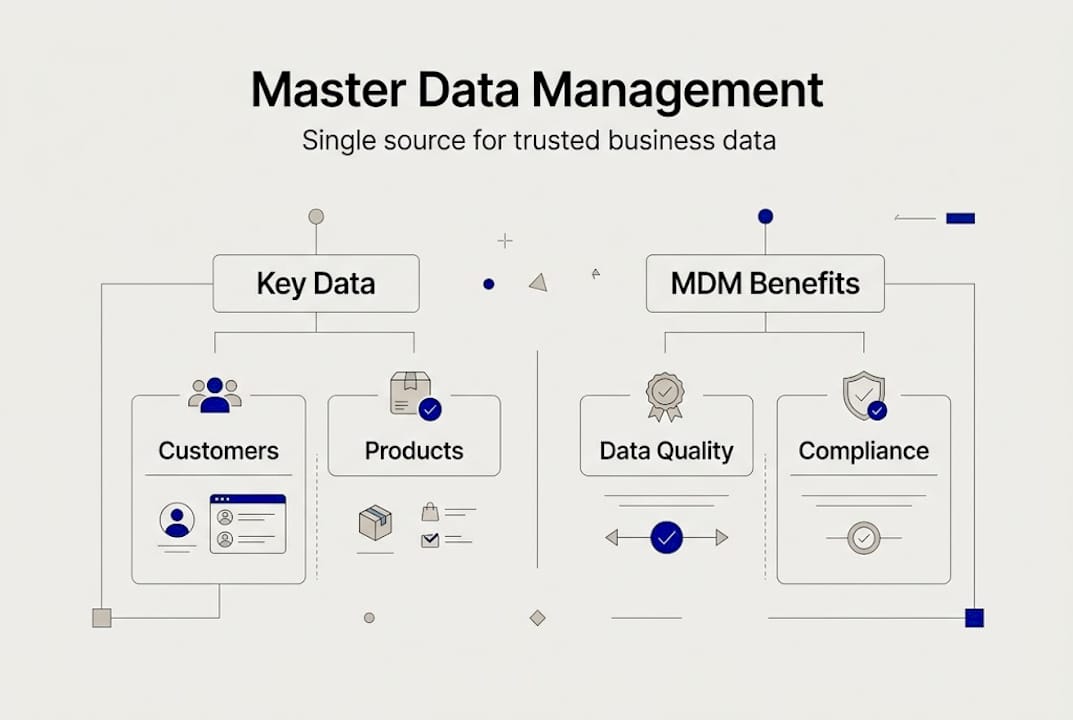
As Gartner explains, “Master Data Management is essential for accurate reporting and business intelligence.” This is not a minor operational detail. When your sales team, finance department, and supply chain function are all working from different versions of a customer record or product catalog, the consequences ripple through every decision.
Here is what MDM actually governs in a typical enterprise:
- Customer data: Names, contact details, account hierarchies, and relationship history
- Product data: SKUs, specifications, pricing tiers, and regulatory classifications
- Supplier data: Vendor profiles, contract terms, and compliance certifications
- Employee data: Roles, organizational structures, and access rights
- Location data: Offices, warehouses, service zones, and regional hierarchies
What separates MDM from general data management is its focus on governance. Regular data management handles how data flows and is stored. MDM defines who owns each data element, how it is validated, and how conflicts between systems are resolved. This is why strong data governance strategies are inseparable from a successful MDM program.
“Without a single source of truth for master data, even the most sophisticated analytics tools will produce unreliable outputs. The problem is not the tool. It is the data feeding it.” — Tamer Badr, Singleclic
For C-level executives, the practical implication is straightforward. MDM is the foundation that makes your technology investments actually work as intended.
Why organizations in KSA and UAE need MDM
Now that you are clear on what MDM means, let us examine why it is especially urgent for enterprises in KSA and UAE.
Both countries are executing ambitious national digital agendas. Saudi Vision 2030 and the UAE’s various smart government initiatives are pushing enterprises, both public and private, to digitize operations at speed. But speed without data discipline creates compounding problems. The faster you scale, the more damage inconsistent master data causes.
Poor data quality costs companies an average of $12.9 million per year, according to IBM research. For large enterprises operating across multiple entities in KSA and UAE, that figure is likely conservative. Multi-entity structures, cross-border operations, and bilingual data environments all amplify the risk.
Regulatory pressure is also intensifying. Both the Saudi Personal Data Protection Law (PDPL) and the UAE’s Federal Data Protection Law require organizations to demonstrate clear data lineage, accuracy, and auditability. MDM directly supports these requirements by establishing documented ownership and traceability for every critical data element. Understanding the role of data in digital transformation is no longer optional for compliance-focused leaders.
| Challenge | Without MDM | With MDM |
|---|---|---|
| Regulatory audit | Manual data reconciliation | Automated, traceable records |
| Multi-system reporting | Conflicting figures across platforms | Unified, consistent outputs |
| Customer experience | Duplicate or outdated records | Single, accurate customer view |
| Onboarding new systems | High integration risk | Standardized data feeds |
The regional business environment adds further complexity. Many GCC enterprises operate through holding structures with subsidiaries across multiple countries, each running different ERP instances or legacy platforms. Without MDM, consolidating financial data or customer insights across these entities is a manual, error-prone process.
- Distributed teams working across time zones with inconsistent data entry practices
- Multi-lingual data (Arabic and English) creating duplicate records
- Frequent mergers and acquisitions introducing new data silos
- Rapid headcount growth outpacing data governance maturity
Pro Tip: Before launching any MDM initiative, map your current data landscape by counting how many systems hold a version of your customer or product records. Most enterprises in the region discover between 5 and 12 separate sources. That number alone builds the business case.
Core benefits and business impact of MDM
With the need established, let us look at the real-world gains your enterprise can expect from MDM.
The most immediate benefit is faster, more reliable decision-making. When your leadership team pulls a report, they should not need to question whether the numbers are accurate. Accurate master data accelerates decision-making and reduces risk, as Forrester’s research confirms. That speed advantage compounds over time, especially when you are competing in fast-moving markets like retail, banking, or healthcare.
Here are the five benefits that matter most to executive stakeholders:
- Improved regulatory compliance: A single, auditable record for every customer, supplier, and transaction reduces your exposure during regulatory reviews.
- Operational cost savings: Eliminating duplicate records and manual reconciliation frees up significant staff time and reduces costly errors in procurement and billing.
- Faster financial close: Finance teams with clean master data consistently close monthly and quarterly books faster, sometimes by several days.
- Better customer experiences: When every customer-facing system shares the same accurate profile, service quality improves and churn decreases.
- Innovation enablement: Clean, structured master data is the prerequisite for AI, predictive analytics, and automation. Without it, these initiatives fail to deliver.
Consider a practical scenario. A regional bank with operations in both KSA and UAE runs separate core banking systems in each country. Before MDM, the risk team had to manually reconcile customer exposure reports across both systems before every credit committee meeting. After implementing MDM with a centralized customer golden record, that reconciliation became automated. The risk team redirected roughly 30% of their weekly hours toward actual analysis rather than data cleanup.

These gains connect directly to your broader digital transformation roadmap. MDM is not a standalone project. It is the data layer that makes every other transformation initiative more effective, from executive analytics tools to AI-driven forecasting.
Overcoming common MDM challenges
Success with MDM comes with unique roadblocks. Here is how to handle them.
The most cited obstacle is not technical. MDM projects fail most often due to lack of executive buy-in and unclear governance, according to TDWI research. This means the conversation about MDM must start in the boardroom, not the IT department. If the CEO and CFO are not aligned on the strategic value, the program will stall the moment it requires cross-departmental cooperation.
Here are the most common challenges and how to address them:
- Leadership misalignment: Establish a data governance council with C-level sponsorship before selecting any technology. The business case must be owned at the top.
- Legacy system integration: Most GCC enterprises have a mix of modern cloud platforms and older on-premise systems. A phased MDM rollout that prioritizes the highest-impact data domains first reduces integration risk significantly.
- Data ownership confusion: Every master data entity needs a designated data steward, a person accountable for its accuracy and consistency. Without this, disputes between departments become endless.
- Multi-lingual data complexity: Arabic and English records for the same customer or supplier create duplicates that automated matching tools struggle to resolve. Invest in language-aware data quality tools from the start.
- Cultural resistance: Teams that have managed their own data for years often resist centralized governance. Change management, training, and visible executive support are essential.
Pro Tip: Start your MDM program with one data domain, customer or product, rather than trying to govern everything at once. A focused first phase delivers quick wins that build organizational confidence and justify further investment. Proper data security in transformation practices should be embedded from this first phase, not added later.
First steps to a successful MDM implementation
Ready to begin? Here is your blueprint for a robust start to your MDM journey.
Before any technology is selected, you need three pre-requisites in place. First, conduct a data audit to understand what master data exists, where it lives, and how inconsistent it currently is. Second, complete a stakeholder mapping exercise to identify who creates, uses, and is accountable for each data domain. Third, review your technology landscape to understand integration complexity and data volumes.
A structured roadmap is key to achieving MDM ROI. Here is a practical five-step framework:
- Define scope and business case: Select one or two data domains to start. Quantify the current cost of poor data quality in those domains to build executive support.
- Establish governance: Create a data governance council, assign data stewards, and document ownership policies before touching any systems.
- Assess and cleanse existing data: Run data profiling tools across your source systems to identify duplicates, gaps, and inconsistencies. Cleanse before you migrate.
- Select and deploy MDM technology: Choose a platform that integrates with your existing ERP and CRM systems. Prioritize solutions that support Arabic data and on-premise deployment if required by your compliance framework.
- Monitor, measure, and expand: Define data quality KPIs from day one. Track improvement over time and use early results to justify expanding MDM to additional data domains.
Pro Tip: Use the 7-step digital transformation checklist to align your MDM initiative with your broader transformation goals. MDM rarely succeeds when treated as an isolated IT project.
Organizations that follow a structured approach consistently achieve faster time-to-value and stronger executive support throughout the program lifecycle.
The uncomfortable truth about MDM: Why technology alone isn’t enough
Here is a perspective that most technology vendors will not tell you: the MDM platform you choose matters far less than the organizational commitment behind it.
We have seen enterprises in the region invest in world-class MDM software, only to see the program stall within 18 months because no one agreed on who owned the customer data domain. The technology was running. The governance was not.
MDM is fundamentally a business discipline that happens to require technology, not the other way around. The success factors for transformation that we consistently observe in high-performing clients are cultural: a CEO who champions data quality publicly, department heads who hold their teams accountable for data accuracy, and a governance structure with real authority to enforce standards.
Without these elements, even the most sophisticated MDM tool becomes an expensive data repository that nobody trusts. The uncomfortable truth is that your MDM program is only as strong as your leadership’s commitment to treating data as a strategic asset, not an IT responsibility.
Accelerate your MDM journey with expert guidance
For organizations seeking a faster, more secure path to modern data management, expert support can make all the difference.
At Singleclic, we have spent over 10 years helping enterprises across KSA, UAE, and Egypt build the data foundations that power real transformation. From initial data audits to full MDM program design and system integration, our team of 70+ consultants brings both regional expertise and global technology depth. Whether you are starting your MDM journey or scaling an existing program, explore our Digital Transformation Office Guide to see how we structure enterprise-wide data initiatives. You can also review our business process automation guide to understand how clean master data amplifies automation outcomes. Reach out to our team for a tailored assessment of your data governance readiness.
Frequently asked questions
What are examples of master data in an organization?
Master data typically includes customers, products, suppliers, employees, and locations, which are the core entities referenced across all enterprise systems and processes.
How does MDM help with regulatory compliance in KSA and UAE?
MDM centralizes and standardizes data records, making it straightforward to demonstrate data accuracy and auditability required under Saudi PDPL and UAE federal data protection regulations.
What is the biggest reason MDM projects fail?
Lack of executive sponsorship and unclear data governance are the leading causes, meaning the problem is organizational, not technical.
How long does it take to implement MDM?
Depending on organizational size and data complexity, MDM implementation timelines typically range from 6 to 18 months from initial planning through go-live.
Does MDM replace ERP or CRM systems?
No. MDM enhances ERP and CRM by supplying clean, standardized data to these platforms but operates as a complementary layer, not a replacement.