TL;DR:
- True service integration coordinates multiple providers to align with business goals, not just system connectivity.
- SIAM structures include layered governance, emphasizing accountability, SLAs, and process harmonization across providers.
- Successful implementation relies on fostering trust, clear roles, and viewing SIAM as an orchestral conductor rather than a control command.
Most enterprise leaders assume service integration means connecting systems. It doesn’t. True service integration is about orchestrating multiple service providers so that every process, every handoff, and every outcome aligns with your business goals. For organizations across KSA, UAE, and Egypt managing a growing web of cloud platforms, ERP systems, and specialized vendors, the gap between technical connectivity and genuine service coordination is where performance breaks down. This guide introduces SIAM (service integration and management), explains the governance models available to you, walks through core processes, and gives you a practical roadmap to move from fragmented IT delivery to real business optimization.
Table of Contents
- Defining service integration and SIAM frameworks
- Core SIAM processes and best practices
- SIAM operating models: Internal, external, and hybrid approaches
- Implementation challenges and how to overcome them
- A strategic perspective: Orchestrating success with service integration
- Take service integration further with Singleclic solutions
- Frequently asked questions
Key Takeaways
| Point | Details |
|---|---|
| SIAM enables collaboration | Service integration is about harmonizing multiple providers to achieve strategic business goals. |
| Choose the right SIAM model | Selecting between internal, external, hybrid, or lead supplier approaches is crucial for optimal results. |
| Align processes for success | Implementing incident, change, and supplier management aligned with SIAM and ITIL ensures clear, effective operations. |
| Plan for challenges | Anticipate cultural clashes, tool interoperability, and change resistance to optimize SIAM implementation. |
| Orchestration over control | SIAM’s power lies in orchestrating collaboration, not strict management or centralized command. |
Defining service integration and SIAM frameworks
Service integration is the discipline of coordinating multiple service providers so they function as one cohesive operation. It goes well beyond technical connectivity. When a new employee joins your organization in Dubai and needs access to HR, IT, and facilities services simultaneously, service integration ensures those three providers collaborate without finger-pointing or delays.
SIAM (service integration and management) is the most mature framework for achieving this. It structures your service ecosystem into three layers. SIAM operates through a layered structure: the Customer organization at the top, a Service Integrator layer in the middle (which can be internal, external, hybrid, or a lead supplier model), and multiple Service Providers at the base. Each layer has defined accountability, preventing the chaos that arises when every vendor only manages their own piece.
Understanding how SIAM compares to related frameworks helps clarify its unique role:
| Framework | Primary focus | Supplier model |
|---|---|---|
| SIAM | Multi-supplier coordination and governance | Multiple providers |
| ITSM | IT service lifecycle management | Typically single provider |
| EAI | Technical data and system integration | System-to-system |
SIAM contrasts with ITSM by emphasizing multi-supplier coordination over single-provider management, and differs from EAI (enterprise application integration) by focusing on service governance rather than technical pipelines.
SIAM enables business optimization in a way that simpler approaches cannot. When providers are governed through a shared framework, SLAs (service-level agreements) become enforceable across the board, escalations follow a clear path, and your team spends less time mediating vendor disputes.
Key benefits enterprises in the MENA region typically realize from SIAM include:
- Unified accountability: One layer owns end-to-end service coordination
- Faster incident resolution: Providers work under shared processes, not separate playbooks
- Better governance: Contracts, SLAs, and reporting are standardized
- Scalability: Adding new providers doesn’t require redesigning your entire model
Pro Tip: The most successful SIAM implementations prioritize harmonization across providers over imposing central control. When working with choosing technology partners, look for vendors who are willing to operate within a shared governance model from day one.
Core SIAM processes and best practices
With the framework explained, let’s dig into the processes that drive effective service integration. SIAM doesn’t invent processes from scratch. It organizes and coordinates the processes you likely already have in place, or should have.
Key SIAM processes include incident management, problem management, change enablement, service request management, supplier management, and toolset management. These are often aligned with ITIL (IT infrastructure library) to ensure consistency and industry-recognized best practices.

Here’s how each process contributes to service integration:
| SIAM process | What it governs | Why it matters |
|---|---|---|
| Incident management | Cross-provider issue resolution | Stops blame-shifting between vendors |
| Problem management | Root cause analysis across services | Prevents recurring failures |
| Change enablement | Coordinated change across providers | Reduces risk of conflicting updates |
| Supplier management | Contracts, performance, compliance | Keeps providers accountable |
| Toolset management | Shared platforms and dashboards | Enables real-time visibility |
Best practices for C-level leaders implementing SIAM processes:
- Align on a single toolset: A shared ITSM platform (such as ServiceNow or equivalent) used across all providers eliminates visibility gaps
- Define cross-provider SLAs: Incident and change SLAs must be agreed upon collectively, not set unilaterally by each vendor
- Conduct regular governance reviews: Monthly or quarterly reviews with all providers surface issues before they escalate
- Embed ITIL practices: Using SIAM-aligned change management practices helps standardize how changes are planned and communicated
“Tamer Badr, founder of Singleclic, notes: ‘One of the biggest integration failures we see in MENA enterprises is not a technology problem. It’s a process ownership problem. When no one is accountable for the end-to-end service experience, every provider optimizes for themselves.’”
Pro Tip: Process silos kill SIAM programs faster than technology gaps. Before selecting tools, document every cross-provider handoff and assign explicit ownership. The gaps you find in that exercise are exactly where SIAM delivers the most value.
SIAM operating models: Internal, external, and hybrid approaches
Having mapped the processes, it’s essential to understand which SIAM operating model suits your business environment. There are four recognized models, each with distinct trade-offs.
SIAM operates through internal, external, hybrid, or lead supplier models. Choosing the right one depends on your organization’s size, regulatory environment, existing capabilities, and risk tolerance.
| Model | Description | Best for |
|---|---|---|
| Internal | Your own team acts as service integrator | Large enterprises with mature IT functions |
| External | A third-party integrator manages all providers | Organizations lacking internal SIAM expertise |
| Hybrid | Combination of internal staff and external expertise | Mid-to-large enterprises wanting control and scale |
| Lead supplier | One primary vendor also plays integrator role | Simpler ecosystems with one dominant provider |
For enterprises in KSA, UAE, and Egypt, the hybrid model is often the most practical. Many regional organizations have strong internal IT teams but lack SIAM-specific governance experience. Bringing in a specialized external integrator for governance design while retaining internal control of strategy gives you the best of both worlds.
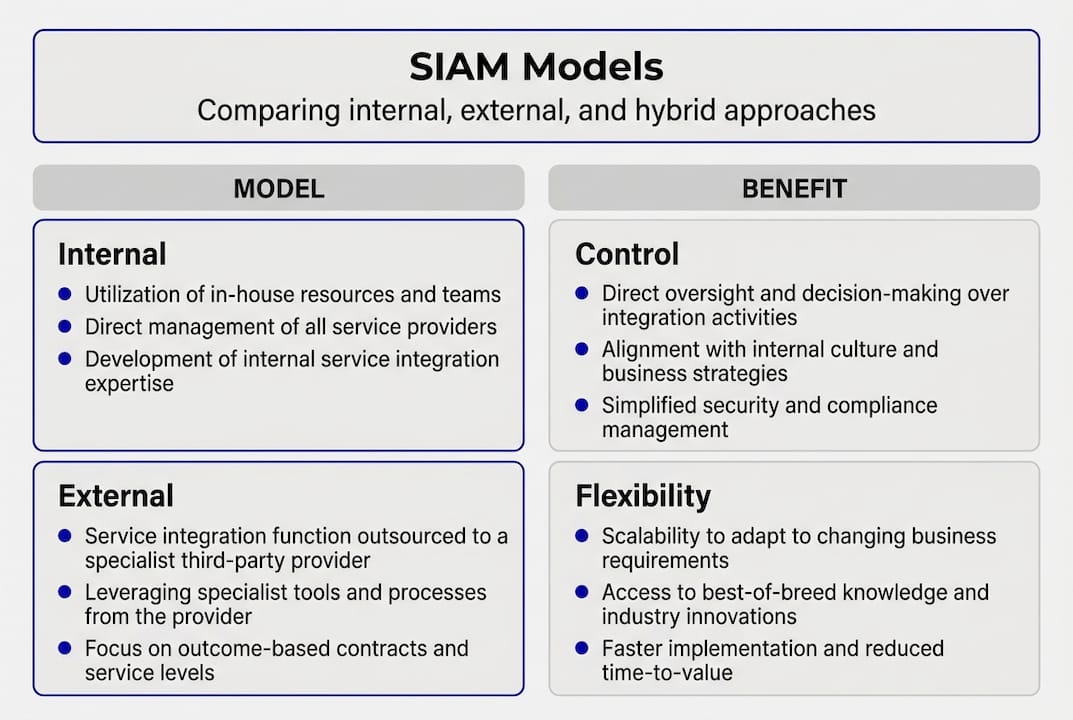
That said, hybrid models offer flexibility but require precise role delineation to avoid accountability gaps. Without a clear RACI (responsible, accountable, consulted, informed) matrix that covers both internal staff and external partners, disputes will arise.
Factors to consider when choosing your SIAM model:
- Regulatory requirements: Government and banking sectors in KSA and UAE often require data sovereignty, which favors internal or hybrid models
- Speed to value: External models deploy faster but cost more over time
- Supplier relationships: If you have long-term contracts with dominant vendors, the lead supplier model may reduce transition friction
- Internal capability: Honest assessment of your team’s SIAM readiness guides the right choice for technology partner selection
Implementation challenges and how to overcome them
Choosing your model is only step one. Implementing SIAM brings unique challenges that must be managed proactively, particularly for enterprises operating across multiple countries and regulatory environments.
The most common SIAM implementation obstacles include organizational change resistance, cultural clashes between providers, tool interoperability issues, balancing control versus expertise in hybrid models, and ensuring SIAM-aware contracts. Each of these can derail a program if not addressed early.
Here’s how to tackle each challenge:
- Change resistance: SIAM restructures accountability and reporting relationships. Leaders must communicate the “why” early and consistently, not just the “what”
- Cultural clashes: When providers from different corporate cultures (or countries) must collaborate, invest in joint workshops and shared governance forums to build working relationships before go-live
- Tool interoperability: Mandate API-compatible toolsets in your procurement process. Don’t let providers bring in isolated platforms that can’t share data
- Hybrid model accountability: A living RACI document, updated every quarter, prevents the slow drift of responsibility that erodes hybrid SIAM programs
- Contract design: SIAM-aware contracts include cross-provider collaboration obligations, not just individual SLAs. Legal and procurement teams must understand this shift
For enterprises in Saudi Arabia and Egypt specifically, where many organizations are scaling digital operations rapidly, the pace of change can make SIAM governance feel like a brake. The key insight is that SIAM governance doesn’t slow you down. Without it, uncoordinated provider expansion does.
Visit our guide on enterprise integration steps to see how leading MENA organizations have structured their integration journeys.
Pro Tip: Address change resistance before you finalize your SIAM design. Run stakeholder workshops with both internal teams and provider leads in the planning phase. When people shape the model, they defend it during implementation rather than work around it.
A strategic perspective: Orchestrating success with service integration
Here’s something C-level leaders rarely hear about service integration: the organizations that struggle most are not the ones with the fewest resources. They are the ones that treat SIAM as a control mechanism.
When the service integrator layer acts as a command center, issuing directives and monitoring compliance, providers become defensive. Communication slows. Innovation stops. The integrator becomes a bottleneck, not a bridge.
The most effective SIAM programs we have seen across MENA enterprises treat the integrator layer as a conductor. Success hinges on SIAM as a conductor, not dictating but harmonizing providers, with hybrid models requiring precise role delineation. A conductor doesn’t play every instrument. They create the conditions for each musician to perform at their best.
In KSA and UAE, where enterprise ecosystems often include international technology vendors alongside regional specialists, the conductor model builds the trust needed for real collaboration. Providers who trust the integrator layer share early warning signals, flag risks proactively, and align faster on joint solutions.
Learn from organizations that have applied these regional integration lessons successfully. The counterintuitive truth is that giving providers more autonomy within a clear governance structure produces better outcomes than tightening control. Governance sets the boundaries. Trust drives performance within them.
Take service integration further with Singleclic solutions
Understanding SIAM is a strategic advantage. Acting on it is where results are made.
At Singleclic, we help enterprises across KSA, UAE, and Egypt design and implement service integration strategies that go beyond theory. From ERP and CRM implementation to business process automation and N8N system integration, our team of 70+ consultants brings both SIAM knowledge and regional expertise to every engagement. If you’re evaluating your readiness for integration, start with our ERP readiness assessment or explore practical ERP integration tips built specifically for MENA business operations. We’re ready to be your integration partner, not just your vendor.
Frequently asked questions
How does service integration differ from traditional IT service management?
Traditional ITSM typically manages a single supplier relationship, while service integration through SIAM coordinates multiple providers across a layered governance structure, ensuring end-to-end accountability that single-provider models cannot deliver.
What are the main challenges in implementing SIAM for enterprises?
Key challenges include organizational change resistance, cultural clashes, tool interoperability issues, and designing contracts that include cross-provider collaboration obligations rather than just individual SLAs.
Which SIAM operating model is best for businesses in KSA, UAE, or Egypt?
Hybrid models offer flexibility but require careful planning to ensure clear accountability. The right choice depends on your organization’s regulatory environment, internal capability, and how many dominant vendors already exist in your ecosystem.
How does SIAM align with ITIL processes?
Key SIAM processes such as incident, problem, change, supplier, and toolset management align directly with ITIL practices, giving enterprises a familiar structure to build their multi-provider governance model on.
What’s one common mistake when implementing service integration?
Over-centralizing control turns the service integrator into a bottleneck. SIAM works best when providers are harmonized within a governance framework rather than dictated to, preserving their ability to contribute expertise and flag issues proactively.
Recommended
- Digital Transformation Roadmap for C-Level Success
- Enterprise Integration Steps for Saudi UAE: Cut Failures 40%
- 7 Business Automation Best Practices for C-Level Success | Singleclic
- The ultimate business transformation checklist for C-level leaders
- Smart SaaS hiring strategies: Your… | GENTY recruitment