The five highest-impact digital cost saving strategies leaders can act on right now are: software and SaaS rightsizing, cloud optimization through FinOps discipline, automation and AI for OPEX reduction, vendor consolidation with data-driven contract renegotiation, and operating-model modernization. Every other tactic is a derivative of one of these five. Bain’s IT cost transformation research frames these across three planes: reduce (10–20% savings), replace (20–30%), and rethink (30–40%) in mature programs. The sequence matters as much as the tactics.
Here is what each lever delivers and why it belongs at the top of your triage list:
- SaaS and license rightsizing: Organizations commonly waste 20–30% of software spend on unused or underutilized seats. Reclaiming them costs nothing except a license audit.
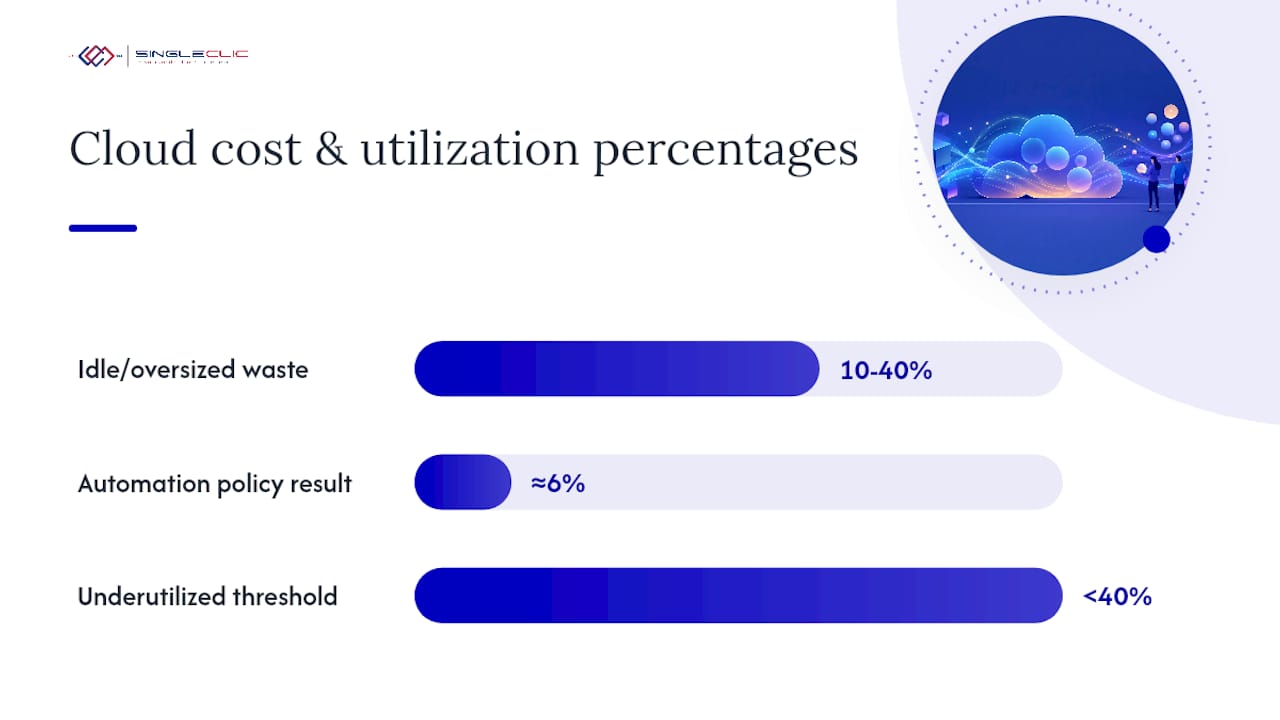
- Cloud optimization and FinOps: Idle and oversized cloud resources routinely account for 10–40% of cloud bills. Rightsizing instances and scheduling nonprod shutdowns are week-one actions.
- Automation and AI for OPEX: Help-desk bots, RPA for back-office processes, and predictive maintenance reduce labor-intensive transaction costs. The savings are real, but only when freed capacity is actively redeployed.
- Vendor consolidation and contract renegotiation: Fragmented supplier relationships hide volume discounts and create renewal risk. Consolidating and renegotiating with usage data typically yields near-term concessions.
- Operating-model modernization: Migrating legacy workloads to SaaS, PaaS, or containerized architectures produces the largest structural savings, though it requires the longest runway.
Benchmark: Gartner’s rapid IT cost reduction guidance confirms that short-term tactical actions can free 10–20% of IT spend within weeks, while longer-horizon rearchitecting unlocks the larger structural gains.
Key takeaways
The most durable digital cost saving programs combine quick tactical wins with a reinvestment policy that funds structural modernization, governed by a cross-functional steering committee that tracks run-rate savings every month.
| Point | Details |
|---|---|
| Start with the five core levers | SaaS rightsizing, cloud FinOps, automation, vendor renegotiation, and operating-model modernization cover the vast majority of recoverable spend. |
| Quick wins fund structural change | Short-term actions deliver 10–20% savings; use that capital to fund the replace and rethink phases targeting 20–40%. |
| Governance prevents regression | A steering committee, FinOps squad, and monthly KPI review keep savings from reverting within two quarters. |
| Reallocation is not optional | Automation savings only appear on the P&L when freed staff capacity is actively redirected to higher-value work. |
| Singleclic accelerates pilots | Singleclic’s Cortex platform and ERP/CRM integration capability support 4–6 week automation pilots with measured outcomes in KSA and UAE. |
Table of Contents
- What quick wins can you capture in the next 90 days?
- How do you audit and rightsize software and SaaS spending?
- How can you cut cloud costs without slowing down engineering?
- How do automation and AI reduce OPEX, and what happens to your team?
- What infrastructure changes produce the largest structural savings?
- How do you win better terms from vendors using data?
- How do you build governance that sustains savings over time?
- What does a practical scan-to-scale implementation playbook look like?
- What does the research say, and where do programs most often fail?
- How do you manage change so cost initiatives actually stick?
- How do you protect security and compliance while cutting costs?
- How do you build a culture that sustains cost discipline over time?
- The cost discipline most leaders underestimate
- How Singleclic accelerates your cost optimization program
- Sources
What quick wins can you capture in the next 90 days?
Short-term digital cost reduction does not require a transformation program. It requires a focused sprint with clear owners and a 90-day clock. The actions below are low-risk, high-return, and executable without major architecture changes.
-
Run a license audit (days 1–10). Pull every active SaaS subscription from your finance and IT systems. Cross-reference against active directory and usage logs. DigitalOcean’s cost-optimization guide identifies SaaS license creep as one of the primary cost leaks, with organizations wasting a significant share of software spend on seats no one logs into.
-
Kill orphaned cloud resources (days 1–14). Unattached storage volumes, idle snapshots, and forgotten test environments accumulate silently. A two-person cloud ops review typically surfaces these within a week. Deleting them costs nothing and produces immediate bill reduction.
-
Rightsize virtual machines (weeks 2–6). Compare actual CPU and memory utilization against provisioned capacity. Downsizing oversized instances to the next tier down is a low-risk change that engineering teams can execute in a scheduled maintenance window.
-
Pause noncritical projects (weeks 1–3). A short moratorium on discretionary IT projects frees both budget and engineering bandwidth. Finance and IT leadership should jointly identify candidates using a simple impact-vs.-spend matrix.
-
Renegotiate near-term supplier terms (weeks 4–12). Bring current usage data and renewal dates to every vendor conversation. Suppliers with renewals inside 90 days are most receptive to concessions when you show underutilization evidence.
-
Reclaim unused cloud reserved instances (weeks 2–8). Reserved capacity purchased for projects that have ended or scaled down can often be sold on cloud marketplace exchanges or converted to on-demand to stop the commitment bleed.
Quick-win benchmark: Gartner’s tactical guidance supports 10–20% IT spend reduction from these short-term actions alone, without touching core architecture.
Who to involve: IT operations owns cloud and license cleanup. Procurement owns supplier renegotiation. Finance validates the run-rate savings and locks them into the budget baseline. A weekly 30-minute standup between these three functions keeps the sprint on track and prevents recapture of savings by new uncontrolled spend.
How do you audit and rightsize software and SaaS spending?
SaaS sprawl is the most predictable recurring leak in enterprise IT budgets. The fix is a repeatable five-step process, not a one-time cleanup.
- Inventory every subscription. Pull from accounts payable, corporate card statements, and IT service management tools. Shadow IT lives in expense reports, not the IT register.
- Run usage analytics. Most SaaS platforms expose last-login dates and feature utilization via admin consoles or APIs. Flag any seat with 90-day inactivity as a reclaim candidate.
- Map entitlements against actual need. A user licensed for an enterprise tier who only uses three basic features is a downgrade candidate, not just a reclaim candidate.
- Reclaim and renegotiate. Return unused seats at the next renewal cycle. Use utilization data as leverage to negotiate lower per-seat pricing or a smaller committed volume.
- Enforce policy and tagging. Every new SaaS purchase should require buy-center approval and carry a cost-center tag. This prevents the next wave of shadow IT before it starts.
| Signal | Metric to track | Action |
|---|---|---|
| Unused seats | % seats with zero logins in 90 days | Reclaim or reassign |
| Feature mismatch | % users on premium tier using only basic features | Downgrade license tier |
| Duplicate tools | Count of tools serving the same function | Consolidate to one vendor |
| Shadow IT | Subscriptions outside IT register | Bring under buy-center governance |
| Run-rate savings | Monthly spend reclaimed | Report to steering committee monthly |
Pro Tip: Attach cost-center tags to every SaaS subscription at the point of purchase. When a tag is missing, the purchase is blocked. This single policy change eliminates most shadow IT before it reaches the invoice stage.
How can you cut cloud costs without slowing down engineering?
Cloud cost optimization is not a one-time rightsizing exercise. It is a continuous discipline, and the organizations that treat it as such capture savings that persist rather than regress within two quarters.
The practical playbook runs in this order:
- Rightsize instances. Pull 30-day utilization data and identify instances running below 40% CPU and memory. Move them to the next smaller instance family.
- Enable autoscaling. Workloads with predictable traffic patterns should scale down during off-peak hours automatically. This alone can cut compute costs on variable workloads by a meaningful margin.
- Schedule nonprod environment shutdowns. Development and staging environments running 24/7 are a common waste. A scheduled shutdown policy for nights and weekends reduces nonprod compute spend.
- Remove orphaned resources. Unattached disks, unused load balancers, and stale snapshots accumulate after every project. A monthly sweep removes them before they compound.
- Apply storage lifecycle policies. Move infrequently accessed data to lower-cost storage tiers automatically. Most cloud providers offer tiered storage with significant price differences between hot and cold access classes.
- Apply reserved or committed-use discounts selectively. Commit only to workloads with stable, predictable baselines. Committing to oversized capacity defeats the purpose.
McKinsey’s FinOps-as-code analysis documents a retailer case where automated policy enforcement reduced cloud costs by approximately 6% on a persistent basis. The mechanism is embedding cost guardrails directly into provisioning pipelines so engineers receive real-time cost feedback and automated remediation fires before waste accumulates.
- Cloud ops team: owns rightsizing, scheduling, and orphan removal.
- FinOps function: owns reserved/committed discount strategy and cost reporting.
- Engineering leads: own autoscaling configuration and pipeline cost guardrails.
Savings range: Cloud idle and oversized resources typically represent 10–40% of cloud bills, per DigitalOcean’s cost-optimization research. Rightsizing and scheduling alone address the bulk of that range without architectural changes.
How do automation and AI reduce OPEX, and what happens to your team?
Automation and AI deliver reliable OPEX reductions in a specific set of use cases. The savings are not theoretical, but they do not materialize automatically.
High-value automation targets:
- Help-desk chatbots: Tier-1 IT support tickets resolved by a bot cost a fraction of agent-handled tickets. Deflection rates of 30–50% are common in mature deployments.
- RPA for back-office processes: Invoice processing, purchase order matching, and employee onboarding contain high-volume, rule-based steps that RPA handles without error or overtime. Process automation cuts hidden operational costs in ways that rarely appear on a standard P&L until you measure transaction-level cost.
- Predictive maintenance: Sensor-driven maintenance scheduling reduces unplanned downtime and parts waste in asset-heavy operations.
- Cognitive spend analysis: Wharton’s digital cost management research documents cases where cognitive tools classified more than 98% of purchase transactions, compressing spend analysis from weeks to days and surfacing consolidation opportunities that manual review missed entirely.
Implementation approach:
- Select one high-volume, rule-based process as the pilot. Measure the baseline cost per transaction before automation.
- Deploy the automation in a controlled environment. Run it in parallel with the manual process for two to four weeks to validate accuracy.
- Measure run-rate savings against the baseline. Calculate cost per transaction post-automation and annualize the delta.
- Create an explicit reallocation plan for the staff time freed. Assign those hours to growth tasks, higher-value analysis, or reskilling programs before the automation goes live.
That last step is where most programs fail. BCG’s analysis of AI-first cost advantage is direct: failing to plan reallocation of staff time after automation prevents organizations from realizing the full financial benefit. The capacity exists on paper but gets absorbed back into the same low-value work unless leadership actively redirects it. Workforce transformation planning is not an HR afterthought; it is a prerequisite for capturing automation savings.
What infrastructure changes produce the largest structural savings?
Short-term wins free cash. Infrastructure modernization is where you permanently lower the cost base. The decision is not simply “cloud vs. on-prem” but a sequenced set of tradeoffs across cost, control, and risk.
Recommended modernization sequence:
- Modular extraction: Identify the highest-cost, lowest-differentiation workloads running on legacy infrastructure. These are the first migration candidates because they carry the least business risk.
- Hybrid migration: Move extracted workloads to cloud IaaS or PaaS. Retain on-prem only for workloads with regulatory, latency, or data-sovereignty requirements.
- Platform modernization: Containerize stateful applications and adopt serverless for event-driven workloads. This reduces the per-unit compute cost and eliminates idle capacity.
Bain’s reduce-replace-rethink framework places infrastructure modernization in the “rethink” plane, where mature programs capture 30–40% savings. That range assumes full rearchitecting, not a lift-and-shift. A lift-and-shift to cloud without optimization often increases costs in the short term.
Governance considerations: Every infrastructure migration should carry a compliance and security review before workloads move. Regulated industries in the US, including healthcare (HIPAA) and financial services (SOX, PCI-DSS), have data-residency and audit-trail requirements that must be mapped to the target architecture before migration begins, not after.
How do you win better terms from vendors using data?
Vendor consolidation and contract renegotiation are among the fastest paths to near-term savings because they require no technology change. They require evidence and preparation.
Negotiation checklist:
- Pull usage data for every major vendor: active users, features consumed, and capacity utilized versus contracted.
- Identify bundling opportunities: two or more vendors serving overlapping functions are a consolidation candidate and a negotiating lever.
- Benchmark your effective unit price against published market rates or peer data from procurement networks.
- Address nonprice terms: payment timing, auto-renewal clauses, exit provisions, and SLA credits are all negotiable and carry real financial value.
- Bring renewal exposure into the conversation: a vendor who knows you are 18 months from renewal has less urgency than one facing a 60-day window.
Dashboard metrics to bring to every negotiation:
- Effective unit price (total spend divided by active users or transactions)
- Unused capacity percentage (contracted minus consumed)
- Renewal date and auto-renewal trigger date
- Alternative vendor pricing (even a credible alternative quote shifts leverage)
Procurement tactics that compound over time:
- Stagger renewal dates across vendors so you always have at least one active negotiation with leverage.
- Request mutual cost transparency: share your utilization data and ask the vendor to share their cost-to-serve. This shifts the conversation from list price to value.
- Use volume-based bundling to consolidate spend with fewer vendors in exchange for tiered discounts.
Wharton’s cognitive analytics research shows that classifying fragmented transaction data with analytics tools accelerates spend analysis and surfaces supplier consolidation opportunities that manual review misses. The same capability that speeds up spend analysis also builds the evidence base for your next vendor negotiation.
How do you build governance that sustains savings over time?
One-time cost actions without governance revert. Within two to three quarters, uncontrolled spending returns, cloud waste rebuilds, and shadow IT reappears. Sustained digital financial efficiency requires a governance structure with teeth.
Governance template:
- Steering committee: CIO, CFO, and at least one business-unit leader. BCG recommends explicit CIO/CTO participation to ensure automation accelerates high-value change rather than only speeding up legacy processes. Meets monthly to review savings actuals versus targets and approve reinvestment decisions.
- FinOps squad: A small cross-functional team (cloud ops, finance, engineering) that owns cloud cost reporting, reserved-instance strategy, and guardrail enforcement. Meets weekly.
- Business owners: Each cost-center owner is accountable for their SaaS and cloud spend against a monthly budget. Variance above a defined threshold triggers an escalation to the steering committee.
KPIs to track:
- Run-rate savings (annualized, by initiative)
- Cost per transaction (for automated processes)
- Cloud spend per resource unit ($/RU, tracked weekly)
- License utilization rate (active seats divided by licensed seats)
- Time to reclaim (days from identification of waste to confirmed savings)
Reinvestment policy: Earmark a defined percentage of captured savings for replacement and modernization projects. BDO’s governance guidance stresses that programs without a reinvestment policy tend to deliver one-off cuts rather than structural improvement.
What does a practical scan-to-scale implementation playbook look like?
The difference between organizations that capture savings and those that announce initiatives is a repeatable program structure. Here is a compact playbook you can start this quarter.
Roadmap:
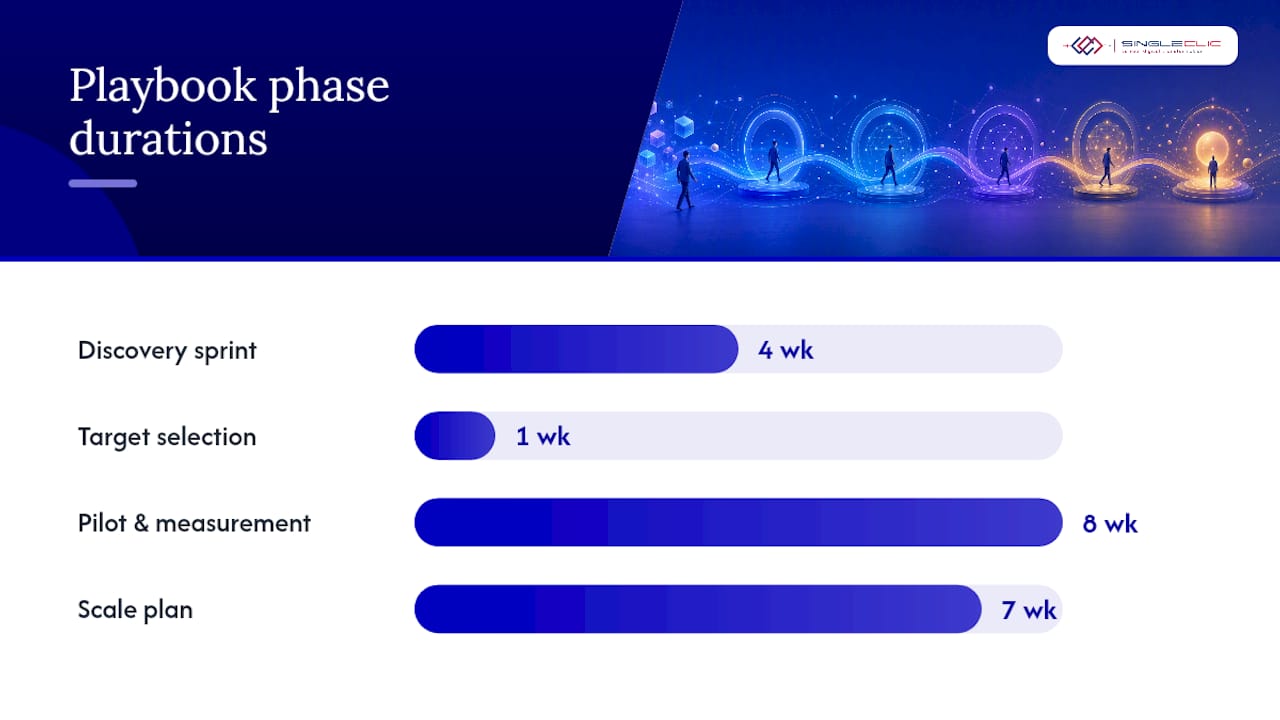
- Discovery sprint (weeks 1–4): Inventory all software, cloud, and vendor spend. Produce a ranked opportunity list using an impact-effort matrix. Assign a cross-functional owner to each opportunity.
- Target selection (week 4): Select two to three quick-win pilots with the highest impact-to-effort ratio. Define baseline metrics, target delta, and measurement window for each.
- Pilot and measurement (weeks 5–12): Run pilots with weekly check-ins. Measure run-rate savings against the baseline at the end of the window. Document what worked and what required adjustment.
- Scale plan (weeks 10–16): For pilots that hit their target, build a scale plan with resource requirements, timeline, and accountability checkpoints. Pilots that missed target go back to root-cause analysis before scaling.
- Accountability checkpoints: Monthly steering committee review of actuals versus targets. Quarterly reinvestment decision based on confirmed savings.
Impact-effort prioritization:
- High impact, low effort: License reclamation, orphaned cloud resource deletion, nonprod scheduling. Start here.
- High impact, high effort: Infrastructure modernization, ERP consolidation, enterprise automation. Fund with quick-win savings.
- Low impact, low effort: Minor process tweaks. Batch these and delegate.
- Low impact, high effort: Avoid or defer indefinitely.
Pilot measurement checklist:
- Baseline metric (cost per transaction, monthly spend, license count)
- Target delta (specific percentage or dollar reduction)
- Verification window (4–8 weeks of post-implementation data)
- Named owner accountable for the outcome
- Reinvestment commitment tied to confirmed savings
Benefits of workflow automation pilots are most reliably captured when the measurement window is long enough to exclude launch-week anomalies and short enough to maintain momentum.
What does the research say, and where do programs most often fail?
The research consensus across Gartner, Bain, McKinsey, BCG, BDO, and Wharton converges on four structural points that separate programs that deliver from those that stall.
Research-backed foundations:
- The reduce-replace-rethink sequence works because it matches risk tolerance to time horizon. Quick wins build credibility and fund the harder structural changes.
- FinOps-as-code makes cloud cost governance continuous. Embedding guardrails in provisioning pipelines eliminates the need for periodic manual cleanup and prevents regression.
- Cross-functional governance is not optional. BDO’s analysis is clear that AI and automation programs without structured governance and cross-functional alignment consistently underdeliver on savings.
- Cognitive analytics compresses spend analysis timelines from weeks to days, enabling faster consolidation decisions and more frequent renegotiation cycles.
Common pitfalls and how to avoid them:
- Cutting blindly: Across-the-board budget cuts without usage data eliminate productive spend alongside waste. Always cut with evidence.
- Failing to reallocate capacity: Automation that frees 20% of a team’s time delivers zero financial benefit if that time flows back into the same low-value work. Build the reallocation plan before the automation goes live.
- Missing continuous governance: A one-time audit without a recurring governance structure produces a one-time result. Savings regress without a FinOps squad and steering committee maintaining discipline.
- Ignoring reinvestment: Programs that capture savings without earmarking a portion for modernization end up repeating the same cleanup cycle every 18 months.
Pro Tip: Before launching any automation initiative, document exactly where the freed capacity will go. Assign a named owner to the reallocation plan and include it as a KPI in the steering committee’s monthly review. This single discipline separates programs that show up on the P&L from those that show up only in slide decks.
How do you manage change so cost initiatives actually stick?
IT cost-saving transformations fail at the people layer more often than the technology layer. A license audit that reclaims seats but triggers a revolt from business units who feel blindsided will not survive its first renewal cycle.
Effective change management for cost programs starts with communication before action. Business-unit leaders need to understand what is being measured, why, and what the reclaimed savings will fund. When the reinvestment story is clear, “we are cutting your software budget” becomes “we are redirecting that spend to a capability you actually asked for.”
Training matters more than most programs budget for. When a help-desk bot replaces Tier-1 ticket handling, the agents who handled those tickets need a credible path to higher-value work. Without that path, resistance is rational. Workforce transformation planning should be scoped and funded as part of every automation pilot, not added as an afterthought after go-live.
Two practices that consistently improve adoption rates: first, involve a business-unit champion in the pilot design so the process being automated reflects how the team actually works, not how IT thinks it works. Second, publish a simple dashboard showing what the initiative saved and where that money went. Transparency about reinvestment converts skeptics faster than any internal marketing campaign.
How do you protect security and compliance while cutting costs?
Cost reduction and cybersecurity are not opposing forces, but they create real tension when cuts are made without a risk lens. The most common hidden expense in aggressive cost programs is a breach or compliance penalty that costs more than the savings it was meant to protect.
Three principles keep cost and security aligned:
Never cut security tooling on utilization alone. A security tool with low daily active usage may still be covering a critical control. Evaluate security spend against the risk it mitigates, not the seat-utilization metric you apply to productivity software.
Vendor consolidation can improve security posture. Fewer vendors means fewer integration points, fewer credential sets to manage, and a smaller attack surface. Consolidation done well is both cheaper and more secure than a fragmented tool landscape.
Compliance requirements scope your modernization options. Before migrating any workload, map it to its applicable regulatory framework. HIPAA, SOX, PCI-DSS, and state-level data privacy laws (including California’s CCPA) each carry specific requirements for data residency, audit trails, and access controls. A migration that saves $200,000 annually but triggers a $500,000 compliance remediation is not a savings initiative.
Build a simple risk-cost matrix for every proposed cut: estimated annual savings on one axis, estimated risk exposure (probability times impact) on the other. Any initiative where risk exposure exceeds savings by more than a defined threshold requires CISO sign-off before proceeding.
How do you build a culture that sustains cost discipline over time?
Sustained digital cost optimization programs are cultural achievements as much as technical ones. Organizations that maintain discipline between formal review cycles share a few specific practices.
Cost visibility at the team level is the most powerful cultural lever. When engineering teams see their cloud spend in real time, tied to their own deployments, behavior changes without mandates. FinOps-as-code makes this possible by surfacing cost data in the same pipelines where engineers make provisioning decisions.
Leadership modeling matters. When a CIO publicly reviews cloud spend in the same meeting where they review feature velocity, cost consciousness becomes a professional norm rather than a finance department concern. The steering committee’s monthly review, visible to business-unit leaders, sends the same signal at the organizational level.
Recognition for cost discipline reinforces the behavior. A team that identifies and eliminates $300,000 in annual waste deserves the same recognition as a team that ships a new product feature. Most organizations celebrate revenue generation and ignore cost stewardship; the ones that sustain savings over multiple years treat both equally.
Finally, embed cost criteria into project approval processes. Any new technology purchase or infrastructure provisioning request should include a cost-per-unit estimate, a utilization forecast, and a decommission plan. This prevents the next wave of waste before it starts and makes cost thinking a standard part of how your organization evaluates every technology decision.
The cost discipline most leaders underestimate
The programs I see deliver the most durable savings share one characteristic: they treat the first quick win as a funding mechanism, not a finish line. A license audit that reclaims $400,000 in annual SaaS spend is valuable. But its real value is the credibility it creates with the CFO and the capital it provides to fund the harder structural work.
The temptation is to declare victory after the quick wins and move on. The organizations that resist that temptation, that use the first 90 days to build a steering committee, establish KPIs, and earmark reinvestment, are the ones that show up with a structurally lower cost base two years later. The ones that stop at the audit are back running the same audit 18 months later.
If you are leading a cost program in KSA or UAE, the same sequencing applies, but the context adds a layer. Many regional enterprises are simultaneously managing legacy ERP debt and rapid growth, which means the “rethink” plane is not a future consideration but an active constraint. Singleclic’s Cortex platform and Microsoft Dynamics 365 and Odoo implementations are specifically designed for this environment: connecting approvals, ERP, CRM, data, and legacy workflows without requiring a full rip-and-replace. Start one pilot this quarter. Assign a cross-functional owner. Measure it properly. That is the first step.
How Singleclic accelerates your cost optimization program
Most cost optimization programs stall not because the strategy is wrong but because the implementation capacity is not there. Singleclic gives technology and business leaders a direct path from diagnosis to measurable savings, without the 18-month consulting engagement.
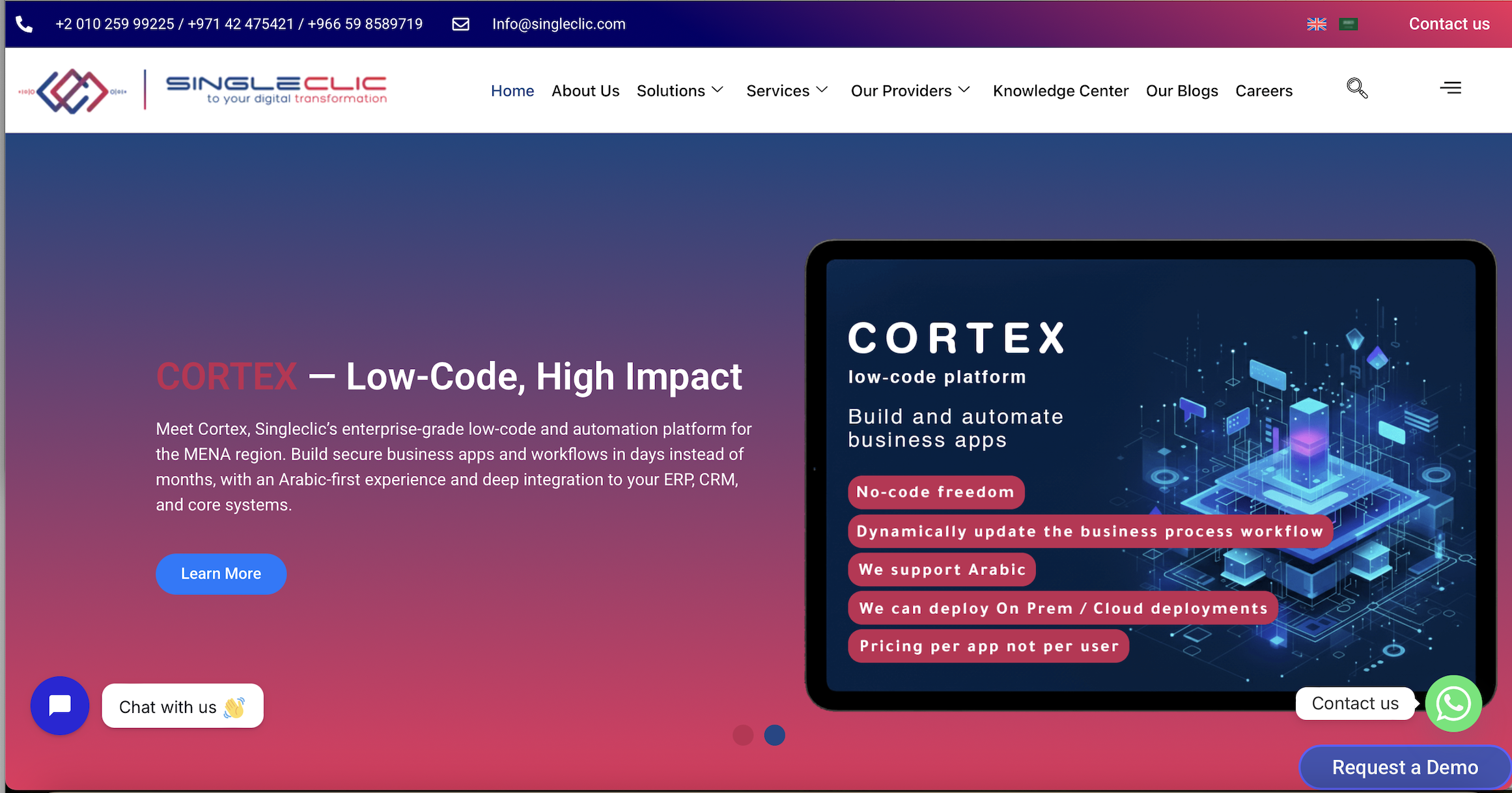
As a Microsoft Dynamics 365 integrator, Odoo Silver Partner, and IBM BAW specialist, Singleclic has delivered a documented 21% productivity improvement and 12% cost reduction in digital procurement engagements. The Cortex low-code platform connects approvals, ERP, CRM, legacy systems, and workflows in a single environment, making it practical to run a 4–6 week automation pilot without a full development team. For enterprises in KSA and UAE managing both legacy debt and growth pressure, that speed matters.
The business process automation guide for C-level leaders outlines exactly how Singleclic structures pilots, measures run-rate savings, and scales what works. If you are ready to move from audit to action, contact Singleclic to scope a discovery sprint for your organization.
Sources
The sources below are the primary research backing this playbook. Each one serves a specific audience within your organization.
- Reduce, Replace, Rethink: Transforming Technology Costs
- 11 IT Cost Optimization Strategies for Scalable Savings in 2025 | DigitalOcean
- AI-enabled cost optimization | BDO Canada
- How leaders build an AI-first cost advantage
- Digital cost management solutions (Wharton extract)
Recommended
- Digital Procurement: 21% Productivity & 12% Cost Cuts Explained
- Low-Code, High Impact: Accelerating Enterprise Innovation While Slashing Operational Costs | Singleclic
- Uncovering the Invisible: How Process Automation Cuts Hidden Operational Costs | Singleclic
- Digital Adoption: Driving True Business Optimization