Workflow stagnation is not a minor inconvenience — it is a strategic liability. Organizations across KSA, UAE, and Egypt that delay modernizing their operations are already losing ground to competitors who have embraced agile, AI-driven processes. C-level leaders can boost efficiency up to 40% by aligning with Vision 2030 mandates and integrating cloud and AI technologies. This guide gives you a direct, evidence-based path to future-proofing your workflows, from readiness assessment through execution and measurement.
Table of Contents
- Why future-proofing workflows matters for C-level leadership
- Assessing your organization’s workflow readiness
- Building the foundation: Technologies and frameworks for agile workflows
- A step-by-step roadmap to future-proofing workflows
- Common challenges and proven solutions for workflow transformation
- Verifying success: KPIs and metrics for continuous workflow improvement
- Partnering for transformation: How Singleclic supports future-proofing workflows
- Frequently asked questions
Key Takeaways
| Point | Details |
|---|---|
| Workflow modernization delivers real ROI | Savvy C-suite leaders can boost efficiency up to 40% by embracing agile, AI, and cloud-based workflows. |
| Assess readiness before you act | Understanding current workflow maturity is essential for targeting impactful, sustainable changes. |
| Adopt agile and digital tools | Frameworks like Scrum and technologies such as low-code platforms drive continuous workflow improvement. |
| Track progress with KPIs | Monitor top workflow metrics to ensure continual optimization and business alignment. |
Why future-proofing workflows matters for C-level leadership
With the challenge established, let’s unpack why regional leaders are prioritizing future-proofing right now. The MENA region is not just digitizing — it is restructuring entire economies. National agendas like Saudi Vision 2030, the UAE’s Operation 300bn, and Egypt’s Digital Egypt initiative are not background noise. They are reshaping procurement rules, talent expectations, and competitive benchmarks across every sector.
“Digital transformation strategies for future-proofing workflows emphasize agile practices, AI integration, cloud adoption, and robust change management to enhance operational efficiency.”
Digital stasis creates compounding risk. When your workflows are manual or fragmented, every new regulation, market shift, or talent change amplifies the disruption. 48% of MENA organizations have already made digital transformation their top priority for 2025 and beyond. If you are not in that group, you are already behind.
Here is what future-proofing delivers at the executive level:
- Operational agility: Faster response to market changes and regulatory shifts
- Cost efficiency: Reduced manual overhead and process redundancy
- Talent retention: Modern tools attract and keep high-performing teams
- Resilience: Distributed, cloud-enabled workflows survive disruptions that cripple legacy systems
The MENA digital transformation trends show that organizations investing in workflow modernization now are building durable competitive advantages. The disruption examples in MENA make clear that waiting is the riskiest strategy of all.
Assessing your organization’s workflow readiness
Now, determine where your organization stands before investing in transformation. Skipping this step is one of the most expensive mistakes executives make. You cannot optimize what you have not mapped.
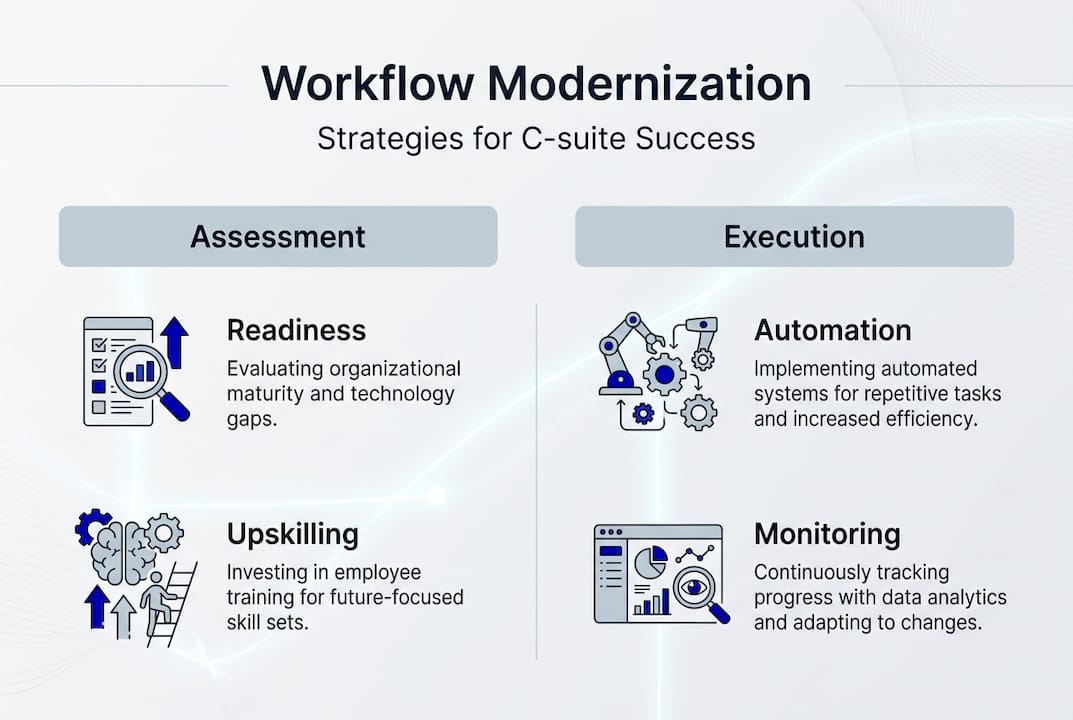
C-level leaders should assess digital readiness, upskill teams, and leverage technology for efficiency before committing to large-scale rollouts. Start with an honest inventory of your current state.
| Dimension | Legacy | In transition | Future-ready |
|---|---|---|---|
| Process automation | Manual, paper-based | Partial automation | End-to-end automated |
| Data visibility | Siloed, delayed reports | Dashboards in select areas | Real-time, org-wide analytics |
| System integration | Disconnected tools | Some API connections | Fully integrated ecosystem |
| Change adaptability | Slow, high resistance | Moderate flexibility | Rapid iteration cycles |
| Workforce digital skills | Low adoption | Mixed capability | Continuous upskilling culture |
Use this four-step approach to identify your gaps:
- Map your core workflows end to end, including every handoff, approval, and data entry point
- Score each workflow against the table above to identify where you sit on the maturity curve
- Prioritize by impact — focus first on workflows that touch revenue, compliance, or customer experience
- Validate with your ERP readiness checklist to confirm your systems can support the changes you plan
Pro Tip: Do not rely solely on IT or operations teams for this assessment. Middle managers who live inside these workflows daily will surface the real bottlenecks faster than any audit. Their early involvement also builds the internal champions you will need during rollout. Explore how automated workflow improvements can address the gaps you uncover.
Building the foundation: Technologies and frameworks for agile workflows
With readiness established, select and align the right technology stack and operating models. The right combination of tools and methods is what separates a successful transformation from an expensive pilot that never scales.
The core technology stack for future-proof workflows includes:
- AI and machine learning: Predictive analytics, intelligent document processing, and decision automation
- Cloud platforms: Scalable infrastructure that supports remote work, data sharing, and rapid deployment
- Robotic Process Automation (RPA): Eliminates repetitive, rule-based tasks across finance, HR, and operations
- Low-code platforms: Enable business teams to build and modify workflows without deep coding expertise
GCC AI adoption is accelerating, with leaders focusing on workflow redesign and business-led strategy rather than isolated tech experiments. Organizations that treat AI as a workflow tool — not just a data science project — consistently outperform peers.

| Framework | Legacy approach | Agile digital approach |
|---|---|---|
| Process design | Waterfall, annual reviews | Iterative sprints, continuous updates |
| Decision-making | Hierarchical, slow approvals | Distributed, data-driven |
| Technology updates | Infrequent, high-risk upgrades | Continuous deployment, low disruption |
| Team structure | Functional silos | Cross-functional, product-oriented teams |
Scrum and Kanban are not just software development tools. Applied to business workflows, Scrum’s sprint cycles let you test and refine process changes in two-week windows. Kanban’s visual boards give operations leaders real-time visibility into bottlenecks. The Business Process Reengineering guide for KSA and UAE organizations recommends starting with agile methods before scaling digital tools.
For executives exploring advanced workflow automation, low-code platforms like Cortex from Singleclic offer Arabic-enabled, on-premise deployment that meets the compliance and data sovereignty requirements of banks and government entities across the region. Review the top digital trends for executives to stay ahead of what is reshaping operations in 2026.
A step-by-step roadmap to future-proofing workflows
Once foundations are in place, implement change and drive results step by step. This is where strategy becomes execution.
MENA organizations are focusing on strategic technology integration and process automation with low-code platforms as the backbone of their transformation programs. Follow this executive roadmap:
- Align your strategic vision with national digital agendas — map your transformation goals to Vision 2030, UAE digital economy targets, or Egypt’s Digital Egypt milestones
- Conduct a full workflow readiness assessment using the criteria from Section 3 above
- Select your technology stack based on your maturity level, compliance requirements, and integration needs
- Upskill your workforce with targeted digital training, focusing first on the teams operating your highest-impact workflows
- Run a controlled pilot on one or two priority workflows before committing to org-wide rollout
- Deploy and integrate your chosen platforms, ensuring real-time data flows between ERP, CRM, and automation tools
- Measure and iterate using the KPIs defined in Section 7 of this guide
The stepwise process of aligning vision, assessing readiness, upskilling, and leveraging technology is not optional — it is the difference between transformation that sticks and change that fades after the launch event.
Pro Tip: Define your workflow KPIs before you deploy any technology. Metrics like process cycle time, automation rate, and exception handling frequency give you a baseline to measure against. Without a baseline, you cannot prove ROI to your board. Use low-code automation steps to accelerate deployment and review digital solutions ROI benchmarks to set realistic targets.
Common challenges and proven solutions for workflow transformation
Even with a roadmap, barriers can arise — here is how regional executives are overcoming them.
Three obstacles consistently slow transformation programs in KSA, UAE, and Egypt:
- Legacy systems: Older ERP and document management platforms often lack APIs, making integration costly and slow. The solution is a phased migration strategy that wraps legacy systems with integration middleware before replacing them entirely.
- Talent gaps: Digital skills shortages are real across the region. Address this with structured upskilling programs tied to specific workflow roles, not generic IT training.
- Cultural resistance: Teams that have operated the same way for years will push back on change. Pilot programs that deliver visible wins early are the fastest way to shift mindsets.
Low-code transformation in MENA is helping organizations sidestep the talent gap problem by empowering business users to build and modify workflows without waiting for IT resources.
“Change management is critical to successful digital transformation and operational efficiency. Without it, even the best technology investments underperform.”
The organizations that succeed treat change management as a core workstream, not an afterthought. Assign a dedicated change lead, communicate wins early and often, and tie transformation milestones to individual performance goals.
Verifying success: KPIs and metrics for continuous workflow improvement
To ensure long-term value, measure and optimize your new workflows systematically. Continuous monitoring with KPIs is essential for sustaining operational improvement after the initial transformation phase.
| KPI domain | What to track | Target benchmark |
|---|---|---|
| Process efficiency | Cycle time reduction | 30-50% improvement within 12 months |
| Automation rate | % of tasks automated | 60%+ for high-volume workflows |
| Agility | Time to deploy process changes | Under 2 weeks for low-code updates |
| Adoption | Active user rate on new platforms | 85%+ within 6 months of launch |
| Error rate | Manual exception handling frequency | Below 5% of total transactions |
Embed KPI tracking into your governance structure with these steps:
- Assign KPI ownership to specific workflow leads, not just IT or operations directors
- Review metrics monthly at the executive level for the first year post-launch
- Set improvement thresholds that trigger a process review when performance drops below target
- Use real-time dashboards connected to your automated workflow metrics to eliminate reporting lag
The goal is not to hit a number once. It is to build a culture where workflow performance is a standing agenda item at every leadership review.
Partnering for transformation: How Singleclic supports future-proofing workflows
With your roadmap in action, the right partner can accelerate results and long-term impact. Singleclic brings 10+ years of regional delivery experience, 70+ consultants across KSA, UAE, and Egypt, and a proven track record with 60+ enterprise clients including Emirates Health Services, QNB, and Emaar Misr.
We deliver end-to-end transformation — from strategic consulting and ERP/CRM implementation to RPA, AI, and our Arabic-enabled low-code platform Cortex. Whether you need a digital transformation office to anchor your program or a transformation roadmap for executives tailored to your sector, we build solutions that fit your compliance, language, and operational requirements. Explore how AI automation in low code is reshaping what is possible for MENA enterprises. Contact Singleclic today to start your custom roadmap.
Frequently asked questions
What are the first steps for C-level leaders to future-proof workflows?
Start by aligning workflows with national digital agendas, then conduct a readiness assessment and prioritize quick wins using agile methods. The stepwise process of aligning vision, assessing readiness, and upskilling teams is the proven starting point.
Which technologies deliver the fastest workflow improvements?
Cloud platforms, AI, and low-code automation tools deliver the most immediate gains in efficiency and agility. Digital transformation strategies consistently identify these three as the highest-impact starting points for MENA businesses.
How can we measure the success of workflow transformation?
Track KPIs including automation rates, process cycle time, agility benchmarks, and team adoption rates against defined baselines. Continuous KPI monitoring is what separates organizations that sustain gains from those that plateau after launch.
What challenges might hinder workflow modernization?
Legacy systems, talent gaps, and cultural resistance are the three most common barriers in MENA organizations. All three are manageable with structured change management practices and phased implementation strategies.