TL;DR:
- Quality assurance in software prevents defects by embedding quality checks throughout the development lifecycle. It emphasizes process improvement over testing alone to ensure consistent software quality.
Quality assurance in software is defined as a proactive, process-oriented discipline that embeds quality checks into every phase of the Software Development Life Cycle (SDLC) to prevent defects before they reach production. Unlike testing, which detects defects after code is written, SQA spans the full lifecycle from requirements through deployment. The international standard ISO/IEC 25010 provides the quality model most enterprises use to define and measure what “quality” actually means. If you work in software development or QA, understanding this distinction is the foundation everything else builds on.
What is quality assurance in software development?
Software quality assurance (SQA) is a structured set of activities that verifies both the process used to build software and the product itself. The goal is defect prevention, not just defect detection. This is the critical distinction that separates SQA from software testing as a standalone activity.
Testing is a reactive subset of SQA. SQA is integrated across all phases of the lifecycle, while testing typically targets execution phases. That means a QA professional reviewing requirements documents in week one is doing SQA work, even before a single test case exists.
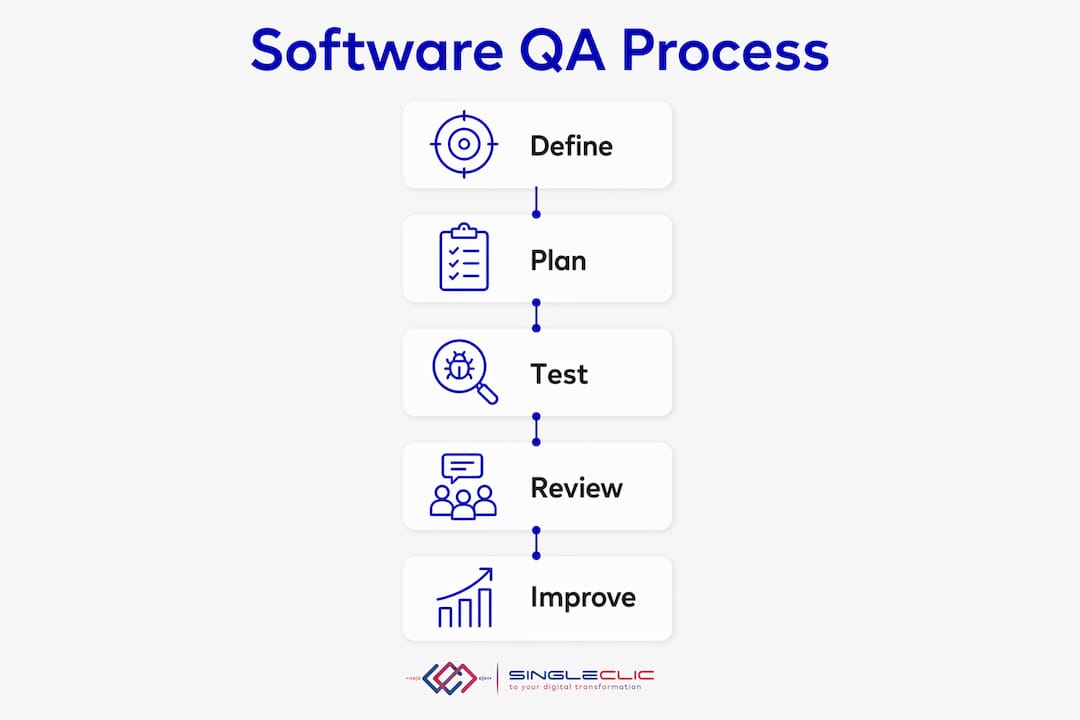
The five core stages of SQA follow a logical progression:
- Discovering — Identify quality risks, ambiguous requirements, and testability gaps early in the project.
- Planning — Define the Software Quality Assurance Plan, which governs how quality activities and compliance verification will take place throughout the project. Good IT project planning at this stage prevents costly rework later.
- Designing — Create test strategies, select test techniques, and establish quality gates for each development phase.
- Executing — Run tests, conduct code reviews, perform audits, and apply automated pipeline checks continuously.
- Improving — Analyze defect trends, update processes, and feed lessons learned back into the next cycle.
SQA plans create governance that ensures consistent application of quality standards independent of delivery pressure. That independence matters because teams under deadline pressure routinely skip quality steps without a governing document holding them accountable.
Pro Tip: Involve QA professionals during requirements management before any design work begins. Requirements that are not testable at the design stage create downstream bottlenecks that automation alone cannot fix.
SQA also integrates naturally with agile and continuous delivery methods. In agile environments, quality gates appear at the end of each sprint rather than at the end of the project. Continuous integration pipelines run automated checks on every code commit, making quality verification a constant background process rather than a periodic event.

Which software testing techniques support effective quality assurance?
Effective software testing techniques fall into three categories: black-box, white-box, and experience-based. Each category targets different types of defects, and combining all three produces the most complete coverage.
Black-box techniques treat the system as an opaque unit. Testers verify behavior against requirements without knowing the internal code structure. Key methods include:
- Equivalence partitioning — Divides input data into groups where all values in a group should produce the same result, reducing the total number of test cases needed.
- Boundary value analysis — Tests values at the edges of input ranges, where defects cluster most frequently.
- Decision tables — Maps combinations of conditions to expected outcomes, making complex business logic testable and traceable.
- Pairwise testing — Generates a reduced set of test cases that covers every two-way combination of input parameters. Pairwise testing reduces combinatorial test cases significantly without sacrificing meaningful coverage.
White-box techniques require knowledge of the internal code. Statement coverage verifies that every line of code executes at least once. Branch coverage confirms that every conditional path runs. Path coverage is the most thorough, testing every possible route through the code logic.
Experience-based techniques rely on tester skill and domain knowledge. Experience-based tests detect defects missed by both black-box and white-box methods, particularly edge cases that formal techniques do not anticipate. Exploratory testing, where testers design and execute tests simultaneously based on real-time observations, is the most widely used experience-based approach.
| Technique category | Primary focus | Best used when |
|---|---|---|
| Black-box | Functional behavior vs. requirements | Requirements are well-defined and complete |
| White-box | Code structure and logic paths | Source code access is available; coverage metrics required |
| Experience-based | Edge cases and unexpected behavior | Formal techniques leave coverage gaps; domain expertise is available |
Pro Tip: Do not treat these categories as competing choices. The strongest QA programs use black-box techniques for functional coverage, white-box for code-level confidence, and experience-based testing to catch what the other two miss.
Balancing manual testing vs automated testing is a practical decision, not an ideological one. Automated tests handle repetitive regression checks efficiently. Manual testers apply judgment to exploratory scenarios, usability assessments, and complex workflows that resist scripting.
How do quality assurance frameworks and international standards guide software quality?
ISO/IEC 25010 is the primary international standard defining software product quality. The framework covers eight quality characteristics that enterprises use to audit and verify quality processes across the full product lifecycle.
Understanding each characteristic helps QA teams set measurable targets rather than vague goals:
| Quality characteristic | What it measures | Why it matters |
|---|---|---|
| Functional suitability | Does the software do what users need? | Validates that requirements are met correctly |
| Performance efficiency | Speed, resource use, and capacity under load | Prevents degradation at scale |
| Compatibility | Works alongside other systems and environments | Reduces integration failures |
| Usability | Ease of learning and operating the software | Directly affects user adoption rates |
| Reliability | Availability, fault tolerance, and recoverability | Determines trust in production environments |
| Security | Protection against unauthorized access and data loss | Critical for regulated industries |
| Maintainability | Ease of modification, testing, and analysis | Reduces long-term technical debt |
| Portability | Ability to move across environments and platforms | Supports cloud migration and multi-platform deployment |
Compliance with ISO/IEC 25010 is ongoing risk management, not a one-time checklist. Organizations that treat it as a checkbox exercise typically pass audits but still ship unreliable software. The standard works when teams use its eight characteristics as a continuous measurement framework, not a final sign-off document.
Frameworks like ISO/IEC 25010 also give QA teams a shared vocabulary with business stakeholders. When a product owner asks why a feature is delayed, a QA professional can point to a specific characteristic, such as reliability or security, and explain the risk in terms that connect to business outcomes. That conversation is far more productive than a generic “we found bugs.”
For organizations in regulated sectors such as banking, healthcare, or government, compliance-by-design practices embed these standards directly into development workflows rather than applying them retrospectively.
What are the best practices and common pitfalls in software QA?
The single most damaging misconception in software QA is treating it as the last line of defense. Viewing QA solely as a defect finder indicates a broken development process. QA is a verification layer supported by code reviews, unit tests, and automated pipeline gates that operate upstream of any formal testing phase.
Best practices that consistently improve outcomes:
- Embed QA activities from requirements analysis through design, coding, and deployment. Do not wait for a “testing phase” to begin quality work.
- Write testable requirements. Involve QA early in requirements analysis for the best outcomes. Requirements that cannot be verified create ambiguity that compounds through every subsequent phase.
- Maintain independence in QA. SQA activities performed independently of delivery pressures provide unbiased insight. Assign QA professionals who are not accountable for delivery speed.
- Automate repetitive regression tests and free skilled testers for exploratory work. Automation handles repetitive tasks; human intuition solves complex issues that scripts cannot anticipate.
- Use quality gates at each SDLC phase. A gate at the end of requirements review, design review, and code review catches defects at the cheapest possible moment.
- Integrate QA into agile development workflows so that every sprint ends with verified, tested increments rather than accumulated technical debt.
Common pitfalls that undermine QA programs:
- Starting test design after coding is complete. This forces testers to reverse-engineer intent from code rather than verify against requirements.
- Measuring QA success by defect count alone. Defect counts reflect what escaped earlier processes. A mature QA program measures defect prevention, not just detection.
- Over-automating without maintaining the test suite. Automated tests that are never updated become noise. Stale tests generate false positives and erode team confidence in the results.
- Treating exploratory testing as optional. Formal techniques miss edge cases by design. Experience-based testing is vital and complements formal approaches, especially for complex business logic.
Pro Tip: Build a “quality gate checklist” for each SDLC phase and make it a required artifact before any phase transition. This creates a paper trail of quality decisions and prevents the “we’ll fix it in testing” mentality from taking hold.
Software quality metrics worth tracking include defect density per module, test coverage percentage by technique type, mean time to detect, and mean time to resolve. These four metrics together give you a picture of both process health and product quality.
Key takeaways
Effective quality assurance in software requires embedding SQA activities across the full SDLC, combining ISO/IEC 25010 standards with black-box, white-box, and experience-based testing techniques, and maintaining QA independence from delivery pressure.
| Point | Details |
|---|---|
| SQA vs. testing | SQA prevents defects across the full SDLC; testing detects them during execution phases only. |
| ISO/IEC 25010 | Use all eight quality characteristics as ongoing measurement targets, not a one-time audit checklist. |
| Testing technique mix | Combine black-box, white-box, and experience-based techniques to close coverage gaps each method leaves alone. |
| Early QA involvement | Testable requirements at the design stage prevent bottlenecks that automation cannot resolve later. |
| Automation balance | Automate repetitive regression tests; preserve skilled human testers for exploratory and complex scenarios. |
QA in 2026: what I’ve learned from years in the field
The conversation around quality assurance has shifted significantly. When I started working with enterprise software teams, QA was almost universally treated as a final gate before release. Teams would finish development, hand the build to a QA team, and wait for a green light. That model produced predictable results: late defect discovery, compressed testing timelines, and releases that felt more like gambles than decisions.
What I see now, particularly in organizations across Saudi Arabia and the UAE that are modernizing their software delivery practices, is a genuine shift toward embedded quality. QA professionals are in requirements workshops. They are reviewing architecture decisions. They are writing acceptance criteria alongside product owners. That shift is not cosmetic. It changes the economics of defect resolution entirely.
The automation conversation has also matured. Early enthusiasm for test automation led many teams to automate everything they could, regardless of whether automation was the right tool. The result was brittle test suites that broke on every UI change and consumed more maintenance time than they saved. The teams I respect most today are deliberate about what they automate. They automate stable, high-frequency regression paths and invest their human testers in exploratory work where judgment and domain knowledge create real value.
The one area where I think most teams still underinvest is requirements testability. Writing a requirement that is clear enough to build from is not the same as writing one that is clear enough to test against. That gap is where the most expensive defects are born. If your QA team cannot write a test case from a requirement without asking clarifying questions, the requirement is not done yet.
My advice to QA professionals in 2026 is to own the quality conversation from day one of a project, not from the first test execution. The earlier you engage, the more influence you have over the outcome.
— Tamer Badr
How Singleclic supports quality-driven software operations
Organizations that take quality assurance seriously need more than good testing practices. They need platforms and processes that make quality visible, measurable, and repeatable across every team and system.
Singleclic works with enterprises across KSA, UAE, and Egypt to build software operations where quality is built into the process, not bolted on at the end. Through Microsoft Dynamics 365 and Singleclic’s Cortex low-code platform, teams get workflow automation, real-time process monitoring, and compliance-by-design capabilities that support continuous quality verification. Cortex connects approvals, ERP data, CRM records, and legacy systems into a single governed workflow, making quality gates enforceable rather than optional. For organizations evaluating how connected ERP and automation can support their quality operations, Singleclic’s team brings over 10 years of regional delivery experience to that conversation.
FAQ
What is quality assurance in software?
Quality assurance in software is a proactive, process-oriented discipline that embeds quality checks across every phase of the SDLC to prevent defects before they occur. It is distinct from testing, which detects defects reactively during or after development.
How does SQA differ from quality control in software?
SQA focuses on improving the processes used to create software, while quality control focuses on evaluating the final product against defined standards. SQA is preventive; quality control is evaluative.
What is ISO/IEC 25010 and why does it matter?
ISO/IEC 25010 is the international standard defining eight software quality characteristics: functional suitability, performance efficiency, compatibility, usability, reliability, security, maintainability, and portability. Enterprises use it to set measurable quality targets and audit their software products.
When should automated quality assurance be used?
Automated quality assurance works best for repetitive regression tests, continuous integration pipeline checks, and high-frequency test scenarios. It does not replace human testers, who are needed for exploratory testing and complex judgment-based scenarios.
What are the most important QA best practices for development teams?
The most effective QA best practices include involving QA from requirements analysis, writing testable requirements, maintaining QA independence from delivery pressure, combining multiple test design techniques, and using quality gates at each SDLC phase transition.