TL;DR:
- Enterprise architecture aligns business processes, data, applications, and technology with organizational goals through four key domains. It enables faster project delivery, reduces costs, and improves risk management by providing structured decision-making. Success depends on leadership involvement, continuous governance, and starting with a focused scope for initial impact.
Enterprise architecture (EA) is defined as the strategic practice of analyzing, designing, planning, and aligning an organization’s business processes, information systems, applications, and technology infrastructure with its core objectives. EA gives executives and IT leaders a shared blueprint for making decisions that connect business strategy to technology execution. Frameworks like TOGAF, developed under The Open Group, and the Zachman Framework have made EA a recognized discipline across industries worldwide. For business and IT leaders in Saudi Arabia, the UAE, and Egypt, understanding what enterprise architecture means is the first step toward building organizations that can adapt, grow, and operate without costly inefficiencies.

What is enterprise architecture and why does it matter?
Enterprise architecture is the structured method of mapping and coordinating four key domains across an organization: Business, Information, Application, and Technology. Each domain represents a layer of the organization, and EA connects them so that decisions in one layer do not create problems in another. Without this coordination, IT projects frequently deliver systems that do not match business needs, and business strategies fail because the underlying technology cannot support them.
EA’s role goes beyond documentation. It acts as a decision-support system that guides investments, manages risk, and identifies where the organization needs to change. When a government agency in Riyadh decides to digitize citizen services, EA determines which processes need redesigning, which data must be centralized, which applications need replacing, and which infrastructure must be upgraded. That sequence of decisions, made coherently, is what EA enables.
The importance of enterprise architecture grows as organizations scale. A 50-person company can manage misalignment informally. A 5,000-person enterprise operating across multiple countries cannot. EA provides the common language and structure that large organizations need to make consistent, well-informed decisions at every level.
What are the core domains of enterprise architecture?
Enterprise architecture coordinates four distinct domains, each with a specific focus and contribution to organizational alignment.
| Domain | Focus | Key Contribution |
|---|---|---|
| Business architecture | Processes, governance, and roles | Defines how the organization operates and who is responsible for what |
| Information architecture | Data assets and management | Ensures the right data reaches the right people at the right time |
| Application architecture | Software systems and interoperability | Maps how applications interact and depend on each other |
| Technology architecture | Infrastructure and hardware | Manages the physical and cloud platforms that run all systems |
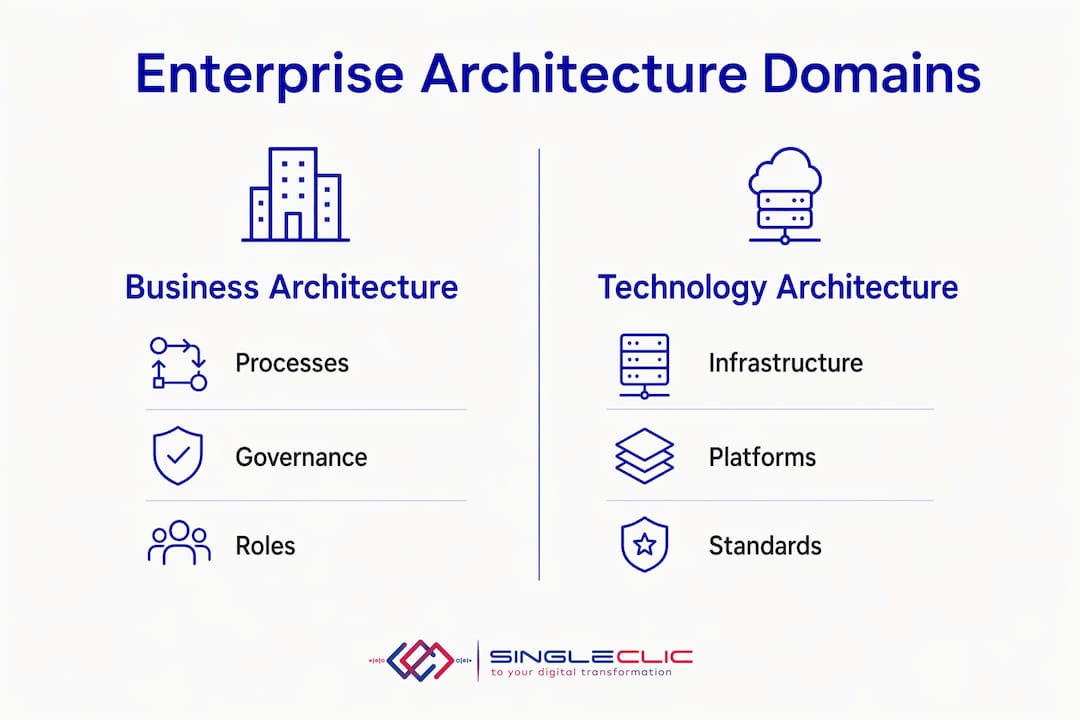
Each domain feeds the others. Business architecture defines what processes need to run. Information architecture determines what data those processes require. Application architecture specifies which software handles that data. Technology architecture provides the infrastructure those applications run on.
A practical example: a healthcare provider in Dubai expanding to a second facility needs to know which patient data systems will serve both locations (information architecture), whether the existing hospital management software can scale (application architecture), and whether the network infrastructure supports two sites (technology architecture). EA answers all three questions within a single coordinated plan.
How do popular enterprise architecture frameworks structure EA practice?
An enterprise architecture framework provides the methods, tools, and best practices that guide how EA is developed and maintained. Without a framework, EA efforts tend to produce inconsistent models that different teams interpret differently.
TOGAF is adopted by over 80% of the world’s leading enterprises. That adoption rate reflects TOGAF’s practical value: it gives organizations a repeatable process for defining a baseline architecture (where you are now), a target architecture (where you want to be), and a transition plan (how you get there). The Zachman Framework takes a different approach, organizing architecture as a matrix of perspectives and abstraction levels, making it useful for large government and defense organizations. The Federal Enterprise Architecture Framework (FEAF) was designed specifically for U.S. federal agencies but has influenced public sector EA programs across the Middle East.
Key benefits that frameworks deliver:
- A common vocabulary that business and IT teams share
- Structured methods for assessing gaps between current and future states
- Governance processes that prevent ad hoc technology decisions
- Reusable models and templates that reduce the cost of each new architecture project
- Defined roles and responsibilities for architecture ownership
Pro Tip: Choose your framework based on organizational maturity, not prestige. A mid-size enterprise in Egypt implementing EA for the first time will get more value from TOGAF’s Architecture Development Method (ADM) than from the full Zachman matrix. Start with the parts of the framework that address your most pressing alignment problems, then expand.
What are the key benefits of implementing enterprise architecture?
The benefits of enterprise architecture fall into four categories: speed, cost, risk, and agility. Each one has a direct impact on how well an organization competes and serves its customers.
-
Faster project delivery. EA standardizes IT environments and eliminates redundant legacy systems. Organizations that apply EA principles consistently deliver projects 20–30% faster than those operating without architectural governance. That speed advantage compounds over time as the technology estate becomes cleaner and more predictable.
-
Lower IT costs. Redundant systems are expensive to license, maintain, and integrate. EA identifies overlapping applications and consolidates them, reducing both direct costs and the hidden cost of managing complexity. Banks in the UAE that have undergone EA-driven rationalization programs routinely report significant reductions in their application portfolios.
-
Better risk and compliance management. EA maps data flows and system dependencies across the organization. That map makes it far easier to assess the impact of a regulatory change, a security incident, or a vendor failure. In regulated sectors like banking and healthcare, this visibility is not optional.
-
Greater organizational agility. When business conditions shift, EA tells leaders which parts of the organization need to change and in what order. Without EA, change projects frequently stall because no one has a clear picture of the dependencies involved.
-
Stronger digital transformation outcomes. EA provides the architectural foundation that digital transformation programs build on. Organizations in Saudi Arabia and the UAE pursuing Vision 2030 and UAE Centennial 2071 goals need EA to ensure their technology investments align with national and organizational strategies.
How can organizations successfully implement enterprise architecture?
EA is a continuous management process, not a one-time project. Organizations that treat it as a project produce documentation that becomes outdated within months. Organizations that treat it as an ongoing practice build a living map of the enterprise that guides every major decision.
A practical implementation follows this sequence:
- Assess the current state. Spend 3–6 months documenting existing processes, systems, data flows, and technology assets. Focus on areas where misalignment is causing the most visible pain.
- Define the target state. Work with business leaders to articulate what the organization needs to look like in 3–5 years. This is not an IT exercise. Business ownership of the target state is what makes EA relevant.
- Build a transition roadmap. Identify the sequence of changes that moves the organization from current to target state. Prioritize changes that deliver the most business value and reduce the most technical debt.
- Govern continuously. Establish an architecture review process that evaluates new projects against the target state before they are approved. This prevents the organization from accumulating new misalignment while fixing old misalignment.
The most common reason EA programs fail is treating EA as rigid documentation rather than a dynamic system. The second most common reason is isolating EA under IT without involving business leaders. Both failures produce the same outcome: an architecture function that no one consults and everyone ignores.
Purely IT-driven EA efforts consistently underperform. Sustained success requires active executive sponsorship and shared ownership between business and IT leadership. When a Chief Operating Officer and a Chief Information Officer co-own the architecture function, the resulting decisions carry authority across the organization.
Pro Tip: Start with a narrow focus on one high-value business domain rather than attempting to document the entire enterprise at once. Early wins build credibility for the EA function and demonstrate its practical value to skeptical executives.
For organizations exploring connected digital architecture, the transition from vision to value depends on this kind of disciplined, iterative approach.
Key Takeaways
Enterprise architecture succeeds when it operates as a living, business-owned decision system rather than an IT documentation project.
| Point | Details |
|---|---|
| EA definition | EA aligns business processes, data, applications, and technology with organizational goals through four coordinated domains. |
| Framework adoption | TOGAF is used by over 80% of leading enterprises and provides a repeatable method for baseline-to-target transitions. |
| Speed and cost gains | EA-driven organizations deliver projects 20–30% faster and reduce costs by eliminating redundant systems. |
| Implementation approach | Start with a 3–6 month current-state assessment, define a business-owned target state, and govern continuously. |
| Critical success factor | Executive sponsorship and shared business-IT ownership are the single strongest predictors of EA program success. |
EA in the Middle East: what I’ve learned from a decade of delivery
Working with enterprises across Saudi Arabia, the UAE, and Egypt for over a decade, I have seen the same pattern repeat. Organizations invest in EA when they feel the pain of misalignment, produce a detailed architecture document, and then file it away. Six months later, the same misalignment problems resurface in a new project.
The organizations that get real value from EA treat it the way a city treats its urban planning function. The plan is never finished. It gets updated every time a new development is proposed, every time a road needs to change, every time population growth shifts demand. That is exactly how EA should work inside an enterprise.
What surprises most executives I work with is that EA is not primarily a technology discipline. The most impactful architecture decisions I have seen were made by operations directors, finance leaders, and CEOs who understood their business well enough to say, “This system does not serve how we actually work.” Technology teams then built around that clarity.
In the MENA region specifically, the pressure to adopt new technology quickly is intense. Vision 2030 in Saudi Arabia and the UAE’s national AI strategy both create urgency. But urgency without architectural discipline produces expensive, fragmented systems that create more problems than they solve. EA is what turns urgency into direction.
The agile approach to enterprise systems applies directly here. EA does not mean slowing down. It means moving fast in the right direction.
— Tamer Badr
How Singleclic supports your enterprise architecture goals
Singleclic works with enterprises across Saudi Arabia, the UAE, and Egypt to turn architectural intent into operational reality. Whether your organization needs to integrate ERP and CRM systems, automate complex approval workflows, or build a connected data layer across departments, Singleclic delivers the implementation expertise to make it work.
Singleclic’s Cortex low-code platform connects ERP, CRM, legacy systems, and workflows into a single governed environment, giving your architecture team the tools to enforce standards without slowing down business units. For organizations building on Microsoft Dynamics 365, the connected ERP and CRM guide covers how integrated enterprise operations align with EA principles in practice. Singleclic also supports ERP and CRM integration strategies that reduce system fragmentation and improve data consistency across the enterprise.
FAQ
What is the enterprise architecture definition in simple terms?
Enterprise architecture is the practice of aligning an organization’s business processes, data, applications, and technology with its strategic goals. It gives leaders a structured way to make decisions that connect business strategy to IT execution.
What does enterprise architecture mean for IT leaders?
For IT leaders, EA provides a governance framework that prevents ad hoc technology decisions and ensures every new system fits the organization’s target state. It reduces technical debt and makes large-scale change projects more predictable.
What is the most widely used enterprise architecture framework?
TOGAF, developed by The Open Group, is the most widely adopted framework, used by over 80% of leading enterprises globally. It provides a repeatable method called the Architecture Development Method (ADM) for moving from a baseline to a target architecture.
What are the main benefits of enterprise architecture for executives?
EA delivers faster project delivery (20–30% improvement), lower IT costs through system consolidation, better risk visibility, and stronger alignment between business strategy and technology investment.
How long does it take to implement enterprise architecture?
The initial current-state assessment typically takes 3–6 months. EA itself is an ongoing management process, not a one-time project, and requires continuous governance to remain relevant as business priorities shift.
Recommended
- What Is Enterprise Agility? A 2026 Guide for Middle East Leaders
- How to Create a Connected Digital Architecture for Enterprise Operations | Singleclic
- How to Build a Connected Digital Architecture for Enterprise Operations: From Vision to Value | Singleclic
- What Is Service-oriented Architecture? A Guide for IT Leaders