TL;DR:
- Measuring both hard and soft ROI provides a comprehensive view of digital investment value.
- Early and ongoing measurement, including AI-driven benefits, maximizes ERP and CRM returns in MENA.
- Regular verification and strategic framing ensure credible results and sustained digital transformation success.
Justifying large-scale ERP and CRM investments has never been more consequential. With MENA IT spend reaching $169B in 2026, growing at 8.9% year over year, boards across KSA and UAE are demanding clearer evidence that digital projects deliver measurable outcomes, not just modernized workflows. Yet most C-level teams still struggle to articulate a return that satisfies both finance committees and operational leaders. This guide walks you through a proven, stepwise approach to measuring digital ROI for ERP and CRM implementations, connecting technology decisions to real business value at every stage.
Table of Contents
- Defining digital ROI: What matters for C-level leaders
- Preparation: Setting up your ROI measurement foundation
- Execution: Proven frameworks to measure ROI for ERP and CRM
- Verification: Validating, optimizing, and communicating ROI results
- Why most digital ROI calculations fail—and what actually works
- Accelerate your digital ROI journey with tailored solutions
- Frequently asked questions
Key Takeaways
| Point | Details |
|---|---|
| Holistic ROI matters | C-levels must measure both financial and non-financial benefits to capture digital value fully. |
| Preparation is critical | Set clear baselines and align goals before ERP or CRM implementation begins. |
| Leverage proven frameworks | Use both traditional and balanced scorecard methods for robust ROI measurement. |
| Continuous validation required | Regularly review and optimize ROI results to drive maximum impact from digital investments. |
| AI integration boosts returns | MENA enterprises see higher ROI with ERP/CRM projects that leverage AI automation and analytics. |
Defining digital ROI: What matters for C-level leaders
When most finance teams hear “ROI,” they reach for a simple formula: net benefit divided by total cost, expressed as a percentage. That number has its place. But for large-scale digital initiatives, it captures only part of the picture, and relying on it exclusively can lead you to dramatically undervalue or misread the real impact of an ERP or CRM investment.
Digital ROI in KSA and UAE encompasses a much broader set of outcomes: process speed, data quality, regulatory compliance, customer satisfaction, and the ability to scale operations without proportional cost increases. According to IDC’s measurement guidance, CIOs who restrict ROI measurement to financial metrics alone miss the strategic value that drives long-term competitive differentiation.
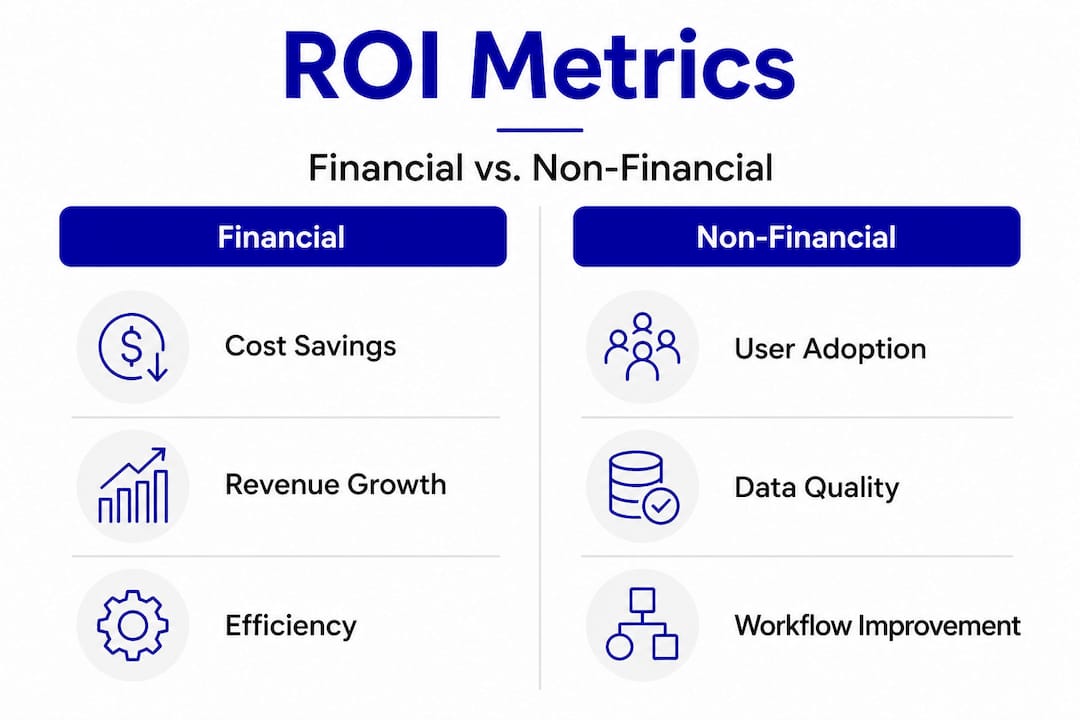
There are two categories of ROI every C-level leader must track:
- Hard (quantitative) ROI: Cost reduction, headcount efficiency, revenue uplift, faster order-to-cash cycles, reduced IT maintenance costs
- Soft (qualitative) ROI: Employee productivity, customer experience improvements, brand equity, regulatory agility, innovation capability
“Measuring only what you can count easily is how companies miss what actually matters. The balance between hard savings and strategic capability is where transformation value lives.” — Tamer Badr, Singleclic
A balanced scorecard approach addresses this gap directly. Rather than focusing solely on financial performance, it evaluates digital impact across four interconnected perspectives: financial, customer, internal process, and organizational learning. This is especially important given the regional digital strategy keys that drive competitive advantage across KSA, UAE, and Egypt, where regulatory environments and customer expectations are evolving rapidly.
| Metric type | Examples | Measurement approach |
|---|---|---|
| Financial | Cost per transaction, revenue per user | Year-over-year financial comparison |
| Operational | Process cycle time, error rate | Pre/post implementation benchmarks |
| Customer | NPS, retention rate, response time | Customer surveys, CRM analytics |
| Strategic | Market share, innovation speed | Executive review, competitive analysis |
The table above makes one thing clear: each dimension requires a different data collection method. That’s why setting up your measurement infrastructure before implementation begins is not optional. It’s the foundation everything else rests on.
Preparation: Setting up your ROI measurement foundation
Having defined the dimensions of ROI, preparation is the crucial first step to ensure your entire measurement process is grounded in the right data and objectives. Many organizations skip this phase in their urgency to get systems live. That decision is costly, because without a documented baseline, you can’t prove what changed after go-live.
Your transformation roadmap for MENA should include a dedicated ROI measurement workstream that starts at least two to three months before implementation. Here are the essential preparation steps:
- Document your current-state baseline. Capture performance data across all areas the ERP or CRM will touch: order processing time, customer response rate, manual data entry hours, finance close cycles, and support ticket volume. The more granular, the better.
- Identify your primary business outcomes. These are the outcomes your executive sponsor cares most about. Revenue growth? Cost reduction? Compliance improvement? Rank them explicitly so your measurement framework stays focused.
- Define your measurement timeline. ROI rarely appears in month one. Set expectations across 30, 90, 180, and 360 days. Some benefits, like process automation savings, appear quickly. Others, like improved customer lifetime value, take 12 to 24 months to materialize.
- Assign measurement ownership. Each metric needs a named owner who is accountable for data collection and reporting. Without ownership, measurement slips as teams get absorbed in day-to-day operations.
- Align stakeholders on what success looks like. Finance, operations, IT, and commercial leadership often have different definitions of “successful implementation.” Document the agreed outcomes and get sign-off before launch.
| Baseline metric | Pre-implementation value | Target post-implementation | Review timeline |
|---|---|---|---|
| Finance close cycle (days) | 12 days | 6 days | 90 days |
| Customer response time | 48 hours | 12 hours | 60 days |
| Manual data entry hours/week | 200 hours | 40 hours | 90 days |
| Report generation time | 4 hours | 20 minutes | 60 days |
| Compliance exceptions/quarter | 15 | 2 | 180 days |
Structured measurement of digital tools impact on finance operations is one of the fastest areas to show demonstrable ROI. Finance teams often see reductions in close cycle time within the first quarter, providing an early proof point that keeps executive confidence high during a longer transformation journey.
Pro Tip: Run a pre-implementation “ROI workshop” with your department heads. Have each team document three metrics they currently track manually and the business impact they believe technology could improve. This surfaces hidden value areas that formal project scoping often overlooks, and it gets operational leaders emotionally invested in the measurement process.
Execution: Proven frameworks to measure ROI for ERP and CRM
With your measurement foundation in place, you can execute a calculation process that survives executive scrutiny and leads to meaningful action. This phase is where most organizations either build credibility or lose it. Getting the method right matters.
Here is a step-by-step process that works for both ERP and CRM projects in the MENA region:
- Calculate total cost of ownership (TCO). Include software licensing, implementation fees, training, change management, integration development, ongoing support, and infrastructure. Many organizations undercount TCO by 20 to 30% because they exclude internal labor costs during implementation.
- Quantify hard savings. Compare your pre-implementation baselines to post-implementation actuals at 90, 180, and 360 days. Convert operational improvements (faster processing, reduced errors) into dollar values using your actual labor rates and error costs.
- Assign monetary value to soft ROI. This step is where most teams hesitate, but it’s essential. Use industry benchmarks to estimate the financial impact of customer retention improvement (typically a 5% improvement in retention increases profits by 25 to 95%), employee time savings, and reduced compliance risk.
- Apply the balanced scorecard overlay. Map each measured outcome to the four scorecard dimensions: financial, customer, internal process, and learning and growth. This gives your board a structured narrative, not just a spreadsheet of numbers.
- Calculate the blended ROI. Once you have both hard and soft values quantified, use this formula: ROI = (Total Benefits minus TCO) divided by TCO, multiplied by 100. A well-executed ERP or CRM implementation in the region typically yields a three-year ROI between 150% and 300%, depending on scope and industry.
- Benchmark against regional peers. The MENA IT spending growth trajectory signals that your competitors are investing heavily. Benchmarking your ROI against sector averages gives your board context for whether your returns are strong, average, or lagging.
The rise of AI-driven digital value has fundamentally changed the ROI equation. AI-integrated ERP and CRM systems are delivering measurably higher returns than traditional implementations because they automate not just tasks but decisions. Predictive maintenance in manufacturing, AI-driven demand forecasting in retail, and automated credit scoring in banking are all producing returns that traditional process automation alone could not match. The AI’s impact on ERP ROI is now one of the most important factors in total value delivered from a digital investment.
Stat to know: MENA IT spend is projected at $169 billion in 2026, with the fastest-growing investments concentrated in AI-integrated enterprise systems. Organizations that layer AI capabilities onto their ERP and CRM implementations are consistently reporting ROI improvements of 30 to 50% above baseline digital deployments.
Pro Tip: Don’t wait until 12 months post go-live to calculate ROI. Publish a 90-day progress report using your early metrics. Even partial wins, like a 40% reduction in report generation time, maintain stakeholder confidence and give you an opportunity to course-correct before small issues become large ones.

Verification: Validating, optimizing, and communicating ROI results
Once your ROI data is in hand, the next phase is verifying, optimizing, and ensuring your success story stands up to internal and external scrutiny. This is often the most neglected phase, but it’s where the real strategic value gets captured and communicated.
Effective verification involves three parallel activities:
- Independent data audits. Have your finance or internal audit team validate the data sources behind your ROI claims. This is particularly important when presenting to boards or external stakeholders. Claims that can’t be traced to clean data sources will be challenged.
- Competitive benchmarking. Compare your outcomes to published industry benchmarks and, where possible, peer organizations. This gives your results external credibility and helps you identify whether you’re capturing all available value.
- Periodic optimization reviews. ROI isn’t a fixed number. System usage patterns evolve, new features become available, and business requirements change. A formal semi-annual review process ensures your ERP or CRM keeps delivering returns as your organization grows.
“The biggest mistake we see regional enterprises make is treating post-implementation review as a formality. In reality, the six-month and twelve-month reviews are where you often find the biggest optimization opportunities.” — Tamer Badr, Singleclic
Common pitfalls to avoid during the verification phase:
- Overclaiming soft ROI without documented methodology. If you assign $2M in value to “improved employee morale,” your finance team will dismiss your entire report.
- Ignoring negative outcomes. Every implementation has areas where expected benefits didn’t materialize on schedule. Acknowledging these transparently and showing your remediation plan builds more credibility than a purely positive narrative.
- Failing to connect ROI to business strategy. Your board doesn’t just want to know the percentage return. They want to understand how the investment advances your three-year strategic plan. Frame your results in that context.
When presenting to boards, structure your communication using a three-layer model: the headline number (blended ROI percentage), the supporting evidence (key metric improvements across each scorecard dimension), and the forward outlook (expected ROI trajectory over the next 12 to 24 months). Understanding digital disruption and ROI dynamics in MENA markets helps you position your results within the larger competitive context your board is already tracking.
Pro Tip: Create a one-page ROI summary dashboard that updates quarterly. Include three to five key metrics, the blended ROI figure, and two to three upcoming optimization initiatives. Boards respond better to consistent, simple reporting than to dense annual documents.
Why most digital ROI calculations fail—and what actually works
After working with enterprises across KSA, UAE, and Egypt for over a decade, one pattern stands out clearly: most digital ROI efforts fail not because of bad data but because of flawed framing. Organizations build a business case focused entirely on cost reduction, get their ERP or CRM live, declare success when costs drop, and then stop measuring.
That approach misses the compounding value that accumulates over time. The real transformation happens in year two and year three, when teams have internalized the system, processes have been refined, and data quality has improved enough to support genuinely strategic decisions. If you stop measuring after year one, you’re leaving the most valuable part of your ROI story untold.
There is also a persistent tendency to separate “digital ROI” from “business performance.” They are the same thing. A CRM that improves customer retention by 8% isn’t delivering “digital ROI,” it’s delivering revenue protection and growth. Framing it in pure technology terms keeps it as an IT metric. Framing it in business terms gets it on the CEO’s agenda.
The counterintuitive truth is that the organizations seeing the highest returns from their ERP and CRM investments are not the ones with the most sophisticated ROI models. They are the ones that stay curious and keep asking “what else can this system do?” after go-live. They use their real examples of digital ROI as living evidence to justify continuous optimization budgets, rather than treating implementation as a one-time project.
The boldest recommendation we can offer is this: measure what genuinely matters to your business, even when it’s hard to quantify. Customer trust, employee confidence, and operational resilience are real business assets. Build a methodology to value them, even imperfectly, and you will make better technology decisions than organizations that only count what’s easy to count.
Accelerate your digital ROI journey with tailored solutions
For leaders ready to turn insight into impact, leveraging tailored support shortens your ROI path and maximizes every digital investment. Knowing the framework is one thing. Executing it with the right technology partner and industry-specific expertise is what separates strong returns from average ones.
At Singleclic, we bring 10 years of enterprise digital delivery across KSA, UAE, and Egypt to every engagement. Our team of 70 consultants and engineers has helped organizations including Emirates Health Services, QNB, Emaar Misr, and AlBaraka build measurement frameworks that connect ERP and CRM implementations directly to board-level business outcomes. Whether you are evaluating your readiness, midway through an implementation, or reviewing post-launch results, we can help you sharpen your ROI story. Explore our process automation guide, get clear on what ERP actually is, or take a structured approach and assess your ERP readiness before your next investment decision.
Frequently asked questions
What is the difference between hard and soft ROI in digital projects?
Hard vs. soft ROI refers to measurable financial gains like cost reduction (hard) versus qualitative benefits like improved customer satisfaction, greater agility, or stronger compliance posture (soft). Both categories must be tracked to present a complete and credible digital ROI case to your board.
Why are AI-enabled ERP and CRM implementations showing higher ROI in MENA?
AI-enabled systems automate both tasks and decisions, unlocking data insights that drive efficiency gains far beyond what traditional process automation delivers, and with MENA IT investment concentrated in AI-integrated platforms, organizations adopting these systems earlier are capturing compounding advantages in operational performance and customer outcomes.
How often should digital ROI be reviewed after implementation?
Quarterly or semi-annual reviews are the standard best practice, ensuring that your ERP or CRM continues to align with evolving business goals and that emerging optimization opportunities are captured before they become missed returns.
Which non-financial metrics should C-levels track for digital ROI?
Beyond financials, you should track operational efficiency gains, customer experience scores, regulatory compliance rates, employee satisfaction, and innovation velocity, as IDC’s measurement framework guidance confirms that these dimensions together form a complete picture of strategic digital value.