What if your bank could onboard an SME client in 15 minutes instead of a full month? That is not a hypothetical. It is already happening across the UAE, and it signals a broader shift that finance leaders in KSA, UAE, and Egypt cannot afford to ignore. Digital tools in finance are enabling measurable business optimization through reduced processing times, improved customer satisfaction, and enhanced operational efficiency. The question is no longer whether to adopt these tools, but how fast you can move and how strategically you can deploy them.
Table of Contents
- How digital tools are reshaping finance operations in KSA, UAE, and Egypt
- Key mechanics powering finance transformation
- Performance impact: Benchmarking ROI, profitability, and market resilience
- Nuances, challenges, and opportunities for C-level decision-makers
- Applying digital tools: Practical steps and best practices for executive leadership
- Connect finance strategy to actionable digital tools
- Frequently asked questions
Key Takeaways
| Point | Details |
|---|---|
| Efficiency breakthroughs | Digital tools in finance can cut processing times by up to 98 percent, unlocking new levels of customer satisfaction. |
| Technology mechanics | API-first platforms, automated decisioning, and AI chatbots drive operational transformation across banking and finance. |
| Performance benchmarking | Digital maturity correlates strongly with improved returns and market resilience, though initial costs may impact profitability. |
| Strategic challenges | Legacy systems and vendor dependency require integrated strategies for successful digital adoption and long-term optimization. |
| Action steps for leaders | Benchmark digital advances, invest post-pilot in AI and automation, and leverage unified platforms for region-specific growth. |
How digital tools are reshaping finance operations in KSA, UAE, and Egypt
Building on that opening reality, let us look at exactly how digital tools are producing results you can measure and report to your board.
The numbers tell a compelling story. Arab National Bank in KSA reduced loan disbursement to 15 minutes, a process that previously consumed days of manual review. In the UAE, SME onboarding dropped from one month to 15 minutes, representing a 98% reduction in processing time. The Aani instant payment platform in the UAE scaled to 1.5 million users and 100,000 merchants, demonstrating that digital infrastructure can support rapid, large-scale adoption when built correctly.
These gains are not isolated. They reflect a structural shift in how finance operations function across the region. Understanding banking’s digital shift helps contextualize why traditional branch-centric models are giving way to app-first, API-driven architectures.
Here is a snapshot of regional digital finance performance:
| Institution / Platform | Country | Key Metric | Improvement |
|---|---|---|---|
| Arab National Bank | KSA | Loan disbursement time | Reduced to 15 minutes |
| UAE SME Onboarding | UAE | Onboarding duration | 1 month to 15 minutes (98%) |
| Aani IPP | UAE | User base | 1.5M users, 100K merchants |
Key operational benefits driving this shift include:
- Faster customer acquisition through automated identity verification
- Lower operational costs by replacing manual document handling
- Improved compliance via real-time audit trails and digital records
- Scalable infrastructure that grows without proportional headcount increases
Key mechanics powering finance transformation
Once you understand the operational shift, it is important to grasp the technologies enabling it.
The technical ecosystem behind finance transformation is more layered than most executives realize. Core digital technologies include API-first lending platforms, eKYC (electronic Know Your Customer), automated credit decisioning, OCR and NFC for document processing, blockchain-based KYC, AI chatbots, and modular cloud architectures. Each of these components plays a distinct role.

Here is how leading regional platforms leverage these mechanics:
| Technology | Regional Example | Primary Benefit |
|---|---|---|
| API-first lending | Tamam (KSA) | Rapid product deployment |
| Blockchain KYC | Norbloc (UAE) | Shared identity verification |
| AI chatbots | Multiple UAE banks | 24/7 customer engagement |
| Modular cloud | Aani (UAE) | Scalable payment infrastructure |
The role of automation in finance extends beyond speed. It fundamentally changes how risk is assessed, how customers are served, and how compliance is maintained. When you layer CRM and AI in banking on top of these platforms, you create a feedback loop where customer data continuously improves service delivery.
- eKYC eliminates paper-based identity checks, cutting onboarding friction
- Automated credit decisioning uses behavioral and transactional data to approve loans in real time
- OCR and NFC digitize physical documents instantly, removing manual entry errors
- Blockchain KYC allows multiple institutions to share verified identity data securely
Pro Tip: Before selecting a technology stack, map your current process bottlenecks first. The most effective digital tools are those that directly address your highest-friction points, not the ones with the most features.
Performance impact: Benchmarking ROI, profitability, and market resilience
Understanding the mechanics, we must now analyze how performance truly changes and where those improvements are strongest.
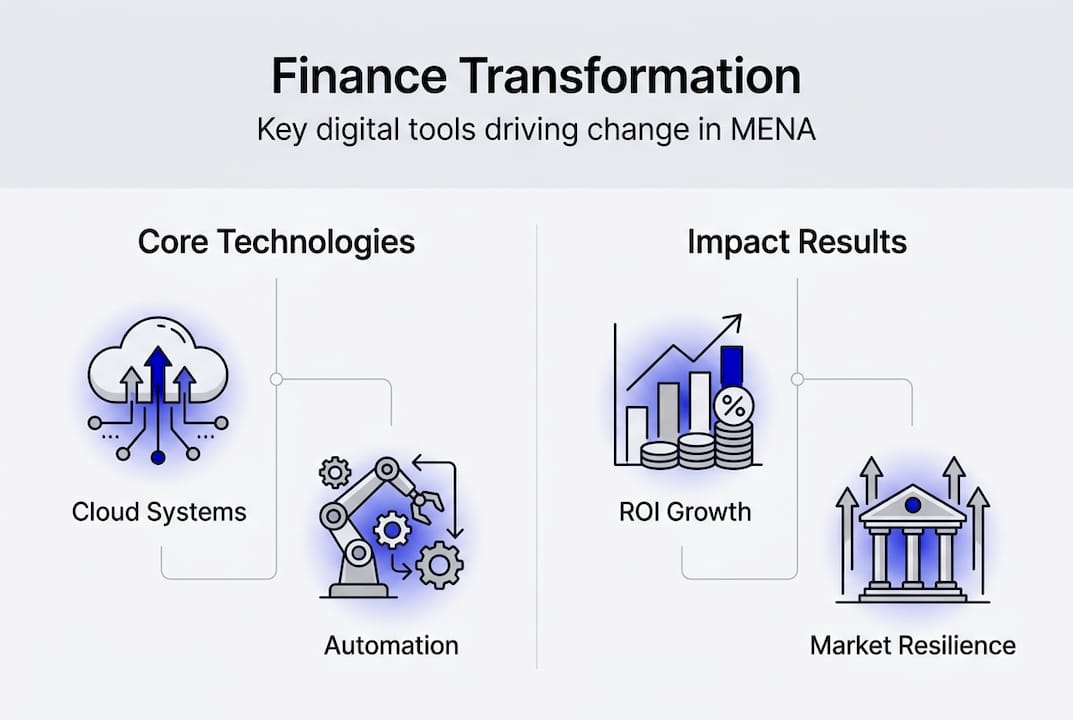
Empirical research provides a nuanced picture. In KSA, digital transformation correlates positively with return on assets and market resilience. Banks that have invested in mature digital platforms show stronger performance metrics across multiple cycles. Egypt presents a more complex picture: digital maturity increases operating margins, but the overall financial performance impact is mixed, with some studies showing no significant improvement in bottom-line profitability.
The IMF and World Bank highlight positive growth and financial inclusion outcomes from digital transformation across GCC and MENA markets, while acknowledging that some Egypt-specific studies show neutral or negative short-term effects. This is not a contradiction. It reflects the difference between digital orientation (having tools) and digital maturity (using them effectively).
Key performance benchmarks across the region:
- KSA: Digital banks demonstrate higher ROA and stronger resilience during market volatility
- UAE: Platforms like Aani show that network effects amplify returns as user adoption scales
- Egypt: Operating margin improvements are real, but short-term profitability dips during implementation phases
- GCC overall: MENA financial transformation data confirms digital banks outperform traditional peers on resilience metrics
“Digital maturity, not just digital adoption, is what separates high-performing finance institutions from those still chasing efficiency gains.” — Tamer Badr, Singleclic
For executives tracking digital disruption examples across MENA, the pattern is consistent: institutions that move beyond pilot programs into scaled, integrated deployments see the strongest returns. The data on AI in banking fraud detection further reinforces this, showing that AI-driven risk management reduces losses while improving customer trust.
Nuances, challenges, and opportunities for C-level decision-makers
With performance benchmarks in mind, C-level leaders must also understand operational and strategic hurdles and how to address them.
Legacy systems remain the single biggest barrier to finance transformation in the region. Between 50% and 76% of institutions in KSA and UAE report that outdated technology is actively limiting their growth opportunities. That is not a minor inconvenience. It is a strategic liability that compounds over time.
Vendor dependency creates a separate risk. When a single technology provider controls critical infrastructure, delays in their roadmap become your delays. Regulatory frameworks from SAMA in KSA and CBE in Egypt provide structured support for digital adoption, but they also require institutions to demonstrate compliance readiness before scaling new tools.
Key challenges and how to address them:
- Legacy system inertia: Prioritize modular upgrades over full replacements to reduce disruption
- Vendor lock-in: Negotiate interoperability clauses and maintain API-level control of your data
- Short-term profitability dips: Model implementation costs against 3 to 5 year ROI projections, not quarterly results
- Digital divide risks: Build inclusive onboarding flows that serve customers with varying digital literacy
- Capital adequacy ratio (CAR) constraints: Understand how CAR moderates fintech impact on your balance sheet before scaling
C-level executives should prioritize integrated strategies that focus on digital maturity rather than digital orientation alone. Unified platforms that consolidate fragmented tools reduce vendor dependency and accelerate the path to sustained optimization.
Pro Tip: If your institution has completed a digital pilot but stalled on scaling, the bottleneck is almost always organizational, not technological. Invest in change management alongside your technology roadmap.
For leaders exploring fintech innovation and tracking digital trends for executives, the opportunity window in KSA and UAE is significant. The Egypt fintech profitability study offers additional context on navigating mixed-result markets.
Applying digital tools: Practical steps and best practices for executive leadership
Armed with both challenges and insights, executives can now move to practical application with clear region-specific steps.
The KSA fintech sector grew to 261 registered fintechs in 2024, and UAE’s Aani platform reached adoption by 10% of the population. These are not vanity metrics. They signal that the market infrastructure for digital finance is maturing rapidly, and the window for first-mover advantage is narrowing.
Here is a practical execution framework for finance executives:
- Benchmark against regional leaders. Identify the top three digital finance institutions in your market segment and map their technology stack against yours.
- Invest in AI and automation post-pilot. Moving from proof-of-concept to full deployment requires dedicated budget, not just enthusiasm. Allocate CAPEX accordingly.
- Balance short-term costs with long-term resilience. IMF data on digital finance confirms that initial investment dips are temporary when implementation is managed well.
- Target underserved segments. KSA has an estimated $80 billion SME finance gap. Sharia-compliant digital lending and SME-focused platforms represent high-growth opportunities with strong regulatory tailwinds.
- Integrate predictive analytics. Using predictive financial insights allows you to move from reactive reporting to proactive decision-making.
- Deploy AI-driven customer engagement. AI chatbots in customer experience reduce service costs while improving satisfaction scores across digital channels.
Pro Tip: Do not treat digital transformation as a technology project. Treat it as a business model evolution. The institutions seeing the strongest returns are those where the CFO and CTO are aligned on a shared optimization roadmap, not operating in separate lanes.
Connect finance strategy to actionable digital tools
Having covered practical implementation, leaders seeking transformation can explore tailored platforms and solutions that close the gap between strategy and execution.
Singleclic works with finance institutions across KSA, UAE, and Egypt to move beyond digitalization into genuine optimization. Whether you are modernizing legacy workflows, scaling automation, or building AI-driven customer journeys, the right platform architecture makes the difference between a pilot that stalls and a transformation that compounds.
Explore how business process management frameworks can streamline your finance operations from end to end. Our enterprise automation solutions are built for the complexity of regional banking and finance environments. And if you are evaluating next-generation platforms, our guide on AI automation in low-code shows exactly how institutions like yours are accelerating delivery without sacrificing control. Singleclic brings 10+ years of regional delivery experience and 70+ consultants ready to support your next phase of growth.
Frequently asked questions
How do digital tools impact short-term vs. long-term profitability in finance?
Initial implementation costs can reduce short-term profitability, but digital maturity consistently boosts operating margins and resilience over a 3 to 5 year horizon. The key is modeling the full investment cycle, not just the first year.
What are the main risks for banks adopting digital tools in KSA, UAE, and Egypt?
Legacy systems limit growth for 50 to 76% of institutions, while vendor dependency, job displacement, and digital divide concerns add further complexity. A phased, modular adoption strategy reduces exposure across all three risk categories.
How can executives maximize business optimization through digital finance tools?
Leaders should prioritize digital maturity over simple adoption, upgrade legacy systems incrementally, and consolidate tools onto unified platforms that support sustained, measurable optimization.
Are there regulatory supports for digital transformation in finance?
Yes. SAMA and CBE frameworks actively facilitate technology adoption, providing structured pathways for institutions to scale digital tools while maintaining compliance and operational integrity.
Where can I find practical digital tool solutions for business optimization?
Singleclic offers curated business process automation and AI-driven platforms built specifically for finance leaders across KSA, UAE, and Egypt, covering everything from ERP integration to on-premise agentic AI deployment.