TL;DR:
- Regulatory compliance requires continuous monitoring, proper localization, and data governance.
- Thorough preparation, including gap assessment and data cleansing, is vital before system configuration.
- Post-go-live compliance ownership and automation are key to sustained regulatory adherence.
Regulatory pressure on organizations in KSA, UAE, and Egypt has never been more intense. E-invoicing mandates, data privacy rules, and audit trail requirements are tightening each year, and the cost of falling short is measured in regulatory fines, wasted implementation budgets, and damaged credibility. In fact, 70% of ERP projects in Saudi Arabia fail due to poor localization and change management. This guide gives you a structured, proven framework to achieve and sustain system compliance across your ERP and CRM platforms from the first planning meeting through go-live and well beyond it.
Table of Contents
- Understanding system compliance: Key concepts and pitfalls
- Preparation phase: Laying the foundations for compliance
- Implementation: Achieving compliance through system setup and integration
- Verification and continuous governance: Ensuring lasting compliance
- Why system compliance is won (or lost) after go-live: An executive reality check
- Streamline compliance across your digital platforms
- Frequently asked questions
Key Takeaways
| Point | Details |
|---|---|
| Plan compliance early | A thorough gap assessment and mapping of requirements prevents costly project rework. |
| Leverage accredited partners | Working with MENA-region compliance experts can reduce integration time by up to 85%. |
| Prioritize ongoing governance | Continuous audits and AI-based monitoring keep your business aligned with fast-changing regulations. |
| Invest in user training | Change management and education are vital to ongoing compliance success. |
Understanding system compliance: Key concepts and pitfalls
System compliance, in the context of ERP and CRM platforms, means that your technology infrastructure consistently meets every applicable regulatory, financial, and operational requirement. It is not simply a matter of installing the right software. It means your system reliably generates legally valid invoices, enforces role-based access controls, maintains complete and tamper-evident audit trails, and integrates cleanly with government portals like ZATCA in Saudi Arabia, the Federal Tax Authority in the UAE, and the Egyptian Tax Authority.
The regulatory landscape across the MENA region is specific and demanding. In KSA, ZATCA Phase 2 requires businesses to clear invoices in real time through a government portal, with precise XML formatting, cryptographic signing, and embedded QR codes. In the UAE, the Federal Tax Authority enforces PEPPOL-based e-invoicing standards, and companies operating in the Dubai International Financial Centre face additional data residency and privacy obligations. Egypt’s own e-invoicing mandate requires ERP systems to connect directly to the Egyptian Tax Authority’s network. Review our MENA compliance guide for a full breakdown of each country’s requirements.
“System compliance is not a feature you configure once. It is a capability you build, measure, and evolve continuously as regulations change around you.” — Tamer Badr, Singleclic
The most common failure points are predictable, and almost all of them are avoidable with the right preparation:
- Inadequate localization: Deploying a global ERP template without adapting it to KSA Arabic language requirements, ZATCA invoice fields, or Egypt’s specific chart of accounts creates immediate compliance gaps.
- Skipping compliance mapping: Teams that configure workflows first and think about compliance second spend enormous time and money on rework. Compliance mapping completed before configuration reduces rework by 35%.
- Lack of continuous monitoring: Regulations change. Companies that treat compliance as a go-live checkbox rather than an ongoing process are exposed every time a regulatory update is issued.
- Poor data governance: Duplicate records, incorrect tax codes, and missing customer data fields create errors that regulators flag during audits.
Understanding where failures originate is the first step toward building a system that avoids them entirely.
Preparation phase: Laying the foundations for compliance
Before any technical configuration begins, your organization needs a clear picture of exactly where your current state falls short of where regulations require you to be. Strong preparation separates organizations that go live cleanly from those that spend months fixing self-inflicted problems.
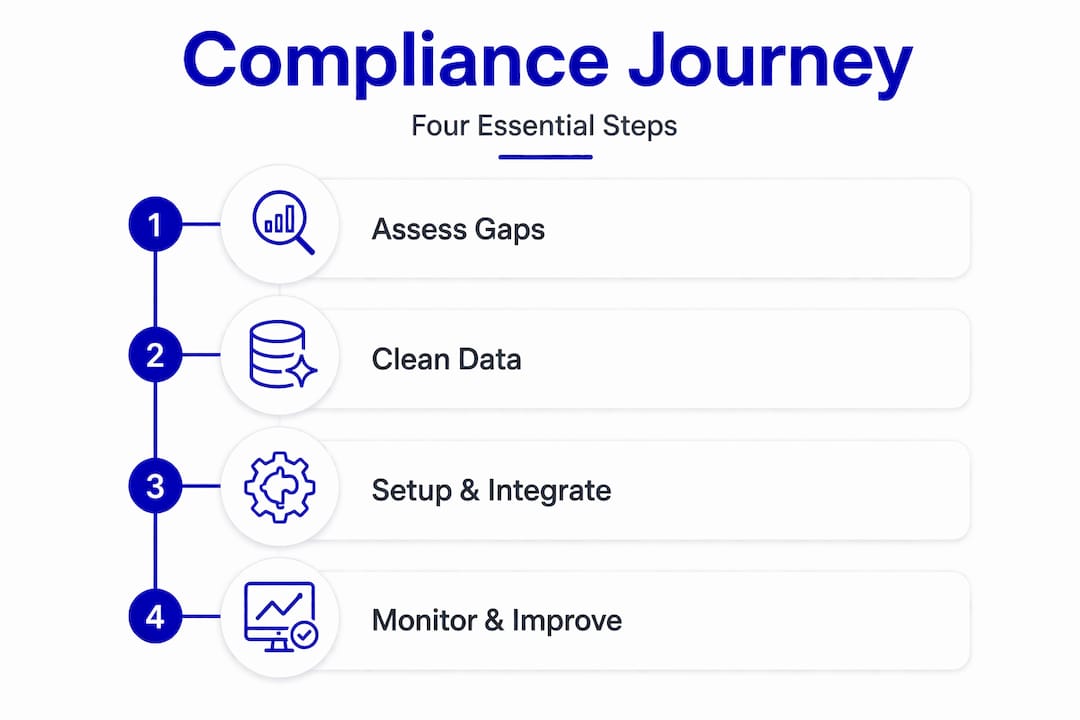
The structured implementation steps that consistently work across the region follow a logical sequence. A UAE e-invoicing readiness study confirms the critical importance of: first, conducting a compliance gap assessment; second, performing data cleansing and classification; third, establishing security and encryption standards; fourth, executing API and integration testing; fifth, running user training and change management programs; and sixth, setting up ongoing monitoring and audit schedules. Each step builds on the previous one.
The compliance gap assessment is where you document every regulatory requirement that applies to your business, then compare it against what your current systems actually do. This produces a prioritized list of gaps. For e-invoicing specifically, this means verifying that your ERP can generate XML in the required schema, that your CRM correctly captures customer tax registration numbers, and that your invoice numbering sequences are tamper-proof.
Data cleansing and classification is the step that most organizations underestimate. Your ERP and CRM are only as compliant as the data inside them. Before go-live, you need to standardize customer master records, validate VAT registration numbers, classify products and services with the correct tax codes, and remove duplicate entries that would generate inconsistent invoice records. In our experience working with clients across KSA and the UAE, data quality issues are responsible for the majority of post-go-live audit failures.

| Preparation task | Why it matters | Estimated effort |
|---|---|---|
| Compliance gap assessment | Identifies regulatory gaps before configuration | 2 to 4 weeks |
| Data cleansing and classification | Ensures accurate invoicing and audit records | 3 to 6 weeks |
| Cross-functional team formation | Embeds compliance ownership across departments | 1 week |
| Regulatory requirements mapping | Reduces configuration rework by up to 35% | 2 to 3 weeks |
Building the right team matters as much as the technical work. Your compliance project team should include finance leaders who understand tax obligations, IT architects who understand integration requirements, legal or compliance officers who track regulatory changes, and operations leads who own the processes your system will govern. Compliance cannot live solely in IT. Read our process compliance guide for practical frameworks on distributing compliance ownership and embedding it into your change management workflow.
Pro Tip: Before any ERP or CRM configuration begins, map every regulatory requirement to a specific system process or field. This creates a traceability matrix that your team can test against during user acceptance testing, and that auditors can review when they request evidence of compliance.
Implementation: Achieving compliance through system setup and integration
With your foundations in place, the focus shifts to technical execution. This is where compliance becomes real, and where decisions made quickly under project pressure tend to create long-term problems.
The core implementation steps for a compliant ERP or CRM rollout in MENA are:
- Configure role-based access controls to enforce data privacy and prevent unauthorized changes to financial records.
- Set up encryption for data at rest and in transit, particularly for customer personal data subject to UAE and KSA privacy regulations.
- Integrate with government portals through tested, certified API connections that meet the technical specifications of ZATCA, FTA, and the Egyptian Tax Authority.
- Run integration testing in an isolated environment before connecting your live system to any government portal.
- Validate invoice output by generating test invoices and verifying XML schema compliance, digital signature validity, and QR code accuracy.
- Document every configuration decision so that future compliance audits have a clear record of how the system was built and why.
One of the most impactful decisions you will make during implementation is whether to build direct API integrations with government portals or to connect through an accredited third-party provider. The data strongly favors the provider route for complex mandates. Accredited providers for ZATCA Phase 2 and FTA PEPPOL handle XML generation, cryptographic signing, QR code embedding, and real-time clearance, reducing implementation time by up to 85% compared to building these capabilities in-house.
| Approach | Implementation time | Maintenance burden | Regulatory risk |
|---|---|---|---|
| Direct API integration | High | High | High if specs change |
| Accredited provider | Low | Low | Managed by provider |
| Hybrid model | Medium | Medium | Partially managed |
Beyond speed, providers absorb the risk of regulatory specification changes. When ZATCA updates its technical standards, the provider updates their connector, not your internal IT team. This is a significant advantage for organizations that do not have dedicated compliance engineering resources. Explore our ERP integration tips for guidance on selecting and evaluating integration partners in MENA.
The cost reduction potential of getting integrations right is substantial. MENA organizations that execute clean ERP integrations report a 30% reduction in operational costs, primarily through eliminating manual reconciliation, reducing invoice errors, and accelerating payment cycles. Your ERP deployment options also affect your compliance posture, particularly around data residency requirements. Review your ERP data security architecture before finalizing your deployment model.
Pro Tip: Always test integrations in an isolated sandbox environment before connecting to any live government portal. A misconfigured API call to ZATCA or the Egyptian Tax Authority during live operations can trigger compliance flags that take weeks to resolve.
Verification and continuous governance: Ensuring lasting compliance
Getting your system live and compliant is a major achievement. Keeping it compliant over time is where the real discipline begins. Regulations across KSA, UAE, and Egypt are evolving rapidly, and the organizations that maintain strong compliance are the ones that treat governance as a standing operational function, not a project phase.
The framework for continuous compliance governance includes the following steps:
- Schedule quarterly compliance audits that review invoice output accuracy, access control logs, data privacy settings, and integration performance.
- Subscribe to regulatory update feeds from ZATCA, the UAE Federal Tax Authority, and the Egyptian Tax Authority so that your team learns about changes before they become effective.
- Deploy automated monitoring that scans your ERP and CRM outputs in real time and triggers alerts when anomalies are detected, such as invoices missing required fields or access logs showing unusual permission usage.
- Run recurring user training sessions that keep your finance and operations teams current on compliance requirements and system procedures.
- Review and update your compliance traceability matrix every time a regulatory change is implemented.
“In the GCC, governance, risk, and compliance must function as a continuous organizational capability, not a project milestone. AI and automation are the tools that make this sustainable at scale.” — Governance, Risk & Compliance in the GCC
AI-powered compliance monitoring is now a practical reality, not a futuristic concept. Systems can scan hundreds of thousands of transaction records daily, flag exceptions immediately, and generate audit-ready reports on demand. For large organizations processing thousands of invoices per month, manual auditing is simply not viable. Our compliance automation tools guide covers the specific technologies available to MENA enterprises today.
The business case for sustained compliance is compelling. Organizations in the UAE that maintain strong CRM compliance have reported CRM ROI between 250% and 450%, driven by cleaner customer data, faster sales cycles, and reduced regulatory friction. AI efficiency strategies combined with compliance automation consistently deliver measurable performance improvements.
The key insight is this: ongoing governance investment pays for itself many times over, while compliance failures create costs that far exceed what prevention would have required.
Pro Tip: Use automation to trigger instant alerts the moment your system detects a compliance failure, such as an invoice processed without the required digital signature or a user accessing records outside their authorized role. Early detection prevents regulatory escalation.
Why system compliance is won (or lost) after go-live: An executive reality check
Here is something that rarely gets said directly: most organizations focus their compliance energy on the pre-go-live phase and treat go-live as the finish line. It is actually the starting line.
In our experience working with over 60 enterprise clients across KSA, UAE, and Egypt, the organizations with the cleanest long-term compliance records share one characteristic that has nothing to do with their initial implementation quality. They have dedicated post-launch compliance champions, and those champions sit in operations and finance, not in IT.
This matters because regulatory changes arrive after go-live. ZATCA Phase 2 expanded its mandate scope significantly after the initial rollout. UAE e-invoicing specifications have been revised multiple times. Egypt’s tax authority continues to update its technical requirements. Every one of these changes required companies to adapt systems that were already live and processing real transactions. The organizations that adapted quickly had people in the business who owned compliance outcomes and had the authority to act.
The uncomfortable reality is that most compliance failures we see are not caused by weak project management or poor technical implementation. They stem from a deliberate decision to defund compliance governance after go-live. Budgets get reallocated, compliance resources get reassigned, and monitoring programs get paused. Then a regulatory change goes unimplemented, an audit finds discrepancies, and the organization scrambles to fix in weeks what proper governance would have caught in days.
Building proven process compliance into your operating model means treating compliance exactly like you treat financial controls: as a permanent function with its own budget, reporting lines, and performance metrics. The organizations that elevate compliance to an operational discipline rather than a project deliverable are the ones that avoid the painful and expensive remediation cycles that their competitors endure.
Streamline compliance across your digital platforms
If this guide has given you a clearer picture of what real ERP and CRM compliance requires, the next step is assessing where your organization stands today and building a roadmap to close the gaps.
At Singleclic, we have helped organizations across KSA, UAE, and Egypt design, implement, and govern compliant ERP and CRM systems for over a decade. Start with our ERP readiness assessment to identify your most critical compliance gaps. Our team brings deep expertise in Odoo, Microsoft Dynamics 365, and accredited e-invoicing integrations for ZATCA, FTA, and the Egyptian Tax Authority. Explore our ERP integration insights and CRM implementation tips to understand exactly how we structure compliant rollouts for enterprises like yours. Your compliance roadmap starts with a single conversation.
Frequently asked questions
What are the critical steps for ERP and CRM compliance in MENA?
The critical steps include compliance gap assessment, data cleansing and classification, security and encryption setup, API and integration testing, user training and change management, and ongoing monitoring and audits. Each step must be completed in sequence to avoid compounding gaps.
How can automation improve compliance management?
Automation supports real-time monitoring and alerting, quarterly audit scheduling, and regulatory update subscriptions, turning compliance from a manual effort into a continuous and scalable organizational capability.
What impact does system compliance have on business performance?
MENA organizations report 30% operational cost reductions through clean ERP integrations, and UAE businesses maintaining strong CRM compliance have achieved ROI between 250% and 450%, driven by cleaner data and faster operational cycles.
Should MENA businesses use local or international providers for compliance integration?
Accredited regional providers specializing in ZATCA Phase 2, FTA PEPPOL, and Egyptian Tax Authority requirements reduce implementation time by up to 85% and absorb the ongoing burden of keeping integrations current with regulatory specification changes.