Matching an ERP and CRM implementation partner to local compliance, integration, and Arabic language needs frustrates regional organizations. Many providers rely on generic templates, lack Saudi Arabia or UAE regulatory expertise, or do not offer true on premise control and low code automation. This comparison shows which Middle East agencies meet deployment, localization, integration, and support needs so you can select the right partner for your business.
Table of Contents
- Singleclic
- OdooTec Saudi Arabia
- Microsoft Dynamics 365
- Microsoft Dynamics 365 Business Central
- Comparison of alternatives
Singleclic
At a Glance
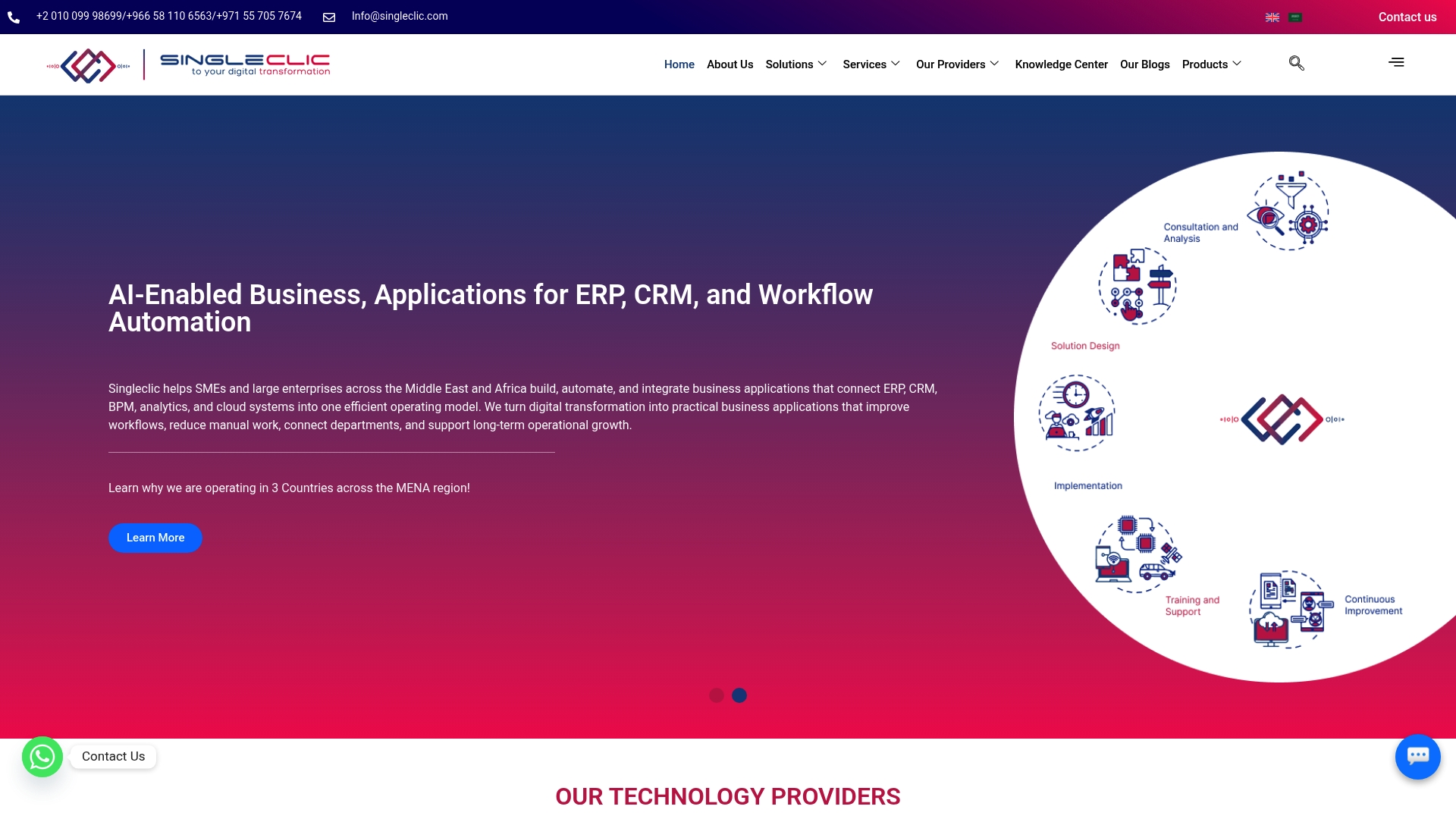
Cortex supports full Arabic user interfaces, on premise deployment for banks and governments, and runtime workflow changes without downtime. Singleclic combines that platform with Microsoft, Odoo, IBM, and Bonitasoft partnerships. The company targets enterprises and government agencies across Saudi Arabia, the UAE, and Egypt.
Core Features
Singleclic delivers a low code platform, AI enabled automation, and native Arabic UI that lets teams build enterprise apps without extensive coding. The platform connects to ERP, CRM, BPM, analytics, and cloud systems and runs in cloud, on premise, or hybrid environments. Services include Microsoft Dynamics 365 F and O, Microsoft Dynamics 365 CRM, Odoo implementations for real estate and construction, IBM BAW and Bonitasoft BPM, and custom web and mobile apps.
Key Differentiator
The standout is an Arabic first low code platform built for regional business needs with on premise deployment options. That design reduces translation and localization work for Arabic speaking teams. The platform also supports runtime workflow changes so process updates do not require lengthy downtime.
Pros
Singleclic brings deep regional experience across the Middle East and Africa and a roster of vertical expertise in government, banking, healthcare, construction, and retail. The firm lists strong partnerships with Microsoft, Odoo, IBM, and Bonitasoft, which simplifies enterprise integrations for organizations already using those vendors. Cortex supports full Arabic UI, unlimited users, and on premise deployment, which matters for regulated institutions that require local control. The company also offers AI enabled decision support, business process automation, and 24/7 after sales support backed by a regional delivery team of consultants and engineers.
Cons
- Publicly accessible, detailed user reviews and case studies are limited, so buyers should validate support commitments and implementation plans during procurement.
Notable Integrations
- Microsoft Dynamics 365 for ERP and CRM integrations.
- Odoo ERP and CRM for modules like accounting and projects.
- IBM workflow and automation tools including IBM BAW and ODM links.
- Bonitasoft BPM for process orchestration and workflow engines.
- Custom API integrations for legacy and third party systems.
Who It’s For
Mid sized to large enterprises and government organizations in Saudi Arabia, the UAE, and Egypt that need localized low code automation and strict deployment controls. Organizations with existing Microsoft, Odoo, or IBM footprints will find integration paths faster. Health authorities, banks, and construction firms that require Arabic UI and on premise options are the best fit.
Unique Value Proposition
Cortex offers on premise deployment combined with full Arabic UI and runtime workflow changes without downtime. That mix lets regulated institutions keep data inside their infrastructure while giving business teams an Arabic enabled low code development surface. The result reduces the need for separate localization projects and limits operational disruption when business processes change.
Real World Use Case
A healthcare authority in Dubai used Singleclic to automate medical procurement, restructure patient management workflows, and establish data analytics reporting. The engagement tied Odoo and IBM workflow components into a single process layer on Cortex. Clinical and operations teams gained faster approvals and clearer operational reports without moving systems offshore.
Pricing
Singleclic does not publish standard product pricing. The vendor offers project based and flexible pricing models and prefers to scope engagements per customer needs. Prospective buyers should request a tailored quote that reflects deployment, integrations, and support levels.
Website: https://singleclic.com
OdooTec Saudi Arabia
At a Glance
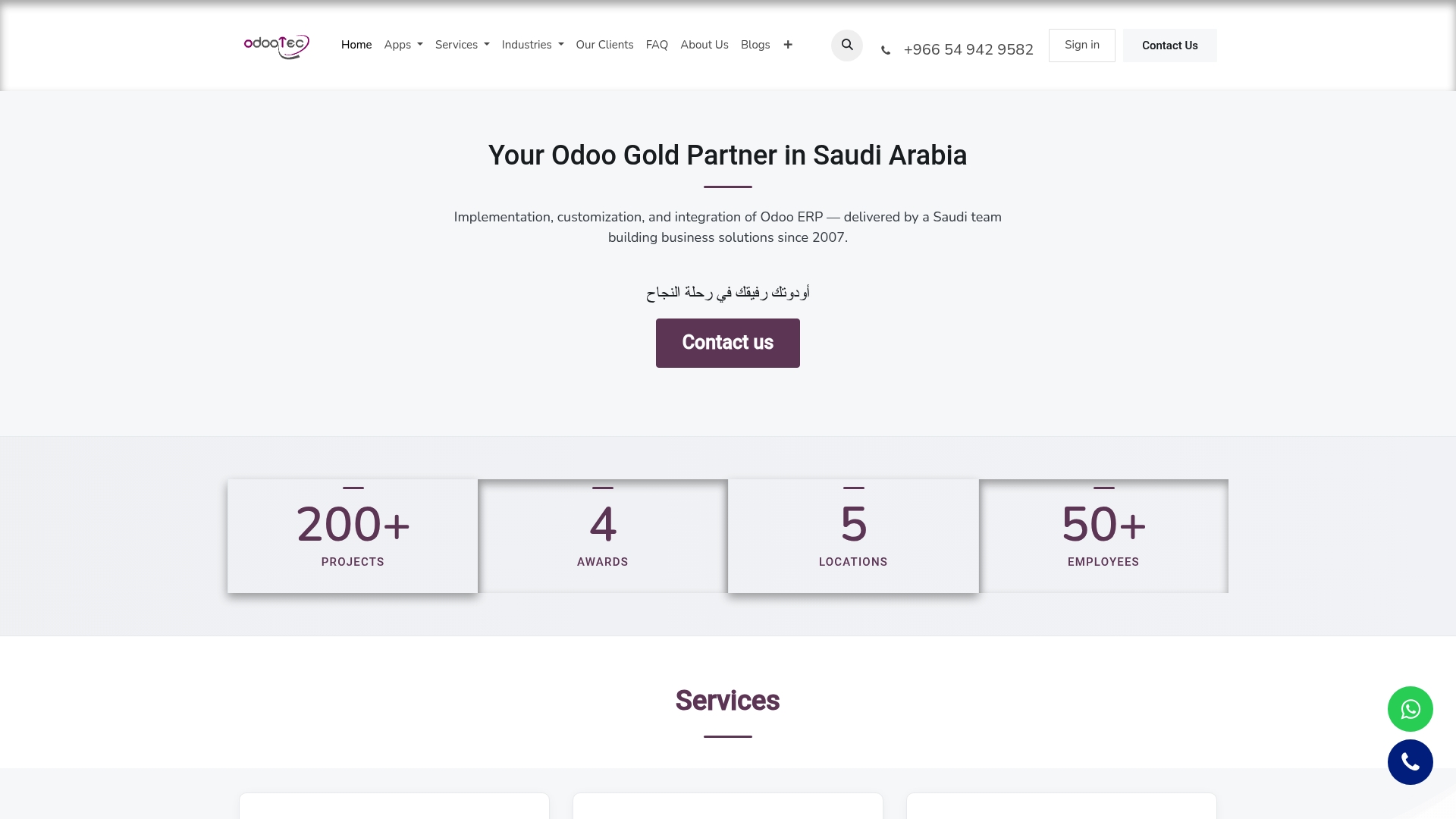
The public site returns an error, which limits direct visibility into product pages and modules. The visible materials identify Odoo as the core platform and emphasize localized implementation and support for Saudi Arabia. That regional focus suggests a partner that adapts Odoo to local compliance and language needs.
Core Features
OdooTec lists multiple business management apps for sales, operations, and productivity alongside industry solutions for manufacturing, trading, logistics, and charities. The company highlights Odoo integration and customization services plus implementation and ongoing support. Localized services for Saudi Arabia appear repeatedly, indicating onshore delivery and post go live assistance.
Key Differentiator
The standout claim is local expertise in Saudi Arabia combined with tailored Odoo ERP implementation services. That local focus implies experience with Saudi regulatory and reporting requirements. For teams seeking a partner who will adapt Odoo to local practices, this is the defining angle.
Pros
OdooTec presents a broad set of application categories and industry templates that match common ERP needs in manufacturing and logistics. The vendor emphasizes customization and integration expertise, which fits organizations with complex legacy systems. A local presence in Saudi Arabia promises faster response times and easier access to consultants for configuration and support.
Cons
- Public-facing product detail is limited. The website error blocks deeper technical evaluation.
- No pricing is listed. The company likely issues custom quotes for implementations.
- Site accessibility issues may indicate irregular maintenance or slower information updates.
When It May Not Fit
If you need quick public access to detailed module specs and trial environments, this provider may not meet that need. Organizations that require transparent, fixed pricing will find limited information here. If you require a low-code, on premise Arabic platform with documented runtime behavior, Singleclic’s Cortex may be a better match for banks and government customers.
Who It’s For
Businesses in Saudi Arabia that need a locally based Odoo integrator and expect tailored configuration and support will find this partner relevant. Midmarket manufacturers, trading houses, logistics firms, and charities with custom reporting or integration needs are the primary fit. Regional teams with existing Odoo deployments who want localized service will benefit most.
Real World Use Case
A charity in Riyadh used Odoo based modules to centralize fundraising, accounting, and stakeholder reporting. OdooTec implemented the modules, mapped local accounts, and trained staff on daily operations. The engagement focused on adapting workflows to local grant and donation reporting.
Pricing
No public pricing or package tiers are listed. The vendor appears to offer custom quotes and enterprise pricing tied to scope and modules. Contacting sales is necessary to receive a tailored estimate for implementation and support.
Website: https://odootec.com
Microsoft Dynamics 365
At a Glance
Built on Microsoft Azure, Dynamics 365 combines CRM and ERP into a single cloud platform with native links to Power BI and the Power Platform. That architecture lets operational data flow from finance to sales without separate data lakes. For organizations in Saudi Arabia and the UAE, that single platform reduces integration points between legacy systems and Office 365 tools.
Core Features
Dynamics 365 bundles customer relationship and enterprise resource planning capabilities with industry modules for manufacturing, oil and gas, and fleet management. It exposes analytics through Power BI and enables process automation via Power Apps and Power Automate. The platform runs as a multi tenant cloud service and integrates with Teams and SharePoint for daily collaboration.
Key Differentiator
The platform’s defining trait is unifying CRM and ERP into one cloud service with deep Microsoft ecosystem integration. That setup shortens data handoffs between front office and back office systems. For organizations already using Office 365, the integration reduces duplication of user administration and reporting work.
Pros
Dynamics 365 covers sales, marketing, finance, supply chain, and HR in one licensed environment, which simplifies vendor management. Its native connections to Teams, SharePoint, and Office 365 keep communications and document storage inside the same ecosystem. The platform supports heavy customization and scale, and Microsoft partner networks deliver implementation and local support in the Gulf region.
Cons
- Complex implementation. Customization demands can extend delivery timelines and require experienced consultants.
- Costly for very small businesses. Licensing and implementation expenses add up for low seat counts.
- Ongoing training required. Teams need continuous upskilling to get full value from advanced modules.
When It May Not Fit
Dynamics 365 may not suit companies with simple bookkeeping needs and fewer than a handful of users. Organizations that cannot budget for multi month implementations should consider lighter payroll or accounting packages. Highly niche workflows with no overlap to Microsoft services may face higher customization bills.
Notable Integrations
- Microsoft Power BI
- Microsoft Power Platform, including Power Apps and Power Automate
- Microsoft Teams
- Microsoft SharePoint
- Microsoft Office 365
Who It’s For
Mid to large sized enterprises across manufacturing, retail, finance, and oil and gas gain the most from Dynamics 365. Regional groups that already rely on Azure and Office 365 will see faster time to value. Singleclic can provide local Dynamics 365 integration services and pair implementations with the Cortex low code platform when on premise Arabic UI or deep process automation is required.
Real World Use Case
A manufacturing company connects sales, supply chain, and production modules to create a single reporting view. That combined data enables real time analytics and alerts for bottlenecks on the shop floor. The result is lower inventory costs and faster product delivery timelines.
Pricing
Pricing is not explicitly stated. Dynamics 365 is typically quoted per customer based on chosen modules, user counts, deployment scope, and support levels. Expect a customized proposal after a scoping exercise with your implementation partner.
Website: https://dynamicssolution.com
Microsoft Dynamics 365 Business Central
At a Glance
ZATCA accredited e invoicing sits inside the global ERP platform. That built-in compliance simplifies tax reporting for companies operating in Saudi Arabia. The solution supports cloud or on premise deployment and mobile access for managers across Saudi Arabia and the UAE.
Core Features
Business Central delivers real-time financials, inventory, sales, and service data within one system. The platform is modular and customizable to match specific business processes while supporting multiple languages and multiple currencies. It integrates local VAT and payment rules for Lebanon, Saudi Arabia, and Qatar, and includes mobile access plus Microsoft Copilot for AI-assisted tasks.
Key Differentiator
The product stands out for its fully integrated local e invoicing compliance, backed by ZATCA accreditation. That integration reduces the need for separate compliance middleware for firms selling in Saudi Arabia. The approach blends global ERP capabilities with local legal requirements.
Pros
Flexible deployment options give organizations a choice between cloud and on premise setups. It carries ZATCA accreditation for e invoicing in Saudi Arabia, which reduces separate compliance steps for local operations. The interface works well for nontechnical staff and connects tightly with other Microsoft tools, lowering integration effort for teams already on that stack. Industry specific adaptations help retailers, manufacturers, and service firms start with prebuilt workflows that match common processes.
Cons
- Implementation can be complex in some regions and often requires specialist consultants.
- Customization and integration work may add time and cost beyond initial estimates.
- Cloud deployment depends on a stable internet connection, which limits suitability in low connectivity areas.
- Pricing is not published and typically requires a consultation, which can slow procurement.
When It May Not Fit
Very small operations with limited budgets for external partners will likely find the total project cost high. Companies in remote locations with unstable internet should avoid the cloud option because core functions depend on connectivity. Organizations that need transparent, fixed list pricing may find the procurement process slower since costs are quoted after consultation.
Who It’s For
This platform fits SMBs expanding across Saudi Arabia and the UAE that need local compliance inside a global ERP. It suits retailers and wholesalers that handle multi location inventory and finance. It also matches manufacturers and professional services that require project accounting and regional tax support, and can be paired with Singleclic’s Cortex for on premise process automation during deployment.
Real World Use Case
A retail chain in Saudi Arabia used EDM’s ZATCA compliant e invoicing integrated with Business Central to centralize sales and tax reporting. That setup reduced duplicated compliance tasks and improved invoice traceability across stores. Store managers used mobile access and AI assistance to respond faster to customer queries and pricing updates.
Pricing
Pricing is not published online and is provided after a consultation. Costs vary by deployment model, customization scope, and compliance work for each country. Expect vendor and partner estimates rather than a fixed list price.
Website: https://edm-tech.com
Comparison of alternatives
Companies evaluating ERP solutions for deployment in the Middle East encounter different nuances in deployment options, language support, and regional compliance readiness. Each alternative presents its own strengths, making it crucial to align chosen solutions with specific organizational needs and priorities.
Regional compliance and language support
Singleclic distinguishes itself with its Arabic-first low-code platform designed to address regional business requirements. This approach minimizes translational overhead and ensures compatibility with the linguistic and practical demands of Middle Eastern enterprises. Moreover, the on-premise deployment options cater to industries with stringent data governance needs. Microsoft Dynamics 365 Business Central, however, excels with its built-in ZATCA-certified e-invoicing module, which is crucial for financial compliance in Saudi Arabia. For organizations requiring immediate compliance mechanisms, Business Central offers a pre-integrated advantage.
Scalability and ecosystem integration
For businesses relying heavily on an existing Microsoft stack, Dynamics 365 ensures smooth integration with tools like Power BI, Office365, and Azure. This interconnection simplifies operations and contributes towards consolidated data workflows. Conversely, Singleclic’s strength lies in its adaptability to integrate with popular ERPs such as Odoo and Microsoft Dynamics and in its ability to facilitate runtime workflow modifications without disrupting ongoing operations.
Best fit
- Enterprises in the Middle East prioritizing localized low-code enterprise application development with flexibility in deployment.
- Small to medium enterprises in Saudi Arabia requiring custom configurations aligned with regional standards and compliance regulations should consider OdooTec.
- Multinational corporations heavily investing in the Microsoft suite desiring integration should opt for Microsoft Dynamics 365.
- Local businesses aiming for precise and standardized compliance, particularly ZATCA-certified e-invoicing, benefit most from Microsoft Dynamics 365 Business Central.
Our pick
Singleclic is the choice for businesses that prioritize a trusted, localized low-code solution equipped for enterprise application integration and regulatory needs. Its Arabic-first approach ensures usability for region-specific team deployments, and advanced on-premise capabilities address stringent legal requirements effectively. However, companies strictly focused on standardized compliance, such as ZATCA prebuilt e-invoicing, might evaluate Microsoft Dynamics 365 Business Central as a viable alternative.
Localized ERP solutions streamline business operations for enterprises in Saudi Arabia and UAE.
| Product | Core Feature | Key Differentiator | Pricing | Notable Limitation |
|---|---|---|---|---|
| Singleclic | Low code platform with Arabic UI | Arabic first low code platform | Price not published | Limited detailed user reviews and case studies |
| OdooTec Saudi Arabia | Multiple business management apps | Localized Odoo ERP implementation | Price not published | Limited public-facing details due to website issues |
| Microsoft Dynamics 365 | Unified CRM and ERP platform | Native Microsoft ecosystem integration | Price not published | Complex implementation for customization needs |
| Microsoft Dynamics 365 Business Central | Modular ERP system with local compliance | ZATCA accredited e-invoicing for Saudi Arabia | Price not published | Implementation complexity for specialized deployments |
common challenges in erp comparison middle east and potential solutions
Choosing the right ERP system in Saudi Arabia, the UAE, and Egypt often means balancing local language needs with strict deployment controls. Singleclic addresses these concerns with Cortex, its Arabic-enabled low-code platform designed specifically for the region’s enterprises and government agencies. Cortex supports runtime workflow updates without downtime, allowing business teams to adapt quickly without interrupting operations.
If you want to reduce translation efforts, maintain full Arabic UI, and keep your data on premise, Singleclic offers tailored ERP and CRM implementations with strong partners like Microsoft Dynamics 365, Odoo, and IBM. With over 10 years of experience and a team of 70+ experts, Singleclic ensures your automation projects meet regulatory requirements and deliver measurable efficiency gains.
Learn more about how Singleclic helps organizations in Saudi Arabia and the UAE with ERP and business process automation at Singleclic. Partner with a trusted local specialist to enhance your operational agility and compliance.
FAQ
How does Singleclic support Arabic language needs for ERP implementation?
Singleclic features a native Arabic UI tailored for regional business requirements. This unique aspect reduces the need for translation and localization, making it easier for teams to develop applications without extensive coding. Organizations in Saudi Arabia and the UAE can benefit from streamlined processes that cater specifically to Arabic-speaking users.
What is the difference between Singleclic and Microsoft Dynamics 365?
Microsoft Dynamics 365 excels in unifying CRM and ERP functionalities within a single cloud platform, enhancing data flow between operational areas. In contrast, Singleclic specializes in Arabic-first low code platforms tailored for regional businesses and offers on-premise deployment options. Organizations seeking localized implementation with Arabic support will find Singleclic to be a suitable fit.
Can I use Singleclic’s low code platform for both mobile and web app development?
Singleclic’s low code platform allows teams to create both web and mobile applications seamlessly. It connects with various systems such as ERP and CRM, making it versatile for different business needs. Companies looking for a flexible development environment will find this capability essential to streamline their application initiatives.
Which platform is best for regulated institutions requiring local control over data?
Singleclic is designed for institutions that mandate local data control, as it offers on-premise deployment options alongside its fully Arabic-enabled features. This capability is ideal for banks and government agencies in the Middle East seeking compliant solutions.
How does Singleclic’s AI-enabled automation benefit business processes?
Singleclic’s AI-enabled automation helps organizations improve decision-making and streamline business processes through intelligent insights. This feature supports operational efficiency and can be particularly advantageous for teams in healthcare, banking, and construction looking to enhance productivity.