TL;DR:
- Change enablement is a structured practice that focuses on supporting people to adopt new processes and technologies for maximum value with minimal disruption.
- It emphasizes outcomes like operational effectiveness over traditional process control and is vital for success in digital transformation efforts in Saudi Arabia and UAE.
Change enablement is the structured practice of preparing and supporting people to adopt new processes, technologies, and behaviors so that organizations realize maximum value with minimum disruption. Unlike traditional change management, which focuses heavily on governance and documentation, change enablement focuses on adoption outcomes and the ongoing support people need to work effectively after a change goes live. Business leaders in Saudi Arabia and UAE are deploying this approach across ERP rollouts, CRM implementations, and digital transformation programs where technical delivery alone rarely delivers lasting results. Frameworks like ITIL 4 and tools like low-code platforms have made change enablement both more structured and more practical for regional enterprises.
What is change enablement and how does it differ from traditional change management?
Change enablement and change management are related but not the same practice. Understanding the difference shapes how you plan, resource, and measure any major organizational change.
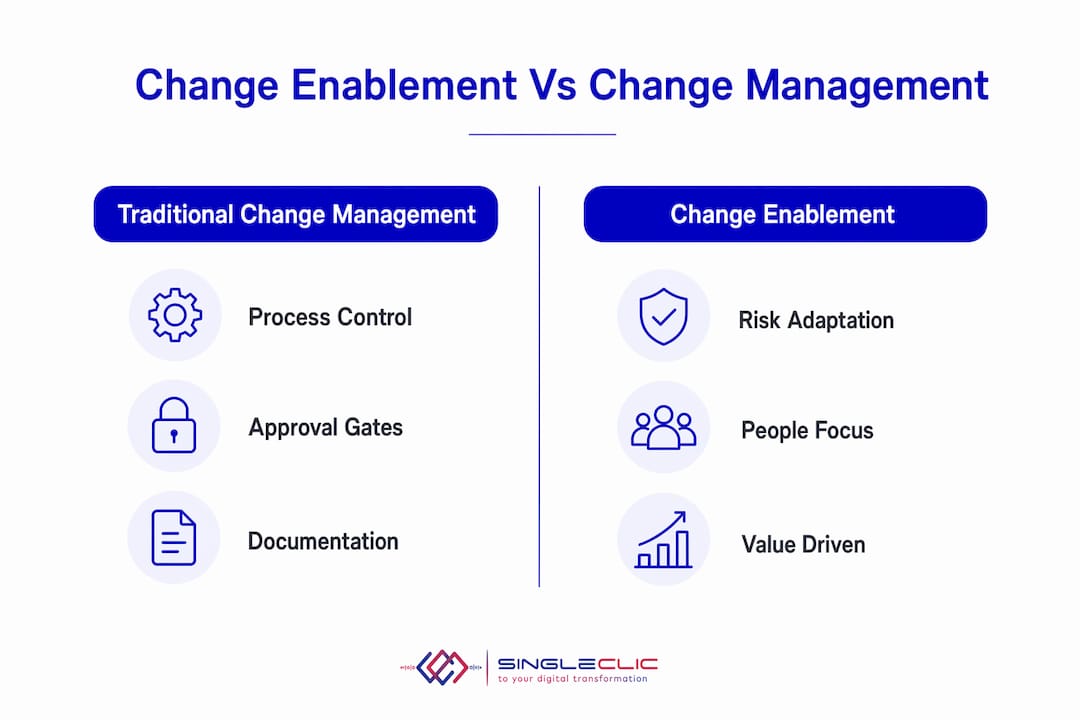
Traditional change management, as defined in ITIL v3, centers on controlling changes through approval gates, documentation, and risk avoidance. The process is thorough but often slow. Approval cycles create bottlenecks, and teams spend more energy on paperwork than on preparing people to work differently.
ITIL 4 change enablement reframes the goal entirely. The practice exists to minimize risk and disruption while maximizing value, not to maximize control. That shift in purpose changes everything downstream, from how governance is structured to how success is measured.
The table below captures the core distinctions:
| Dimension | Traditional change management | Change enablement |
|---|---|---|
| Primary focus | Process control and approval | People adoption and value realization |
| Governance model | Uniform approval for all changes | Right-sized governance by risk level |
| Speed | Slower due to bureaucracy | Faster through pre-authorization and automation |
| Success measure | Change approved and deployed | Operations running effectively post-change |
| Methodology alignment | Waterfall-oriented | Compatible with Agile, DevOps, and CI/CD |
For enterprises in KSA and UAE running Microsoft Dynamics 365, Odoo, or IBM BAW environments, this distinction is practical. A standard patch to a pre-approved workflow should not require the same approval cycle as a full ERP migration. Change enablement builds that logic into governance by design.
Key shifts you will notice when organizations move to a change enablement mindset:
- Governance adapts to risk, not to habit
- Communication and training are treated as delivery requirements, not afterthoughts
- Teams measure whether people can do their jobs better, not just whether the change was deployed
- Feedback loops run continuously, not only at project close
What are the key principles and frameworks of effective change enablement?
Effective change enablement rests on four principles: value-driven governance, continuous communication, role-based capability building, and disciplined execution criteria. Each principle addresses a specific failure point in how organizations typically handle change.
Value-driven governance by risk level
Governance should adapt to risk rather than apply a single approval process to every change. ITIL 4 defines three change types to support this. Standard changes are low-risk, pre-authorized, and can be automated. Normal changes require assessment and approval based on their risk profile. Emergency changes follow an expedited path with post-implementation review.
This routing logic prevents bottlenecks on routine work while maintaining rigorous oversight for high-stakes changes. For a bank in Riyadh or a government entity in Abu Dhabi, automating standard changes alone can free up significant capacity in IT governance teams.
Continuous communication and feedback loops
Adoption risk peaks during execution, not during planning. Teams that communicate once at launch and then go silent see adoption stall within weeks. Effective change enablement treats communication as an ongoing delivery stream, with regular updates, Q&A channels, and visible leadership sponsorship throughout the change lifecycle.

Feedback loops are equally critical. Collecting structured input from end users during rollout lets teams identify resistance early and adjust training or support before problems compound.
Role-based capability building
Generic training fails because different roles face different challenges with the same change. A finance manager adopting Microsoft Dynamics 365 Finance and Operations needs different support than a warehouse supervisor using the same system. Role-specific training paired with immediate practical support structures, including help desks, peer champions, and escalation paths, produces measurably better adoption outcomes.
Go/No-Go criteria and backout planning
Disciplined execution requires explicit criteria before any change goes live. Go/No-Go gates check whether communications are ready, training is complete, backout plans are tested, and stakeholders are aligned. Skipping these checks is the most common reason well-designed changes fail at deployment.
Pro Tip: Build your Go/No-Go checklist into your project management tool so it becomes a mandatory sign-off step, not an optional review. Teams that treat it as optional almost always skip it under deadline pressure.
How is change enablement applied in organizational transformation in Saudi Arabia and UAE?
Organizations in Saudi Arabia and UAE face a specific combination of pressures: rapid digital transformation mandates, multilingual workforces, and cultural dynamics where leadership endorsement carries significant weight. Change enablement strategies that work in these environments account for all three.
The following steps reflect what works in practice for regional enterprises:
-
Assess the change impact by role and location. Map which teams, sites, and job functions are affected before designing any communication or training. A healthcare provider like Emirates Health Services rolling out a new patient management system needs different impact maps than a construction firm in Riyadh deploying Odoo.
-
Secure visible leadership sponsorship early. In KSA and UAE business culture, change that carries explicit senior leadership endorsement moves faster. Identify executive sponsors who will communicate directly with affected teams, not just approve a project plan.
-
Build a local champion network. Champions are employees within each affected team who receive early training and serve as first-line support during rollout. This peer-to-peer model reduces help desk load and builds trust faster than top-down communication alone.
-
Use low-code platforms to accelerate adoption tools. Platforms like Singleclic’s Cortex, which is Arabic-enabled and built for on-premise deployment in MENA enterprises, let organizations build training portals, feedback forms, and workflow guides without waiting for IT development cycles. This matters in environments where Arabic UI/UX is a requirement, not a preference.
-
Run structured feedback cycles during rollout. Collect data weekly during the first 90 days. Track where users are getting stuck, which roles are falling behind, and where workarounds are appearing. Workarounds are the clearest signal that adoption has stalled.
-
Align change enablement with digital transformation goals in KSA and UAE. Change enablement is not a standalone project. It should connect directly to the organization’s broader Vision 2030 or UAE digital economy objectives, giving teams a clear reason to adopt new ways of working.
What metrics and outcomes measure successful change enablement?
Change enablement success is defined by whether employees can run operations effectively after the change, not by whether the change was deployed on schedule. That distinction separates activity metrics from outcome metrics.
Activity metrics count what happened: number of training sessions delivered, approvals processed, communications sent. Outcome metrics measure whether the change achieved its intended business result.
The most useful outcome metrics for change enablement programs include:
| Metric | What it measures |
|---|---|
| Change success rate | Percentage of changes that achieve their intended outcome without rollback |
| Incident rate post-change | Volume of incidents directly linked to a change in the 30 days after deployment |
| Adoption rate by role | Percentage of users in each role actively using the new process or system |
| Time to proficiency | How long it takes each role to reach baseline competency with the new way of working |
| Feedback resolution rate | Percentage of user-reported issues resolved within the first 90 days |
Leadership often underestimates the need for ongoing support post-launch. A common pattern in regional ERP and CRM rollouts is strong adoption in the first two weeks followed by a sharp drop as formal support structures wind down. Sustaining adoption requires keeping support structures active for at least 90 days post-go-live.
ITIL 4 also encourages integration with Agile, DevOps, and CI/CD pipelines to automate risk assessments and reduce approval delays. For organizations running continuous delivery, this integration turns change enablement from a gate into a built-in quality check.
Key takeaways
Change enablement succeeds when governance adapts to risk, people receive role-specific support, and outcomes are measured by operational adoption rather than deployment completion.
| Point | Details |
|---|---|
| Enablement vs. management | Change enablement prioritizes people adoption and value; traditional change management prioritizes process control. |
| Right-sized governance | Classify changes by risk and pre-authorize standard changes to remove unnecessary approval bottlenecks. |
| Role-based training | Build training and support structures around specific job roles, not generic user groups. |
| Post-launch support | Keep champion networks and help desks active for at least 90 days after go-live to sustain adoption. |
| Outcome metrics | Measure change success rate, incident rate, and adoption rate by role, not just deployment completion. |
What I have learned about change enablement after a decade in the region
Working with organizations across Saudi Arabia, UAE, and Egypt for over a decade, I have seen one pattern repeat itself more than any other. Leadership invests heavily in the technology and almost nothing in the people side of the change. The ERP goes live, the CRM is configured, the workflows are built. Then adoption stalls because nobody prepared the teams to actually work differently.
The uncomfortable truth is that most change failures are not technical failures. They are enablement failures. The system works. The people do not know how to use it, do not trust it, or have found workarounds that feel safer than the new process.
What I have found actually works is treating change enablement as a parallel workstream to technical delivery, not a phase that starts after go-live. That means building your champion network before the system is ready, running communication campaigns before training begins, and having your feedback channels live on day one.
In the MENA context specifically, two things matter more than anywhere else I have worked. First, Arabic-language support is not optional. Teams that receive training and support in their primary language adopt faster and retain more. This is why tools like Cortex, Singleclic’s Arabic-enabled low-code platform, make a real difference in regional deployments. Second, leadership visibility is a force multiplier. When a senior leader in Riyadh or Dubai visibly uses and endorses the new system, adoption in their organization accelerates noticeably.
The change management process should never be treated as a compliance exercise. It is the mechanism by which your technology investment actually delivers its promised return.
— Tamer Badr
How Singleclic supports change enablement across KSA and UAE
Organizations in Saudi Arabia and UAE running complex ERP, CRM, or automation programs need more than a technology partner. They need a team that understands how to bring people along with the change.
Singleclic has delivered over 100 enterprise implementations across the region, including projects for Emirates Health Services, Dubai Healthcare City, QNB, and Miahona in Saudi Arabia. The team combines Microsoft Dynamics 365, Odoo, and IBM BAW expertise with Cortex, Singleclic’s Arabic-enabled low-code platform built for MENA enterprises. Cortex supports runtime workflow changes without downtime, which means your change enablement team can adjust processes based on live feedback without waiting for a development cycle. For organizations planning an ERP rollout, the ERP implementation checklist for the Middle East is a practical starting point. Contact Singleclic to discuss how change enablement can be built into your next transformation program from day one.
FAQ
What is change enablement in simple terms?
Change enablement is the practice of preparing and supporting people to adopt new processes or technologies so that the organization actually realizes the intended business benefit. It focuses on outcomes, not just approvals.
How does change enablement differ from change management?
Change management in ITIL v3 focuses on controlling changes through approval processes. Change enablement in ITIL 4 shifts the focus to minimizing disruption and maximizing value, with governance sized to the risk level of each change.
What is the role of ITIL 4 in change enablement?
ITIL 4 defines change enablement as a management practice that classifies changes by risk, pre-authorizes low-risk standard changes, and integrates with Agile and DevOps to accelerate safe delivery.
What are the most important change enablement best practices?
The most effective practices are right-sized governance by risk, role-specific training, a local champion network, continuous feedback loops during rollout, and keeping support structures active for at least 90 days post-launch.
Why does change enablement matter for organizations in Saudi Arabia and UAE?
Organizations in KSA and UAE are executing large-scale digital transformation programs under Vision 2030 and UAE digital economy mandates. Change enablement ensures that technology investments deliver operational results, not just deployment milestones.