TL;DR:
- True digital scalability allows systems to grow impact without proportional cost increases.
- Building scalable infrastructure requires proven frameworks like load balancing and microservices tailored to sector requirements.
- Successful scaling in KSA and UAE depends on adapting solutions to local regulations and ongoing operational agility.
Most executives in construction, healthcare, and banking across KSA and UAE believe that scaling their digital operations is simply a matter of adding more servers, hiring more staff, or buying more software licenses. That assumption is expensive. True digital scalability means your systems and processes can multiply their impact without a proportional increase in cost or complexity. A hospital network serving 500 patients today should be able to serve 5,000 tomorrow using the same core architecture. This article breaks down what digital scalability actually means, how it is built using proven frameworks, and how sector leaders in Saudi Arabia and the UAE can measure and apply it with precision.
Table of Contents
- Understanding digital scalability: Definitions and core concepts
- Frameworks and methodologies: How digital scalability is built
- Sector deep dive: Digital scalability in construction, healthcare, and banking
- Measuring digital scalability: Metrics, ROI, and pitfalls
- The uncomfortable truth: What most leaders get wrong about digital scalability
- Scale smarter with expert-led digital transformation
- Frequently asked questions
Key Takeaways
| Point | Details |
|---|---|
| True scalability multiplies impact | Real digital scalability enables your organization to grow efficiently without linearly increasing costs or complexity. |
| Sector solutions are key | Construction, healthcare, and banking each require tailored frameworks like BIM, ERP, or blockchain for effective scalability in KSA/UAE. |
| Metrics drive success | Tracking KPIs such as uptime, latency, and ROI ensures your scalability initiatives deliver real business results. |
| Hybrid approaches maximize value | Combining cloud, on-premise, and modular solutions ensures compliance and operational resilience. |
Understanding digital scalability: Definitions and core concepts
Digital scalability is the capacity of a system, platform, or organization to handle increasing demand, users, or transactions without degrading performance or requiring a complete redesign. For a C-level leader, this is not a technical footnote. It is a strategic asset. When your ERP handles 200 concurrent users today and 2,000 next year without a rebuild, that is scalability working in your favor. A solid foundation in scalable IT infrastructure is what separates organizations that grow confidently from those that scramble.
One concept that often gets confused with scalability is elasticity. They are related but different. Scalability basics explain it well: scalability is long-term and planned, designed to support sustained growth over months and years. Elasticity, on the other hand, manages short-term spikes, like a bank’s transaction volume surging during a national holiday. You need both, but they require different planning horizons and different investments.
The real distinction executives should internalize is between linear growth and true scale. Linear growth means adding one unit of resource for every unit of demand. True scale means multiplying impact through network effects, automation, and intelligent architecture. A platform that serves 10x the users at 2x the cost is scaling. One that serves 10x the users at 10x the cost is just growing.
“Real scale means multiplying impact, not linear growth. Automation trades nuance for speed, so apply it with intention and moderation.”
Here are the key dimensions of digital scalability every executive should track:
- User and load capacity: Can your systems handle 10x concurrent users without downtime?
- Transaction throughput: How many financial or operational transactions can your platform process per second?
- Cost efficiency: Does your cost per transaction decrease as volume increases?
- ROI acceleration: Does scaling your digital platform produce compounding returns over time?
- Resilience: Can the system recover automatically from partial failures without full outages?
These dimensions apply whether you are running a construction project management platform, a healthcare records system, or a core banking engine.
Frameworks and methodologies: How digital scalability is built
Knowing what scalability is gets you started. Knowing how to build it is what moves the needle. Technology leaders use a range of proven approaches, and the right combination depends on your sector, your compliance environment, and your growth trajectory.
Common technical frameworks include:
- Load balancing: Distributes incoming traffic across multiple servers so no single node becomes a bottleneck
- Microservices architecture: Breaks large applications into smaller, independently deployable services that scale individually
- ERP with horizontal scaling: Enterprise resource planning systems like Microsoft Dynamics 365 or Odoo that add capacity by adding nodes, not replacing the core
- Auto-scaling in cloud environments: Automatically provisions or deprovisions computing resources based on real-time demand
- Database sharding and replication: Splits large databases across multiple servers to improve read/write performance at scale
These methodologies for scalability are not mutually exclusive. The strongest architectures combine several of them.
| Dimension | Traditional scaling | Modern digital scalability |
|---|---|---|
| Approach | Add hardware manually | Auto-scale via cloud or hybrid |
| Cost model | High upfront capital | Pay-as-you-grow operational cost |
| Downtime risk | High during upgrades | Near-zero with rolling deployments |
| Compliance flexibility | Limited | Configurable for local regulations |
| Speed to scale | Weeks to months | Hours to days |
To design a scalable digital environment, follow these steps:
- Assess your current workloads by mapping peak usage, transaction volumes, and bottlenecks across all systems
- Define scaling criteria including the thresholds that trigger capacity additions and the KPIs you will use to measure success
- Implement in phases starting with the highest-impact systems, such as ERP or core banking, before expanding to adjacent platforms
- Monitor continuously using real-time dashboards that track both technical performance and business outcomes
For technology-driven scaling in KSA and UAE, the compliance dimension is critical. Data sovereignty laws and sector-specific regulations mean you cannot always rely on public cloud alone.
Pro Tip: A hybrid scaling model that combines public cloud for burst capacity with on-premise or private cloud for regulated data gives you the best of both worlds. Explore hybrid cloud approaches to find the right balance for your compliance requirements in KSA and UAE.
Sector deep dive: Digital scalability in construction, healthcare, and banking
Theory becomes valuable when it connects to your industry. Here is how digital scalability plays out across the three sectors most relevant to C-level leaders in KSA and UAE.
| Sector | Digital mandate | Scalability tool | Outcome |
|---|---|---|---|
| Construction | BIM, ERP, modular design | Project management platforms | 13% productivity gain |
| Healthcare | EHR, blockchain, edge computing | Sharded databases, cloud | 66.67% latency reduction |
| Banking | Open banking, transaction platforms | Microservices, auto-scaling | Real-time processing at scale |
In construction, BIM mandates for mega-projects like NEOM and Dubai buildings above 12 floors are accelerating the need for scalable digital infrastructure. ERP systems that integrate with BIM platforms allow project teams to manage procurement, workforce, and compliance data at scale. Facilities management cases across the region show 8% energy savings and a 13% workforce productivity gain when scalable digital platforms are deployed effectively. Learn how sector ERP scalability supports these outcomes.

In healthcare, scalability takes on a different urgency. Blockchain-enabled EHR (electronic health record) systems using Modified Genetic Algorithm for database sharding allow patient data to scale across nodes without compromising integrity or access speed. Edge-fog computing reduces latency by 66.67% for emergency care applications, which is a critical metric when seconds matter. Lean digital health platforms can serve millions of patients without requiring a full infrastructure rebuild each time demand grows. Explore healthcare digital frameworks for regional context.
In banking, scalability is about transaction confidence. Key digital scalability models include:
- Microservices-based core banking that allows individual functions like payments, KYC, and reporting to scale independently
- Cloud-native transaction processing that handles volume spikes during peak periods without manual intervention
- API-first architecture that enables open banking integrations without rebuilding the core platform
- Data sovereignty-compliant private cloud that satisfies SAMA and CBUAE regulatory requirements while maintaining elasticity
Measuring digital scalability: Metrics, ROI, and pitfalls
You cannot manage what you cannot measure. For executives overseeing digital scalability initiatives, the right KPIs make the difference between a strategic investment and an expensive experiment.
Executive KPIs to monitor:
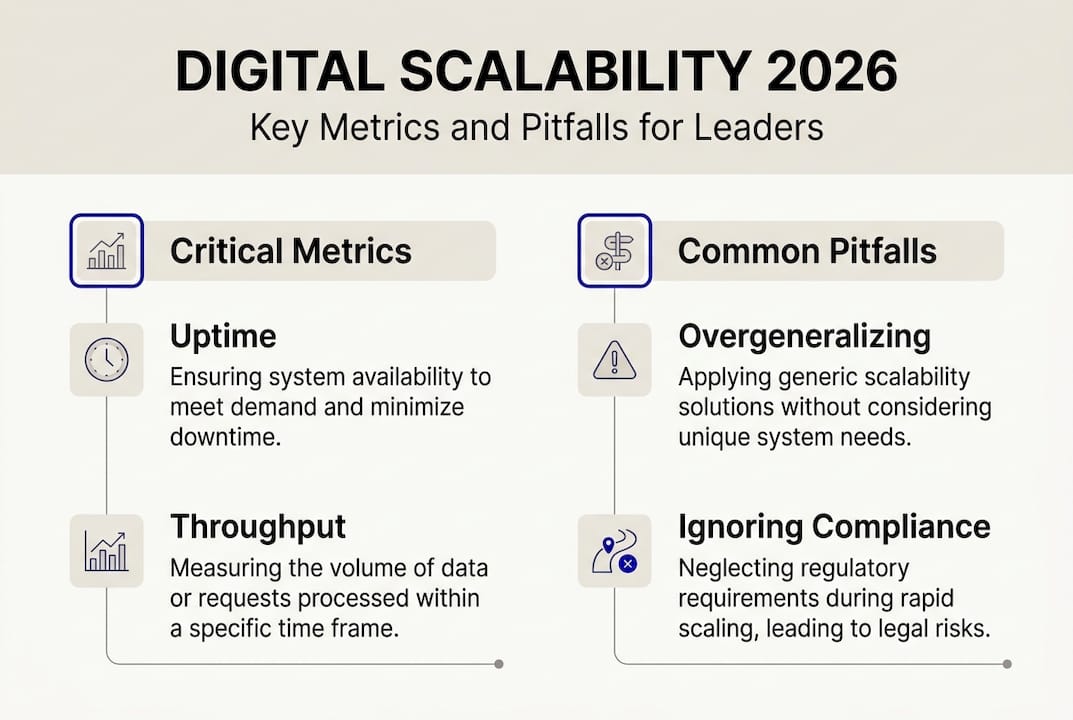
- System uptime: Target 99.9% or higher for mission-critical platforms
- Latency: Measure response times under peak load, not just average conditions
- Cost per transaction: Track whether unit economics improve as volume scales
- Time to market: How quickly can new features or services be deployed without disrupting existing operations?
- ROI: Benchmark against sector analogs. Manufacturing digital ROI can reach 170% when scalability is built correctly from the start
- Data sovereignty compliance rate: Percentage of workloads running on compliant local or private cloud infrastructure
Setting realistic targets matters. Start with a baseline measurement of your current system performance, then define 90-day, 180-day, and 12-month milestones. Avoid the temptation to set targets based on vendor promises rather than your actual operational context.
The most common pitfalls executives encounter include:
- Over-automation: Automating processes before they are fully understood leads to scaling the wrong behavior faster
- Ignoring local compliance: Deploying global platforms without adapting for SAMA, CBUAE, or Saudi Ministry of Health regulations creates legal and operational risk
- Measuring only technical outcomes: A system with 99.9% uptime that fails to improve business throughput is not delivering value
Use IT scalability benchmarks to ground your targets in regional reality rather than global averages that may not apply to your operating environment.
Pro Tip: For construction and healthcare specifically, schedule quarterly cross-team reviews that cover user experience scores and compliance metrics alongside uptime. Technical health and business health are not the same thing, and both need a seat at the table.
The uncomfortable truth: What most leaders get wrong about digital scalability
Here is what we see consistently across KSA and UAE: organizations copy global scalability playbooks without adapting them for local realities. A microservices architecture that works beautifully for a fintech in Singapore may hit immediate compliance walls when deployed for a bank in Riyadh. A cloud-first EHR strategy that serves a European health system may conflict with Saudi Ministry of Health data residency requirements.
The mistake is treating scalability as a purely technical problem with a universal solution. It is not. True scalability in this region requires you to understand the specific mandates governing your sector, whether that is BIM compliance for construction, blockchain governance for healthcare records, or SAMA regulations for banking platforms.
Scaling business through technology in KSA and UAE means championing operational adaptability, not just technical capacity. The leaders who get this right are not the ones with the biggest cloud budgets. They are the ones who ask the harder question: “Does this scale in a way that fits how we actually operate and what our regulators actually require?” That question changes everything.
Scale smarter with expert-led digital transformation
Digital scalability is not a one-time project. It is an ongoing capability that requires the right partner, the right architecture, and the right sector expertise. Singleclic works with C-level leaders across construction, healthcare, and banking in KSA and UAE to design and implement scalable digital environments that grow with your business, not against it.
Whether you are starting with an ERP readiness assessment, exploring ERP scalability for your sector, or looking for a practical ERP streamlining guide to align your teams, Singleclic brings 10+ years of regional experience, 70+ consultants, and a proven track record with clients like Emirates Health Services, QNB, and Emaar Misr. Let’s build something that actually scales.
Frequently asked questions
What is digital scalability in simple terms?
Digital scalability means your systems, processes, and technology can handle growth efficiently without performance loss or major redesign. It is about multiplying impact, not just adding more resources.
How is digital scalability different from elasticity?
Scalability supports sustained, planned growth over time, while elasticity manages short-term demand spikes with flexible resource allocation. The distinction between the two determines which investment you prioritize and on what timeline.
What frameworks help achieve digital scalability in construction or healthcare?
Load balancing, ERP, microservices, modular infrastructure, and blockchain-enabled platforms all support digital scalability in these sectors. BIM, ERP, and blockchain are specifically mandated or strongly recommended for mega-projects across KSA and UAE.
What KPIs should leaders monitor to track digital scalability?
Monitor uptime, latency, cost per transaction, system throughput, and ROI to gauge true scaling success. Uptime, latency, and ROI are the three most actionable starting points for executives new to formal scalability measurement.
Why do digital scalability initiatives fail?
Failures most often stem from poor planning, neglecting local compliance, or focusing only on technical rather than business outcomes. Automation applied without nuance scales problems faster than it scales solutions, which is why business alignment must come before technical execution.