Most ERP systems fail to deliver true scalability when rapid business growth challenges traditional infrastructure. For CIOs and CTOs in Saudi Arabia and UAE, finding solutions that mirror the adaptability seen in leading American cloud platforms can make or break operational efficiency. With complex workflows and fluctuating user needs in Healthcare and Construction, understanding the multidimensional aspects of ERP scalability lets leaders avoid performance bottlenecks, minimize disruption, and optimize expansion strategies from day one.
Table of Contents
- Defining Scalability In Erp Systems
- Types Of Erp Scalability Explained
- Key Scalability Features And Mechanisms
- Scalability In Real Healthcare And Construction Scenarios
- Risks, Costs, And Integration Challenges
- How To Evaluate And Ensure Erp Scalability
Key Takeaways
| Point | Details |
|---|---|
| Scalability is Essential | ERP systems must adapt to evolving business needs, especially in dynamic sectors like Healthcare and Construction. |
| Three Dimensions of Scalability | Focus on technical, functional, and operational scalability to effectively manage growth challenges. |
| Cloud-Based Solutions | Prioritize cloud-based ERP solutions for flexible, modular architectures that support seamless integration and adjustments. |
| Risk Management in Implementation | Conduct thorough risk assessments to address compatibility, data migration, and user resistance when implementing ERP scalability. |
Defining Scalability in ERP Systems
Scalability in enterprise resource planning (ERP) systems represents a critical strategic capability for organizations seeking sustainable growth, especially within dynamic sectors like Healthcare and Construction in Saudi Arabia and UAE. At its core, scalability refers to an ERP system’s ability to seamlessly expand its processing power, storage capacity, and functional capabilities as business requirements evolve.
Understanding scalability involves recognizing its multidimensional nature. Cloud-based ERP architectures now enable organizations to dynamically adjust computational resources, supporting modular and adaptable system configurations. This architectural flexibility allows businesses to scale horizontally by adding computational nodes or vertically by enhancing existing infrastructure capabilities without significant disruption to ongoing operations.
The strategic importance of scalability extends beyond technical considerations. Organizational scalability encompasses the system’s capacity to support increased transaction volumes, accommodate additional users, integrate new business units, and adapt to changing regulatory landscapes. For enterprises in Healthcare and Construction across the Middle East, this means having an ERP solution that can effortlessly manage complex workflows, support multiple languages and currencies, and maintain robust performance as operational complexity increases.
Pro Tip: When evaluating ERP scalability, focus on microservice architectures and cloud-native solutions that offer granular resource allocation and seamless integration capabilities.
Types of ERP Scalability Explained
ERP scalability is not a monolithic concept but a multifaceted approach to system design that enables organizations in Healthcare and Construction across Saudi Arabia and UAE to grow efficiently. Microservice architectures reveal three primary dimensions of ERP scalability: technical, functional, and operational, each addressing unique organizational growth challenges.
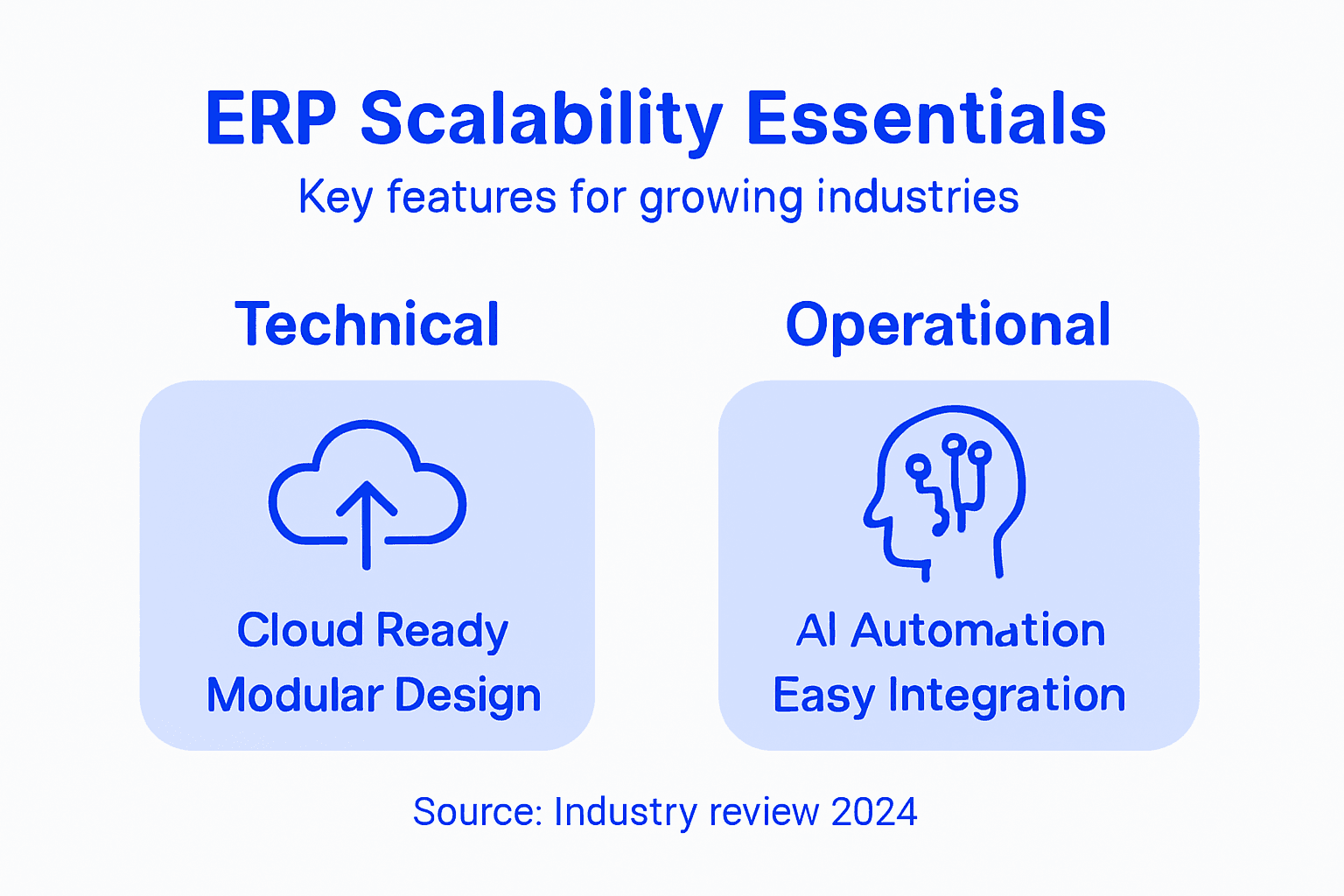
Technical scalability focuses on infrastructure capabilities, allowing businesses to expand computational resources dynamically. This includes horizontal scaling (adding more servers) and vertical scaling (enhancing existing server capabilities). Functional scalability represents the system’s ability to integrate new modules, support additional business processes, and adapt to evolving industry requirements. In regions like the Middle East with rapidly transforming healthcare and construction sectors, this flexibility becomes crucial for maintaining competitive advantage.

Composable ERP approaches introduce a revolutionary perspective on scalability, breaking traditional monolithic systems into modular, replaceable components. This strategy enables organizations to customize their ERP environment, adding or replacing specific functionalities without disrupting entire system architectures. Operational scalability completes this triad, addressing how ERP systems can adapt workflow processes, accommodate increased user loads, and maintain performance under expanding operational complexity.
To better understand ERP scalability, here is a comparison of its main dimensions and business impacts:
| Scalability Dimension | What It Involves | Business Impact |
|---|---|---|
| Technical | Expanding resources, flexible architecture | Supports growth without downtime |
| Functional | Adding modules, supporting new processes | Adapts to evolving market needs |
| Operational | Scaling users, complex workflows | Maintains high performance as workload increases |
Pro Tip: When assessing ERP scalability, prioritize solutions offering granular component interchangeability and seamless integration capabilities across your organization’s technological ecosystem.
Key Scalability Features and Mechanisms
Cloud-based ERP solutions represent a transformative approach to enterprise system scalability, particularly for organizations in Saudi Arabia and UAE’s dynamic Healthcare and Construction sectors. These advanced platforms integrate multiple sophisticated mechanisms that enable businesses to adapt and grow seamlessly, addressing the complex technological and operational challenges of modern enterprises.
The core scalability mechanisms include elastic computing resources, which allow organizations to dynamically adjust computational power based on real-time demand. Modular architecture plays a critical role, enabling businesses to add or modify specific system components without disrupting entire operational workflows. Composable ERP architectures take this concept further by providing granular control over system configuration, allowing enterprises to create custom technology ecosystems that precisely match their unique operational requirements.
Advanced AI integration represents another pivotal scalability mechanism, empowering ERP systems with intelligent automation capabilities. These AI-driven features can optimize process workflows, predict resource requirements, and automatically adapt system configurations to changing business landscapes. For Middle Eastern enterprises seeking competitive advantages, such intelligent scalability means the ability to rapidly respond to market shifts, regulatory changes, and emerging technological opportunities without significant infrastructure overhauls.
Pro Tip: Prioritize ERP solutions that offer flexible, modular architectures with built-in AI optimization to ensure your technological infrastructure can evolve alongside your business strategy.
Scalability in Real Healthcare and Construction Scenarios
Healthcare supply chain management demonstrates the critical importance of ERP scalability in real-world scenarios, particularly in Saudi Arabia and UAE’s rapidly evolving sectors. Organizations face unprecedented challenges that demand flexible technological infrastructures capable of adapting to complex operational requirements and sudden market shifts.
In healthcare settings, scalable ERP systems enable hospitals to manage fluctuating patient volumes, supply chain disruptions, and regulatory compliance with unprecedented efficiency. Digital technologies in construction projects reveal how scalable ERP solutions facilitate seamless integration of complex workflows, resource allocation, and real-time collaboration across multidisciplinary teams. Adaptive technology becomes crucial in managing intricate healthcare facility designs and construction projects that require precise coordination and dynamic resource management.
The practical implications of scalable ERP extend beyond mere technological flexibility. These systems provide organizations with the ability to rapidly deploy new modules, integrate emerging technologies, and respond to regional market dynamics without extensive system redesigns. For Middle Eastern enterprises in Healthcare and Construction, this means maintaining competitive advantage through technological resilience, enabling them to quickly adapt to changing regulatory landscapes, technological innovations, and operational requirements.
Pro Tip: Select ERP solutions with proven track records of seamless scalability and modular design to ensure your technological infrastructure can evolve as rapidly as your business strategy.
Risks, Costs, and Integration Challenges
ERP system implementation risks represent significant strategic considerations for organizations in Saudi Arabia and UAE’s Healthcare and Construction sectors. These complex technological transformations involve multifaceted challenges that extend far beyond simple software deployment, requiring comprehensive risk management and strategic planning.
The primary integration challenges stem from technical compatibility, data migration complexities, and organizational resistance to technological change. Scalability investments often necessitate substantial upfront costs, including infrastructure modifications, staff training, and potential operational disruptions. Cloud-based ERP integration challenges further highlight critical concerns such as data privacy, security vulnerabilities, and potential vendor lock-in scenarios that can significantly impact long-term technological strategy.
Organizations must conduct thorough risk assessments that evaluate not just technological capabilities, but also cultural adaptability, financial sustainability, and alignment with strategic objectives. This holistic approach involves analyzing potential performance bottlenecks, understanding total cost of ownership, and developing robust mitigation strategies that address potential scalability limitations. For Middle Eastern enterprises, this means creating flexible implementation roadmaps that can accommodate regional regulatory requirements and technological ecosystem variations.
This table highlights common ERP scalability risks and effective mitigation strategies:
| Risk Area | Example Challenge | Mitigation Strategy |
|---|---|---|
| Data Migration | Complex legacy conversions | Use phased, validated data transfers |
| Integration | Compatibility with other systems | Implement open standard interfaces |
| Cost Management | High initial investment | Adopt scalable, cloud-based pricing |
| Change Management | Resistance from users | Provide training and clear communication |
Pro Tip: Conduct comprehensive pre-implementation risk assessments and develop phased deployment strategies that allow incremental system integration and continuous performance evaluation.
How to Evaluate and Ensure ERP Scalability
ERP evaluation strategies require a comprehensive approach tailored to the unique technological landscapes of Saudi Arabia and UAE’s Healthcare and Construction sectors. Organizations must move beyond superficial assessment criteria and develop a robust methodology that critically examines an ERP system’s potential for sustained growth and adaptability.
The evaluation process demands a multidimensional assessment framework. Technical scalability metrics should include performance load testing, infrastructure flexibility, and computational resource allocation capabilities. Key evaluation dimensions encompass horizontal scaling potential (adding computational nodes), vertical scaling capacity (enhancing existing infrastructure), and the system’s ability to integrate emerging technologies seamlessly. Enterprises must analyze not just current technological requirements, but project potential operational complexities three to five years into the future.
Effective scalability evaluation extends beyond technical parameters to include organizational readiness and strategic alignment. This involves assessing cultural adaptability, workforce technological competence, and alignment with long-term business objectives. For Middle Eastern organizations, this means understanding regional regulatory environments, linguistic requirements, and the specific workflow complexities inherent in Healthcare and Construction industries. Organizations should develop comprehensive evaluation frameworks that include quantitative performance metrics and qualitative organizational compatibility assessments.
Pro Tip: Create a detailed scalability evaluation scorecard that weighs technical capabilities, integration potential, and strategic alignment to make holistic ERP selection decisions.
Unlock Scalable Growth with Expert ERP Solutions
Scaling your ERP system is critical to overcoming challenges like managing increasing transaction volumes, integrating new business units, and adapting to evolving regulations in Healthcare and Construction sectors. The article highlights the importance of modular, cloud-based architectures and AI-driven optimization to maintain performance and operational efficiency as your organization grows. At Singleclic, we specialize in delivering precisely these scalable, flexible ERP solutions customized for businesses in KSA, UAE, and Egypt.
Our expertise in ERP & CRM Implementation (Odoo, Microsoft Dynamics 365) combined with advanced Business Process Automation using IBM BAW & BonitaSoft empowers your enterprise to evolve technology seamlessly. Through our unique low-code platform Cortex, designed specifically for MENA enterprises, we enable real-time workflow optimization without downtime. With over 10 years of regional experience, we help you conquer scalability risks like integration challenges and high costs while accelerating growth.
Don’t let outdated ERP systems hold your Healthcare or Construction business back. Visit Singleclic today and discover how our scalable enterprise solutions drive operational resilience and future-proof your technology infrastructure. Get in touch now to start transforming your growth journey with trusted regional experts.
Frequently Asked Questions
What is ERP scalability?
Scalability in ERP systems refers to the ability of the system to expand its processing power, storage capacity, and functional capabilities as an organization’s requirements evolve. It ensures that the ERP can grow alongside the business without major disruptions.
Why is scalability important for ERP systems in Healthcare and Construction?
Scalability is important in these sectors because it allows organizations to manage increasing transaction volumes, accommodate more users, and adapt to changing regulatory requirements efficiently. This flexibility is essential for keeping pace with industry demands.
What are the main dimensions of ERP scalability?
The main dimensions include technical scalability, which focuses on infrastructure capabilities; functional scalability, which allows integration of new modules; and operational scalability, which addresses user loads and workflow processes. Each dimension plays a crucial role in supporting organizational growth.
What features should I look for in a scalable ERP solution?
Key features to consider include elastic computing resources, modular architecture for easy expansion, and advanced AI integration for optimizing workflows and adapting to changing business needs. These features help ensure that the ERP system can evolve with the organization.