TL;DR:
- 74% of enterprise migrations fail to achieve expected ROI due to poor planning and weak governance.
- Successful migration depends on strategy, discipline, and choosing appropriate approaches like lift-and-shift, replatforming, or refactoring.
- Partner-led migrations and thorough preparation significantly increase success rates and long-term cloud benefits.
Over 74% of enterprise migrations fail to meet their expected return on investment, not because of bad technology, but because of poor planning and weak governance. Yet cloud adoption is accelerating faster than ever across KSA, UAE, and Egypt, with organizations racing to modernize legacy systems and unlock new competitive advantages. The gap between those who succeed and those who struggle is not about budget size or vendor selection. It is about strategy, alignment, and execution discipline. This guide breaks down what cloud migration really means, which approaches work best for enterprises, and what you need to do to land on the right side of those statistics.
Table of Contents
- What is cloud migration and why it matters for enterprises
- Cloud migration approaches and the strategic framework
- Risks, challenges, and overcoming poor ROI in cloud migration
- Cloud migration success: Practical strategies for enterprise leaders
- Editorial perspective: What most enterprises miss about cloud migration ROI
- Unlocking digital transformation: Next steps for C-level leaders
- Frequently asked questions
Key Takeaways
| Point | Details |
|---|---|
| Cloud migration is vital | Moving to the cloud drives scalability and innovation for enterprises. |
| Planning avoids failure | Strong strategy and planning significantly reduce budget and timeline risks in migration. |
| Partner for success | Partner-led migrations outperform DIY, increasing chances of achieving ROI. |
| Continuous optimization matters | Post-migration improvement and skills training unlock enterprise value and ROI. |
What is cloud migration and why it matters for enterprises
Cloud migration is the process of moving your organization’s digital assets, including data, applications, workloads, and infrastructure, from on-premise or legacy systems to cloud-based environments. It is not simply a technology upgrade. It is a strategic shift that changes how your business operates, scales, and competes.
For enterprise leaders in the MENA region, this shift carries significant weight. 94% of enterprises now use cloud services, and the global cloud services market is projected to reach $31.5 billion in 2026. The question is no longer whether to migrate, but how to do it well. Understanding the cloud role in digital transformation is the first step toward making that decision confidently.
“Cloud migration is not a destination. It is the foundation on which your digital transformation is built. Organizations that treat it as a one-time project rather than an ongoing capability consistently underperform.” — Tamer Badr, Singleclic
Why enterprises migrate to the cloud:
- Scalability: Instantly scale compute and storage resources up or down based on business demand, without capital expenditure.
- Cost optimization: Shift from fixed infrastructure costs to a variable, consumption-based model that aligns IT spend with actual usage.
- Innovation velocity: Access to advanced services like AI, machine learning, and analytics that would take years to build on-premise.
- Business continuity: Cloud platforms offer built-in redundancy and disaster recovery capabilities that legacy systems rarely match.
- Regulatory compliance: Leading cloud providers offer region-specific data residency options, which is critical for banking and government sectors in KSA and UAE.
- Remote and hybrid work: Cloud-native applications support distributed teams without the performance penalties of VPN-dependent legacy systems.
| Driver | On-premise limitation | Cloud advantage |
|---|---|---|
| Scalability | Hardware procurement cycles | Instant elastic scaling |
| Innovation | Long development cycles | Ready-made AI and analytics services |
| Cost model | High fixed capital costs | Pay-as-you-go flexibility |
| Resilience | Single points of failure | Built-in redundancy and failover |
The strategic case is clear. But execution is where most enterprises stumble, and that is what the rest of this guide addresses.
Cloud migration approaches and the strategic framework
Not every workload should be migrated the same way. Choosing the right approach for each application or system is one of the most important decisions you will make during planning.
The three primary migration strategies:
| Approach | Description | Best for | Complexity |
|---|---|---|---|
| Lift-and-shift | Move workloads as-is to the cloud with minimal changes | Legacy apps needing quick migration | Low |
| Replatforming | Make targeted optimizations to leverage cloud capabilities | Apps needing moderate modernization | Medium |
| Refactoring | Redesign and rebuild applications as cloud-native | High-priority apps requiring full optimization | High |
Each approach involves trade-offs between speed, cost, and long-term benefit. Lift-and-shift is fastest but delivers the least optimization. Refactoring takes longer but produces the most cloud-native outcomes. Most enterprise migrations use a combination of all three, depending on the workload priority.
The four key migration phases:
- Strategy: Define business goals, identify workloads, and select the right cloud model (public, private, or hybrid).
- Planning: Conduct a detailed discovery of your current environment, assess dependencies, and build a migration roadmap with clear milestones.
- Execution: Migrate workloads in prioritized waves, test thoroughly at each stage, and maintain rollback options.
- Optimization: Post-migration, continuously review performance, costs, and security to realize the full value of the cloud investment.
One of the most significant factors in migration success is whether you work with an experienced partner or attempt it independently. Partner-led migrations succeed at a 71% rate compared to just 49% for DIY efforts. That 22-point gap is not trivial. It represents millions in potential cost overruns and months of lost productivity. An efficient migration workflow built around proven methodology makes a measurable difference, and solid IT project planning is what separates the 71% from the 49%.
Pro Tip: Bring your key stakeholders, including finance, operations, HR, and legal, into the migration planning process from day one. Migrations that fail often do so because IT made decisions in isolation. Cross-functional alignment prevents costly surprises during execution.
Risks, challenges, and overcoming poor ROI in cloud migration
The numbers are sobering. 31% of projects miss timelines, 38% exceed budgets by an average of 23%, and 74% fail to deliver the expected ROI. These are not edge cases. They represent the majority of enterprise migration efforts globally, and the pattern holds across industries.
Understanding why migrations fail is the first step to avoiding the same outcome.
Top migration mistakes that derail projects:
- Poor discovery and planning: Underestimating the complexity of existing environments, including hidden dependencies and technical debt, leads to scope creep and budget overruns.
- Weak governance: Without clear ownership, decision-making authority, and escalation paths, projects stall when problems arise.
- Security gaps: Migrating workloads without a security-first mindset creates vulnerabilities. Reviewing data protection mistakes before you begin is essential.
- Insufficient testing: Rushing through testing phases to hit deadlines results in performance issues and system failures post-migration.
- Neglecting post-migration optimization: Many organizations declare victory once workloads are in the cloud, then wonder why costs are higher than expected. The cloud is not self-optimizing.
- Change management failures: End users who are not prepared for new systems resist adoption, which directly undermines the ROI case.
“The 74% ROI failure rate is not a technology problem. It is a planning and people problem. The organizations that beat those odds invest as much in governance and change management as they do in the technical migration itself.” — Tamer Badr, Singleclic
You can reduce these risks significantly with a few deliberate choices. First, invest in a thorough discovery phase before committing to a migration timeline. Second, establish a migration governance board with representation from IT, finance, and business units. Third, build a clear communication plan that keeps all stakeholders informed at every stage. Reviewing cloud workflow success rates from comparable projects gives you realistic benchmarks to plan against.

Pro Tip: Create a dedicated risk register for your migration project. Document every identified risk, its likelihood, its potential impact, and the mitigation plan. Review it weekly during execution. This single habit dramatically improves your ability to catch problems before they become crises.
Cloud migration success: Practical strategies for enterprise leaders
The good news is that 65% of migrations are completed on time and within budget when the right practices are in place. That means success is absolutely achievable. It just requires deliberate preparation and disciplined execution.
Steps for a successful enterprise cloud migration:
- Preparation: Conduct a full inventory of your current environment. Map every application, its dependencies, its data flows, and its business criticality. This is your migration blueprint.
- Partnership: Select an experienced migration partner with a proven track record in your industry and region. Verify their methodology, not just their credentials.
- Execution: Migrate in waves, starting with lower-risk workloads. This builds team confidence, surfaces hidden issues early, and allows you to refine your process before tackling mission-critical systems.
- Review: After each migration wave, conduct a structured review. Measure performance against your baseline, assess cost variances, and capture lessons learned before proceeding.
- Optimization: Treat post-migration optimization as a permanent discipline, not a project phase. Set up cost monitoring, performance dashboards, and regular architecture reviews.
Understanding the full range of enterprise cloud benefits helps you build a more compelling internal business case and set realistic expectations with your board. Equally important is establishing cloud security best practices from the start, since security incidents post-migration are one of the fastest ways to erode stakeholder confidence.
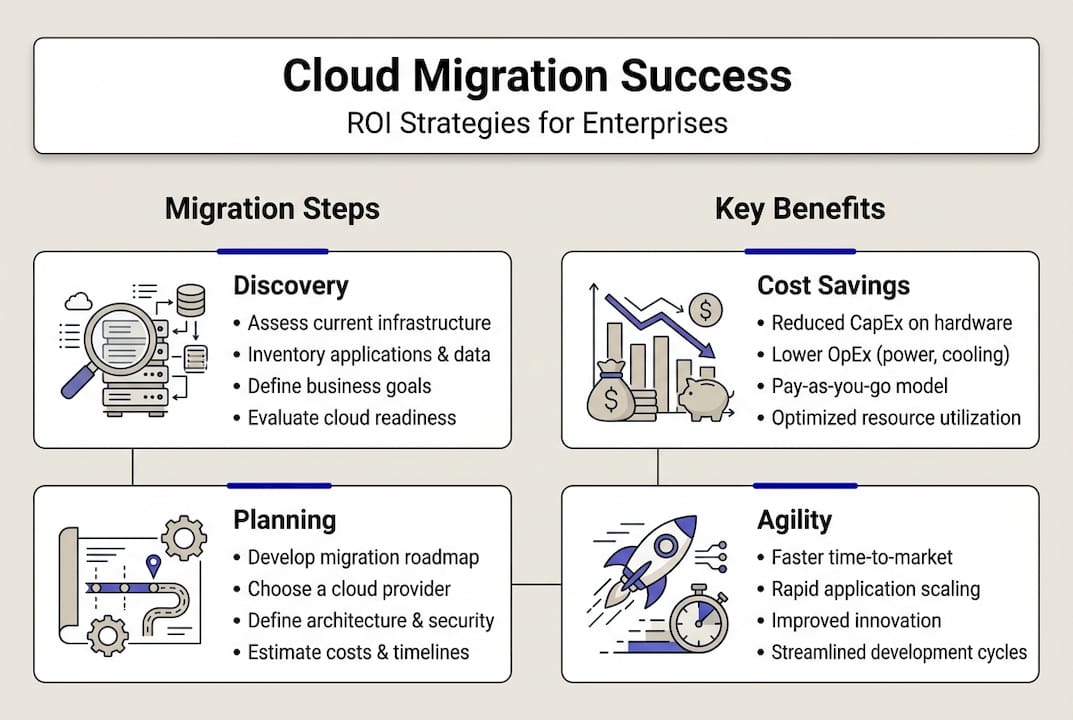
Statistical callout: Organizations that follow a structured, partner-led migration methodology complete their projects on time and within budget at a 65% rate, compared to significantly lower rates for unstructured, DIY approaches.
Pro Tip: Invest in cloud skills training for your IT team before and during the migration, not after. Teams that understand cloud-native concepts make better decisions during execution and are far more effective at post-migration optimization. This is one of the highest-return investments you can make in your migration program.
Editorial perspective: What most enterprises miss about cloud migration ROI
Here is something most migration guides will not tell you: the technology is rarely the problem. After working with enterprise clients across KSA, UAE, and Egypt, the pattern we see repeatedly is that organizations invest heavily in selecting the right cloud platform and the right tools, then underinvest in the human and organizational side of the equation.
Change management is not a soft skill. It is a hard business requirement. When your finance team does not understand the new reporting environment, or your operations managers resist the new workflow tools, your ROI evaporates regardless of how technically sound the migration was.
The contrarian truth is this: the organizations that achieve the best outcomes from cloud migration are not always the ones with the biggest budgets or the most sophisticated technology stacks. They are the ones that treat cloud’s real impact as an organizational transformation, not just an IT project. They invest in culture, capability, and continuous improvement as seriously as they invest in infrastructure.
Success in 2026 and beyond belongs to leaders who understand that the cloud is a platform for ongoing optimization, not a finish line.
Unlocking digital transformation: Next steps for C-level leaders
Cloud migration is one piece of a much larger digital transformation picture. The organizations that extract the most value from their cloud investments are those that connect migration to broader operational improvements, from process automation to AI-driven decision-making.
At Singleclic, we work with enterprise leaders across KSA, UAE, and Egypt to build migration strategies that deliver real, measurable outcomes. Whether you are just beginning to map your cloud journey or looking to optimize an existing cloud environment, our team brings the regional expertise and technical depth to guide you. Explore our digital transformation office resources, review our C-level transformation roadmap, or learn how business process automation can amplify the value of your cloud investment.
Frequently asked questions
What are the main types of cloud migration?
The main types of migration are lift-and-shift, replatforming, and refactoring. Each offers a different balance of speed, cost, and long-term cloud optimization potential.
Why do most cloud migration projects fail to meet ROI expectations?
74% of migrations miss their ROI targets primarily because of poor upfront planning, weak governance structures, and a failure to invest in post-migration optimization and change management.
How can enterprises improve the success rate of cloud migration?
Partnering with an experienced provider raises success rates from 49% to 71%. Combining that with structured project planning and continuous post-migration review produces the strongest outcomes.
What is the typical timeline and budget risk for enterprise cloud migration?
31% of projects miss their planned timelines, and 38% exceed their budgets by an average of 23%, typically due to underestimated complexity and insufficient discovery work before migration begins.
Recommended
- Common Mistakes in Cloud Data Protection: What Businesses Must Avoid in 2025 | Singleclic
- Digital solutions driving 10x ROI for KSA and UAE enterprises
- Cloud Migration Workflow: 84% Avoid Overruns, 30% Efficiency
- Why Cloud Adoption Transforms Enterprise Operations
- Cloud storage costs for video creators: 2026 guide