TL;DR:
- Most digital transformation projects in the Gulf fail due to neglecting structured change management.
- Effective change management can boost ROI, employee engagement, and leadership credibility.
- Culturally adapted frameworks like Lewin’s and Kotter’s models, combined with visible leadership, drive success.
Technology budgets are growing across Saudi Arabia and the UAE at a record pace, yet 60% of transformation projects stall before delivering measurable results. The reason is rarely the software. It is almost always the people, the culture, and the leadership behaviors surrounding the rollout. For C-level executives driving Vision 2030 initiatives or UAE National Agenda priorities, this is a costly blind spot. Change management is not a soft add-on to your digital roadmap. It is the engine that determines whether your investment creates lasting value or collects dust in a project post-mortem report. This guide breaks down what the data says, what proven models look like in Gulf context, and what you should do right now.
Table of Contents
- The real cost of neglecting change management
- How structured change management drives transformation results
- Cultural factors: Why context matters more than the model
- Practical steps: Building a change-ready organization
- The uncomfortable truth: Why most digital initiatives fail (and how to do better)
- Turn change management insight into transformation action
- Frequently asked questions
Key Takeaways
| Point | Details |
|---|---|
| Change management is decisive | Neglecting change management causes most digital projects to fail or stall in the Gulf region. |
| Culture dictates strategy | Adapting frameworks to local leadership and workforce culture is essential for transformation success. |
| Leadership drives adoption | Active C-level sponsorship and communication can boost transformation results by 40% or more. |
| Actionable steps matter | Structured, evidence-based change initiatives paired with continuous feedback drive lasting impact. |
The real cost of neglecting change management
With the challenge established, it is critical to quantify what is actually at stake. Digital transformation failure is not an abstract risk. It is a budget line that disappears with nothing to show for it.
Consider the pattern across the Gulf: organizations invest millions in ERP rollouts, cloud migrations, and AI-powered platforms, only to find that employees resist new workflows, middle managers quietly revert to old systems, and the promised efficiency gains never materialize. The key risks for Gulf leaders are well-documented, and neglecting structured change management sits at the top of that list.
Here is what the numbers actually say:
| Risk factor | Impact on transformation projects |
|---|---|
| No formal change management | Up to 70% lower ROI |
| Weak executive sponsorship | Projects stall within 6 months |
| Poor communication strategy | Employee adoption drops below 40% |
| Cultural resistance unaddressed | Budget overruns average 25-40% |
The pattern becomes even sharper in KSA and UAE. High-context communication norms, hierarchical decision-making, and a multigenerational workforce create a uniquely complex environment. When transformation success factors are ignored, the consequences are visible and fast:
- Stalled projects: Teams continue parallel manual processes alongside new systems indefinitely.
- Lost engagement: High-performing employees disengage when change feels imposed rather than co-created.
- Wasted budget: Licensing fees, implementation costs, and training investments yield no measurable output.
- Leadership credibility gaps: When projects fail visibly, executives lose political capital for future initiatives.
The leadership and efficiency boost data confirms it: the gap between organizations that manage change deliberately and those that treat it as secondary is not marginal. It is transformational.
The uncomfortable math is this: if you are spending $5 million on a digital transformation initiative and you skip structured change management, you are effectively gambling the full $5 million on your employees figuring it out themselves. Most won’t.
How structured change management drives transformation results
Understanding the cost, leaders must next know what actually works. Two models consistently produce results in the Gulf context, each offering a different but complementary approach.
Kurt Lewin’s three-stage model is the more foundational of the two. It breaks change into Unfreeze, Change, and Refreeze. The Unfreeze phase is where most Gulf leaders underinvest. It requires disrupting the status quo deliberately, creating psychological readiness before any new system goes live. According to Frontiers in Psychology, Lewin’s model is effective in the Saudi industrial sector when transparent communication, participation, and training are integrated alongside cultural factors.
Kotter’s 8-step model offers a more granular process. As change management research confirms, it provides a structured methodology specifically suited for large-scale digital transformation change. The eight steps move from creating urgency through anchoring new practices in organizational culture.
Here is how both models apply practically:
- Create urgency: Use real business data to show the cost of not changing.
- Build a guiding coalition: Identify respected influencers across departments, not just the IT team.
- Communicate the vision clearly: Every employee should understand what success looks like and why it matters to them.
- Enable action: Remove structural blockers. Outdated approval processes kill new system adoption fast.
- Generate short-term wins: Celebrate early milestones publicly. This is especially effective in high-context Gulf cultures where collective recognition carries weight.
- Sustain momentum: Reinforce new behaviors through performance frameworks.
- Anchor change: Update job descriptions, KPIs, and onboarding to reflect new ways of working.
A strong regional example comes from ADNOC’s culture transformation in the UAE, which we cover in more detail in the next section. The result of managed, structured change was not just engagement metrics. It was financial.
Pro Tip: Appoint a digital leader from each business unit as a change champion. These individuals translate the executive vision into daily team language, closing the communication gap that kills most rollouts.
Investing in digital upskilling alongside your change program is not optional. Employees who feel competent in new systems become advocates. Those who feel left behind become resistors.

Cultural factors: Why context matters more than the model
While structure is vital, local context can make or break change efforts in the Gulf. Applying a Western-designed change framework in KSA or UAE without cultural adaptation is one of the most common and costly mistakes regional executives make.
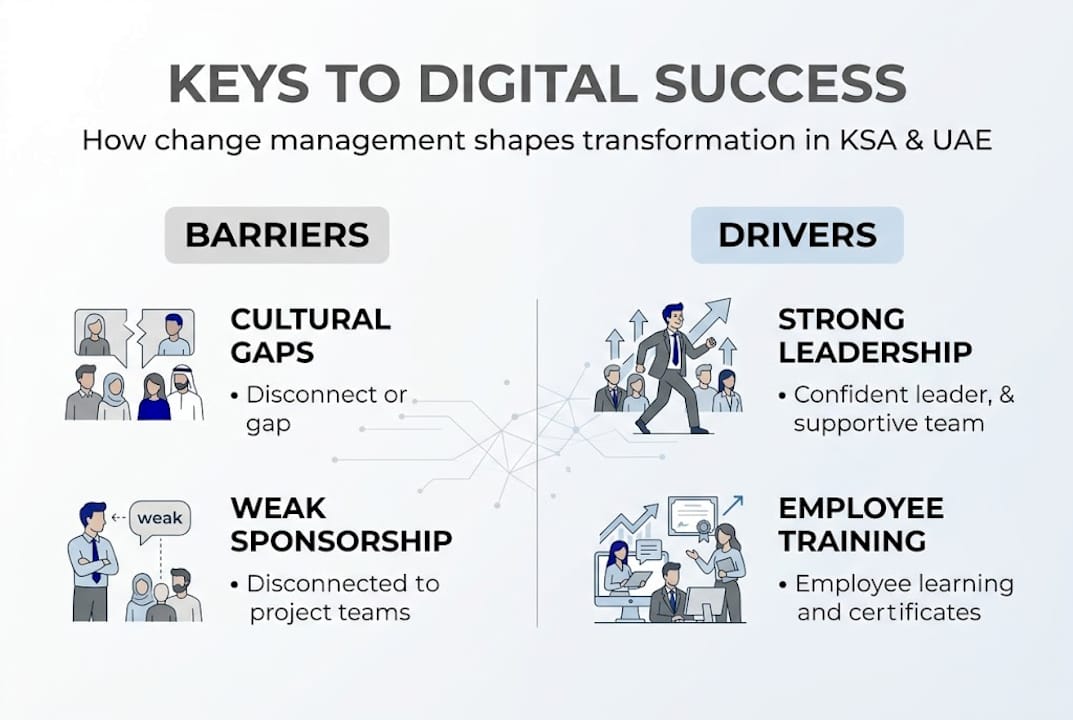
Saudi Arabia and the UAE both feature high power distance, meaning employees are less likely to voice disagreement with leadership openly. They are also more collectivist, meaning group consensus and peer influence drive behavior more than individual incentives. Cultural resistance rooted in traditionalism and hierarchy requires culturally responsive strategies. Without them, resistance compounds quietly until it becomes visible failure.
The types of resistance you should expect include:
- Traditionalism: Long-tenured employees who have built expertise around existing systems may view new tools as a threat to their status.
- Fear of transparency: New digital systems often increase visibility of individual and team performance, which can feel threatening in hierarchical cultures.
- Communication barriers: When change messaging comes only from the top in formal Arabic or corporate English, it loses meaning for frontline teams.
- Misaligned incentives: If managers are still evaluated on old metrics, they will not champion new behaviors.
Responsive strategies for the Gulf include:
- Participative decision-making: Involve respected team leads and senior individual contributors in system design decisions early. This is not consultation theater. It must be genuine input that shapes outcomes.
- Transparent, layered communication: Use multiple channels and languages. An executive town hall in formal Arabic followed by line manager briefings in team-specific contexts works far better than a single top-down announcement.
- Visible leadership role modeling: When senior leaders visibly use new platforms and reference them in meetings, adoption accelerates across all levels. This is supported by research on culture and change in the regional context.
Pro Tip: Before any major system launch, map your informal influence network. In Gulf organizations, the most influential people in a change effort are rarely the ones with the biggest titles. Identify and engage them first.
Keeping pace with top digital trends means nothing if your people are not ready to adopt them. Cultural readiness is your fastest path to ROI, and it requires deliberate investment, not just good intentions.
Practical steps: Building a change-ready organization
Now that the importance of context is clear, what should effective change leadership look like in practice? Here is an actionable playbook built specifically for executives in KSA and UAE.
Step-by-step change leadership actions:
- Define and communicate a clear vision: Before any technology goes live, articulate what success looks like for the organization and for each team. Vague goals create vague commitment.
- Establish governance early: Create a change steering committee that includes HR, operations, IT, and at least one C-level sponsor who is visible and active, not ceremonial.
- Invest in targeted upskilling: Training must be role-specific and delivered in accessible formats. Generic digital literacy sessions produce minimal behavior change.
- Manage resistance proactively: Identify resistors early through pulse surveys and one-on-one conversations. Engage them rather than bypass them.
- Measure what matters: Track adoption metrics, not just system usage. Are employees using the new tools in ways that change outcomes?
Inclusive leadership and adaptive change management raise digital transformation success rates by 40% in KSA and UAE. That is not a soft metric. That is the difference between a project that delivers ROI and one that becomes a cautionary case study.
The ADNOC example is the clearest regional proof point. Their culture transformation program, anchored in structured change management, increased employee engagement from 67% to 74% and leadership effectiveness from 60% to 74%, while saving AED 50 million. The financial return from investing in people and process was not marginal. It was massive.
Must-have leadership behaviors for maximizing buy-in:
- Communicate change rationale in terms of employee benefit, not just organizational strategy.
- Be visible at every critical milestone: launches, training sessions, go-live dates.
- Address resistance publicly and with empathy, not defensiveness.
- Reward early adopters with recognition that carries cultural weight.
- Use your transformation roadmap to track and communicate progress consistently.
Embed continuous improvement by building formal feedback loops into your project governance. Monthly retrospectives, adoption dashboards, and open channels for frontline input are not bureaucratic overhead. They are the mechanism that keeps your digital strategy elements alive beyond the launch date. Research on digital impact in banks confirms that sustained adoption, not initial deployment, is what drives measurable performance gains.
The uncomfortable truth: Why most digital initiatives fail (and how to do better)
After the actionable playbook, it is time for a candid reflection on what most guides miss.
Most change management programs fail not because the framework was wrong but because it was treated as a project phase rather than a permanent leadership practice. Executives sign off on a change management plan, assign it to HR, and return to their operational priorities. Then they are surprised when the transformation stalls six months in.
The real issue is that culturally adapted change requires ongoing executive presence, not just initial sponsorship. In the Gulf, where authority and visibility carry significant cultural weight, your absence signals that the change is no longer a priority. Teams read that signal fast.
As Tamer Badr, founder of Singleclic, puts it: “The organizations we see succeed in the region are the ones where the CEO talks about the transformation every single week, not just at the launch event. Sustained, visible sponsorship is the single biggest predictor of success we observe across our client engagements.”
Checklists and frameworks are tools, not substitutes for conviction. Leadership transformation requires as much focus on motivation and meaning as on process and technology. If your people do not understand why the change matters to them personally, no model in the world will move them.
Turn change management insight into transformation action
You now have the framework, the evidence, and the cultural context to lead digital transformation with confidence. The next step is building the organizational infrastructure to make it sustainable.
Singleclic helps C-level leaders across KSA, UAE, and Egypt move from insight to implementation. Whether you are designing your governance structure, automating core workflows, or scaling a full transformation program, our team of 70+ consultants brings regional expertise to every engagement. Explore the Digital Transformation Office Guide to structure your transformation function, use our C-Level transformation roadmap to sequence your priorities, or review our process automation guide to identify rapid-win opportunities. Reach out to start a conversation built around your specific context.
Frequently asked questions
How does change management impact digital transformation ROI?
Effective change management drives ROI by increasing employee adoption, reducing stalled projects, and protecting implementation budgets. Digital transformation in Saudi banks shows a direct correlation between transformation maturity and financial performance metrics.
What are the top reasons digital transformation projects fail in Saudi Arabia or UAE?
Weak executive sponsorship, cultural resistance, and poor communication are the primary failure drivers. Nearly 60% of projects stall in KSA and UAE when change management is absent or underfunded.
Which change management model is best for Gulf region organizations?
Kurt Lewin’s and Kotter’s models both deliver results when adapted for local culture. Lewin’s model works especially well in Saudi industrial contexts when participation and transparent communication are built into each stage.
Can culture limit digital transformation in the Middle East?
Yes. High power distance and collectivist norms can slow or block change when strategies are not culturally adapted. Culturally responsive approaches are essential, not optional, in Saudi and UAE transformation programs.
What immediate actions should leaders take to boost change readiness?
Align change programs with strategic goals, communicate the vision in language that resonates with each team, and invest in targeted upskilling. Adaptive leadership behaviors raise transformation success rates by 40% in the region.