TL;DR:
- Most Gulf organizations mistakenly believe launching a mobile app, call center, and website creates an omnichannel experience. True omnichannel depends on shared data, context, and seamless customer journeys across all channels. Success requires deep backend integration, unified customer identities, and continuous data orchestration tailored to the MENA market.
Most business leaders in the Gulf believe they have cracked the omnichannel experience simply by launching a mobile app alongside their call center and website. That belief is costing them customers. The omnichannel experience is not about the number of channels you operate; it is about whether those channels share data, context, and continuity so that a customer who starts a conversation on WhatsApp can finish it at a branch without repeating themselves. For organizations in Saudi Arabia, the UAE, and Egypt competing in increasingly digital markets, understanding this distinction is not optional. It is the difference between customer loyalty and customer churn.
Table of Contents
- What is omnichannel experience and why does it matter
- The operational backbone: why integration is key to true omnichannel unity
- Distinguishing multichannel from omnichannel: a comparison and implications
- The role of technology architecture and data orchestration in omnichannel success
- Applying omnichannel strategies in MENA: practical considerations and benefits
- Our perspective: omnichannel is a data strategy, not a channel strategy
- Ready to build a real omnichannel experience for your organization?
- Frequently asked questions
What is omnichannel experience and why does it matter
Omnichannel experience is a customer experience strategy that creates connected and consistent interactions across every channel and touchpoint a customer uses. That means web, mobile app, social media, physical store, and call center all operate from the same customer data, delivering a continuous journey rather than isolated episodes.
Think about what this looks like from the customer’s perspective. A retail banking client in Riyadh checks their loan status on the mobile app during their commute. They call customer service from the car. They arrive at the branch an hour later to sign documents. In a true omnichannel setup, the call center agent already knows about the app inquiry, and the branch officer sees the full interaction history. No one asks, “Can you repeat your account number?” That kind of experience builds real trust.
Now contrast that with what most organizations actually deliver. A customer reaches out via email, receives a generic response, then calls in and is transferred twice while starting from scratch. That is not an omnichannel experience. That is fragmented service wearing the costume of digital transformation.
The distinction matters because of what it costs you operationally and commercially. Here is what a well-executed omnichannel strategy delivers:
- Higher customer retention because clients do not feel abandoned between channels
- Reduced agent handling time since representatives have full context before the first word is spoken
- Consistent brand messaging across every interaction, not just the marketing layer
- Better cross-sell and upsell opportunities because you understand the customer’s journey holistically
- Faster issue resolution which directly lowers operational costs
An omnichannel marketing strategy extends these benefits beyond service into how you communicate, promote, and personalize offers. When marketing, sales, and operations share one customer view, revenue opportunities multiply.
The operational backbone: why integration is key to true omnichannel unity
Understanding what omnichannel is only gets you halfway there. The harder question is what makes it work. The answer is backend integration, and most organizations underestimate how deep it needs to go.

Omnichannel requires an underlying architecture of shared data, connected workflows, and one unified view of the customer’s journey to prevent mixed messages and customer frustration. Without this, your channels may look coordinated from the outside but operate as independent silos internally.
Consider a telecom company in the UAE that launches a self-service portal for billing alongside its existing IVR and retail stores. If the portal updates billing data in one system and the IVR pulls from another, a customer who pays online may still receive an overdue call. That is not an edge case. That is what happens when channels are added without digitizing the underlying operations that connect them.
The operational consequences of siloed channels include:
- Broken promises at fulfillment when a web order confirmation does not match warehouse inventory
- Repeated customer identification across interactions, which signals internal disorganization
- Inconsistent pricing or offer delivery when sales tools do not sync with CRM records
- Agent frustration from working with incomplete or contradictory data
“The single biggest failure point in omnichannel projects we see across the region is not the front-end experience. It is the absence of a unified data layer underneath it.” — Tamer Badr, Singleclic
Pro Tip: Before investing in any new customer-facing channel, audit whether your existing systems can share real-time updates with it. If a new channel cannot read from and write to your central customer record, you are building a silo, not an omnichannel operation.
Distinguishing multichannel from omnichannel: a comparison and implications
The terms multichannel and omnichannel are often used interchangeably, which is a significant strategic error. Understanding what is multichannel experience versus omnichannel changes how you allocate technology investment and measure customer experience outcomes.
Multichannel offers multiple channels but with no conversation continuity, while omnichannel connects those channels for fluid, uninterrupted interactions. The practical difference is enormous.
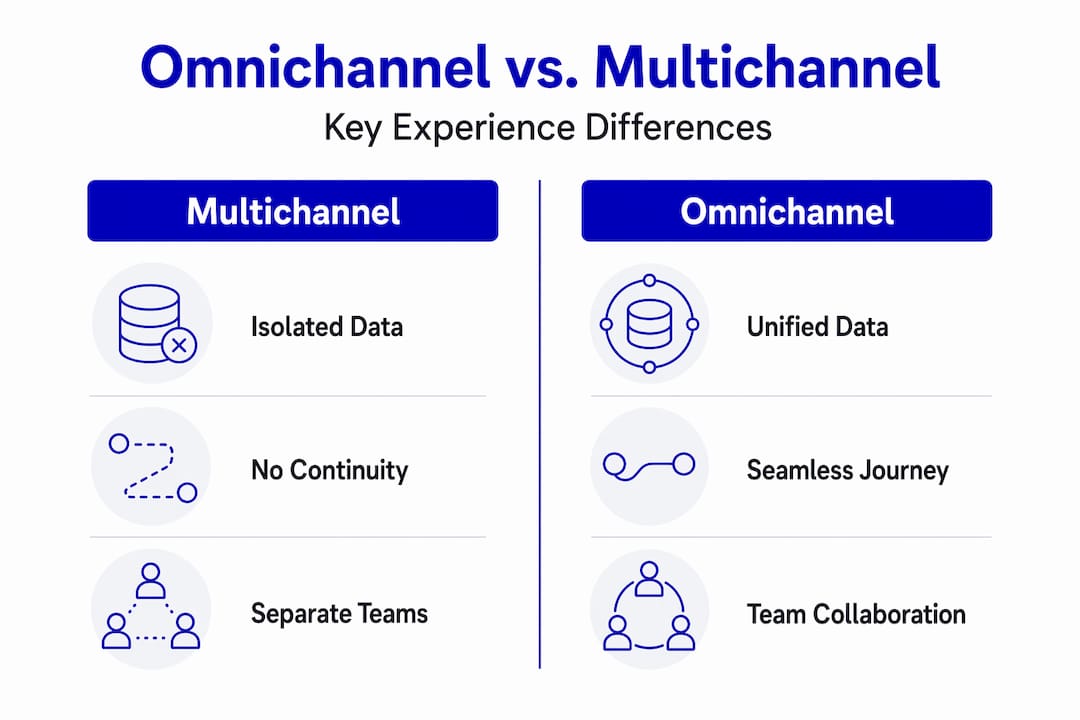
| Dimension | Multichannel | Omnichannel |
|---|---|---|
| Data sharing | Each channel holds separate data | All channels draw from one customer record |
| Customer context | Starts fresh on every channel | Carries full history across channels |
| Staff experience | Agents work with channel-specific views | Agents see one unified journey timeline |
| Personalization | Generic, channel-specific messaging | Context-aware, behavior-driven messaging |
| Operational complexity | Lower initial setup | Higher setup, lower long-term cost |
| Customer effort | High (repeat themselves often) | Low (context travels with them) |
The implications of this table matter more than the table itself. Decision-makers who invest in multichannel thinking they have achieved omnichannel end up with more technology spend, more customer complaints, and less actionable data. The channels multiply but the intelligence does not.
For a retail organization in Saudi Arabia running a loyalty program, the gap is immediately visible. A multichannel retailer might track loyalty points separately in-store and online, forcing customers to manage two balances. A true omnichannel vs multichannel comparison reveals that the omnichannel retailer consolidates both into one program that updates in real time, regardless of where the transaction happened.
Key implications for MENA decision-makers:
- Do not count channels as a proxy for experience quality. Four connected channels outperform ten disconnected ones every time.
- Customer expectations in the Gulf are high. Saudi and UAE consumers routinely switch providers after a single frustrating service interaction.
- Superficial multichannel setups create data debt that becomes progressively harder to unify as you scale.
The role of technology architecture and data orchestration in omnichannel success
True omnichannel means implementing a backend that maintains continuity with shared customer identity and journey data. But what does that actually require from a technology standpoint? The architecture beneath a functioning omnichannel experience has several non-negotiable components.
-
Single customer identity management. Every customer must have one persistent ID recognized across web, mobile, CRM, and in-store systems. Without this, the same person appears as different records in different channels, and unified experience becomes impossible.
-
Real-time event handling. Customer actions, a purchase, a complaint, a page visit, must trigger immediate updates across connected systems. Batch-processing data overnight breaks the continuity that omnichannel promises.
-
An orchestration layer. This is the decision engine that routes customer interactions intelligently based on current context. If a customer just submitted a complaint, the orchestration layer should suppress promotional outreach automatically and route the next interaction to a resolution specialist.
-
Governance and explainability. Every automated decision in the journey must be traceable. If a customer is denied a service or receives an incorrect offer, your team must be able to identify exactly which data point or rule triggered that outcome.
-
CRM-powered personalization. Your CRM is not just a contact database. In an omnichannel architecture, it becomes the engine for personalized journey delivery based on behavioral signals, purchase history, and service interactions.
Pro Tip: When evaluating platforms for omnichannel deployment, look specifically for probabilistic identity matching capabilities. Deterministic matching (based on email or phone) works well in controlled environments, but real customer journeys involve anonymous browsing, multiple devices, and shared accounts. Probabilistic matching connects these fragments into one coherent profile.
Applying omnichannel strategies in MENA: practical considerations and benefits
With the architecture understood, the question shifts to execution. How do you actually build omnichannel in markets like Saudi Arabia and the UAE, where enterprise complexity, Arabic language requirements, and regulatory environments add real constraints?
Operational truth must match customer-facing promises, particularly in inventory accuracy and fulfillment across channels. That is the starting point for MENA retailers, banks, and telecom providers deploying omnichannel strategies.
Here is a practical implementation sequence:
- Consolidate customer identity first. Before adding channels, unify your existing customer records across CRM, ERP, and service systems into one master profile.
- Centralize inventory and fulfillment data. If a customer can order online and pick up in-store, both systems must reflect real-time availability.
- Select a low-code platform in MENA that supports Arabic UI and on-premise deployment. Speed of deployment matters in competitive markets, and low-code tools improve agility significantly.
- Deploy channel by channel, not all at once. Start with the two or three channels your customers use most frequently, get the data flow right, then expand.
- Measure channel-switching rates. If customers are forced to repeat information when moving between channels, that is your signal that the integration is incomplete.
The benefits of omnichannel experience vary by industry. Here is how they play out across key MENA sectors:
| Industry | Primary benefit | Typical MENA use case |
|---|---|---|
| Retail | Unified loyalty programs | Online purchase, in-store pickup with consistent rewards |
| Banking | Reduced complaint resolution time | App inquiry resolved at branch without re-verification |
| Telecom | Lower churn through proactive engagement | Usage alerts on app followed by contextual upgrade offer via SMS |
| Healthcare | Appointment continuity | Referral from portal completed at clinic without paperwork duplication |
| Government | Faster citizen service delivery | Online form submission with in-person follow-up tracked in one system |
Pro Tip: Customer identity consolidation is the highest-leverage starting point in MENA markets. Organizations that solve this first reduce their average inquiry handling time significantly, because agents stop spending the first two minutes of every interaction locating the right customer record.
Our perspective: omnichannel is a data strategy, not a channel strategy
After working with enterprise clients across KSA, UAE, and Egypt for over a decade, one pattern is unmistakable. Organizations that succeed at omnichannel think of it as a data and process challenge first, and a technology or channel challenge second.
The conventional framing leads leaders to ask, “Which new channels should we add?” The better question is, “How well do our existing channels share data, and where does that sharing break down?” Adding a sixth channel to five broken ones does not improve the experience. It compounds the problem.
What we see at Singleclic is that the organizations making genuine progress are the ones willing to do the unglamorous work upfront: mapping every customer touchpoint, auditing every data handoff, and identifying every point where context is lost. That diagnostic work is not exciting. But it is what separates omnichannel in practice from omnichannel as a PowerPoint ambition.
The MENA context adds specific complexity. Arabic language support, on-premise data residency requirements for government and banking clients, and the speed at which consumer expectations are evolving in Saudi and UAE markets all demand that your omnichannel foundation be genuinely solid. A platform that delivers omnichannel in English but fragments the experience in Arabic is not actually omnichannel for your market.
The businesses we see winning are treating omnichannel as a continuous capability, not a project with a launch date. They iterate, they measure channel-switching friction, and they invest in governance so the system stays coherent as it scales. That mindset is what “Beyond Digitalization, Elevating Through Optimization” means in practice.
Ready to build a real omnichannel experience for your organization?
Understanding the theory is the easy part. Turning omnichannel into a working reality across your CRM, ERP, service channels, and customer touchpoints requires the right technology partner and the right platform.
At Singleclic, we have helped enterprise clients across Saudi Arabia, the UAE, and Egypt build genuine omnichannel foundations using Microsoft Dynamics 365, Odoo, and our own Arabic-enabled low-code platform, Cortex. Cortex is built specifically for MENA enterprises, supporting full Arabic UI, on-premise deployment for regulated industries, real-time process updates, and deep integration with your existing systems. Whether you are starting with customer identity unification or deploying a full orchestration layer, our team of 70+ consultants and engineers is ready to help you move from disconnected channels to a connected customer experience that actually delivers.
Connect with our team at Singleclic to start the conversation.
Frequently asked questions
What is the difference between omnichannel and multichannel customer experience?
Omnichannel connects all communication channels so customer context travels seamlessly between them, while multichannel simply offers multiple channels with no integration, resulting in fragmented, repetitive interactions.
Why is backend integration crucial for effective omnichannel strategies?
Backend integration creates the shared data and workflows that allow every team and system to see the same customer journey, which prevents inconsistent service and reduces customer churn.
How can low-code platforms benefit omnichannel implementation in MENA?
Low-code platforms significantly improve business agility and cut deployment time, making it faster for MENA organizations to integrate channels and deliver connected customer experiences without heavy custom development.
What is the first step in building an omnichannel customer journey?
Unify your customer identity data across all existing systems before adding new channels. Without one master customer profile, every new touchpoint you add will deepen fragmentation rather than reduce it.
Which MENA industries benefit most from omnichannel strategies?
Banking, telecom, retail, healthcare, and government all see measurable gains, particularly in complaint resolution speed, customer retention, and operational cost reduction, when they implement a properly integrated omnichannel approach.