Batch processing fits bounded data you can collect and analyze on a schedule, while event-driven processing fits unbounded streams that need a response in milliseconds or seconds. Most enterprises end up running both, using batch for reporting and machine learning training, and event-driven pipelines for fraud alerts or live personalization. The real test is whether your data has a known end point, and this guide walks through the trade-offs, use cases, and a decision checklist to help you pick correctly.
TL;DR:
- Batch processing is ideal for reporting and machine learning training when data has a clear end point, while streaming is necessary for real-time fraud detection and personalization.
- Streaming systems respond within milliseconds to seconds but are more costly and complex to operate, requiring careful design for exactly-once processing and handling late events.
- Hybrid approaches like Lambda and Kappa are optimal based on whether your data is bounded or unbounded, with a cautious path recommending pilot testing one high-value streaming use case first.
- Critical implementation factors include watermarks, schema management, idempotency, and processing semantics, which determine pipeline reliability and scalability.
- Before building, evaluate business latency tolerances, data continuity, operational costs, and team skill levels to choose the simplest, least expensive architecture that meets your needs.
Table of Contents
- Batch vs event-driven: why boundedness decides everything
- Comparing the trade-offs: latency, cost, state, and debugging
- When to use batch, streaming, or a middle ground
- Hybrid patterns: Lambda, Kappa, and where teams go wrong
- Tooling and implementation details that decide success
- A quick checklist before you commit to an architecture
- Why pragmatism beats architecture purity
- How Singleclic helps you build the right pipeline
- Sources
- FAQ
Batch vs event-driven: why boundedness decides everything
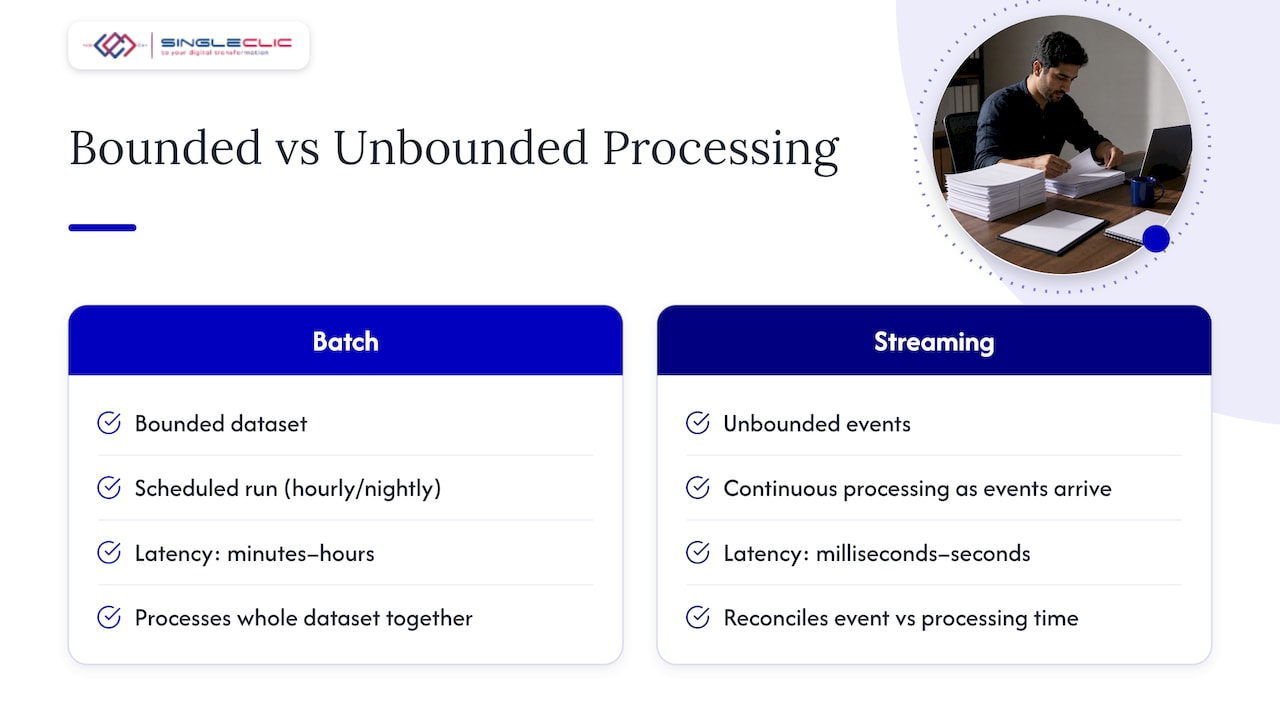
Batch processing works on a bounded dataset: a fixed set of records collected over a period, then processed together in a scheduled run, often nightly or hourly. Event-driven, or streaming, processing works on unbounded data: events keep arriving indefinitely, and the system processes each one, or small groups of them, continuously as they land.
That distinction drives everything downstream. Batch typically runs in minutes to hours, while streaming responds in milliseconds to seconds, and that latency gap shapes cost, tooling, and team structure.
Streaming systems also have to reconcile event time (when something actually happened) with processing time (when the system saw it). Because events can arrive late or out of order, streaming platforms use watermarks to decide when a time window can be considered complete, trading a bit of latency for correctness. Get this wrong, and your real-time dashboard quietly reports incomplete numbers as if they were final.
Comparing the trade-offs: latency, cost, state, and debugging
Once you accept the bounded versus unbounded split, the practical differences fall into four buckets that matter to anyone signing off on architecture.
- Latency and business value: batch processes with longer delays suit scenarios like finance reporting, while real-time processing that responds within seconds or milliseconds is essential for urgent use cases like fraud detection.
- Cost and operational model: streaming infrastructure typically runs 24/7 with persistent brokers and consumers, while batch jobs can be scheduled and shut down between runs, which usually makes streaming the more expensive default. Micro-batching splits the difference, running small batches every few seconds to minutes when sub-minute freshness is enough.
- State and consistency: exactly-once processing is achievable in modern streaming platforms, but it requires deliberate design, including checkpointing and deduplication, since the alternative, at-least-once delivery, can produce duplicate events that downstream logic must handle.
- Debugging and observability: batch failures are retrospective. You rerun the job against the same bounded input and inspect the output. Streaming failures happen live, against data that keeps moving, which makes reproducing an issue harder and puts more weight on logging, replay, and monitoring from day one.
None of these trade-offs is abstract. Each one shows up as a line item in your cloud bill or an incident in your on-call rotation within the first quarter of running the system in production.
When to use batch, streaming, or a middle ground
The use case usually tells you which architecture fits before you write a line of code.
- Batch fits reporting and machine learning training, where you need consistency across a full dataset rather than up-to-the-second freshness, and where dashboards built on batch-refreshed data still serve most operational reporting needs well.
- Event-driven fits fraud detection, real-time personalization, and IoT monitoring, where a delayed reaction has a direct cost, such as flagging a suspicious transaction before it clears.
- Micro-batching fits the middle ground, giving you near-real-time freshness, typically seconds to a few minutes, without the full operational overhead of a continuous streaming pipeline.
Before committing, ask your team five questions: How much latency can the business actually tolerate? Is the source data genuinely unbounded, or just frequent? What does an always-on pipeline cost against a scheduled one? Does the team have the skills to run stateful streaming jobs in production? And what happens, financially or operationally, if the answer arrives an hour late? If none of the answers demand sub-second response, start with batch and prove the business case for streaming before you build it.
Hybrid patterns: Lambda, Kappa, and where teams go wrong
Two architectural patterns dominate hybrid setups. Lambda runs a batch layer and a streaming layer side by side, giving you fast approximate results now and accurate reconciled results later. Kappa treats everything as a stream, including historical reprocessing, and relies on a replayable log as the single source of truth. The decisive factor between them is still whether your data has a known end: Lambda tends to persist in brownfield systems that need full-dataset shuffles for accuracy, while Kappa fits greenfield designs built around replayable event logs from the start.

The safest migration path is narrow: pick one high-value streaming path, pilot it, measure it, and expand only once it proves out. Resist rebuilding every batch job as a stream on principle. The most common anti-pattern is over-engineering: teams add streaming infrastructure for workloads that batch or micro-batching would have handled at a fraction of the cost, then duplicate business logic across both systems because nobody owns the reconciliation.
Pro Tip: Pilot one streaming use case end to end, including monitoring and replay, before you touch a second one.
Tooling and implementation details that decide success
The tools you pick follow directly from the pattern you choose. Batch workloads typically run on Spark or a workflow orchestrator handling scheduled jobs. Streaming workloads typically pair a durable broker such as Apache Kafka with a processing engine like Flink or Spark Structured Streaming.
A few implementation details separate a working pipeline from a fragile one:
- Event-time windows and watermarks determine how long you wait for late data before finalizing a window, directly affecting both accuracy and latency.
- Exactly-once versus at-least-once semantics dictate whether you need deduplication logic downstream or can rely on the platform’s guarantees.
- Schema registry and retention policy decide how long you can replay history and how safely producers and consumers evolve independently.
- Idempotency design at the consumer level protects you when, not if, an event gets delivered twice.
Get these four right early, and scaling the pipeline later is a capacity problem, not a rewrite.
A quick checklist before you commit to an architecture
Bring this into your next architecture review rather than debating in the abstract.
- Latency tolerance: can the business wait minutes or hours, or does it need a response in seconds?
- Data shape: is the source bounded and finite, or genuinely continuous?
- Cost and SLA tolerance: can you justify an always-on pipeline against its operational cost?
- Engineering maturity: does the team have experience running stateful streaming jobs in production?
For a pilot, scope it narrowly and track end-to-end latency, cost delta against the batch equivalent, error rate, and replay time after a failure. Before anything reaches production, require clear schema ownership, documented SLAs, and a runbook for replay and recovery.
Why pragmatism beats architecture purity
Across enterprise projects in the region, the pattern that works is pilot first, hybrid by design. Teams that commit to streaming everywhere before proving business value tend to spend more on infrastructure than they recover in speed. The ones that start with a single high-value streaming path, backed by solid batch foundations, scale with far less rework.
— Tamer Badr
How Singleclic helps you build the right pipeline
Choosing between batch and event-driven processing is rarely a one-time decision, it is a series of trade-offs that need revisiting as your data grows. We work with enterprises across various industries to design pipelines that match the business need rather than the trend.
- AI solutions and data analytics to identify which workloads genuinely need real-time processing versus scheduled reporting.
- Business process automation to connect event-driven triggers directly into operational workflows.
- A low-code platform to orchestrate approvals, ERP, CRM, and legacy systems without rebuilding them from scratch.
- Integration services to connect streaming or batch outputs directly into the systems teams already use daily.
If your team is weighing a pilot or reviewing an existing pipeline, visit our services page to schedule an architecture review.
Sources
- Batch vs Streaming Processing: Differences, Use Cases & Trade-Offs
- Streaming analytics | Apache Flink docs
- Exactly-once in Dataflow | Google Cloud Documentation
- Stream vs Batch Processing: Lambda, Kappa, and the End of That Debate – HLD Handbook
FAQ
What are the four types of data processing?
Data processing is commonly grouped into batch, real-time (streaming or event-driven), online transaction processing, and manual processing, though definitions vary by source. In enterprise architecture, the practical distinction that matters most is between batch and event-driven models, since they determine latency, cost, and tooling.
What does event-driven mean?
Event-driven means a system reacts to individual events, such as a transaction or a sensor reading, as they occur, rather than waiting for a scheduled batch. It relies on continuous, unbounded data flows and typically responds in milliseconds to seconds.
Is batch processing still used today?
Yes, batch processing remains widely used for reporting, machine learning training, and back-office workloads where a scheduled run is more cost-efficient than an always-on pipeline. Many enterprise pipelines still favor batch or micro-batching unless sub-second freshness delivers a proven business benefit.
What is the difference between batch processing and real-time processing?
Batch processing works on a bounded, finite dataset processed at scheduled intervals, typically taking minutes to hours. Real-time, or event-driven, processing works on unbounded, continuous data and responds in milliseconds to seconds, at the cost of higher operational complexity.
How does Singleclic help enterprises choose between batch and streaming?
Singleclic works with enterprise clients to assess which workloads need real-time responsiveness and which are better served by scheduled batch runs, then builds the pipeline and integration layer accordingly. This often includes connecting the result into existing ERP, CRM, or low-code workflows through Cortex or Singleclic’s Business Process Automation services.