Real-time process optimization automates monitoring and corrective action across ERP and CRM workflows, closing the gap between a process breaking down and someone fixing it. The immediate next step is simple: pick one high-volume approval process with clean event logs and run a 90-day pilot. Singleclic builds this capability on its Cortex platform, and the approach lines up with what the Deloitte Global Process Mining Survey 2025 found among enterprises already running these programs.
TL;DR:
- Real-time process optimization uses event-driven architectures to monitor workflows and automate corrective actions without waiting for batch updates.
- Pilots should focus on high-volume, low-regulatory-risk processes with clear KPIs, lasting between 90 to 180 days for effective measurement.
- Success relies on building canonical data models, ensuring data governance, and incrementally automating low-risk actions like alerts and routing.
- Enterprises pairing process mining with automation and AI gain more measurable value than those using mining solely for visibility purposes.
- Cortex, Singleclic’s low-code platform, enables integration with existing systems and supports deployments across MENA, including full Arabic UI and real-time workflow updates.
Table of Contents
- What real-time process optimization is and the value it creates
- Core components and architecture that make it work
- Data governance and interoperability requirements for regulated enterprises
- Implementation roadmap: pilot to scale with timeline and quick wins
- Measuring success: KPIs, ROI signals, and validation approaches
- Practical perspective: removing organizational blockers
- How Singleclic helps: Cortex, delivery model, and next steps
- Sources
- FAQ
What real-time process optimization is and the value it creates
In an enterprise context, real-time process optimization means continuously watching how work actually moves through your ERP and CRM systems, then automating the adjustments needed to keep it on track. This is different from industrial process control, and it has nothing to do with tuning physical equipment. It is about approvals, claims, onboarding, procurement, and the other workflows that run your business.
It also goes further than traditional robotic process automation or batch analytics. RPA replays fixed steps; batch analytics tells you what happened last month. Real-time process optimization builds a live map of your process, known as a digital twin, and uses it to catch problems as they form. The Deloitte Global Process Mining Survey 2025 found that process mining has moved from a niche analysis tool to a strategic enabler, and that organizations pairing it with execution features and AI get more measurable value than those who only model and observe.
The business outcomes leaders care about tend to cluster around a few themes:
- Faster approvals, with fewer manual handoffs slowing down each step.
- Higher throughput per employee as exceptions get routed automatically instead of queued.
- Better compliance, because every deviation is logged and traceable rather than discovered after the fact.
Core components and architecture that make it work
A real-time optimization program rests on a handful of layers that need to work together, not a single tool. Walking through them with your architects before a vendor conversation saves time later.
- Event capture: instrumenting ERP, CRM, and legacy systems to emit events as work happens, not just at batch close.
- Integration and streaming layer: an event-driven architecture that moves data to where it is needed without waiting for a nightly job.
- Canonical data model: a shared definition of what a “case,” a “customer,” or an “approval” means across systems.
- Process mining and analytics: the engine that reconstructs the real process flow from event logs, flagging bottlenecks and deviations.
- Decision engine: rules or AI models (often expressed in DMN) that decide what corrective action to trigger.
- Execution and runtime workflow: the layer that actually carries out the action, whether that is auto-approving a transaction or rerouting an exception.
- Observability and audit: logging every automated decision so it can be reviewed and defended later.
IBM’s process mining materials describe this digital twin as something that should support visualization, prescriptive analytics, and simulation, not just a static dashboard. Integration patterns matter as much as the components themselves: schema versioning, clear error and retry policies, and defined latency targets for each workflow determine whether the system holds up under real load. Enterprises that want a single governed platform for workflow, decisions, and process mining often look at architectures similar to IBM Cloud Pak for Business Automation, which bundles these layers rather than stitching them together piecemeal. Platforms like Polarising’s enterprise integration services illustrate the middleware patterns that make this kind of event flow reliable across legacy and cloud systems.
Pro Tip: Design your canonical events once and reuse them across every workflow; retrofitting a shared schema after three different teams have built their own is far more expensive than agreeing on it up front.
Data governance and interoperability requirements for regulated enterprises
Regulated sectors cannot treat governance as an afterthought. The UAE Digital Data Interoperability Implementation Guide sets out expectations that apply directly here: canonical models, validation rules, lineage tracking, and governance checkpoints before data moves reliably between entities in real time. Treat these as a checklist rather than a document to file away.
- Build a canonical data model and validation rules before connecting a second system to the first.
- Assign globally unique identifiers (GUIDs) to core entities so records stay traceable across ERP, CRM, and legacy platforms.
- Version every schema change and run it through a conformance gate in test and staging before it touches production.
- Define a RACI matrix early, naming who owns data quality, who approves model changes, and who signs off on go-live.
- Put data model changes through a named steward or governance owner, often framed as a Director of Data or DDGO role, before they ship.
Conformance sprints, short cycles dedicated purely to validating that data meets the agreed model, catch problems while they are cheap to fix rather than after a workflow has gone live on bad data.
Implementation roadmap: pilot to scale with timeline and quick wins
Most successful programs follow the same shape: a tight pilot, a short pause to measure, then a deliberate scale-out. Trying to automate everything at once is the most common way these programs stall.
- Select the pilot using four filters: high transaction volume, a clear KPI, accessible event logs, and low regulatory risk.
- Inventory and instrument, mapping the current process and wiring up event capture for the systems involved.
- Mine the process, letting the data reveal the actual flow, including the exceptions nobody documented.
- Automate incrementally, starting with low-risk corrective actions like SLA alerts and routing before touching approvals.
- Measure against baseline for 90 to 180 days, then decide what scales and what gets redesigned.
- Scale to adjacent processes, reusing the canonical model and integration patterns built in the pilot.
Quick wins worth aiming for during the pilot include automatic SLA breach alerts, auto-approval rules for low-value, low-risk transactions, and intelligent routing that sends exceptions to the right queue without a manual triage step. Bring in a center of excellence or an external integrator once the pilot proves out and scaling touches more than two or three systems: that is usually the point where in-house capacity alone starts to slip. A practical transformation framework for rolling out automation at scale is a useful reference for teams building this internal capability for the first time. For more tactical detail on sequencing quick wins, see 10 proven ways to optimize workflows in 2026.
Measuring success: KPIs, ROI signals, and validation approaches
The metrics that matter are the ones tied to how work actually flows: cycle time, throughput, exception rate, SLA adherence, and how quickly the team detects and resolves a problem (MTTD and MTTR). On the financial side, track cost per transaction, FTE hours recovered from manual exception handling, and any change in billing or cashflow velocity tied to faster approvals.
Enterprises that pair process mining with execution and AI features see more measurable operational value than those using mining for visibility alone, according to the Deloitte Global Process Mining Survey 2025. That single finding is why the roadmap above pushes toward automation early rather than treating mining as a standalone analytics exercise.
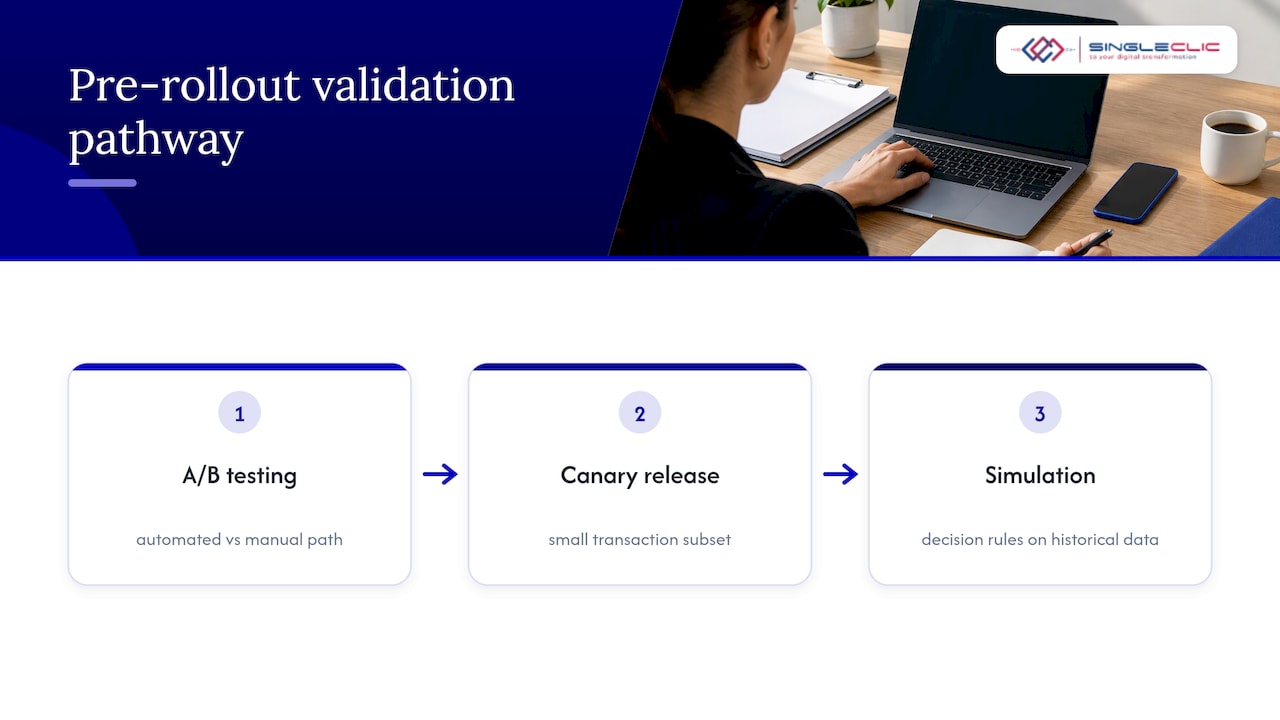
Before a full rollout, validate with A/B tests between the automated path and the manual one, canary releases to a small transaction subset, and simulation of the decision rules against historical data. For a fuller framework on tying this back to ROI, see enterprise workflow optimization and ROI.
Practical perspective: removing organizational blockers
The technology is rarely what kills these programs. Lack of a senior sponsor, ownership split across three departments, procurement that treats the pilot like a five-year platform decision, and messy source data do far more damage than any architecture gap.
The fix is unglamorous: name one executive sponsor, stand up a small center of excellence, budget the pilot as an experiment rather than a transformation, and insist on a data conformance sprint before anyone automates a decision. For government and regulated projects, get interoperability and procurement alignment settled before the pilot starts, not during it.
— Tamer Badr
How Singleclic helps: Cortex, delivery model, and next steps
If you want this capability without assembling six vendors yourself, specialized firms can provide end-to-end delivery. Experienced teams implement ERP, CRM, and automation projects for enterprise clients in KSA, UAE, and Egypt.
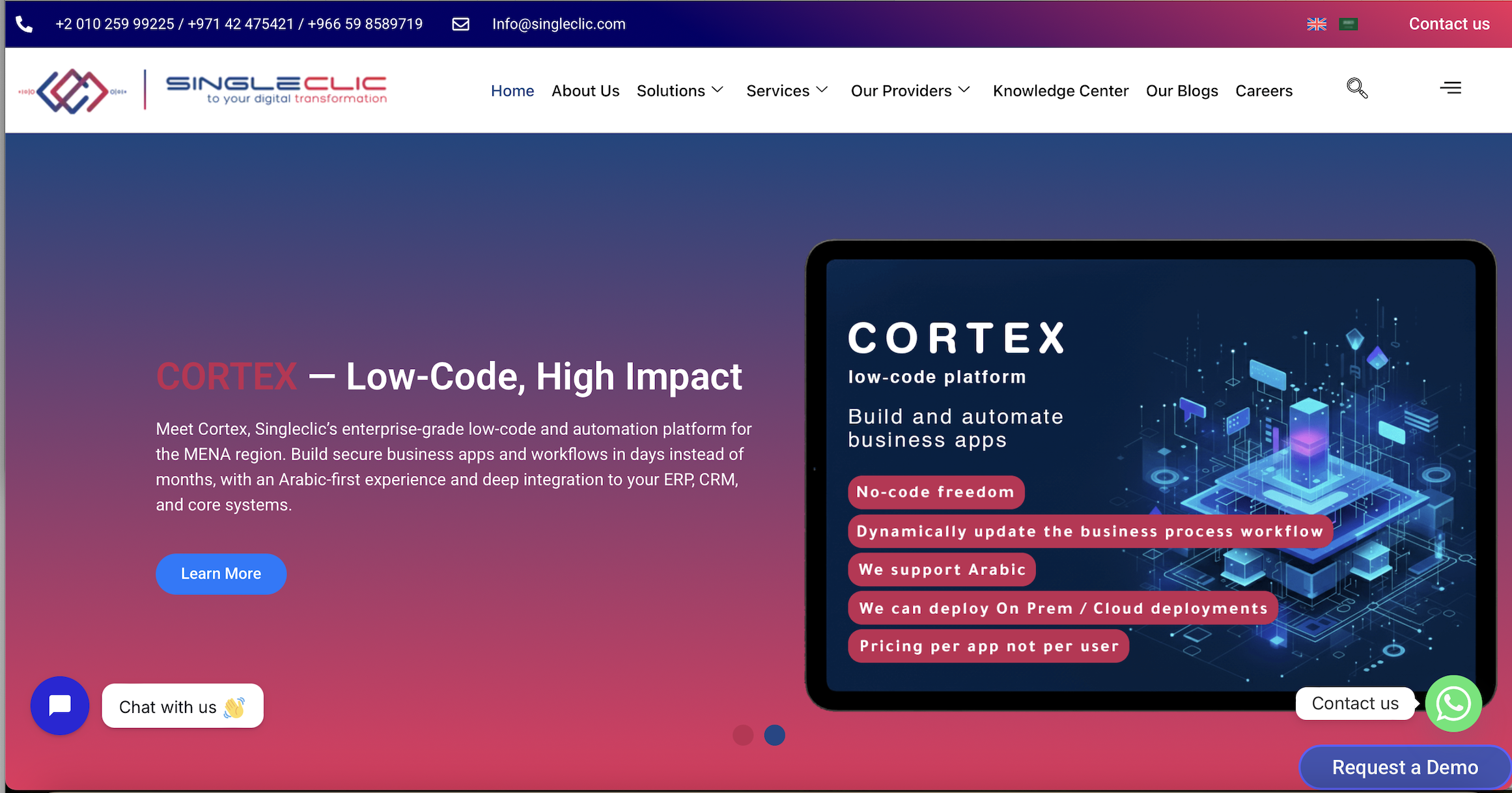
Cortex is an Arabic-enabled, on-premise low-code platform built for real-time process optimization in MENA enterprises:
- Runtime workflow changes without downtime, so corrections ship without a maintenance window.
- Full Arabic UI/UX with support for unlimited users, suited to government and banking deployments.
- Deep integration with ERP, CRM, and legacy systems already in place.
Combined with Singleclic’s Microsoft Dynamics 365 implementation work and IBM BAW expertise, Cortex gives your team one route from pilot to scale instead of a patchwork of point tools. Scope your pilot through Singleclic’s services overview to see where it fits your current stack.
Sources
FAQ
What is real-time process optimization in simple terms?
It means continuously watching how work moves through your ERP and CRM systems and automatically correcting problems, like a stuck approval or a missed SLA, as they happen rather than after the fact. It relies on process mining to build a live map of the process and a decision engine to trigger the fix.
How long does a pilot program typically take?
A well-scoped pilot generally runs 90 to 180 days, covering inventory, instrumentation, mining, incremental automation, and measurement against a baseline. The timeframe depends on how clean the event logs are and how many systems the pilot process touches.
What KPIs prove the program is working?
Cycle time, throughput, exception rate, SLA adherence, and mean time to detect and resolve issues are the core operational metrics. Cost per transaction and recovered staff hours are the financial signals that typically matter most to leadership.
Does this require replacing our ERP or CRM system?
No. Real-time process optimization layers event capture, integration, and a decision engine on top of your existing ERP and CRM systems rather than replacing them. Platforms like Cortex are built to integrate with what you already run.
How does Singleclic support a real-time optimization project?
Singleclic combines its Cortex low-code platform with Microsoft Dynamics 365 and IBM BAW implementation experience to design, build, and scale these programs for enterprises in KSA, UAE, and Egypt. Pilots are typically scoped through a services engagement rather than a fixed package, since the right starting point depends on your existing systems and data quality.