AI risk management is the discipline of identifying, assessing, treating and monitoring the risks an AI system creates, from the day you plan it to the day you retire it. For a UAE or Saudi executive, it works best as an extension of the enterprise risk, security and compliance routines you already run, with named owners, a living risk register and controls that sit inside the workflows where AI makes decisions. That last part is where we spend our time: at Singleclic we build the ERP, CRM and process automation layers where approvals, data and AI outputs meet.
TL;DR
- AI risk is operational, security and compliance risk. Treat it inside your existing enterprise risk framework, not as a separate technology project.
- Start with an inventory of every AI system, dataset and interface, then score each risk for likelihood and impact on a 5×5 matrix.
- Give every risk and every control one named owner, and choose one of four treatments: avoid, accept, mitigate or transfer.
- Monitoring never ends. Reassess at planned intervals and whenever the model, the data, the process or the threat changes.
- Controls work best when built into approval workflows and system integrations, so evidence is produced as work happens.
Table of Contents
- Article details
- What AI risk management covers
- The UAE rules and guidance that shape your program
- Building an AI governance framework that people follow
- Step by step: assessing and prioritizing AI risk
- What to put in an AI risk register
- Controls that sit inside the workflow
- Integrating with enterprise risk, privacy and security
- Monitoring, testing and incident response
- Use cases: where AI risk management shows up
- How Singleclic helps
- Perspective
- Start with a governed pilot
- FAQ
- Sources
Article details
- SEO title: AI risk management: a practical guide for UAE and Saudi leaders
- Slug: ai-risk-management-uae-saudi-guide
- Primary keyword: ai risk management
- Secondary keywords: ai governance framework, ai risk register
- Pillar cluster: Enterprise AI, governance and secure adoption in MENA
What AI risk management covers
The Abu Dhabi Department of Health describes its approach in its Responsible AI Risk Management Protocol as covering an initial assessment of deployed use cases and continuous monitoring of how they evolve and perform. The risks it names are a useful checklist for any sector: hallucinations (confident but fabricated outputs), data drift (the real-world data slowly stops matching the data the model learned from), cyberattacks, data breaches, biased training data, privacy exposure, reputational damage, financial impact and operational disruption. Patient safety is specific to healthcare, but the rest applies to a bank, a developer or a government entity.
For a Gulf organization, most of these risks are not abstract ethics questions. AI systems depend on data pipelines and outside vendors, and either can fail, be manipulated or leak sensitive information, as JOH Partners’ 2026 analysis of AI governance in the Gulf boardroom puts it. That framing helps a C-level reader: you already know how to manage operational and security risk. AI adds new failure modes to it.
Three situations create AI risk, and each needs a different control set:
- Building AI, where training data, model testing and release approval matter most.
- Buying AI, where supplier terms, data location and the vendor’s own change control matter most.
- Using AI, including staff using generative tools on their own, where policy, access and human review matter most.
Most organizations in the region are in the second and third situations. Your register should say which one each system belongs to.
The UAE rules and guidance that shape your program
There is no single UAE “AI law” that covers every company. What exists is layered: federal policy and strategy, data protection law, sector regulators and the financial free zones. Your obligations depend on what you do and where you are licensed.
- Central Bank of the UAE (CBUAE). Its Guidance Note on consumer protection and the responsible adoption and use of AI expects licensed financial institutions to maintain a documented AI/ML governance framework proportionate to their size, nature and complexity. The board and senior management are accountable for AI systems and outcomes.
- Federal cybersecurity. The National Cyber Security Policy for Artificial Intelligence calls for a governance framework covering secure design, development and operation, supply-chain risk management, an accurate inventory of AI/ML assets, patching, and continuous monitoring, testing and incident response.
- Health sector. The DoH protocol above sets a four-stage process for risk assessment, evaluation and treatment, monitoring and review, and communication and consultation.
- Data protection. Where personal data is involved, the federal privacy law and the DIFC and ADGM regimes apply according to where each entity sits. Our guide to digital compliance in KSA, UAE and Egypt maps how these obligations land on digital projects, and our piece on data privacy for executives in KSA and UAE covers the leadership side.
If you operate in Saudi Arabia as well, run the same process and map controls to Saudi requirements separately. Do not assume a UAE-compliant program carries over unchanged.
International references help you structure the work. The US NIST AI Risk Management Framework 1.0 organizes activity into four functions: Govern, Map, Measure and Manage. It treats Govern as a cross-cutting function that runs through the other three. You do not need to adopt it formally to borrow its vocabulary, and it gives your board a neutral reference.
Building an AI governance framework that people follow
An AI governance framework is the set of decisions, roles and rules that determine who may deploy AI, under what conditions and who answers when it goes wrong. The CBUAE guidance is specific about the shape: governance structures should support informed decisions, enable risk identification and mitigation, align AI with the institution’s risk appetite, and assign adaptable roles to the Audit and Risk Committee, Risk Management, Internal Audit and IT. Even if you are not a bank, this is a sound template.
Who owns what
NIST describes governing authorities setting policies that reflect mission, values and risk tolerance, with senior leadership setting the tone for risk culture and management aligning technical risk work to those policies. In practice, a workable split looks like this:
| Role | Accountable for |
|---|---|
| Board or executive committee | Risk appetite for AI, approval of high-impact use cases |
| CIO or CTO | Inventory of AI systems, architecture, integration, monitoring tooling |
| Chief risk officer or risk function | Scoring method, register, escalation thresholds |
| Legal, compliance and data protection | Regulatory mapping, impact assessments, supplier clauses |
| Business owner of each use case | Outcomes, human oversight, day-to-day exceptions |
| Internal audit | Independent testing of controls |
The Australian government’s AI adoption guidance makes the same point from outside the region: assign, document and communicate accountable people for every AI system, including third-party oversight, testing and redress, and document what happens when someone acts outside the defined risk appetite.
Two failures recur. The first is leaving AI to the technical team alone. The second is writing a policy that no workflow enforces. If a policy says high-risk outputs need human approval, there must be an approval step in the system where the work happens, with a record of who approved what.
Proportionate depth
A chatbot that drafts internal meeting notes does not need the scrutiny of a credit scoring model or a triage tool. Set depth by purpose, complexity, autonomy and the consequences for the people affected. Define two or three tiers, such as low, medium and high impact, and state which controls each tier requires. This keeps the program from stalling every pilot while still giving the serious systems real oversight.
Step by step: assessing and prioritizing AI risk
The process below follows the structure of the DoH protocol, which is among the most concrete official documents available in the UAE.
Step 1: inventory your AI assets
List every AI system, the data assets feeding it, the platforms it runs on and the interfaces it touches. Include tools adopted by departments without IT involvement. The DoH protocol begins here, and rates asset criticality from Low (1) to Very High (4) based on impact, in its case on patient safety. In your organization, use the business impact that matters most to you: customer harm, regulatory breach, financial loss or service outage.
What goes wrong: shadow AI. Supply chain and HR teams often start with a generative tool before any register exists. Ask each function head what they use.
Step 2: find threats and vulnerabilities
Examine the architecture, data sources, algorithms and operating environment of each system. Look at the full chain: where the data comes from, who can change it, which vendor hosts the model, how outputs flow into downstream systems such as ERP or CRM.
Step 3: score likelihood and impact
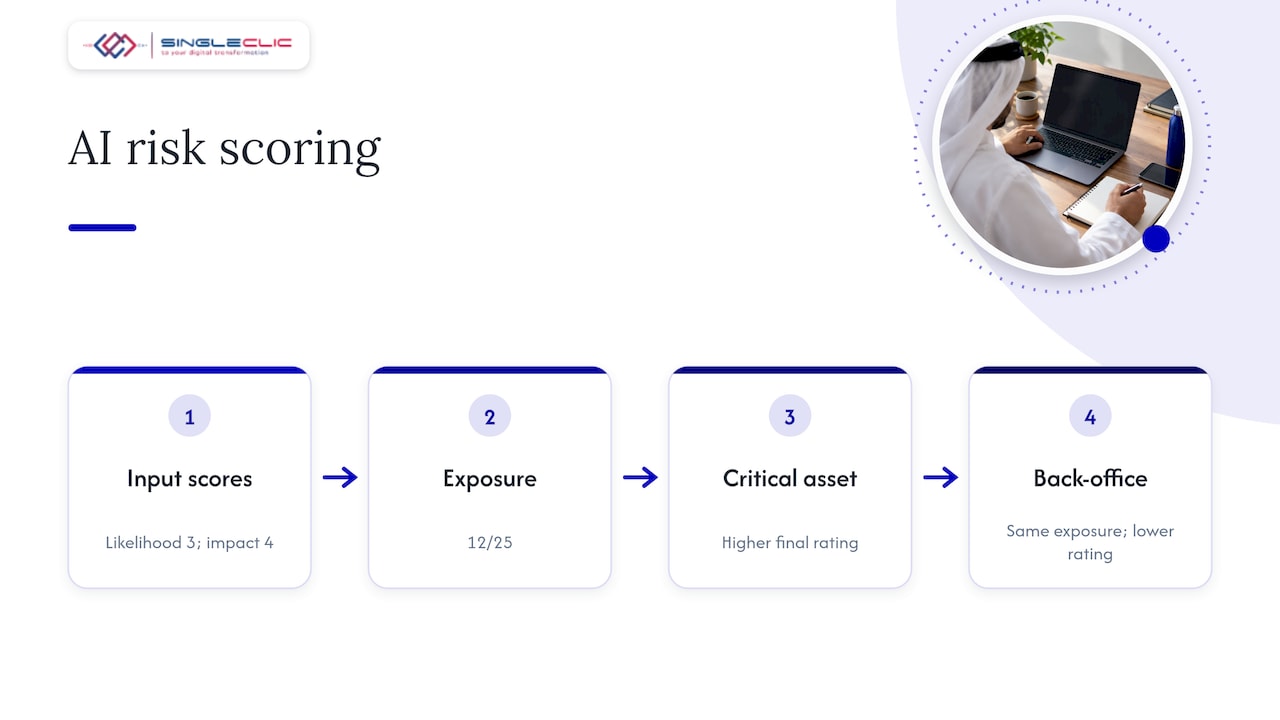
The protocol scores likelihood and impact from 1 to 5 on a 5×5 matrix, then combines the resulting exposure with asset criticality to rate the risk. A simple illustration, with figures of our own for demonstration: a demand forecasting model that feeds purchasing could have a likelihood of 3 (data drift is plausible after a supplier change) and an impact of 4 (stock-outs on critical items), giving an exposure score of 12 out of 25. Because the asset is critical to operations, it is rated higher than the same exposure on a back-office summarizer.
Step 4: choose a treatment
The DoH protocol sets four treatments:
- Avoid: a system with very high residual risk must not be implemented.
- Accept: within risk appetite, preferably only for low or very low risk.
- Mitigate: add controls until the residual risk is acceptable.
- Transfer: shift part of the exposure through insurance, service contracts or SLAs.
The EU’s data protection supervisor reaches the same four options in its November 2025 guidance on AI risk management, built on ISO 31000:2018, and adds that treatment is iterative: you reassess until residual risk is acceptable.
Step 5: assign owners and communicate
Each risk and each control gets a named owner responsible for evaluating and treating it over time. Communication is the fourth stage of the DoH protocol: leadership, regulators where relevant, and the teams running the systems all need the same picture.
What to put in an AI risk register
An AI risk register is the working record of all this. Keep it short enough that people update it. A useful entry includes:
| Field | Example |
|---|---|
| Risk ID | AI-014 |
| System and use case | Invoice matching model in finance |
| Category | Reliability, data quality |
| Description | Drift after a vendor format change causes wrong auto-approvals |
| Owner | Head of finance operations |
| Likelihood and impact (1 to 5) | 3 and 4 |
| Inherent and residual rating | High, then Medium after controls |
| Controls | Confidence threshold, human review above set value, weekly accuracy report |
| Treatment | Mitigate |
| Dates | Identified, last reviewed, next review |
The EDPS guidance describes the register as the product of risk identification, with analysis grading likelihood and impact and evaluation comparing results against risk appetite. Add one rule that many registers lack: a risk that stays above appetite after controls is escalated to a named executive, not left open.
Controls that sit inside the workflow
A control on paper is a hope. A control inside a process is evidence. These are the controls that matter most, and where they live.
- Human oversight. Route AI outputs above a value, risk score or sensitivity threshold to a person for approval. This belongs in the workflow engine, with the approver and time recorded.
- Data access and residency. Limit which data the model can see and where it is processed. Our guides on UAE data residency for enterprises and data security practices for IT teams in UAE and KSA go deeper.
- Supplier clauses. The UAE AI Ethics Guidelines, as summarized by Regulations.AI, recommend third-party supplier clauses, lifecycle risk assessments, pre-deployment checks and post-deployment monitoring. Put model change notification, incident reporting and audit rights in contracts.
- Testing before release. The DoH protocol says controls should be tested through simulations or pilot studies before full implementation.
- Fairness and robustness checks. The UAE AI Charter’s safety guidance, analyzed with KPMG, points to stress testing, adversarial testing, benchmarking and fair datasets.
- Deployment choice. For sensitive data, an on-premise or tightly controlled environment can be the control that settles the debate. Our article on what secure AI changes for organizations that cannot compromise on data control covers the options, and the guide to secure AI adoption in regulated industries takes it from policy to production.
Integrating with enterprise risk, privacy and security
A separate AI risk silo creates duplicated effort and gaps. The CBUAE’s integration guidance says AI tools should be part of the enterprise-wide risk management framework, that AI policies should complement rather than duplicate existing obligations, and that consumer risk from AI-driven models belongs in the conduct risk framework. It also asks institutions to rate each AI system on data quality and sensitivity, AI capability, controls, impact, and dependence on AI or third parties, and to consider independent third-party review of internally developed AI for suitability, security and reliability.
Translate that into three practical moves:
- Use the same scoring scale and risk appetite statements as your enterprise risk register, so AI risks roll up to the same board report.
- Link the AI register to your privacy impact assessments and your information security incident process, so one incident is not handled three times.
- Make risk committees able to challenge AI-driven processes. Board members do not need to read model code, but they should see a one-page summary of each high-impact system: purpose, data, owner, residual risk and last test.
Monitoring, testing and incident response
The DoH protocol calls for systematic reviews of treatment-plan progress, reassessment at planned intervals and whenever organizational, technological, business-process or threat changes occur, plus regular checks of control effectiveness with corrective actions verified against root causes. The lesson is that approval at launch is the start of the work.
A monitoring rhythm that works for most enterprises:
- Continuous: accuracy, error rates, drift indicators and access logs on high-impact systems.
- Monthly: exceptions reviewed by the business owner, including overridden AI outputs.
- Quarterly: register review, control testing on high-rated risks, report to the executive committee.
- On trigger: reassessment when a vendor updates a model, a data source changes, a regulation moves or an incident occurs.
For incidents, decide in advance who can suspend an AI system, who informs the regulator or affected customers where required, and how the lesson returns to the register. A runtime switch that can pause an automated step without taking down the whole process is worth more than a long incident policy.
Use cases: where AI risk management shows up
- Banking and financial services: credit, fraud and customer communication models fall under the CBUAE expectations, with board accountability and integration into enterprise risk.
- Healthcare: clinical and administrative AI needs asset criticality, continuous monitoring and clear escalation, as the DoH protocol shows.
- Supply chain: demand forecasting and inventory models carry drift and data quality risks. See our notes on AI in inventory and sales optimization and AI-powered workforce and inventory analytics.
- HR: screening, scheduling and workforce analytics raise bias and privacy questions that need human review and documented fairness checks.
- ERP and finance: AI inside the ERP, such as matching, forecasting and anomaly detection, needs approval thresholds and audit trails. Our AI ERP guide for UAE and Saudi Arabia explains where these decisions sit.
- Government: sensitive data and public accountability make on-premise deployment and documented oversight the default expectation.
For the wider executive agenda, our AI transformation guide for C-suite leaders sets AI risk next to strategy and investment.
How Singleclic helps
Singleclic has more than 10 years of digital delivery in the region, over 70 consultants and engineers across KSA, UAE and Egypt, and over 100 enterprise clients, including Emirates Health Services, Dubai Healthcare City and QNB. We work with Microsoft Dynamics 365, Odoo and IBM BAW, in sectors such as healthcare, banking, government, real estate and construction.
For AI risk management, our contribution is the layer where controls become operational:
- Approvals and oversight: business process automation that routes AI outputs to the right approver and keeps the record.
- ERP and CRM integration: Dynamics 365 implementation and integration, so AI outputs feed the systems of record in a governed way.
- Cortex: our Arabic-enabled, on-premise low-code platform for MENA enterprises, with full Arabic UI/UX, unlimited users, deployment for banks and governments, runtime workflow changes without downtime and deep integration with enterprise systems. You can read more on the Cortex low-code platform page.
- AI and data analytics: development of AI-powered business applications and analytics, within the governance you define.
Perspective
Most AI risk programs fail in the gap between the policy document and the daily process. A board approves a principle, and then nothing in the ERP, the CRM or the approval chain makes anyone follow it.
Our view is that governance has to be built where work happens. When a risk register says an output above a threshold needs human sign-off, the workflow should enforce it, log it and make it visible to risk and audit. That is why we connect approvals, ERP, CRM, data, legacy systems and workflows on one platform, Cortex, and why we take on-premise deployment seriously for banks and government entities that must keep control of their data.
For UAE and Saudi leaders, the practical start is modest: an inventory, a scoring method, named owners and one or two high-value use cases with controls you can show an auditor. Build from there.
Tamer Badr
Start with a governed pilot
If you have an AI inventory and a draft register, the next step is to put controls into one real process, such as invoice approval, procurement or customer onboarding, and measure the result. Our team can scope that with you across Dynamics 365, Odoo, IBM BAW or Cortex. Explore our AI, automation and low-code services or reach us through Singleclic.
FAQ
What is the difference between AI risk management and AI governance?
AI governance is the structure: policies, roles, committees and risk appetite. AI risk management is the working process inside it: identifying, scoring, treating and monitoring specific risks. The IAIF describes governance as a continuous cycle that cannot be assigned only to a technical team, legal department or external auditor, so both need executive ownership.
Do UAE companies need a formal AI risk framework?
It depends on your sector and license. The CBUAE expects a documented, proportionate AI/ML governance framework from the institutions it supervises, and the DoH has issued a protocol for the health sector. Other organizations should check the data protection law that applies to each entity, and a framework is still the clearest way to show control.
What should an AI risk register contain?
At minimum: a risk ID, the system and use case, category, description, a named owner, likelihood and impact scores, inherent and residual ratings, controls, the treatment decision and review dates. Add an escalation rule for risks that stay above appetite after controls.
How often should AI risks be reviewed?
Monitor high-impact systems continuously and review the register at planned intervals, such as quarterly. Also reassess whenever the model, the data, the business process or the threat environment changes, as the DoH protocol advises.
Can we manage AI risk if we use vendor AI and do not build models?
Yes, and most organizations are in this position. Inventory the vendor tools, score the risks from data exposure and dependence on the supplier, write change notification and audit rights into contracts, and place human approval steps in your own workflows around the vendor’s outputs.
Sources
- Responsible AI Risk Management Protocol, Department of Health Abu Dhabi
- Guidance Note on consumer protection and responsible adoption and use of AI, CBUAE Rulebook
- Integration with existing frameworks, CBUAE Rulebook
- National Cyber Security Policy for Artificial Intelligence, u.ae
- AI Risk Management Framework 1.0, NIST
- Guidance for risk management of artificial intelligence, EDPS
- Guidance for AI adoption: implementation guidance, Australian Government
- AI Governance in the Gulf Boardroom, JOH Partners
- UAE AI Ethics Guidelines, Regulations.AI
- The Future of AI Governance: the UAE Charter and global perspectives