Build–operate–transfer (BOT) is the right model when your organization wants a fully owned offshore development or IT services capability, has a horizon of at least 24 months, and needs direct control over intellectual property or regulated operations. Expect a build phase lasting a few months, an operate phase lasting one to several years, and a transfer window of a few months. The payoff shows up after handover, when you pay direct employment costs instead of vendor margin.
TL;DR:
- The build phase of BOT should be at least two years, with a minimum of 10 team members, to make the economics versus BPO favorable.
- Clear documentation, milestone approvals, and knowledge transfer processes are critical to prevent transfer failures.
- Contract clauses for transfer triggers, IP ownership, and post-transfer support greatly influence a smooth handover.
- Staff attrition, cultural mismatches, and incomplete documentation are common causes of transfer disruptions that can be mitigated with proper planning.
- Embedding client staff early, conducting regular documentation reviews, and using systems like Singleclic can improve transfer readiness and success.
Table of Contents
- When does the build operate transfer model actually make sense?
- The phase-by-phase checklist: build, operate, transfer
- Which contract clauses make or break the transfer?
- What actually causes BOT transfers to fail?
- What Singleclic’s regional delivery experience teaches about transfer readiness
- How Singleclic helps you run a transfer-ready BOT engagement
- Sources
When does the build operate transfer model actually make sense?
BOT is not the default answer for every offshore hiring decision. It earns its complexity when a specific combination of factors lines up, and it becomes the wrong tool when they don’t.
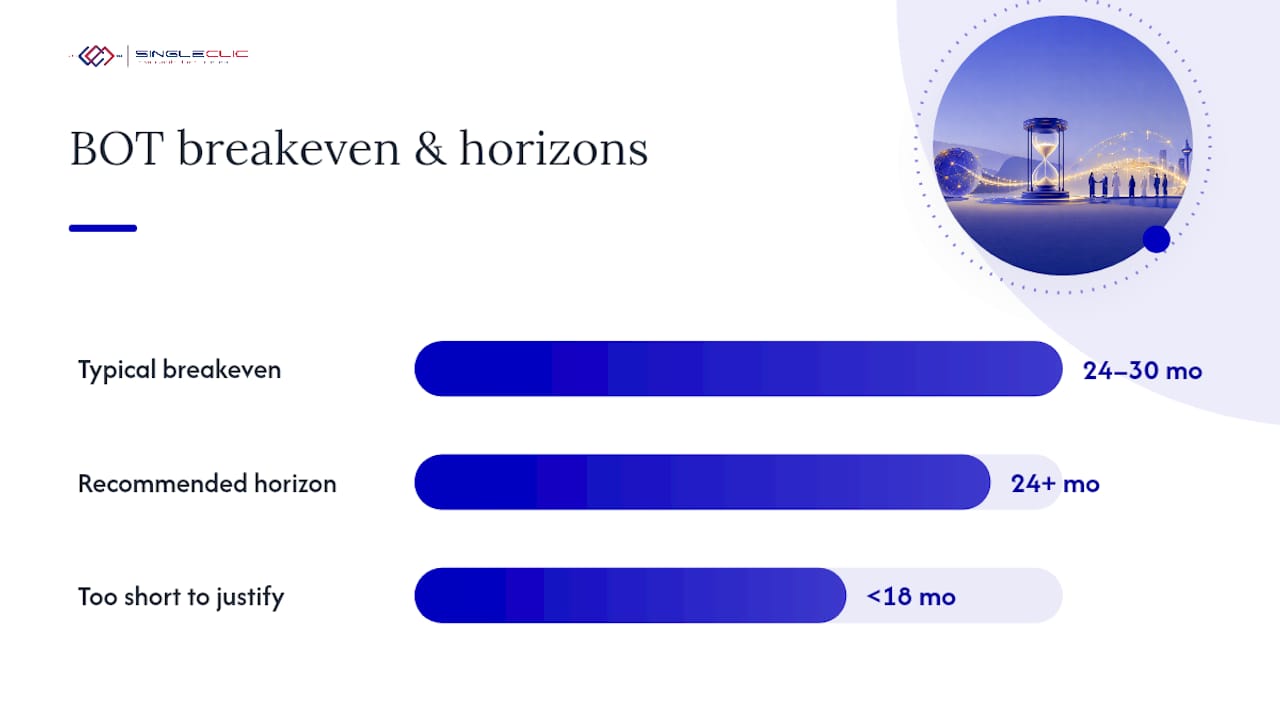
The clearest signal is headcount and horizon. A unit under 10 people rarely justifies the legal setup, entity formation, and governance overhead BOT requires; you’re better off with a straight staffing or BPO arrangement. Once you’re planning a team of 10 or more with a multi-year runway, ideally 24 months or longer, the math shifts. Industry analysis puts the typical breakeven against BPO around 24 to 30 months, since BOT front-loads vendor setup fees but removes the ongoing margin you’d otherwise pay indefinitely.
The second signal is control. If your operation touches sensitive IP, patient data, financial records, or anything under a regulator’s eye, you need the ownership path BOT provides rather than a permanent outsourcing relationship where the vendor retains legal control of the team.
Quick decision checklist:
- Choose BOT if: you need 10+ people, a 24+ month horizon, and eventual legal ownership of the unit.
- Choose BPO instead if: you need under 10 people, a short-term project, or no plan to internalize headcount.
- Choose a direct captive if: you already have deep local incorporation experience and don’t need a vendor to absorb setup risk.
Pro Tip: Run the breakeven math before you sign anything. If your realistic operate phase is under 18 months, BOT’s setup costs rarely pay back before you’d have exited a straight BPO contract anyway.
The phase-by-phase checklist: build, operate, transfer
Each BOT phase has its own deliverables, and vague language here is exactly what causes disputes at handover. Treat the following as a starting point for your statement of work (SOW), not a nice-to-have.
1. Build phase
- Confirm the legal entity structure (branch, subsidiary, or vendor-held entity with a transfer clause) before signing premises leases.
- Lock IT and security baselines: network architecture, endpoint policy, data residency, and access controls, all approved by your own security team, not just the vendor’s.
- Set up payroll, benefits, and local statutory compliance in the operating jurisdiction.
- Approve the initial hiring plan, including role definitions, seniority mix, and salary bands, against your own compensation philosophy.
- Require milestone signoffs at key points such as entity registration, initial hires, and infrastructure readiness.
2. Operate phase
- Split governance clearly: you own technical direction and delivery priorities; the vendor owns people operations, local HR, and facilities.
- Define KPIs up front, including ramp velocity (hires per month against plan), quality metrics (defect rates, SLA adherence), and attrition rate. Trigent’s operational guidance recommends tying acceptance criteria to these thresholds rather than subjective vendor reporting.
- Build the recruitment pipeline against your brand and culture from day one, not the vendor’s generic template. Embedding client-approved hiring standards early measurably reduces attrition and friction at transfer.
- Require living documentation: runbooks, SOPs, and a knowledge base updated continuously, not assembled the month before handover.
3. Transfer phase
- Execute employment novation or re-employment offers for retained staff, with clear timelines and retention incentives.
- Reassign leases, hardware, and any vendor-held assets to your legal entity.
- Transfer software licenses and confirm IP ownership in writing, covering code, documentation, and process designs. Detailed transfer mechanics should be spelled out in the original MSA, not negotiated fresh at handover.
- Hold formal knowledge-transfer sessions with sign-off checkpoints, not a single farewell workshop.
- Confirm final acceptance against the KPI thresholds set during the operate phase before releasing the transfer payment.
Build the KT package around runnable environment snapshots, incident runbooks, a maintained knowledge base, and role-level competency matrices. A slide deck is not a knowledge transfer.
Which contract clauses make or break the transfer?
The commercial terms you negotiate at signing determine whether your transfer is a clean handover or a six-month legal argument. A handful of clauses do most of the work:
- Transfer triggers: the specific conditions (time elapsed, KPI thresholds, or client election) that activate the transfer clause.
- Pricing formula: how the transfer fee is calculated, commonly one to three months of the prevailing operating fee or a pre-agreed formula.
- Novation mechanics: exact process for moving employment contracts, including notice periods and severance responsibility.
- IP and ownership schedule: an explicit list of what transfers (code, data, designs, vendor tools) versus what stays licensed.
- Post-transfer transitional services agreement (TSA): a short paid support window, typically 30 to 90 days, since real issues tend to surface in the first three months after handover regardless of how thorough the KT was.
- Warranties and indemnities: vendor commitments on data integrity, compliance, and IP cleanliness at the moment of transfer.
Negotiate phased transfer payments tied to acceptance milestones rather than a single lump sum, and consider an escrow arrangement for source code and critical documentation. Ring-fence business-critical assets early so they can’t become a bargaining chip if the relationship sours before transfer.
What actually causes BOT transfers to fail?
Most failed transfers trace back to the same handful of causes, and all of them are avoidable if you plan for them at contract stage rather than at handover.
- Attrition spikes near transfer. Staff who joined for vendor-side stability sometimes leave when ownership changes hands. Counter this with retention bonuses tied to the transfer date, communicated early.
- Cultural mismatch. A team hired against a generic vendor template rather than your standards struggles to integrate post-transfer.
- Incomplete documentation. Runbooks written the week before handover are almost always thin. Weak KT and documentation is one of the most commonly cited causes of post-transfer disruption.
- Vendor lock-in. Proprietary tools or undocumented workarounds that only the vendor’s staff understand.
- Licensing gaps. Software licenses registered to the vendor’s entity that don’t cleanly reassign.
Pro Tip: Insist on quarterly documentation signoffs during the operate phase, not a single audit before transfer. A runbook reviewed four times a year gets caught early when it’s wrong; one reviewed once gets discovered wrong during the transfer itself.
Embed your own staff inside the vendor’s operation well before transfer, run incremental KT milestones rather than one final push, and keep escrow and contractual exit protections in place from day one.
What Singleclic’s regional delivery experience teaches about transfer readiness
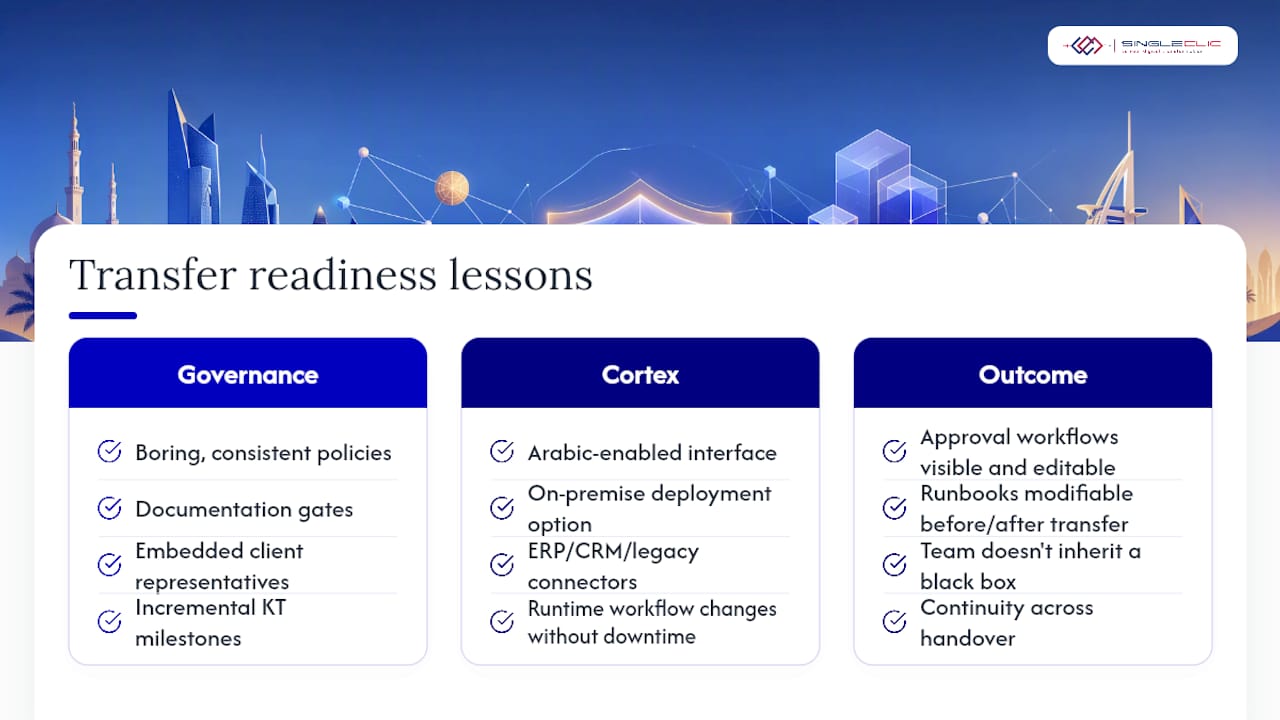
Over more than 10 years delivering enterprise projects across Saudi Arabia, the UAE, and Egypt, one pattern holds: transfers succeed when governance is boring and consistent, not heroic at the end. Documentation gates, embedded client representatives, and incremental KT milestones matter more than any single handover event.
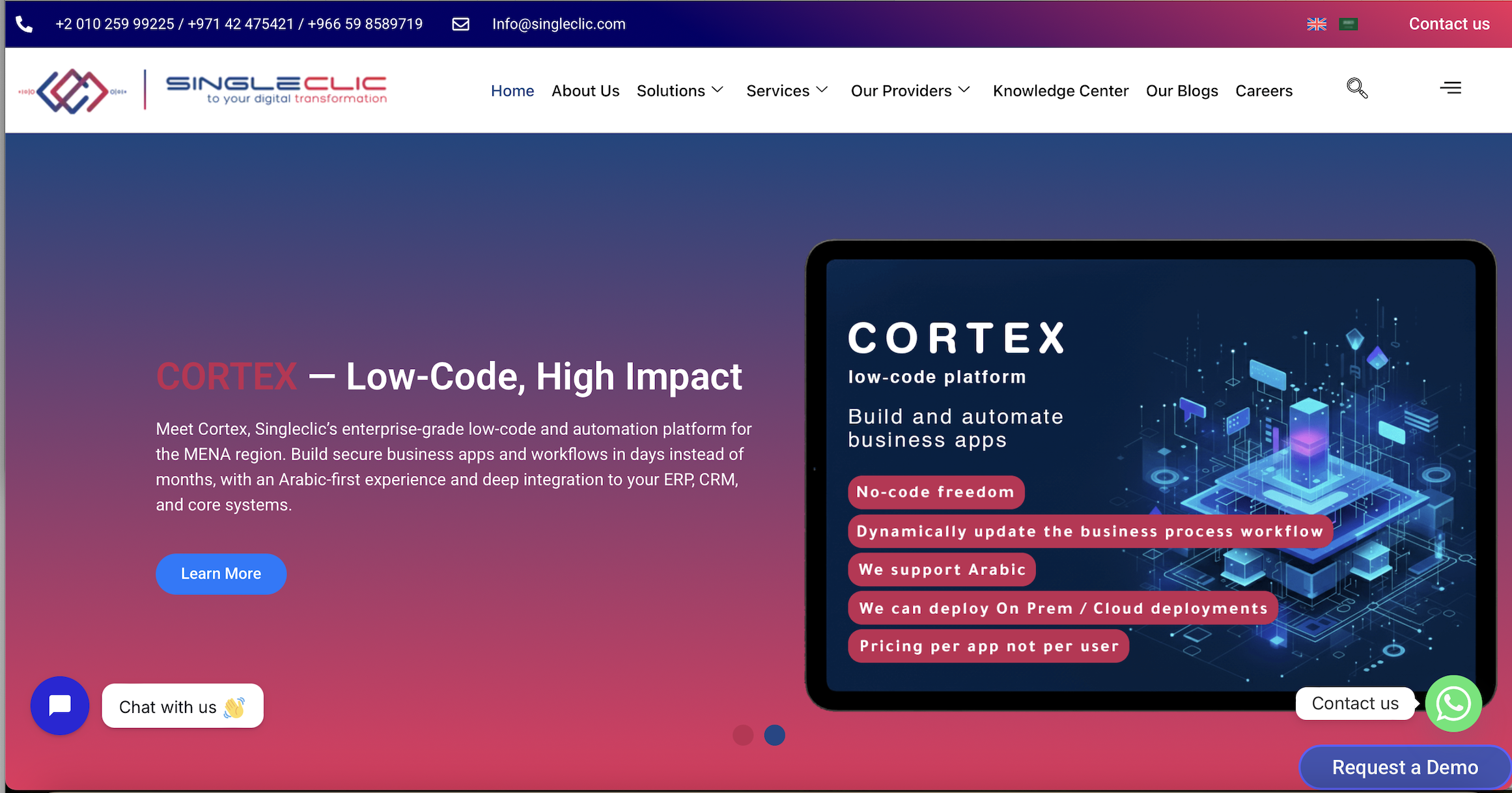
Cortex, Singleclic’s low-code and business process management platform, was built for exactly this kind of continuity. Its Arabic-enabled interface, on-premise deployment options, and ability to connect ERP, CRM, and legacy systems mean approval workflows and runbooks live in a system you can inspect and modify without touching code, before and after transfer. Runtime workflow changes without downtime mean your team doesn’t inherit a black box.
— Tamer Badr
How Singleclic helps you run a transfer-ready BOT engagement
Singleclic is the alternative to an open-ended outsourcing contract for enterprises in KSA, UAE, and Egypt that want an offshore or ERP-focused capability they will eventually own outright, not rent indefinitely. Where a generic vendor hands you a slide deck at transfer, Singleclic builds the operation on documented, inspectable processes from day one.
Our services span setting up and operating offshore delivery teams, Microsoft Dynamics 365 and Odoo implementation, business process automation with IBM BAW, and Cortex deployment for knowledge capture, approvals, and runbooks that survive the handover intact. If you’re drafting an RFP, ask any prospective partner to commit to specific KPI thresholds for ramp velocity, quality, and attrition, plus a written transfer checklist covering assets, licenses, and IP before you sign.
If your roadmap includes an ERP or CRM platform as part of the transferred operation, our guide on connected ERP and CRM with Microsoft Dynamics 365 walks through what a leader should expect from that layer specifically. When you’re ready to scope a BOT-style engagement, request a discovery call with Singleclic and get a phase-by-phase proposal with named KPIs and a defined transfer date, not an open-ended retainer.
Sources
- Rise of the BOTs: Exploring Build-Operate-Transfer Models for IT and Business Process Services
- Build Operate Transfer (BOT) Model: Benefits & Key Stages
- What Is Build Operate Transfer? The BOT Model Explained
- Build-Operate-Transfer Model for Offshore Software Development Full Scale | BOT Guide 2026