Copilot Studio agents are low-code enterprise AI agents that reason through requests, ground their answers in your organization’s own data, and act on that data through connected tools. Use Copilot Studio when an agent needs integrations, autonomous multistep actions, or governed knowledge access; use the simpler Agent Builder in Microsoft 365 Copilot when you just need a quick, declarative assistant for a single team. Start with a scoped pilot before expanding into full production orchestration.
TL;DR:
- Agents built with Copilot Studio require an Azure subscription, which can increase costs for organizations not already leveraging Azure services.
- The choice of harness (GitHub Copilot or standard) is fixed at the design stage because switching later requires rebuilding the agent entirely.
- Effective testing and monitoring involve creating comprehensive test sets and reviewing conversation transcripts to detect issues not visible in aggregated metrics.
- Deploying agents externally or for regulated industries may need on-premise solutions like Cortex to meet data sovereignty and language requirements.
- Cost management depends on usage patterns, with a focus on task complexity and tool invocation frequency, not just user volume or conversation count.
Table of Contents
- What is Copilot Studio and what does it actually build?
- Which harness should you choose: GitHub Copilot, standard, or Copilot chat?
- How do you test and monitor a Copilot Studio agent?
- Where can you publish and deploy a Copilot Studio agent?
- What security and governance controls keep enterprise agents safe?
- How much does Copilot Studio cost to run?
- What enterprise architectures and use cases actually deliver ROI?
- What’s the implementation checklist for a Copilot Studio project?
- Singleclic’s view on secure, on-prem, and Arabic-capable agent deployments
- How Singleclic helps you build production-ready agents
- Sources
What is Copilot Studio and what does it actually build?
Microsoft Copilot Studio is a graphical, low-code environment for building and managing AI agents that connect to organizational data and publish across channels, according to Microsoft’s own product documentation. That single sentence hides three distinct building blocks that get confused constantly, even by experienced Power Platform teams.
An agent is the packaged unit: instructions, knowledge sources, tools, and a personality wrapped into something a user or another system can talk to. A workflow (built with Power Automate under the hood) is a deterministic sequence of steps, useful when you already know exactly what needs to happen and in what order. An agent flow sits between the two. It is a flow that an agent can call dynamically, letting the agent decide when automation logic should fire rather than hardcoding that decision into the conversation itself.
Copilot Studio’s console handles the full lifecycle for all three:
- Author agents through natural-language prompts or a visual canvas, no traditional coding required
- Preview behavior in a live test pane before anything reaches a real user
- Evaluate responses against test sets and grader rubrics
- Monitor live performance through activity trace and analytics dashboards
- Publish to Microsoft Teams, SharePoint, external websites, custom apps, or Microsoft 365 Copilot itself
One dependency catches teams off guard: using agents requires an Azure subscription tied to your tenant, since billing and certain compute-heavy tools run through Azure metering. If your organization has never provisioned Azure for anything beyond basic Microsoft 365 licensing, budget time for that setup before your first pilot, not during it.
Which harness should you choose: GitHub Copilot, standard, or Copilot chat?
This is the single most consequential decision in any Copilot Studio project, and it has to happen before you write a line of agent instructions. Microsoft’s own harness documentation confirms that the GitHub Copilot harness supports a natural-language-first authoring model with improved orchestration for multi-step autonomous tasks, while the standard harness works through explicit topics and flow-based control. Once you pick one, you cannot migrate an existing agent to the other. It has to be rebuilt.
Here is the practical decision path:
- Choose the GitHub Copilot harness when the agent handles reasoning-heavy, multi-step tasks where the exact conversational path can’t be fully scripted in advance, such as research assistance or complex case triage.
- Choose the standard harness when you need predictable, repeatable conversations with tight control over what the agent can say and do, such as regulated customer service scripts or HR policy lookups.
- Extend Copilot chat (inside Microsoft 365 Copilot) when the goal is augmenting an existing enterprise assistant rather than shipping a standalone agent, and you don’t need custom tool orchestration.
Practitioners commonly pick the GitHub Copilot harness for its flexibility and later discover they’ve given up the fine-grained flow control the standard harness provides by default, a trade-off worth weighing carefully before committing.
Pro Tip: Treat the harness decision as architecture, not a UI preference. Lock it in during the design phase, alongside your integration and knowledge-source plan, because reversing it later means starting the build over.
How do you test and monitor a Copilot Studio agent?
Copilot Studio treats evaluation as part of the build cycle, not an afterthought bolted on before launch. The platform provides test sets and shared grader libraries so teams can validate agent responses objectively, rather than relying on a handful of manual spot checks that miss edge cases.
The iteration loop that works in practice:
- Draft instructions and knowledge connections, then run them through Preview / Try it immediately, before adding complexity
- Build a test set covering realistic phrasing, edge cases, and adversarial prompts, not just the happy path
- Run the Evaluate tab against that test set and review grader scores before every meaningful change ships
- Once live, track activity trace and run history to see exactly which topics, tools, and knowledge sources fired on each conversation
Pro Tip: Track four metrics from day one: task success rate, tool invocation frequency, fallback rate, and escalation rate to a human. A rising fallback rate almost always means a knowledge-source gap, not a model problem.
Analytics dashboards surface these numbers automatically, but the real value comes from reading actual transcripts, not just the summary charts. Patterns that never show up in aggregate metrics, like users rephrasing the same question three different ways before giving up, only surface when someone reads the conversation itself. Build a standing habit of transcript review into your operations cadence, because agent quality drifts as source data and user behavior change, and a monitoring approach worth borrowing from established agent lifecycle practices treats this as an ongoing discipline rather than a one-time launch gate.
Where can you publish and deploy a Copilot Studio agent?
Publishing targets are not interchangeable, and picking the wrong one for your audience creates authentication headaches later. An agent destined for internal staff behaves very differently from one facing external customers.
- Microsoft Teams works best for internal-facing agents where single sign-on through Entra ID is already in place and no separate authentication layer is needed.
- SharePoint embedding suits agents tied to a specific site’s content, like a department’s policy assistant.
- Custom websites or apps give you full control over branding and authentication, but require more setup work around API keys and access tokens.
- Microsoft 365 Copilot extends your agent into the assistant employees already use daily, which is often the fastest path to adoption for internal tools.
- Demo sites are worth using for stakeholder sign-off before committing to a public channel.
Production readiness means more than flipping a publish toggle. If you’re using bring-your-own machines for computer-use tools, provision Entra ID identities and Intune enrollment before testing starts, not after, since regulated or privacy-sensitive deployments need authentication and network configuration settled during the design phase. Pilot with one channel and a small user group, measure the metrics from the previous section, then expand.
What security and governance controls keep enterprise agents safe?
Governance for agents isn’t fundamentally different from governance for any enterprise application, but the attack surface is wider because agents can reason their way into unexpected requests. Role-based access control needs to apply at three layers: who can build agents, who can publish them, and who can query them once live. Maintaining a live agent inventory across your tenant matters more than it sounds. Shadow agents built by individual teams without central visibility are how licensing costs and compliance gaps both quietly accumulate.
Data policies determine what an agent can see, and by extension, what it might accidentally surface. Grounding controls should scope each agent to the minimum set of knowledge sources it actually needs, never the broadest set available in the tenant. Layer in operational controls on top:
- Human-in-the-loop checkpoints for any action with financial, legal, or HR consequences
- Escalation rules that route uncertain or high-stakes conversations to a person automatically
- Run history retention long enough to support audits, with clear ownership over who reviews that history
- Cost and license tracking tied to the agent inventory, reviewed on a fixed schedule rather than only when a budget alert fires
Organizations in regulated sectors, banking, healthcare, and government among them, often need data sovereignty guarantees that a pure public-cloud deployment can’t fully satisfy. On-premise and hybrid options exist for exactly this reason, and Singleclic’s own Cortex platform was built with that constraint in mind for MENA enterprises that need Arabic-language support and on-premise deployment for banks and government bodies specifically.
Pro Tip: Build your agent inventory spreadsheet before your third agent goes live, not your tenth. Retrofitting governance onto agents already in production is far more disruptive than starting with it. For a deeper walkthrough of access boundaries, see Singleclic’s practical playbook for Microsoft Copilot governance.
How much does Copilot Studio cost to run?
Copilot Studio bills through two mechanisms, and understanding both before you scope a pilot prevents an unpleasant surprise on the first invoice. Microsoft’s pricing structure includes tenant-wide Copilot Credit packs, which are fixed prepaid bundles, alongside a pay-as-you-go meter, and both require an Azure subscription connected to your tenant before agents can run at all.
Credits get consumed by actions like generative answers, tool invocations, and certain premium connectors, not simply by a conversation existing. A single complex request that calls three tools and generates two AI responses can consume noticeably more credit than a simple FAQ lookup, which makes usage patterns, not headcount, the real driver of cost.
Practical controls for a pilot phase:
- Estimate cost using your expected message volume multiplied by the average number of tool calls per conversation, not raw user counts
- Start on pay-as-you-go during early testing so you’re not locked into a credit pack sized for guesswork
- Confirm which Azure region and tenancy your subscription uses before provisioning, since data residency requirements can constrain your options
- Set spend alerts at the Azure subscription level, not just inside Copilot Studio’s own dashboard
What enterprise architectures and use cases actually deliver ROI?
The strongest Copilot Studio deployments combine an agent’s reasoning layer with a workflow’s deterministic execution and a governed knowledge layer underneath both. A customer service agent that deflects routine tickets, escalates complex ones to a human, and logs every interaction back into Dynamics 365 delivers a measurably different outcome than a standalone chatbot with no system-of-record connection.
Documented patterns worth modeling your own architecture on include regulatory research automation, virtual concierge experiences for customer-facing scenarios, and conversational banking augmentations layered on top of existing systems, all of which appear in Microsoft’s own adoption case studies. Common threads across those examples:
- Agents paired with Dataverse or Dynamics 365 data consistently outperform agents working from static documents alone
- MCP-based tool sharing reduces duplicate integration work once an organization runs more than two or three agents
- Human review checkpoints on high-stakes actions did not slow deployments meaningfully, but they did prevent the failure modes that erode user trust
The lesson that carries across nearly every case study: agents that only converse underperform agents that also act, provided that action is properly grounded and governed. That gap between a conversational demo and a production system tied into real business data is exactly where most Copilot Studio projects stall.
What’s the implementation checklist for a Copilot Studio project?
Run your project through five phases in order, and resist the urge to skip ahead to building before the earlier phases are settled.
- Pre-project: assign clear ownership, define success metrics before writing any instructions, and complete a compliance review for data sensitivity.
- Build: lock the harness decision, map knowledge sources to specific business needs, and decide which tools need MCP versus a direct connector.
- Test and pilot: define evaluation criteria and pass thresholds up front, scope the pilot to one channel and a limited user group, and set explicit gates for expanding beyond it.
- Publish: confirm authentication matches the audience, whether internal staff, contractors, or public customers.
- Operate: establish monitoring cadence, cost review intervals, and governance ownership before declaring the project “done.”
Pro Tip: The most common failure isn’t a bad agent. It’s skipping phase one and jumping straight to building, which means nobody agreed in advance what “success” actually looks like. Teams exploring how low-code automation fits their broader platform strategy tend to run this checklist as a recurring template across multiple agent projects, not a one-time exercise.
Singleclic’s view on secure, on-prem, and Arabic-capable agent deployments
Public-cloud Copilot Studio fits most standard use cases well. But for banks, healthcare providers, and government bodies in the region that need Arabic-first interfaces and data that never leaves their own infrastructure, a pure cloud deployment often can’t meet the compliance bar. Singleclic built Cortex, our on-premise, Arabic-enabled low-code platform, specifically for that gap, and we’ve deployed it for clients including Emirates Health Services and Dubai Healthcare City. When sovereignty is non-negotiable, that’s the conversation worth having first.
— Tamer Badr
How Singleclic helps you build production-ready agents
Singleclic is the practical alternative when a pure cloud Copilot Studio build hits a wall on data sovereignty, Arabic-language requirements, or deep ERP integration, three constraints that stop plenty of promising pilots from ever reaching production. We run discovery workshops that map your knowledge sources and integration points before a single agent gets built, then handle implementation, connect agents into your existing Dynamics 365 or Odoo environment, and manage governance and licensing so agent sprawl never becomes a hidden cost.
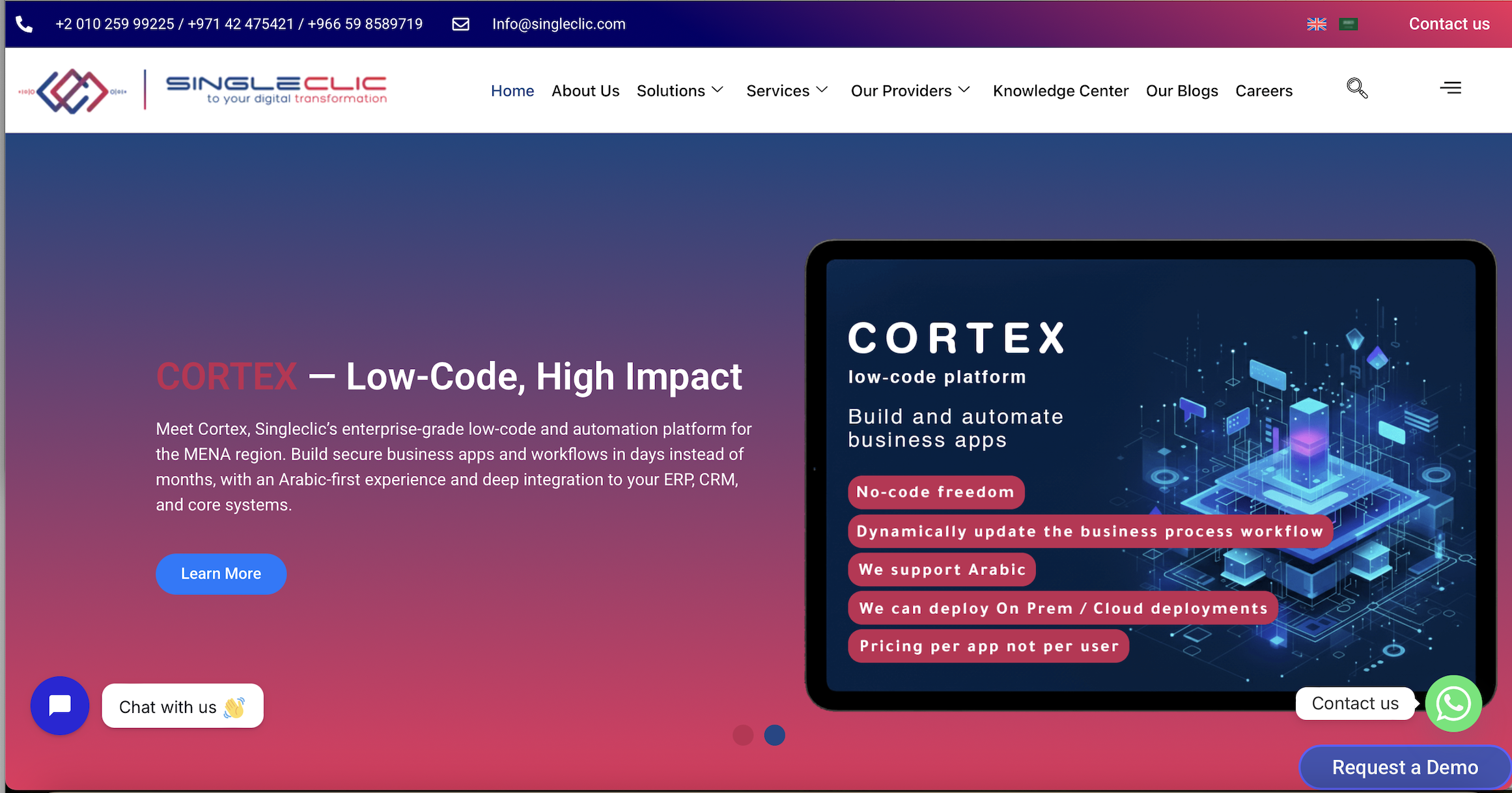
For organizations that need on-premise deployment or Arabic UX baked in from day one, our Cortex platform connects approvals, ERP, CRM, and legacy systems without sending sensitive data to a public cloud. If you’re weighing whether your next agent project needs Dynamics 365 or Odoo underneath it, our guide on what Microsoft Dynamics 365 actually connects is a solid next read. Ready to scope a pilot? Contact Singleclic for a discovery workshop and we’ll map your first agent-in-a-day engagement together.
Sources
Authoring starts on the Describe tab, where you write what the agent should do in plain language, and Copilot Studio scaffolds instructions, topics, and suggested knowledge sources from that description. The Configure tab then gives you granular control over each element the description generated. Teams that want an even lighter starting point sometimes prototype in Agent Builder first, since Agent Builder is a simpler, natural-language-driven tool suited to quick declarative agents, then graduate the concept into full Copilot Studio once it needs real integrations.
Knowledge sources are where most agent projects earn or lose their ROI. An agent that only holds a conversation without grounding in real organizational data delivers limited enterprise value, a point Microsoft’s own guidance on agent knowledge makes directly. Connect agents to:
- Copilot Studio overview – Microsoft Learn
Govern these sources deliberately. Every knowledge source an agent can query is also a source an agent could accidentally expose to the wrong audience, so scope access at the source level, not just at the agent level.
Tools are what turn a conversational agent into one that acts. AI prompts let an agent call a defined generative task as a reusable unit. Model Context Protocol servers give agents a standardized way to discover and invoke tools and resources, which matters once you have more than one agent needing the same set of capabilities. Build a custom MCP server when multiple agents need centrally managed, versioned access to the same tool; reach for a standard connector or a direct REST API call when it’s a single agent talking to a single system with no reuse requirement.
The computer use tool deserves special mention. When an agent has to operate a legacy system with no API, a computer-use agent (CUA) that drives the UI directly can be more resilient than brittle RPA scripts. Use hosted machines for prototyping speed, and move to bring-your-own machines once you need production-grade control over the environment.
Pro Tip: Don’t build a custom MCP server for a one-off integration. That overhead only pays off when at least two agents will reuse the same tool surface.