TL;DR:
- Effective governance is essential in large-scale transformations, ensuring strategy alignment, accountability, and risk mitigation. Customizing governance frameworks to sector-specific challenges and regional nuances maximizes value realization and minimizes leakage. Leaders should embed governance into digital operations, prioritize participation, and use risk-proportionate controls to sustain momentum and competitive advantage.
Transformation programs across KSA, UAE, and Egypt are consuming enormous capital, yet many C-suites find themselves staring at results that fall far short of projections. The issue is rarely the technology chosen or the budget allocated. It is governance. Organizations lose 10-20% of expected financial impact from transformation leakage driven by external shocks, misaligned incentives, and weak oversight. This article gives you a practical, sector-specific blueprint for building the governance infrastructure that turns ambitious transformation programs into sustainable, measurable business value.
Table of Contents
- Why governance is the linchpin of transformation
- What does effective governance look like? Cross-sector frameworks
- Gaps and risks: Where governance typically fails
- From oversight to value: Tactics for optimizing governance in transformation
- A transformation leader’s view: What most executives get wrong about governance
- Transform governance into a competitive advantage with the right tools
- Frequently asked questions
Key Takeaways
| Point | Details |
|---|---|
| Governance maximizes impact | Strong governance prevents value leakage, ensuring operational goals are met. |
| Sector-specific frameworks | Adapting governance models to industry needs boosts transformation success in MENA. |
| Watch for overreach | Proportionate controls enable innovation while managing risk. |
| Accountability delivers value | Holding teams accountable can drive significant performance and financial uplift. |
| Data-driven, participatory approach | Engaging stakeholders and using clear KPIs build lasting governance effectiveness. |
Why governance is the linchpin of transformation
Governance, in the context of large-scale transformation, is not a compliance checkbox. It is the operating system that keeps strategy, execution, and accountability synchronized across every layer of your organization. Think of it as the mechanism that answers three essential questions at any point in a program: Are we still aligned with the original objective? Who is responsible when something deviates? And how do we course-correct before the deviation becomes a loss?
For MENA enterprises, those questions carry additional weight. Digital governance in MENA must account for uneven regulatory maturity across countries, multilingual operational environments, and varying digital infrastructure between urban centers and secondary cities. Governance frameworks built for Western markets often fail here because they ignore those nuances entirely.
In construction, the stakes around governance are especially visible. Governance in KSA construction embeds sustainability requirements, real-time financial tracking, and risk mitigation directly into digital frameworks, producing measurable improvements in audit readiness and project transparency. That is not an abstract benefit. On a multi-billion riyal infrastructure project, knowing exactly where every dirham sits at every stage is the difference between delivering on schedule and absorbing catastrophic overruns.
Banking presents a different but equally demanding governance challenge. Bank transformation governance relies on clear decision rights, automated controls, and portfolio-level oversight to keep regulatory risk in check without strangling execution velocity. The specific mechanism that matters most in banking is the allocation of decision rights: who can approve what, at what speed, and under what conditions. Without that clarity, transformation teams default to seeking approval for every micro-decision, and programs grind to a halt.
Understanding data governance for C-level leaders is foundational to getting this right, because data visibility is what makes every other governance mechanism function.
“Governance is not a constraint on transformation. It is the structure that makes transformation survivable.” — Tamer Badr, Singleclic
Pro Tip: Align your board-level objectives with your transformation KPIs from day one. When the board measures success using the same indicators the transformation team uses, accountability flows naturally rather than being imposed after the fact.
What does effective governance look like? Cross-sector frameworks
Understanding governance’s power is one step. Witnessing its operational reality is another. Effective governance is not a single model. It is a set of components assembled differently depending on your sector, your regulatory environment, and your transformation maturity.
The McKinsey Transformation Office model provides a useful anchor. It relies on CEO-sponsored steering committees that meet weekly, KPI dashboards updated in near real-time, and stage-gates that require explicit sign-off before each program wave progresses. Those three components, steering committees, dashboards, and stage-gates, form the governance spine that you customize for your sector.
Here is how that customization plays out across four sectors relevant to MENA executives:
| Sector | Primary governance focus | Key mechanism | MENA-specific challenge |
|---|---|---|---|
| Construction | Financial tracking and audit readiness | Stage-gates tied to project milestones | Complex subcontractor networks in KSA mega-projects |
| Banking | Regulatory compliance and decision rights | Automated controls with portfolio oversight | Cross-border regulatory alignment across UAE and KSA |
| Healthcare | Patient data protection and clinical outcomes | Weekly KPI reviews tied to clinical metrics | Data interoperability between private and public facilities |
| Government | Transparency and citizen service delivery | Participatory review mechanisms | Rural-urban digital disparity in Egypt and KSA |
To build a governance structure that actually fits your sector, follow these steps:
- Define your decision rights clearly. Map every major decision category in your transformation program and assign explicit ownership. Ambiguity in decision rights is the single fastest way to create bottlenecks.
- Establish a CEO-sponsored steering committee. The committee must have real authority to reallocate resources and adjust priorities. A committee with advisory-only status cannot course-correct a derailing program.
- Build a KPI dashboard that links operational metrics to financial outcomes. Tracking activity (tasks completed, systems deployed) without linking to business outcomes (cost reduction, revenue impact) produces governance theater, not governance value.
- Implement stage-gates with hard criteria. Each gate should require specific evidence, not just a progress report, before the next wave begins.
- Schedule structured risk reviews at fixed intervals. Monthly is too infrequent for most transformation programs. Weekly or bi-weekly reviews catch deviations before they compound.
The IT governance best practices required at the technology layer feed directly into these broader program governance structures. Getting the two aligned is essential.
One area MENA executives frequently underestimate is change management for digital success. Governance frameworks that ignore human adoption create a paradox: technically sound programs fail because the people responsible for executing them lack the clarity and motivation to follow through.

Gaps and risks: Where governance typically fails
Having seen governance in action, it is critical to recognize where it often falls short and why. Even organizations that invest in governance infrastructure frequently find it underperforming. The gap between governance design and governance execution is where transformation value disappears.
McKinsey GRC benchmarking places average maturity scores around 2.9 out of 4.0 across industries. That sounds adequate until you look at the weak spots: 67% of life sciences and healthcare organizations need improvement in risk appetite definition, and 54% of infrastructure organizations show gaps in stress testing capability. For MENA construction and healthcare leaders, those are not abstract statistics. They are direct indicators of where your governance framework is most likely to crack under pressure.
The most common governance failures follow recognizable patterns:
- Over-complexity in documentation. Governance teams produce exhaustive process maps and policy documents that no one reads and no one follows. Documentation that exists to satisfy auditors rather than guide decisions adds cost without adding control.
- Accountability gaps at the middle layer. C-suite ownership is clear. Front-line responsibility is assigned. But the layer between them, division heads, program directors, and regional managers, often has no clear accountability for transformation outcomes.
- Misaligned risk thresholds. Applying the same risk tolerance to a core banking system migration as to a low-risk chatbot deployment creates unnecessary friction in exactly the places where speed is most valuable.
- Lagging indicators dominate dashboards. When your governance KPIs are all backward-looking (budget spent, milestones completed), you lose the ability to intervene before problems become losses.
- Governance structures that outlive their purpose. Committees and review cycles established for the launch phase of a transformation often continue unchanged into the stabilization phase, consuming time without producing value.
The AI governance dimension deserves specific attention. Governance overreach in AI programs creates serious delays for low-risk use cases. When every AI initiative, regardless of its risk profile, must go through the same heavy approval process, you slow down the deployments that could deliver the fastest value. The solution is risk-proportionate governance: rigorous controls for high-stakes AI applications, lighter-touch processes for low-risk automation.
The key risks in digital projects that C-suite leaders in GCC face frequently connect back to these exact governance gaps. And the transformation leakage data confirms that organizations without robust financial oversight are the ones absorbing the largest portion of that 10-20% impact loss.
Pro Tip: Apply risk-proportionate governance rather than uniform policies. Categorize your transformation initiatives into high, medium, and low risk tiers. High-risk initiatives get weekly steering committee attention. Low-risk initiatives get a monthly checkpoint. That one structural change alone frees up significant executive bandwidth.
The MENA transformation roadmap provides a strong foundation for calibrating your risk tiers to regional realities.
From oversight to value: Tactics for optimizing governance in transformation
Addressing gaps sets the stage for impact. Now see how governance becomes a true value creator when you move from reactive oversight to proactive performance management.
The most significant insight from recent transformation research is the relationship between accountability and financial outcomes. Only 10% of transformations actively prioritize accountability as a performance mechanism, yet organizations that do achieve 2.7 times the EBITDA uplift compared to those that treat accountability as a secondary concern. That is not a marginal difference. It is the gap between a transformation that pays for itself and one that does not.
Here is what optimized governance looks like in practice:
- Weekly transformation reviews with real consequences. Reviews that never result in resource reallocation or escalation are social events, not governance events. Every weekly review should end with at least one concrete decision.
- KPI dashboards that link to individual accountability. When every KPI on the dashboard has a named owner, performance discussions become specific and actionable rather than diffuse.
- Stage-gate criteria that include financial validation. Before a program wave progresses, require evidence that the preceding wave has delivered its projected financial impact. This single practice catches value leakage before it compounds.
- Engage your top performers as governance champions. Governance fails when it is seen as a compliance burden. When your highest-performing leaders visibly operate within governance structures, the rest of the organization follows.
- Use an AIQ Score for AI transformation oversight. As AI initiatives multiply across your enterprise, a standardized scoring framework for AI readiness and risk enables consistent governance without creating a bottleneck for every deployment.
The connection between governance and financial performance is also explored in the data governance ROI guide, which provides specific metrics for quantifying the return on governance investment. For C-suites that need to make the business case internally, that resource is genuinely useful.
Your digital strategy essentials for KSA, UAE, and Egypt should incorporate governance KPIs from the design phase. Retrofitting governance into an already-running transformation is significantly more expensive and disruptive than building it in from the start.
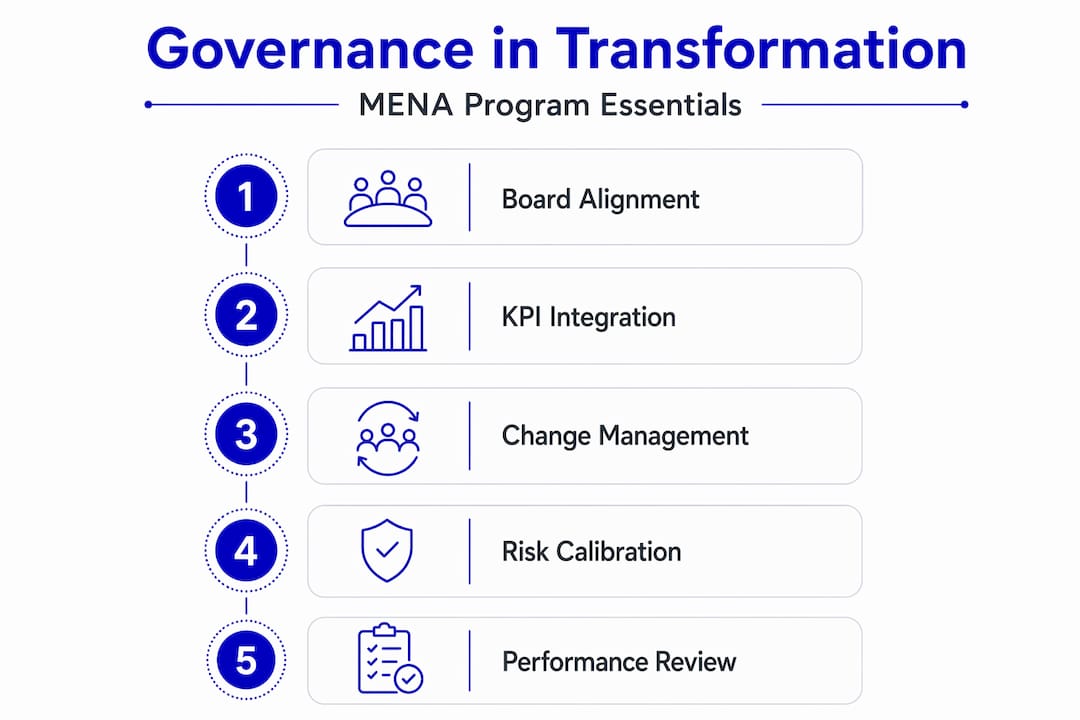
Pro Tip: Balance performance accountability with genuine engagement. Leaders who enforce accountability without building commitment create compliance without energy. Transformations that sustain momentum combine clear consequences for underperformance with meaningful recognition for results.
A transformation leader’s view: What most executives get wrong about governance
With actionable tactics laid out, let’s step back for an unfiltered, executive perspective.
The single most persistent mistake we see from C-suite leaders across MENA is confusing documentation with control. Organizations invest months producing governance frameworks, policy documents, risk matrices, and RACI charts. Then they assume governance is in place. It is not. Governance is in place when the people running your transformation make better decisions, faster, with clearer accountability. Documents do not make decisions. People do.
The second mistake is applying governance frameworks without sector-relevant nuance. A governance model designed for a European pharmaceutical company will not work for a KSA construction conglomerate operating across 15 active project sites. The underlying logic of steering committees and stage-gates may transfer. The specific controls, risk thresholds, and review cadences must be rebuilt from scratch for your context.
In MENA specifically, two factors are consistently undervalued. The first is trust. In Egypt and KSA especially, governance mechanisms that feel imposed from above without consultation generate quiet resistance. Participatory data strategies, where operational teams have input into the KPIs that measure their performance, produce dramatically better adherence than top-down mandates. The second is the digital disparity between urban centers and secondary locations. A governance framework that assumes every team member has the same level of digital access and literacy as your Cairo or Riyadh headquarters staff will fail in the field.
The counterintuitive lesson from digital disruption examples across MENA is that loosening controls in genuinely low-risk areas accelerates overall transformation velocity without meaningfully increasing risk. Executives who treat all governance as equally critical end up with governance that is equally ignored.
The organizations that get governance right treat compliance as an enabler. When regulatory requirements are embedded into workflows rather than layered on top of them, compliance happens automatically. The burden disappears. The control remains.
Transform governance into a competitive advantage with the right tools
Organizations ready to rethink governance can move from theory to real competitive advantage using Singleclic’s suite of resources and solutions.
Embedding governance into your transformation is not just a process challenge. It is a technology challenge. ERP and automation platforms, when configured correctly, enforce governance controls automatically, making compliance the path of least resistance rather than an additional burden on already stretched teams.
Singleclic works with construction, banking, healthcare, and government organizations across KSA, UAE, and Egypt to build governance infrastructure directly into their digital operations. Our process automation solutions for transformation embed stage-gates, approval workflows, and KPI tracking into the systems your teams already use. Our ERP implementation practice ensures that financial oversight and audit readiness are operational from day one. And our AI automation capabilities include the risk-proportionate governance frameworks that let you move fast on low-risk initiatives without compromising control on high-stakes deployments. If you are serious about making your next transformation deliver its full projected value, governance is where you start.
Frequently asked questions
What is the main purpose of governance in transformation?
Governance ensures alignment, accountability, and risk management throughout a transformation program, maximizing the value delivered. The McKinsey Transformation Office model uses CEO-sponsored steering committees, weekly reviews, KPI dashboards, and stage-gates to operationalize this purpose.
How does governance reduce financial leakage in transformation?
Effective governance uses financial oversight and P&L tracking to mitigate 10-20% impact leakage from external factors during transformation, ensuring projected value is actually captured.
What’s the risk of too much governance in digital transformation?
Excessive governance can slow innovation, especially with AI. Governance overreach in AI creates delays for low-risk use cases, making risk-proportionate processes essential for maintaining transformation velocity.
What should MENA leaders prioritize to improve governance?
Focus on participatory data strategies, clear performance metrics, and region-specific risk management approaches. Digital governance in MENA must address uneven data interoperability, privacy gaps, and rural-urban disparities to be effective in regional contexts.