Regulatory penalties in KSA and UAE are rising sharply, and organizations that treat compliance as an afterthought are paying the price in fines, operational shutdowns, and lasting reputational damage. For C-suite executives and compliance officers across the region, the challenge is not just knowing the rules but embedding them into daily operations at scale. The good news is that structured frameworks, the right technology, and genuine leadership commitment can reduce compliance violations by 50% while cutting incident response time by 60%. This guide delivers exactly that: a practical, field-tested approach to ensuring process compliance across your organization.
Table of Contents
- Understanding process compliance: What’s at stake?
- Pillars of effective process compliance
- Structured risk management workflow for compliance success
- Integrating technology: Automation as a compliance enabler
- Sustaining compliance: Culture, training, and continuous improvement
- Rethinking process compliance: Why culture and tech must align
- Take your compliance strategy to the next level
- Frequently asked questions
Key Takeaways
| Point | Details |
|---|---|
| Compliance is strategic | Executive support and alignment with local regulations are non-negotiable for effective process compliance. |
| Pillars enable resilience | A foundation of regulatory intelligence, risk management, and technology secures compliance. |
| Workflow clarity matters | A structured, well-documented workflow with clear accountability prevents costly failures. |
| Automation drives results | Tech-enabled compliance reduces errors, speeds up response, and eases audit burdens. |
| Culture sustains compliance | Ongoing training and leadership engagement embed compliance into organizational habits. |
Understanding process compliance: What’s at stake?
Process compliance means your organization consistently executes its defined procedures, policies, and controls in line with internal standards and external regulations. It is not a checkbox exercise. It is the operational backbone that keeps your business legally sound, strategically agile, and trusted by stakeholders.
For leaders in KSA and UAE, the stakes are especially high. The regulatory environment is evolving rapidly, driven by Vision 2030 mandates, the Personal Data Protection Law (PDPL) in Saudi Arabia, ZATCA’s e-invoicing requirements, and a growing body of sector-specific rules across healthcare, banking, and construction. Non-compliance in this environment carries three categories of risk:
- Financial risk: Regulatory fines, penalties, and increased audit costs that erode margins
- Legal risk: Licensing revocations, litigation exposure, and personal liability for executives
- Reputational risk: Loss of client trust, partner relationships, and competitive standing
What makes this uniquely challenging in the region is the speed of regulatory change. UAE business compliance drivers show that organizations must monitor multiple overlapping frameworks simultaneously, from federal mandates to emirate-level requirements.
“The organizations that thrive under regulatory pressure are the ones that treat compliance as a strategic asset, not a legal obligation.” — Tamer Badr, Singleclic
The process risk management workflow framework emphasizes that sustainable compliance requires executive sponsorship, cross-functional ownership, and measurable targets aligned to Vision 2030 and PDPL mandates. Without C-suite engagement, compliance programs stall at the policy level and never reach operational reality.
Pillars of effective process compliance
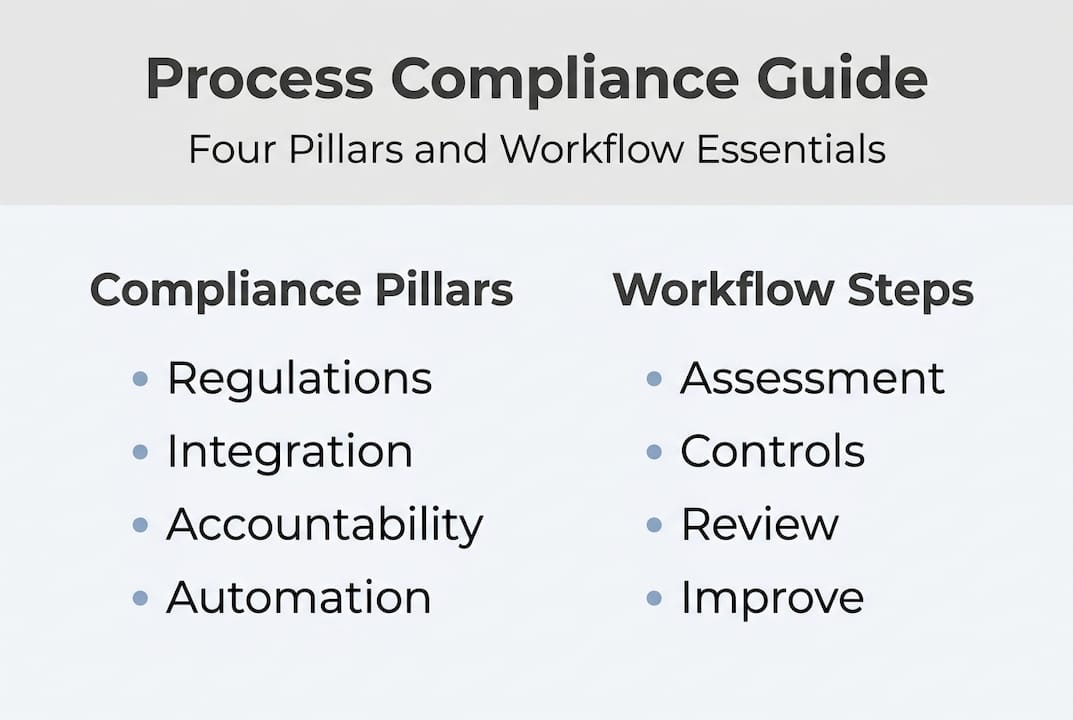
Building compliance into your organization’s DNA requires more than policies and audits. It demands a structured, four-pillar approach that addresses intelligence, risk, operations, and improvement simultaneously.
| Pillar | Focus area | Key outcome |
|---|---|---|
| Regulatory intelligence | Monitoring laws, updates, sector rules | No compliance blind spots |
| Risk-based management | Prioritizing high-impact risk areas | Efficient resource allocation |
| Operational integration | Embedding controls in workflows | Consistent execution at scale |
| Continuous improvement | KPIs, feedback loops, benchmarking | Adaptive, resilient compliance |
These four compliance pillars are not sequential. They operate in parallel, reinforcing each other. Regulatory intelligence feeds your risk assessments. Risk assessments shape your operational controls. And continuous improvement keeps the entire system calibrated as your business and the regulatory landscape evolve.
Operational integration is where most organizations struggle. Embedding compliance controls directly into process management steps means your teams do not need to remember to comply. The process itself enforces the requirement. This is a critical shift from reactive to proactive compliance.

Automation plays a major role here. A well-designed process automation checklist ensures that controls are triggered automatically at the right workflow stage, reducing the reliance on individual judgment and memory.
Pro Tip: Start your compliance program by mapping your highest-risk processes first. Identify where a single failure would cause the most regulatory or financial damage, then build your controls around those points before expanding to lower-risk areas.
Structured risk management workflow for compliance success
A clear, repeatable workflow is what separates organizations that manage compliance consistently from those that scramble after incidents. The structured risk management workflow follows six defined phases:
- Identify: Brainstorm and catalog all process risks across departments, using cross-functional input to avoid blind spots
- Assess: Score each risk by likelihood and impact, prioritizing the ones that threaten regulatory standing or operational continuity
- Mitigate: Design and assign specific controls, escalation paths, and ownership for each high-priority risk
- Implement: Integrate controls into live workflows, supported by training and clear documentation
- Monitor: Track compliance metrics in real time, using dashboards and automated alerts to catch deviations early
- Document: Maintain audit-ready records of every decision, control action, and incident response
Accountability is non-negotiable at each phase. Every process must have a named owner, and compliance officers must have visibility into execution across all business units. This is where the requirements management workflow becomes essential: it ensures that compliance requirements are formally captured, assigned, and tracked from policy to practice.
| Approach | Reactive compliance | Proactive compliance |
|---|---|---|
| Trigger | Incident or audit finding | Scheduled review and monitoring |
| Ownership | Compliance team only | Distributed process owners |
| Documentation | After-the-fact | Real-time and continuous |
| Outcome | Damage control | Prevention and resilience |
The business process management steps that support this workflow also help leaders set quantitative targets: reducing process failure rates by 40% and cutting incident response time by 60% are achievable benchmarks when the workflow is properly implemented and monitored.
Integrating technology: Automation as a compliance enabler
Manual compliance processes are a liability. Human error, inconsistent execution, and slow response times create gaps that regulators and auditors will find. Technology closes those gaps systematically.
Here is what modern automation delivers for compliance teams:
- Accuracy: Automated controls execute identically every time, eliminating the variability of manual checks
- Audit trails: Every action is logged automatically, giving you BPM-powered audit trails that are always current and complete
- Speed: Automated alerts and escalations cut response time dramatically compared to manual monitoring
- Cost efficiency: Fewer manual review hours and lower incident remediation costs over time
BPM platforms, low-code tools, and AI-driven workflow engines are now accessible to organizations of all sizes. Automated workflows can enforce approval chains, flag policy exceptions, and route compliance tasks to the right owner without manual intervention. This is the shift from reactive to proactive compliance in practice.
Low-code platforms for compliance are particularly valuable in the MENA context because they allow compliance teams to adapt workflows quickly when regulations change, without waiting for lengthy IT development cycles. Singleclic’s Cortex platform, for example, supports runtime workflow changes without downtime, which is critical when ZATCA or PDPL requirements are updated mid-year.
Pro Tip: When evaluating compliance automation tools, prioritize platforms that offer on-premise deployment options. For banks and government entities in KSA and UAE, data sovereignty requirements make cloud-only solutions a compliance risk in themselves.
Sustaining compliance: Culture, training, and continuous improvement
Technology and workflows are only as effective as the people who operate them. Long-term compliance success depends on building a culture where accountability is visible, training is ongoing, and improvement is systematic.
Leadership behavior sets the tone. When executives visibly champion compliance, attend training sessions, and hold teams accountable to compliance KPIs, it signals that this is a strategic priority, not a back-office function. Building a compliance culture through training and accountability is the single most reliable predictor of sustained compliance performance.
Key practices for sustaining compliance culture include:
- Regular policy communication: Send concise, role-specific compliance updates whenever regulations change, not just during annual reviews
- Role-based training: Tailor training content to the specific risks and controls relevant to each team’s daily work
- KPI integration: Tie compliance metrics directly to performance reviews and departmental scorecards
- Incident learning: Treat every compliance failure as a learning event, with root cause analysis and process updates documented in your digital audit workflow
- Benchmarking: Compare your compliance performance against regional best practices and Vision 2030 targets to identify gaps before regulators do
Continuous improvement means your compliance program evolves with your business. Set quarterly review cycles for high-risk processes, and annual reviews for stable, lower-risk areas. When a regulatory update hits, your team should be able to assess the impact and update controls within days, not months.
Rethinking process compliance: Why culture and tech must align
Here is something most compliance frameworks will not tell you directly: technology adoption without cultural alignment is one of the most expensive mistakes an organization can make. We have seen it repeatedly across KSA and UAE enterprises. A sophisticated BPM platform gets deployed, workflows are automated, dashboards go live, and then compliance rates barely move. Why? Because the people responsible for executing those workflows do not feel ownership over the outcomes.
The uncomfortable truth is that cultural inertia is a bigger compliance threat than any regulatory gap. When teams view compliance as something done to them rather than by them, they find workarounds. They bypass controls. They document after the fact.
Leading organizations in the region solve this by connecting automation for executives directly to accountability structures. Process owners are named. Compliance metrics appear in leadership reviews. And when a control fails, the conversation is about process improvement, not blame. That combination of smart technology and genuine human ownership is what produces lasting compliance results.
Take your compliance strategy to the next level
Building a resilient compliance program is a strategic investment, and you do not have to figure it out alone. Singleclic has spent over a decade helping C-suite leaders and compliance officers across KSA, UAE, and Egypt design, automate, and sustain high-performance compliance programs.
Explore our process automation guide built specifically for C-level decision-makers, or visit our digital transformation office to see how we structure enterprise-wide compliance and automation programs. Whether you need a full BPM implementation or a targeted compliance automation solution, Singleclic is ready to help you move from policy to practice, fast.
Frequently asked questions
What is the most common cause of process compliance failure?
The most common causes are unclear workflows, lack of executive support, and insufficient training or monitoring. Securing executive sponsorship and assigning cross-functional ownership are the first steps to closing these gaps.
How can automation reduce compliance risk?
Automation eliminates manual errors, enforces controls consistently, and provides BPM-generated audit trails that make compliance management transparent and defensible during audits.
What KPIs should leaders track for process compliance?
Track compliance violation rates, incident response times, successful audit completions, and employee training completion rates. Targets such as reducing violations by 50% and cutting response time by 60% give your program measurable direction.
How often should compliance processes be reviewed?
Review high-risk processes quarterly and all others at least annually, or immediately after any major regulatory update or incident. Continuous benchmarking against regional standards helps you stay ahead of regulatory changes rather than reacting to them.