Many executives in the MENA region hear about Robotic Process Automation and assume it’s just another buzzword for basic automation. That misconception costs businesses real competitive advantage. RPA uses software robots to automate rule-based tasks across applications, delivering measurable efficiency gains and cost reductions. For C-level leaders navigating digital transformation in KSA, UAE, and Egypt, understanding what RPA truly offers and how to implement it strategically separates organizations that optimize operations from those stuck in manual processes. This guide clarifies RPA fundamentals, business benefits, implementation best practices, and its role in accelerating your digital transformation journey.
Table of Contents
- Key takeaways
- What is robotic process automation (RPA)?
- Business benefits of RPA for MENA enterprises
- Implementing RPA: strategic considerations and best practices
- RPA’s role in digital transformation for MENA businesses
- Explore digital transformation solutions with SingleClic
- Frequently asked questions
Key Takeaways
| Point | Details |
|---|---|
| RPA fundamentals | RPA uses software robots to automate rule based tasks across applications, delivering measurable efficiency gains and cost reductions. |
| RPA versus AI | RPA is not artificial intelligence and follows explicit rules, though it can leverage AI for more complex decision making. |
| Strategic implementation | Adopting RPA requires a clear strategy and integration with existing systems to maximize impact and reduce risk. |
| Regional transformation impact | In MENA, RPA accelerates digital transformation by enabling rapid automation of pain points and scalable growth across functions. |
What is robotic process automation (RPA)?
Robotic Process Automation represents a technology approach where software robots mimic human actions to complete repetitive business tasks. These bots interact with applications the same way employees do, clicking buttons, entering data, reading screens, and moving information between systems. Unlike traditional automation that requires deep system integration and custom coding, RPA works at the user interface level, making it faster to deploy and easier to modify.
Think of RPA bots as digital workers that never sleep, never make transcription errors, and process tasks at machine speed. They excel at high-volume, rule-based activities where the steps follow predictable patterns. Common applications include data entry across multiple systems, invoice processing, customer onboarding workflows, report generation, and transaction reconciliation. In banking, bots handle account opening documentation. In healthcare, they process insurance claims. In manufacturing, they manage purchase orders and inventory updates.
A critical distinction: RPA is not artificial intelligence, though the two technologies often work together. RPA follows explicit rules you program. It cannot make judgment calls or handle exceptions requiring human reasoning. However, when you combine RPA with AI capabilities like natural language processing or machine learning, bots can handle more complex scenarios, understand unstructured data, and make simple decisions based on patterns.
Traditional automation typically requires IT teams to build custom integrations between systems, modify databases, or develop new applications. That process takes months and demands ongoing technical maintenance. RPA offers a different path:
- Bots work through existing user interfaces without changing underlying systems
- Business users can often configure simple automations with minimal technical training
- Implementation timelines measure in weeks rather than months
- Changes to processes require bot reconfiguration, not system redevelopment
- Lower upfront investment compared to enterprise-wide system overhauls
For MENA executives evaluating automation options, RPA provides a pragmatic entry point. You can automate specific pain points quickly, demonstrate ROI to stakeholders, and scale gradually across departments. This approach reduces risk while building organizational capability in process optimization.
Business benefits of RPA for MENA enterprises
The value proposition for RPA extends beyond simple cost reduction. Organizations implementing RPA strategically see significant operational efficiency and scalability improvements that compound over time. Understanding these benefits helps executives prioritize automation investments and set realistic expectations for returns.

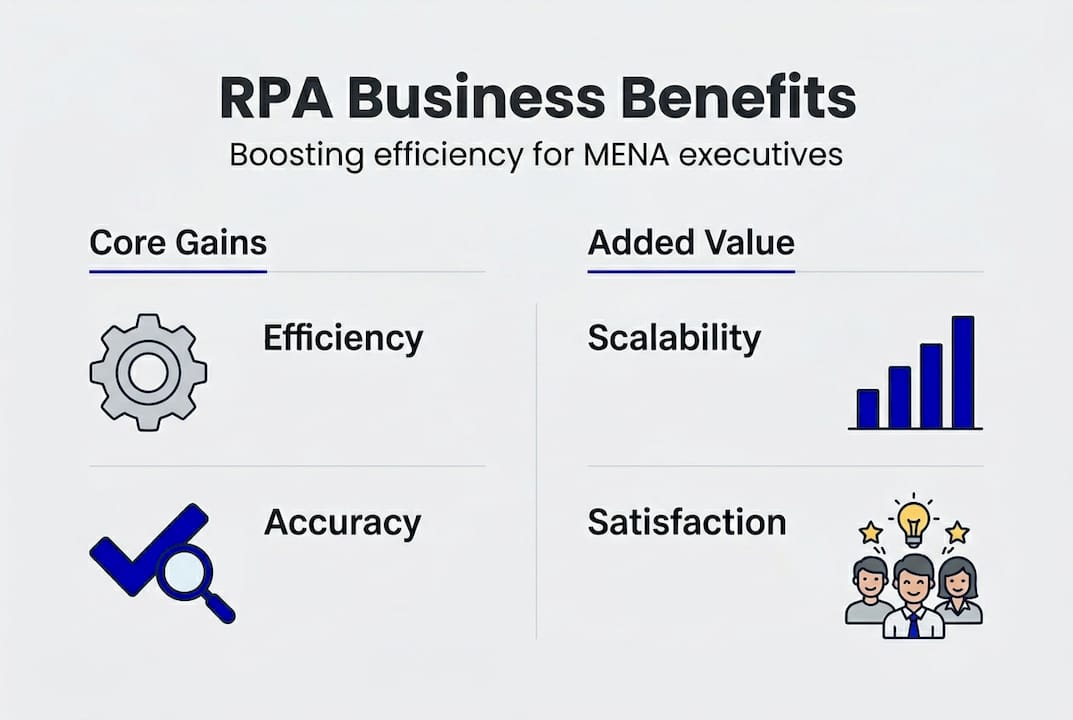
Efficiency gains appear immediately when bots take over repetitive tasks. A process that took an employee 30 minutes now completes in 3 minutes. Bots work 24/7 without breaks, handling overnight processing that would otherwise wait until morning. This speed advantage means faster customer response times, shorter processing cycles, and increased throughput without adding headcount. In customer service, bots can process routine inquiries instantly while escalating complex issues to human agents.
Cost savings materialize through multiple channels. Direct labor costs decrease as bots handle volume previously requiring temporary staff during peak periods. Indirect savings come from faster processing reducing working capital tied up in pending transactions. Error correction costs drop significantly. In finance departments across MENA, organizations report 30 to 50 percent reductions in processing costs for accounts payable and receivable after RPA deployment.
Accuracy improvements deliver both financial and reputational value. RPA reduces errors in data processing, improving accuracy and compliance across operations. Bots don’t misread numbers, skip fields, or transpose digits. This precision matters enormously in regulated industries like banking and healthcare where errors trigger compliance issues, penalties, and customer trust problems. Audit trails automatically capture every bot action, providing documentation that manual processes struggle to maintain consistently.
Scalability becomes straightforward with RPA. Traditional scaling requires hiring, training, and managing additional staff proportional to volume increases. RPA scaling means deploying additional bot licenses and configuring them to handle extra load. During seasonal peaks or market expansions, you can spin up capacity quickly and scale back when demand normalizes. This flexibility particularly benefits MENA organizations navigating rapid growth or market volatility.
Employee satisfaction often improves when RPA eliminates tedious tasks. Staff previously stuck doing data entry or document processing can focus on analysis, customer relationships, and problem solving. This shift reduces turnover in roles typically suffering high attrition and improves overall workforce engagement.
Pro Tip: Start your RPA journey with high-volume, rule-based processes that have clear inputs and outputs. Invoice processing, employee onboarding, and report generation typically deliver quick wins that build organizational confidence before tackling more complex automation opportunities.
Implementing RPA: strategic considerations and best practices
Successful RPA implementation requires more than selecting software and pointing it at processes. Effective RPA requires aligning with business strategy and preparing the organization for change. Executives who approach RPA strategically avoid common pitfalls that derail automation initiatives.
-
Identify and prioritize suitable processes for automation. Not every process benefits from RPA. Ideal candidates involve high transaction volumes, follow standardized steps, use structured data, and require minimal human judgment. Document your current process thoroughly before automating. Many organizations discover inefficiencies during this analysis that should be fixed before automation rather than automating broken processes. Create a prioritization matrix scoring processes on factors like volume, complexity, error rates, and strategic importance.
-
Engage stakeholders early to drive adoption and minimize resistance. Employees fear RPA will eliminate their jobs. Address this directly by communicating how automation eliminates tedious work while creating opportunities for more valuable contributions. Involve process owners in bot design so they feel ownership rather than victimization. Celebrate quick wins publicly to build momentum. Resistance typically comes from middle management worried about losing headcount budgets, so align incentives around efficiency gains rather than staff reductions.
-
Ensure integration with existing enterprise systems. RPA works alongside your ERP, CRM, and other applications, so compatibility matters. Test bots thoroughly in staging environments that mirror production. Consider how bot credentials and access rights will be managed securely. Plan for scenarios where underlying systems change, requiring bot updates. Establish governance around who can create and modify bots to prevent chaos as automation scales across the organization.
-
Define KPIs for performance and ROI measurement. Establish baseline metrics before automation so you can demonstrate improvement. Track processing time, error rates, cost per transaction, and customer satisfaction scores. Calculate ROI including both hard savings like reduced labor costs and soft benefits like faster processing enabling better customer experience. Review bot performance regularly, as processes drift over time and bots may need adjustment to maintain effectiveness.
-
Build internal capability rather than relying entirely on vendors. While external consultants accelerate initial deployment, long-term success requires internal expertise. Train business analysts and process owners in bot configuration. Establish a center of excellence that shares best practices, maintains standards, and supports departments implementing automation. This investment pays dividends as automation scales enterprise-wide.
Pro Tip: Pilot small projects before committing to enterprise-wide RPA rollouts. A successful pilot proves value, identifies implementation challenges, and builds organizational capability in a controlled environment. Choose a pilot process that matters to business outcomes but won’t cripple operations if issues arise during testing.
RPA’s role in digital transformation for MENA businesses
Robotic Process Automation serves as a foundational technology driving efficiency and agility in broader digital transformation initiatives. For MENA executives, understanding how RPA fits within transformation strategy helps maximize its impact and avoid treating it as an isolated technology project.
RPA accelerates business process reengineering by making experimentation less risky. Traditional process changes require extensive planning, system modifications, and long implementation timelines. With RPA, you can test new process designs quickly, measure results, and iterate based on data. This agility transforms how organizations approach improvement, shifting from big-bang changes every few years to continuous optimization.
The table below contrasts traditional approaches with RPA-enabled digital transformation:
| Aspect | Traditional approach | RPA-enabled transformation |
|---|---|---|
| Implementation timeline | 6-18 months for major changes | 2-8 weeks for process automation |
| Risk profile | High risk, big-bang changes | Lower risk, incremental improvements |
| Required investment | Major system overhauls, custom development | Bot licenses, configuration, training |
| Flexibility to change | Difficult and expensive to modify | Easy to reconfigure bots as needs evolve |
| Employee impact | Significant disruption, retraining | Gradual transition, reduced tedious work |
RPA complements other digital technologies rather than replacing them. When combined with AI and machine learning, bots can handle unstructured data like emails or scanned documents. Integration with ERP systems allows end-to-end automation of order-to-cash or procure-to-pay cycles. Connection to CRM platforms enables automated customer communications and data updates. This ecosystem approach multiplies value beyond what any single technology delivers alone.
MENA businesses face unique dynamics that make RPA particularly valuable. Labor markets in the region often feature skills mismatches, with shortages in specialized roles while administrative positions remain abundant. RPA allows organizations to reallocate staff from routine tasks to higher-value work without forced reductions. Cost pressures in competitive markets demand efficiency gains that don’t compromise quality. Government initiatives promoting digital economy development create favorable conditions for automation adoption.
Regulatory compliance requirements across banking, healthcare, and government sectors in KSA, UAE, and Egypt demand accuracy and auditability that RPA naturally provides. Bots create detailed logs of every action, supporting compliance reporting and audit requirements. This documentation capability reduces regulatory risk while streamlining compliance processes.
For organizations beginning digital transformation journeys, RPA offers tangible early wins that build stakeholder confidence and fund subsequent initiatives. The relatively quick implementation and clear ROI make RPA an ideal starting point before tackling more complex transformation programs involving cloud migration, AI implementation, or enterprise architecture overhauls.
Explore digital transformation solutions with SingleClic
Navigating RPA adoption and broader digital transformation requires expertise in both technology and business process optimization. SingleClic supports MENA enterprises with tailored strategies combining RPA, business process automation, and enterprise systems integration. Our team helps you identify high-impact automation opportunities, design implementation roadmaps, and build internal capability for sustained success.
Whether you’re starting your digital transformation journey or scaling existing automation initiatives, we provide the guidance and technical expertise to accelerate results. Explore our digital transformation roadmap resources designed specifically for C-level executives making strategic technology decisions. Our approach combines world-class platforms like UiPath for RPA with deep industry knowledge across banking, healthcare, construction, and government sectors throughout KSA, UAE, and Egypt.
Frequently asked questions
What types of business processes are best suited for RPA?
Rule-based, repetitive processes with structured data and high transaction volumes deliver the strongest RPA returns. Invoice processing, customer onboarding, data entry across multiple systems, report generation, and transaction reconciliation represent ideal starting points. Processes requiring significant human judgment or handling mostly unstructured data need AI augmentation before automation makes sense.
Can RPA integrate with existing ERP and CRM systems in MENA enterprises?
Yes, RPA integrates effectively with ERP and CRM platforms without requiring major system modifications. Bots interact through user interfaces the same way employees do, working alongside Odoo, Microsoft Dynamics 365, SAP, and other enterprise systems. This approach increases automation potential while improving data accuracy across integrated systems. Learn more about how AI enhances ERP capabilities when combined with automation.
What are common challenges when adopting RPA and how can they be mitigated?
Process complexity, employee resistance, and poor system integration represent the most frequent obstacles. Mitigation strategies include thorough process documentation before automation, stakeholder engagement addressing job security concerns, and pilot programs proving value before enterprise rollout. Organizations also struggle with governance as automation scales, so establishing clear standards and a center of excellence prevents chaos. Review our comprehensive guide for C-level leaders for detailed implementation frameworks.
How long does it typically take to see ROI from RPA investments?
Most organizations see positive ROI within 6 to 12 months for well-selected processes. Simple automations can pay back in weeks when applied to high-volume tasks with clear cost savings. Complex implementations involving multiple systems or significant change management may take longer. The key is starting with quick wins that fund subsequent automation expansion rather than attempting enterprise-wide transformation immediately.
Does RPA require extensive IT involvement or can business units implement it independently?
Modern RPA platforms enable business users to configure simple automations with minimal technical training. However, IT involvement remains important for governance, security, system integration, and scaling. The most successful approaches combine business unit ownership of process selection and design with IT support for technical implementation and infrastructure. This collaboration ensures automation aligns with both business needs and technical standards.