Over 60 percent of american companies report that outdated systems slow down their daily operations. To keep up with rapidly changing business demands, modern organizations need tools that unify data and processes. Learning the truth about ERP systems can clear up common misconceptions and help you see how flexible solutions improve efficiency for businesses of all sizes.
Table of Contents
- What Is ERP? Core Definition And Myths
- ERP Types And Deployment Models Compared
- Key Features And Functionalities Of ERP Systems
- Real-World ERP Applications Across Industries
- Implementation Risks And Cost Considerations
- Choosing ERP Versus Alternatives For Business
Key Takeaways
| Point | Details |
|---|---|
| ERP Integration | ERP systems provide a unified platform that connects various business processes, enhancing operational efficiency and data-driven decision-making. |
| Misconceptions Addressed | ERP solutions are not exclusively for large organizations; they can be scaled and customized for any business size or budget. |
| Deployment Options | Businesses can choose from various ERP deployment models (on-premises, cloud, hybrid, multicloud) based on their specific needs and resources. |
| Implementation Challenges | Successful ERP implementation requires careful planning regarding costs, potential disruptions, and strategic alignment with business objectives. |
What Is ERP? Core Definition and Myths
Enterprise Resource Planning (ERP) is a powerful software system that integrates multiple core business processes into a centralized platform, enabling organizations to streamline operations, enhance efficiency, and make data-driven decisions. At its core, an ERP solution acts as the digital nervous system of a modern enterprise, connecting critical departments like finance, human resources, supply chain management, and customer relations.
Contrary to popular misconceptions, ERP systems are not exclusively designed for large corporations with massive budgets. Modern ERP solutions can be customized for organizations of all sizes, offering scalable and flexible implementations that meet diverse business needs. The myth that ERPs are prohibitively expensive no longer holds true, as contemporary platforms deliver substantial return on investment by reducing operational inefficiencies and providing real-time insights.
Businesses in Saudi Arabia and UAE are increasingly recognizing the transformative potential of ERP systems. Key myths that persist about these platforms include:
- Myth 1: ERP is only for large enterprises
- Myth 2: Implementation is too complex and disruptive
- Myth 3: ERPs provide value only for executives
- Myth 4: One-size-fits-all approach to business management
In reality, ERP systems are dynamic tools that can adapt to unique organizational requirements, offering granular customization and supporting businesses across various sectors including construction, healthcare, banking, and government services. By breaking down operational silos and providing a unified view of business processes, ERP solutions empower teams to collaborate more effectively and make strategic decisions with greater confidence.
ERP Types and Deployment Models Compared
Enterprise Resource Planning (ERP) systems have evolved significantly, offering multiple deployment models that cater to diverse business needs and technological infrastructures. Modern organizations can choose from four primary ERP deployment strategies that provide unique advantages and challenges for businesses across different scales and industries.
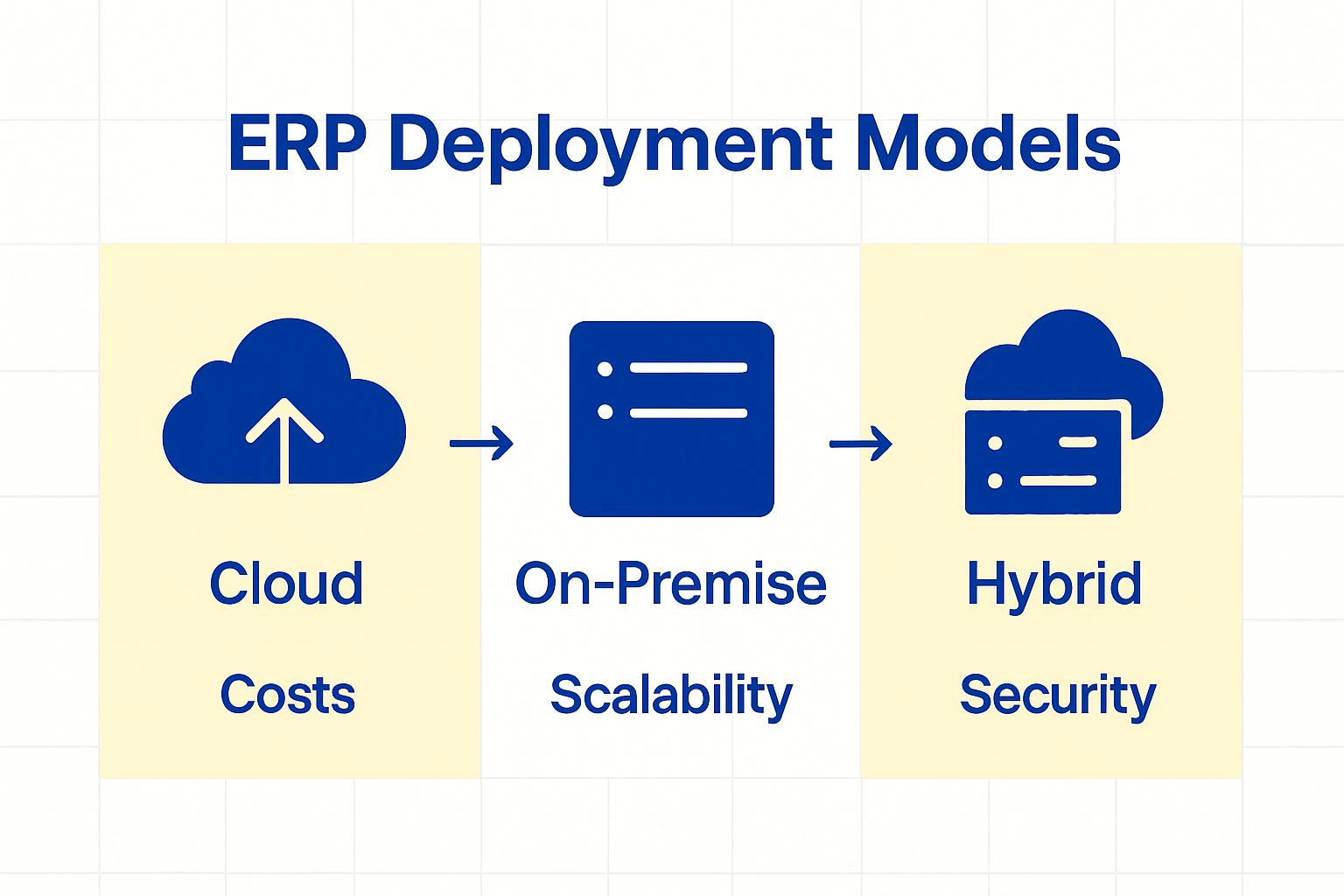
The primary deployment models include on-premises, cloud-based, hybrid, and multicloud ERP systems. On-premises ERP solutions require businesses to host and manage the software on their own servers, providing maximum data control and customization potential. Cloud-based ERP platforms, in contrast, are hosted remotely by vendors, offering lower initial investment, automatic updates, and enhanced accessibility from multiple locations. This model is particularly attractive for small to medium-sized businesses in Saudi Arabia and UAE seeking scalable technological solutions.
Comparing ERP Deployment Models:
-
On-Premises ERP
- Complete data control
- Higher upfront infrastructure costs
- Extensive internal IT management required
- Best for highly regulated industries
-
Cloud ERP
- Lower initial investment
- Easy scalability
- Automatic software updates
- Accessible from multiple devices
-
Hybrid ERP
- Combines on-premises and cloud features
- Flexible infrastructure
- Gradual digital transformation
- Customizable integration
-
Multicloud ERP
- Utilizes multiple cloud providers
- Enhanced system redundancy
- Improved scalability
- Reduced vendor lock-in risks
Businesses must carefully evaluate their specific operational requirements, budget constraints, and long-term digital transformation strategies when selecting an ERP deployment model. The right approach depends on factors like industry regulations, technological infrastructure, budget flexibility, and organizational growth projections.
Key Features and Functionalities of ERP Systems
Enterprise Resource Planning (ERP) systems represent a comprehensive technological solution designed to integrate multiple functional areas of business operations through interconnected modules. These sophisticated platforms enable organizations to streamline processes, enhance communication, and drive strategic decision-making across various departments.
The core functionalities of ERP systems typically encompass several critical business domains. Financial Management modules handle accounting, budgeting, and financial reporting, providing real-time insights into an organization’s fiscal health. Human Resources modules manage employee data, payroll, recruitment, and performance tracking, while Supply Chain Management components optimize inventory, procurement, and logistics processes. Businesses in Saudi Arabia and UAE can leverage these integrated systems to achieve unprecedented operational efficiency and transparency.
Key ERP System Functionalities:
-
Financial Management
- General ledger
- Accounts payable/receivable
- Financial reporting
- Budget tracking
-
Human Resources
- Employee record management
- Payroll processing
- Performance evaluation
- Recruitment tracking
-
Supply Chain Management
- Inventory control
- Procurement automation
- Vendor management
- Logistics optimization
-
Customer Relationship Management
- Sales tracking
- Customer interaction history
- Marketing campaign management
- Service request handling
By consolidating diverse business processes into a unified platform, ERP systems eliminate data silos, reduce manual interventions, and provide actionable insights that drive strategic growth. Organizations can customize these modules to align with their specific operational requirements, ensuring flexible and scalable technological solutions that adapt to evolving business landscapes.

Real-World ERP Applications Across Industries
Enterprise Resource Planning (ERP) systems have transformed operational capabilities across diverse industries, providing tailored solutions that address unique business challenges. ERP technologies integrate core business processes with remarkable versatility, enabling organizations to optimize performance and drive strategic growth across multiple sectors.
In manufacturing, ERP systems revolutionize production management by synchronizing inventory control, supply chain logistics, and production planning. Healthcare organizations leverage these platforms to streamline patient data management, billing systems, and administrative workflows. Retailers utilize ERP solutions to track sales, manage customer relationships, and optimize inventory distribution. Financial institutions implement ERP technologies to enhance regulatory compliance, manage complex transactions, and improve risk management strategies.
Industry-Specific ERP Applications:
-
Manufacturing
- Production scheduling
- Inventory tracking
- Quality control management
- Supply chain optimization
-
Healthcare
- Patient record management
- Billing system integration
- Compliance tracking
- Resource allocation
-
Retail
- Point-of-sale integration
- Customer relationship management
- Inventory forecasting
- Multi-channel sales tracking
-
Financial Services
- Transaction processing
- Regulatory reporting
- Risk management
- Financial forecasting
Businesses in Saudi Arabia and UAE are increasingly recognizing the transformative potential of industry-specific ERP implementations. By adopting customized ERP solutions, organizations can achieve unprecedented operational efficiency, reduce manual interventions, and create data-driven strategies that respond dynamically to market demands. The key lies in selecting flexible ERP platforms that can be tailored to specific organizational requirements while maintaining scalability and performance.
Implementation Risks and Cost Considerations
Enterprise Resource Planning (ERP) implementation represents a significant strategic investment that demands careful financial and operational planning. Organizations must navigate multiple potential risks and challenges during the implementation process, understanding that successful deployment requires more than technological investment.
The financial landscape of ERP implementation involves substantial upfront costs, including software licensing, hardware infrastructure, customization, and comprehensive staff training. Businesses in Saudi Arabia and UAE typically encounter initial investments ranging from $150,000 to $750,000 depending on organizational complexity and selected solutions. Beyond direct expenses, companies must factor in indirect costs such as potential productivity disruptions during system transition, potential workflow redesign, and the opportunity cost of implementing new technological systems.
Key Implementation Risks and Mitigation Strategies:
-
Financial Risks
- Unexpected customization expenses
- Longer implementation timelines
- Hidden infrastructure upgrade costs
- Resource allocation challenges
-
Operational Disruption Risks
- Temporary productivity reduction
- Learning curve for employees
- Potential data migration errors
- Workflow transformation challenges
-
Technical Risks
- System compatibility issues
- Integration complexities
- Cybersecurity vulnerabilities
- Performance optimization challenges
-
Strategic Risks
- Misalignment with business objectives
- Insufficient change management
- Inadequate user adoption
- Limited scalability
Successful ERP implementation requires a holistic approach that balances technological capabilities with organizational readiness. Businesses must develop comprehensive change management strategies, invest in continuous employee training, and maintain flexible implementation frameworks that allow incremental adaptation. By anticipating potential challenges and developing robust mitigation plans, organizations can transform potential risks into opportunities for operational excellence and digital transformation.
Choosing ERP Versus Alternatives for Business
Selecting the right technological solution is critical for organizational efficiency, and businesses must carefully evaluate whether a comprehensive Enterprise Resource Planning (ERP) system or alternative software solutions best meet their operational requirements. Businesses must consider factors such as scalability, integration capabilities, and long-term strategic alignment when making this pivotal decision.
Traditional standalone software solutions often create operational silos, with each department utilizing disparate systems that complicate data sharing and strategic decision-making. ERP systems, in contrast, provide a unified platform that integrates multiple business functions, offering real-time insights and streamlined workflows. For organizations in Saudi Arabia and UAE, this comprehensive approach can significantly enhance operational transparency and competitive agility.
Comparative Analysis of ERP vs Alternative Solutions:
-
ERP Systems
- Comprehensive integration
- Real-time data synchronization
- Centralized reporting
- Scalable infrastructure
-
Standalone Software
- Department-specific functionality
- Lower initial investment
- Limited cross-departmental communication
- Higher long-term complexity
-
Best-of-Breed Solutions
- Specialized features
- Targeted performance
- Multiple vendor management
- Complex integration challenges
-
Custom Development
- Tailored specifically to needs
- High development costs
- Extended implementation timelines
- Maintenance complexity
Ultimately, the decision between an ERP system and alternative solutions depends on an organization’s unique operational landscape, budgetary constraints, and strategic growth objectives. While ERP platforms require significant initial investment, they offer unparalleled potential for holistic business transformation, providing a robust technological foundation that adapts and scales with organizational evolution.
Unlock True Business Efficiency with Expert ERP Solutions
The article highlights common challenges in adopting ERP systems such as complex implementation, high costs, and misalignment with unique business needs. These pain points often cause hesitation, yet the goal remains clear: streamlined operations, data-driven decisions, and scalable growth. Singleclic understands these challenges and delivers tailored ERP and digital transformation services designed for organizations in KSA, UAE, and Egypt. We specialize in turning ERP myths into measurable benefits by combining deep industry expertise with top-tier platforms like Odoo and Microsoft Dynamics 365.
Take the step beyond digitalization and embrace true optimization through a solution customized for your business. With over a decade of regional experience, 70+ skilled consultants, and flexible onboarding, Singleclic empowers your teams to collaborate more efficiently and adapt quickly to changing market demands. Discover how our ERP & CRM Implementation and Business Process Automation services can simplify your ERP journey right now. Visit Singleclic today to learn more and transform your business operations with confidence.
Frequently Asked Questions
What is ERP and how does it benefit a business?
ERP (Enterprise Resource Planning) is a software system that integrates multiple core business processes into a centralized platform, improving operational efficiency and enabling data-driven decision-making.
What are the different types of ERP deployment models?
The main ERP deployment models include on-premises, cloud-based, hybrid, and multicloud systems, each offering unique advantages and challenges concerning cost, control, and flexibility.
How can ERP systems enhance financial management in a business?
ERP systems help streamline financial management by providing real-time insights into accounting, budgeting, and financial reporting, ensuring better fiscal health and transparency across the organization.
What are some common implementation risks of ERP systems?
Common risks include financial risks from unexpected costs, operational disruptions during the transition, technical issues like system compatibility, and strategic misalignment with business objectives.
Recommended
- Business Processes in ERP: Streamlining Operations for Maximum Efficiency | Singleclic
- 7 Reasons Why CRM Odoo is the Best Choice for Growing Businesses | Singleclic
- Unlocking Business Growth with Odoo CRM: 6 Key Benefits for CEOs and SMBs | Singleclic
- The Essential ERP Framework for Streamlined Business Operations | Singleclic