TL;DR:
- Process visibility enables organizations to monitor and understand real-time workflow performance, identifying delays and inefficiencies. It complements process control by providing descriptive insights that support faster, data-driven decision-making in high-growth Gulf markets. Building genuine operational clarity requires a disciplined approach, combining technology with organizational change; low-code platforms like Cortex facilitate rapid implementation and ongoing improvement.
Process visibility is defined as the ability to see and understand how work flows through an organization, recognizing where delays and inefficiencies occur in real time. For business leaders in Saudi Arabia, the UAE, and across the Gulf, this capability is no longer optional. It is the foundation of evidence-based management. Without it, decisions rest on assumptions rather than facts. Platforms like SAP, Microsoft Dynamics 365, and modern process analytics tools have made real-time operational insight accessible at scale. The result is faster decisions, fewer surprises, and a measurable improvement in operational performance.
What is process visibility and why does it matter now?
Process visibility is the capability to monitor, measure, and interpret every step of a business process as it happens. The industry also refers to this concept as operational visibility or business process observability, terms you will encounter in enterprise technology discussions. All three phrases describe the same core need: knowing what is actually happening inside your operations, not just what you think is happening.

The gap between assumption and reality is where performance problems hide. A procurement process that looks fine on a monthly report may be stalling at the approval stage every week. A customer onboarding workflow may be completing on time for 80% of cases while silently failing for the other 20%. Without granular, real-time insight, neither problem surfaces until it becomes a crisis.
For organizations running Microsoft Dynamics 365 or Odoo, the data to close this gap already exists inside the system. The challenge is surfacing it in a way that drives decisions rather than just filling dashboards.
How does process visibility differ from process control?
This distinction matters more than most executives realize. Process visibility is descriptive. It shows you what happened and what is happening. Process control is prescriptive. It governs what is allowed to happen before a transaction completes.
| Dimension | Process visibility | Process control |
|---|---|---|
| Function | Observe and report on workflow status | Enforce rules before actions post |
| Timing | Retrospective and real-time monitoring | Preventive, embedded in execution layer |
| Output | Dashboards, alerts, analytics | Guardrails, approvals, automated blocks |
| Risk profile | Identifies issues after or as they occur | Prevents errors from entering the system |
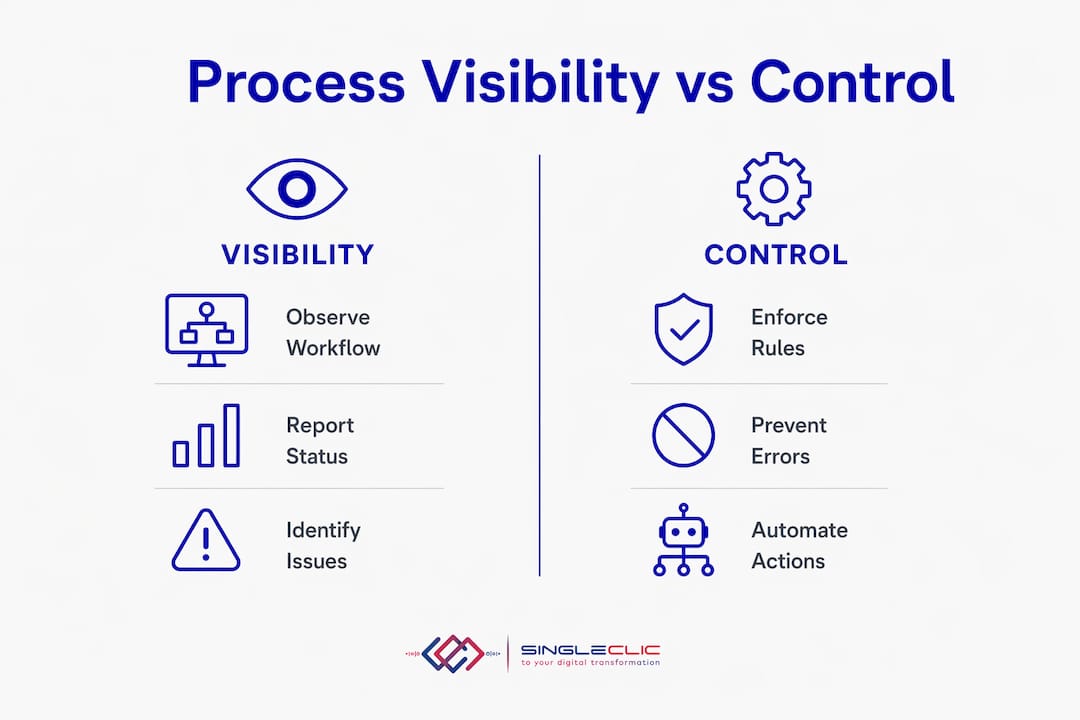
A dashboard showing that 30% of purchase orders exceeded budget last quarter is visibility. A system that blocks a purchase order from posting until a manager approves it is control. Effective process control requires rules enforcement before transactions post, with guardrails that make the right action the easiest action. Without execution layers, ERP systems provide record-keeping but not operational control.
The practical implication: visibility and control are complementary, not interchangeable. You need both. Visibility without control tells you what went wrong. Control without visibility leaves you blind to whether your guardrails are actually working.
Pro Tip: If your team relies solely on weekly or monthly reports to manage operations, you have an operational blind spot. Reporting shows outcomes. Real-time visibility shows causes. Invest in process analytics that surface the “why” behind performance variation, not just the “what.”
Why is process visibility essential for operational excellence?
Operations leaders need process visibility to understand why routine processes fluctuate and to respond faster to market unpredictability using credible data. This moves decisions from gut instinct to evidence-based management. That shift is significant in high-growth markets like Saudi Arabia and the UAE, where organizations are scaling rapidly and process complexity grows with every new business unit, partner, or regulatory requirement.
The benefits of strong operational visibility include:
- Faster bottleneck identification. You see exactly where work stalls, which team, which step, and how often.
- Reduced operational risk. Anomalies surface before they become failures, cutting the cost of correction.
- Better resource allocation. Data shows where capacity is wasted and where it is stretched, so you can rebalance without guesswork.
- Improved ROI on technology investments. When you can measure process performance, you can prove whether an ERP or automation project delivered its promised value.
- Stronger compliance posture. Audit trails and real-time monitoring make regulatory reporting faster and more accurate, a growing priority for banks and government entities in the Gulf.
Digital transformation initiatives across Saudi Arabia’s Vision 2030 programs and the UAE’s national digitization agenda have pushed process transparency to the top of the executive agenda. Organizations that can demonstrate operational clarity attract better partners, win more government contracts, and retain talent more effectively.
How does process visibility support sustainability goals?
Process visibility has expanded to cover sustainability by monitoring materials, energy, and emissions across the value chain, supporting decarbonization and circular economy goals. This is no longer a niche concern. Investors, regulators, and major procurement teams in the Gulf are asking for it.
The specific capabilities this unlocks include:
- Tracking energy consumption at the process level, not just the facility level
- Identifying Scope 3 emission hotspots across supplier networks
- Monitoring material flows to reduce waste and support circular economy reporting
- Assessing climate-related risks embedded in supply chain processes
- Generating audit-ready sustainability data for ESG disclosures
In sustainability-focused enterprises, process visibility extends to monitoring environmental impacts throughout the supply chain, becoming a foundation for resilience and compliance. For construction and real estate companies in Saudi Arabia and the UAE, where large-scale projects carry significant environmental footprints, this capability is becoming a competitive differentiator.
Pro Tip: When building your process visibility program, map your sustainability data requirements alongside your operational ones from the start. Retrofitting emissions tracking into an existing visibility architecture costs significantly more than designing for it upfront.
What practical steps improve process visibility for your business?
Improving operational visibility is a structured effort, not a single technology purchase. The following steps reflect what works in practice for Gulf enterprises moving from traditional reporting to real-time process insight.
- Audit your current data flows. Identify which processes generate data, where that data lives, and whether it is accessible in real time. Most organizations discover significant gaps at this stage.
- Define the process metrics that matter. Cycle time, error rate, exception frequency, and SLA compliance are standard starting points. Align metrics to business outcomes, not just IT system health.
- Implement process mining or workflow analytics. Tools in this category analyze event logs from your ERP or BPM system to reconstruct actual process flows. This reveals the difference between your designed process and what employees actually do.
- Deploy a visual workflow designer. Visual representations of process flows make it far easier for non-technical managers to spot inefficiencies and communicate improvement priorities.
- Adopt a low-code platform for rapid iteration. Low-code platforms accelerate the improvement of process visibility by enabling rapid development and integration of workflow visualizers and analytics dashboards. They reduce dependency on specialized IT resources and allow business teams to build and modify dashboards without waiting months for development cycles.
- Integrate business process observability. Business Process Observability combines technical telemetry with workflow intelligence to provide real-time visibility across systems, detecting stalled transactions and SLA risks before they impact customers.
The contrast between traditional and modern approaches is stark:
| Approach | Traditional reporting | Real-time process analytics |
|---|---|---|
| Data freshness | Weekly or monthly | Continuous or near real-time |
| Failure detection | After the fact | As it happens or before impact |
| User | Finance and IT teams | Operations managers and executives |
| Decision speed | Days to weeks | Hours or same day |
| Adaptability | Static reports | Dynamic dashboards with drill-down |
For Gulf enterprises running IBM BAW, Microsoft Dynamics 365, or Odoo, the integration layer is where visibility either succeeds or fails. Analyzing business processes before deploying automation tools is the step most organizations skip, and it is the one that determines whether your visibility investment pays off.
Key takeaways
Process visibility is the foundation of evidence-based management, and organizations that invest in it consistently outperform those that rely on periodic reporting alone.
| Point | Details |
|---|---|
| Visibility vs. control | Visibility describes what is happening; control prevents errors before they occur. Both are required. |
| Real-time over reporting | Periodic reports show outcomes; real-time analytics reveal causes and allow faster correction. |
| Sustainability link | Process visibility now extends to emissions and supply chain monitoring, a growing compliance requirement in the Gulf. |
| Low-code advantage | Low-code platforms reduce the time and cost of building process dashboards and workflow analytics. |
| Start with process audit | Map existing data flows and define outcome-linked metrics before selecting any technology tool. |
Process visibility in the gulf: what i’ve learned from the field
By Tamer Badr
The most common mistake I see among business leaders in Saudi Arabia and the UAE is treating process visibility as a reporting upgrade. They invest in a new dashboard layer on top of an existing ERP and expect transformation. What they get is prettier data about the same problems.
Real visibility requires you to change how your organization thinks about process data. It is not a tool you buy. It is a discipline you build. The organizations I have worked with that achieved genuine operational clarity shared one trait: they started by asking “why does this process vary?” before they asked “what tool should we use?”
The second gap I see consistently is the disconnect between IT monitoring and business process health. Monitoring only component status can leave hidden failures in business transactions uncovered. A server can be green while a critical approval workflow sits stalled for three days. Business-level observability closes that gap.
For Gulf enterprises specifically, the low-code opportunity is real and underused. Singleclic’s Cortex platform, built for MENA enterprises with full Arabic UI and on-premise deployment, allows operations teams to build and modify process dashboards without writing code. That matters in markets where IT capacity is stretched and business requirements change fast. The organizations that will lead in operational excellence over the next five years are the ones building visibility into their processes today, not waiting for a perfect technology stack to appear.
— Tamer Badr
How Singleclic helps you build real process visibility
Singleclic works with enterprises across Saudi Arabia, the UAE, and Egypt to close the gap between operational data and operational insight. As a Microsoft Dynamics 365 integrator, Odoo Silver Partner, and IBM BAW specialist, Singleclic designs end-to-end process visibility architectures that connect your ERP, BPM, and analytics layers into a single coherent view. The Cortex low-code platform accelerates this work by letting your operations team build and iterate on dashboards without waiting on IT development cycles. If you are planning an ERP implementation or assessing your current process maturity, start with the ERP implementation checklist built specifically for Middle East enterprises. For a broader view of how automation and visibility work together, the business process automation guide for C-level leaders is a practical next step.
FAQ
What is the process visibility definition in simple terms?
Process visibility is the ability to see and understand how work moves through your organization in real time, including where it slows down, fails, or succeeds.
How does process visibility differ from operational visibility?
Operational visibility is the broader term covering all aspects of business operations. Process visibility is a subset focused specifically on workflow steps, handoffs, and performance within defined business processes.
What are the most important process visibility metrics?
Cycle time, error rate, exception frequency, and SLA compliance rate are the four metrics that give operations leaders the clearest picture of process health and where improvement is needed.
What tools improve process visibility for enterprises?
ERP platforms like Microsoft Dynamics 365 and Odoo, process mining tools, workflow analytics dashboards, and low-code platforms like Cortex all contribute to stronger process visibility when integrated correctly.
Why do gulf enterprises struggle with process visibility?
Most organizations in Saudi Arabia and the UAE have invested in ERP systems but have not connected them to real-time analytics layers. The result is data-rich but insight-poor operations, where decisions still rely on periodic reports rather than live process intelligence.