TL;DR:
- Projects with well-managed requirements are three times more likely to succeed and significantly reduce costs and defects.
- Effective requirements capture functional, non-functional, and regulatory needs from stakeholders, preventing costly rework.
- Strong executive sponsorship and organized governance are crucial for requirements success, beyond just tools and processes.
Projects with managed requirements are 3x more likely to succeed, yet most executives treat this step as an IT formality rather than a strategic priority. In KSA and UAE, where ERP and CRM investments routinely run into millions of dollars, the gap between a successful rollout and a costly failure often traces back to how well requirements were defined and managed before a single line of code was written. This article breaks down what requirements management actually means for your business, what the data says about its impact, and how you can use it to protect your investment and accelerate operational efficiency.
Table of Contents
- What are software requirements and why do they matter?
- How structured requirements management reduces risk and cost
- Common pitfalls and costly edge cases in ERP/CRM projects
- Modern trends: AI and advanced tools for requirements management
- The uncomfortable truth most leaders overlook about requirements management
- Next steps: Streamline your ERP and CRM implementation with expert support
- Frequently asked questions
Key Takeaways
| Point | Details |
|---|---|
| Failure risk slashed | Managing requirements brings ERP/CRM project failure rates below 20 percent and maximizes business ROI. |
| Unmatched cost savings | Structured requirements cut project costs by 62 percent and prevent expensive late errors. |
| AI-driven defect reduction | Modern tools can reduce software defects by up to 65 percent through better requirements management. |
| Executive leadership critical | Organizational alignment and C-level sponsorship are key to successful requirements implementation. |
| Compliance is non-optional | KSA/UAE leaders must build regulatory compliance into requirements to ensure project success. |
What are software requirements and why do they matter?
Now that we’ve discussed the importance of requirements management generally, let’s define what software requirements mean for your business operations.
Software requirements are the documented descriptions of what a system must do, how it must perform, and what constraints it must operate within. For ERP and CRM implementations, requirements go far beyond feature checklists. They capture how your procurement cycle should work in the system, how customer data should flow between departments, what reports finance needs on demand, and how the platform must behave under your regulatory environment.
There are two main categories you need to understand:
- Functional requirements describe what the system does. For example, the CRM must automatically assign leads to sales reps based on territory, or the ERP must generate VAT-compliant invoices for Saudi tax authority (ZATCA) submissions.
- Non-functional requirements describe how the system performs. Response time under peak load, data encryption standards, uptime guarantees, and Arabic language support all fall here.
Both categories are equally important. Focusing only on functional requirements is one of the most common mistakes in regional ERP projects, and it leads to systems that technically work but fail operationally.
“A system that meets its functional requirements but crashes under load, or fails to support Arabic character sets, is not a successful implementation. It is an expensive prototype.” — Tamer Badr, Singleclic
For enterprises investing in digital solutions for KSA/UAE, the stakes are particularly high. Your workforce spans multiple nationalities, your compliance requirements include ZATCA, PDPL (Personal Data Protection Law in Saudi Arabia), and UAE data residency rules. Your ERP needs to handle multi-currency transactions, and your CRM needs to support both Arabic and English interfaces seamlessly. None of this happens unless these requirements are explicitly captured and managed from day one.
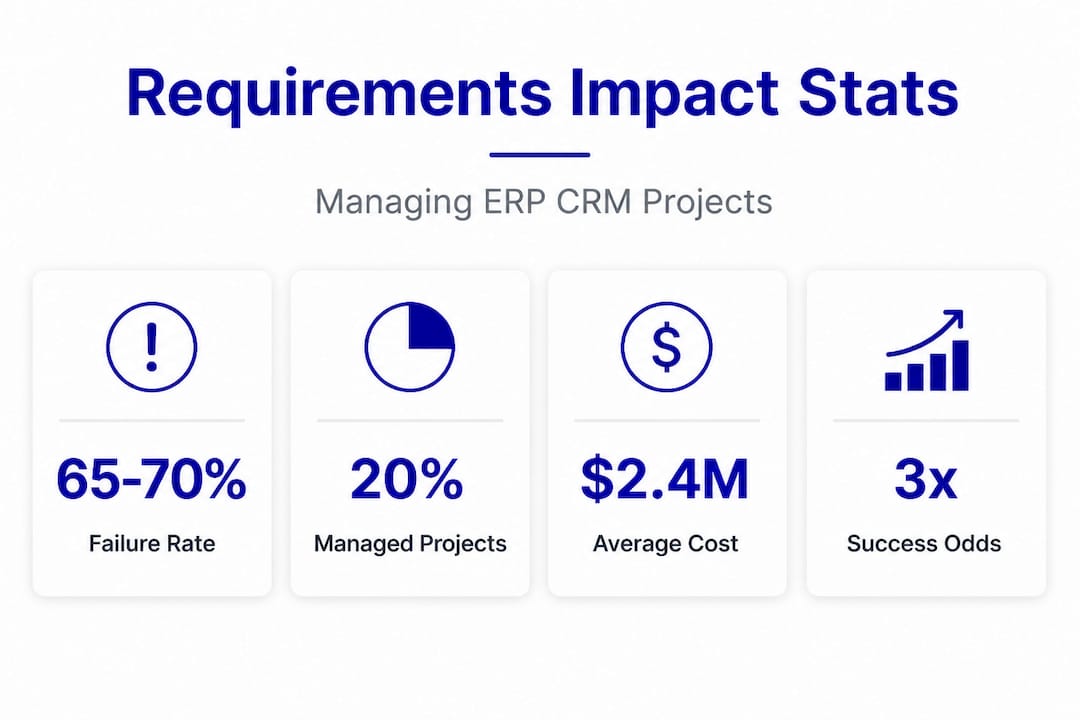
The numbers make a compelling case for discipline here. Structured requirements management reduces failure rates from 65 to 70 percent down to below 20 percent, cuts project costs by 62 percent, and reduces post-release defects by 40 to 60 percent. These are not marginal improvements. They represent the difference between a project that transforms your operations and one that consumes your budget and damages team morale.
Understanding strategic CRM benefits also depends on well-defined requirements. Without them, even the best CRM platform becomes a data repository rather than a revenue engine. The foundation for any successful implementation is a solid requirement gathering guide that captures business objectives first, then translates them into system specifications.
| Requirements factor | Impact on project |
|---|---|
| Documented functional requirements | Reduces misalignment between IT and business units |
| Non-functional requirements defined | Prevents performance and compliance failures post-launch |
| Stakeholder sign-off on requirements | Cuts late-stage change requests by up to 50% |
| Requirements traceability maintained | Links deliverables back to business objectives |
How structured requirements management reduces risk and cost
With the basics of requirements established, it’s time to quantify the business value of actually managing these requirements rigorously.
Scope creep is the single biggest budget killer in ERP and CRM projects. It happens when requirements are vague, undocumented, or not formally approved. A stakeholder mentions a new report during a demo, the development team interprets it broadly, and suddenly three weeks of work have been added without a corresponding budget or timeline adjustment. Multiply this by a dozen similar incidents and you have a project that is 40 percent over budget before go-live.

Structured requirements management stops this pattern by creating a formal change control process. Any modification to agreed requirements goes through review, impact assessment, and approval. This does not slow down the project; it protects it.
Here is a side-by-side view of what changes with and without structured requirements:
| Dimension | Unstructured approach | Structured approach |
|---|---|---|
| Scope definition | Informal, verbal, evolving | Documented, version-controlled, approved |
| Change management | Ad hoc, reactive | Formal review, impact-assessed |
| Defect origin | Discovered post-launch | Identified during requirements review |
| Cost profile | Back-loaded, unpredictable | Front-loaded, predictable |
| Stakeholder alignment | Frequent disputes | Clear accountability |
The financial case is straightforward. Preventing 50 percent of rework on a $2.4 million project saves $250,000, and 56 percent of defects originate in the requirements phase. Fixing a defect in the requirements phase costs roughly one dollar. The same defect found during testing costs ten dollars. Found in production, it can cost one hundred dollars or more in rework, downtime, and lost productivity.
The return on investment is equally compelling. Structured requirements processes deliver an ROI of $3.30 to $7.50 for every dollar invested, and organizations using them are three times more likely to achieve project success, according to INCOSE (International Council on Systems Engineering).
Here is a practical sequence for implementing structured requirements management in your next ERP or CRM project:
- Define business objectives first. Before writing any technical requirement, document the operational outcomes you expect. “Reduce order-to-cash cycle by 30 percent” is a better starting point than “implement an ERP.”
- Engage cross-functional stakeholders. Finance, operations, IT, compliance, and customer-facing teams all have requirements. Missing any one group creates gaps.
- Classify and prioritize requirements. Use a priority framework like MoSCoW (Must have, Should have, Could have, Won’t have) to ensure core functionality is delivered before nice-to-haves.
- Get formal sign-off. Every approved requirement should carry a timestamp and a named approver. This creates accountability and prevents requirement disputes later.
- Build a change control process. Any requirement change after sign-off must go through a defined approval workflow with documented impact on cost and timeline.
Pro Tip: Assign a dedicated requirements owner, not just a project manager, on every ERP or CRM engagement. This person is responsible for maintaining the requirements baseline, managing changes, and ensuring traceability throughout the project lifecycle. Organizations that skip this role consistently report higher rework rates and longer timelines.
Understanding requirements workflow optimization and applying practical ERP integration tips are both downstream benefits of getting requirements right at the start.
Common pitfalls and costly edge cases in ERP/CRM projects
Next, let’s look at what goes wrong when requirements are not managed proactively, and how C-level leaders can avoid being caught off guard.
Even experienced teams fall into predictable traps. Understanding these failure patterns in advance gives you a significant advantage when steering your next implementation.
The five most common pitfalls in ERP and CRM requirements are:
- Ambiguous specifications. Vague requirements like “the system should be user-friendly” are impossible to validate. They invite subjective interpretation and almost always result in rework.
- Scope creep from late changes. Changing requirements after development begins can make late fixes 10 times more expensive than addressing the same issue at the requirements stage. Each late-stage change ripples through design, development, testing, and training.
- Missing business corner cases. Standard workflows get documented, but edge cases are ignored. What happens when a customer disputes an invoice in a multi-currency deal? What if an employee changes roles mid-project approval cycle? These scenarios need requirements too.
- Integration and data migration gaps. ERP and CRM systems do not operate in isolation. Requirements that fail to address how data migrates from legacy systems, or how integrations with third-party platforms behave, create expensive surprises during testing.
- Ignoring regulatory compliance. In KSA and UAE, ERP failure statistics consistently show that non-compliance with local tax, data residency, or reporting standards triggers costly rework. ZATCA e-invoicing requirements in Saudi Arabia alone have forced multiple post-go-live system modifications for organizations that did not address them upfront.
“The most dangerous requirements are the ones nobody wrote down because everyone assumed someone else was handling them.” — Tamer Badr, Singleclic
Building key elements of a digital strategy always includes regulatory compliance as a non-negotiable requirements category. Similarly, a robust change management strategy ensures that when requirements do change, the organization absorbs those changes without derailing the project.
Pro Tip: Run a “corner case workshop” before finalizing requirements. Bring together finance, operations, IT, and compliance for a half-day session focused exclusively on exception scenarios. What happens when the system receives unexpected inputs? What are the failure modes? These sessions routinely surface 20 to 30 requirements that would otherwise be discovered in production.
Modern trends: AI and advanced tools for requirements management
As technology evolves, so do the tools and methods available for managing requirements. Here’s how modern trends are reshaping the landscape.
Artificial intelligence is changing the speed and accuracy of requirements work in measurable ways. AI-powered requirements tools can parse large volumes of stakeholder interviews, meeting transcripts, and legacy documentation to identify patterns, flag ambiguities, and suggest missing requirements. The productivity gains are significant.
Key capabilities that AI brings to requirements management include:
- Natural language processing to analyze stakeholder inputs and extract structured requirements automatically
- Conflict detection that identifies contradictory requirements before they reach development
- Traceability automation that links requirements to test cases and deliverables without manual effort
- Change impact analysis that predicts the downstream effects of a requirement modification in seconds rather than days
AI tools reduce defects by 40 to 65 percent in organizations that adopt them consistently, representing one of the highest-impact investments available for ERP and CRM project governance.
However, technology alone does not solve the problem. A common and underreported challenge is human resistance. When AI tools surface missing or conflicting requirements, they can expose gaps in organizational knowledge or process ownership. Some teams resist this transparency because it makes incompetence visible. C-level leaders who understand this dynamic can address it by framing AI-assisted requirements as a quality improvement tool rather than a performance evaluation mechanism.
The 2026 digital trends for KSA/UAE consistently highlight AI-augmented project governance as a top priority for regional enterprises. Organizations pairing AI requirements tools with strong governance frameworks are consistently outperforming those relying on traditional manual processes. Improving team productivity through AI-assisted workflows is no longer optional for enterprises competing at scale in the Gulf region.
The balance between empirical data from AI analysis and contextual knowledge from domain experts remains critical. AI identifies patterns; experienced practitioners interpret them. Neither replaces the other.
The uncomfortable truth most leaders overlook about requirements management
Here is where most leaders get requirements management wrong in KSA and UAE, and what that means for your next project.
Most executives who experience a failed ERP or CRM implementation blame the software vendor, the implementation partner, or the budget. Rarely do they look at their own organizational structure and governance. Yet the evidence points clearly in that direction.
Some organizations treat requirements as a procurement or IT issue, when the core problem is actually organizational positioning and governance. Traceability tools help, but the baseline success rate for projects with traceability in place is still only 31 percent. That number should shock you. Organizations that have traceability but lack executive alignment still fail nearly seven times out of ten.
The real issue is that requirements management requires cross-functional authority. No IT manager can force a CFO to attend requirements workshops. No project coordinator can compel the COO to sign off on scope. Only executive sponsorship at the C-level creates the organizational gravity needed to keep requirements work on track and prevent the gradual erosion of discipline that leads to scope creep and late failures.
Poor software requirements cause $2.41 trillion in losses globally every year, and the solution lies not in better tools alone but in governance frameworks with real executive accountability. AI-augmented processes help address edge cases faster, but they need organizational backing to be effective.
What we have observed across 60-plus enterprise implementations in the region is that the projects which succeed are the ones where a senior executive, often the CEO or COO, treats requirements management as a personal priority, not a delegated task. They attend the key workshops. They resolve conflicts between business units. They enforce the change control process when departments push back.
This is not glamorous work. But it is the work that determines whether your ERP investment delivers the efficiency and competitive advantage you are expecting, or becomes a cautionary tale. Understanding digital disruption case studies from the region reinforces this point consistently: leadership behavior is the differentiating factor, not the technology stack.
Next steps: Streamline your ERP and CRM implementation with expert support
To put these principles into action, here is how you can leverage expert support and next-generation solutions for your ERP and CRM needs.
If the insights in this article have prompted a closer look at how your organization handles requirements, you are already ahead of most. The next step is translating that awareness into action.
At Singleclic, we have spent over a decade helping enterprises across KSA, UAE, and Egypt build the requirements foundation that makes ERP and CRM implementations succeed the first time. Whether you are starting a new implementation or trying to rescue a struggling one, we can help you assess ERP readiness and identify the gaps before they become expensive problems. Our team applies proven ERP integration tips and structured requirements frameworks to every engagement, ensuring your investment is protected. For teams ready to take action, our CRM implementation tips resource is a practical starting point for any CIO or CTO planning a rollout. Reach out to our team and let’s build the right foundation for your next project together.
Frequently asked questions
How does requirements management reduce project failure rates in ERP/CRM?
Structured requirements management reduces failure rates from 65 to 70 percent down to below 20 percent, with simultaneous reductions in project costs by 62 percent and post-release defects by 40 to 60 percent. The discipline of documenting, approving, and tracking requirements eliminates the ambiguity that drives the majority of costly failures.
What ROI can executives expect from investing in requirements management?
Typical returns are $3.30 to $7.50 for every dollar invested, driven primarily by early defect prevention and the elimination of expensive rework cycles. Organizations that prioritize this investment consistently report faster go-live timelines and stronger operational alignment post-launch.
What is the impact of AI on requirements management for ERP/CRM?
AI-driven tools reduce defects by 40 to 65 percent through automated conflict detection, traceability, and natural language analysis of stakeholder inputs. They accelerate requirements analysis significantly but require organizational support to be effective.
Why do ERP/CRM projects in KSA/UAE need to prioritize regulatory compliance?
Global project failure benchmarks apply directly to regional implementations, and local regulations such as ZATCA e-invoicing, PDPL, and UAE data residency rules create compliance requirements that must be captured upfront. Organizations that address these in requirements rather than after go-live avoid some of the most expensive rework scenarios in the region.
What’s the biggest mistake executives make in requirements management?
The main error is treating requirements as purely a procurement or IT responsibility, when organizational positioning and governance are the actual determinants of success. Even organizations with traceability tools in place show a baseline success rate of only 31 percent without strong executive sponsorship and cross-functional authority.