TL;DR:
- Over 70% of digital transformation projects fail due to underestimated organizational change challenges rather than technological issues.
- Effective change management, involving stakeholder analysis, resistance planning, and reinforcement, is crucial for success and must be integrated into overall strategies.
Over 70% of digital transformation projects fail to meet their goals not because of broken technology, but because organizations underestimate how hard it is to change the way people work. For C-level executives and IT leaders in KSA and UAE, this is a costly misconception. Whether you are modernizing a hospital network, rolling out an ERP system across a construction group, or upgrading a bank’s core platform, the technology is rarely the problem. The people, the processes, and the culture around that technology are what determine whether your investment succeeds or stalls.
Table of Contents
- Defining change management: What it is and what it is not
- Why change management is essential in digital transformation
- The core stages of effective change management
- Building a change-ready organization in KSA and UAE enterprises
- Overcoming challenges: Pitfalls and proven solutions
- What most leaders get wrong about change management
- Start strong: Change management resources and expert help
- Frequently asked questions
Key Takeaways
| Point | Details |
|---|---|
| Change management defined | It is a structured, strategic approach for guiding people and systems through organizational change. |
| Critical for digital transformation | Robust change management dramatically improves the success rate of digital initiatives in KSA and UAE. |
| Follow proven frameworks | Using structured models and clear communication ensures smoother transitions and stronger adoption. |
| Leadership drives success | C-level engagement and a change-ready culture are the backbone of effective transformation. |
| Avoid common pitfalls | Proactive planning and measuring results help address challenges before they derail your project. |
Defining change management: What it is and what it is not
Before you can apply change management effectively, you need to understand what it actually covers, because most organizations get this wrong from day one.
“Change management is the structured approach to transitioning individuals, teams, and organizations from a current state to a desired future state.” That definition sounds straightforward, but in practice, most leaders reduce it to sending a few announcement emails and scheduling a training session. That is not change management. That is communication, and there is a significant difference.
Here is what real change management includes:
- Stakeholder analysis: Identifying who is affected, how deeply, and what their concerns are before any rollout begins
- Resistance planning: Anticipating where pushback will come from and designing responses in advance
- Process redesign: Ensuring workflows are updated to match the new systems, not just layered on top of old habits
- Adoption tracking: Measuring whether people are actually using the new tools, not just whether the tools are available
- Post-implementation reinforcement: Sustaining behavioral change after go-live, not just preparing for it
“The biggest mistake we see in the region is treating change management as a checkbox activity. By the time the system is live, the budget is spent and the change team is gone. Adoption collapses.” — Tamer Badr, Singleclic
It is also a mistake to see change management as exclusively an HR responsibility or a purely IT concern. In reality, it sits at the intersection of strategy, operations, technology, and people. When you treat the change management process workflow as a shared organizational priority, your chances of success increase substantially.
Pro Tip: Before your next transformation project kicks off, run a change impact assessment across all affected departments. Quantify the scope of role changes, process adjustments, and skill gaps. That data will define your change management budget and timeline far more accurately than assumptions will.
Why change management is essential in digital transformation
With a clear definition in mind, let’s examine why change management deserves serious attention, especially for digital transformation success in the region.
Over 70% of digital transformation initiatives fail when change management is an afterthought. That statistic is not abstract. In KSA and UAE, where organizations across construction, healthcare, banking, and telecom are investing billions in modernization, the cost of that failure rate is enormous. A delayed ERP rollout at a major contractor can cascade into project overruns. A failed EMR (electronic medical records) system at a hospital network can affect patient safety. A botched core banking upgrade can trigger regulatory scrutiny and customer churn.
Change management for digital success in this region also carries unique dimensions that do not apply universally:
- Regulatory environment: Banking and healthcare in KSA and UAE operate under SAMA, MOH, and DHA regulations, meaning your transformation must remain compliant throughout the transition period, not just at the end state
- Workforce diversity: Enterprise teams in both countries often include a mix of nationals and expatriate staff, each with different communication styles, technical backgrounds, and change tolerances
- Cultural dynamics: Hierarchy plays a meaningful role in how decisions are communicated and accepted; top-down endorsement from senior leaders carries significant weight in driving adoption
- Pace of change: Telecom providers and construction firms are absorbing massive technology shifts simultaneously, from 5G infrastructure to smart site management, requiring parallel change management tracks
A C-level digital transformation roadmap that excludes change management is essentially a technology deployment plan, and those routinely underdeliver. The most successful regional transformations we have observed combine rigorous technology selection with equally rigorous people and process planning.
The core stages of effective change management
Understanding why change management matters leads directly into how you execute it effectively, step by step.
The ADKAR model, developed by Prosci, is one of the most widely used frameworks in enterprise environments. It breaks change into five sequential stages that each individual must pass through:
- Awareness: People need to understand why the change is happening and what the consequences of not changing are. This is not one announcement; it is a sustained communication effort involving multiple channels and messengers.
- Desire: Awareness alone does not motivate action. Leaders must create genuine desire by connecting the change to individual benefits, team goals, and organizational direction. This is where town halls, manager conversations, and early wins matter most.
- Knowledge: People need practical information about how to operate in the new environment. Training programs, digital adoption platforms, and role-specific guides all serve this stage.
- Ability: Knowledge does not automatically translate into capability. Practice time, coaching, and low-stakes environments to experiment in are essential to building real skill.
- Reinforcement: Without reinforcement, people revert. Recognition, accountability structures, updated KPIs, and ongoing feedback loops lock in the new behavior.
Structured workflows and defined stages drive the efficiency of this process significantly. Organizations that document and govern each stage see faster adoption and fewer post-launch support incidents.
Here is a reference table summarizing each stage with associated activities and success indicators:
| Stage | Key activities | Success indicators |
|---|---|---|
| Awareness | Executive communications, town halls, briefings | % of employees who understand the reason for change |
| Desire | Manager engagement, benefits messaging, early wins | Employee survey scores on willingness to support change |
| Knowledge | Training sessions, e-learning, user manuals | Training completion rates, knowledge check scores |
| Ability | Supervised practice, coaching, sandbox environments | Error rates, help desk ticket volume post-launch |
| Reinforcement | Performance reviews, recognition programs, audits | Long-term adoption rates, business outcome metrics |
Pro Tip: Use your 7-step transformation checklist to map ADKAR activities against your project timeline. Assign ownership for each stage to a named leader, not just a team, so accountability is clear and actionable.
Building a change-ready organization in KSA and UAE enterprises
Once the process is understood, it’s time to look at what actually enables sustainable change at the organizational level.

The difference between organizations that consistently absorb transformation and those that resist it is not budget or technology access. It is organizational readiness, and that readiness is built deliberately over time. Leadership plays a pivotal role in shaping whether a culture embraces or deflects change.
Here are the core practices that build change-ready enterprises in KSA and UAE:
- Conduct a change readiness assessment before every major initiative. Map current skills, process maturity, and past transformation experiences. Identify pockets of resistance before they become blockers.
- Invest in middle management. Front-line managers are your most powerful change agents. They translate strategic decisions into daily behaviors. Equip them with talking points, decision authority, and visible executive backing.
- Create psychological safety. People need to feel comfortable raising concerns without fear of being seen as obstructing progress. Open feedback channels and regular check-ins make concerns surface early, when they are still manageable.
- Align change activities with local context. In KSA, Vision 2030 alignment is a powerful motivator for many employees. In UAE, the emphasis on innovation and global competitiveness resonates strongly. Frame your change narrative in terms that connect to those larger goals.
“You cannot import a change management playbook from another region and expect it to work here. The cultural context, the regulatory landscape, and the leadership dynamics are distinct. What works in Europe may create resistance in Riyadh.” — Tamer Badr, Singleclic
Understanding digital culture’s impact on organizational behavior is equally critical. Organizations that actively cultivate a digital-first mindset, where experimentation is encouraged and learning from failure is normalized, adapt to new systems faster and with less friction.
Here is a comparison of change-ready versus change-resistant organizational cultures:
| Dimension | Change-ready culture | Change-resistant culture |
|---|---|---|
| Leadership visibility | Executives visibly champion initiatives | Leaders delegate change to IT or HR |
| Communication | Transparent, two-way, continuous | One-directional announcements |
| Middle management | Engaged, empowered, trained | Confused, bypassed, or skeptical |
| Feedback loops | Structured and acted upon | Informal or ignored |
| Recognition | Celebrates adoption and progress | Focuses only on technical delivery |
| Risk tolerance | Pilots and learns iteratively | Waits for full certainty before acting |
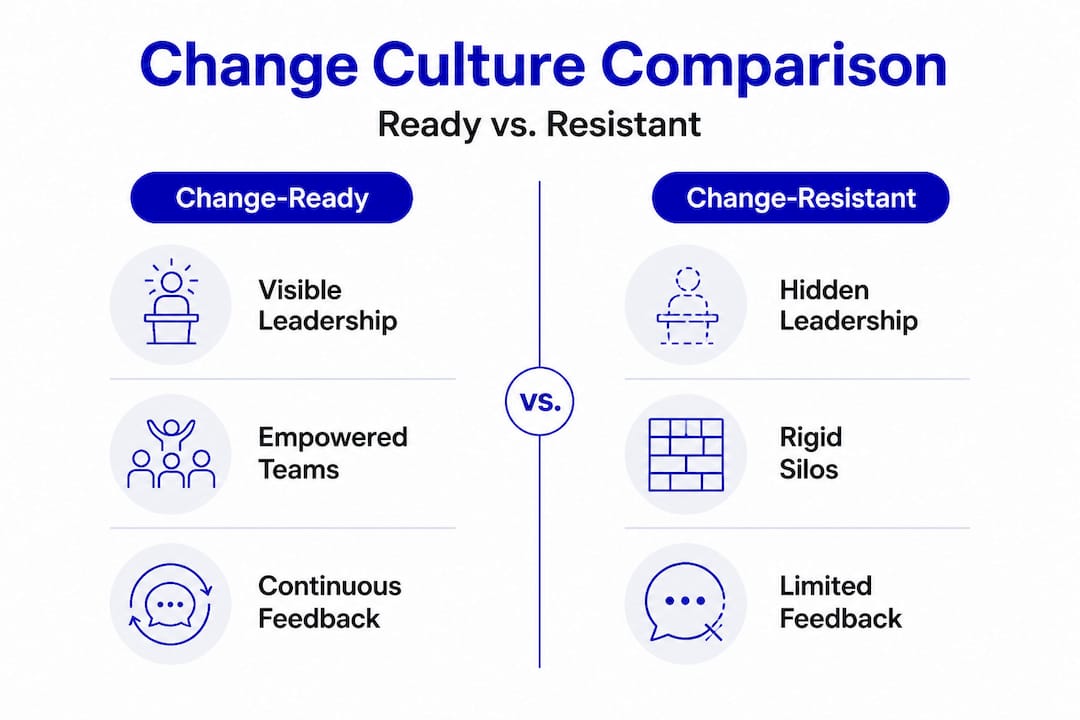
The outcomes of these two cultures play out in every ERP go-live, every CRM rollout, and every process automation initiative you undertake. Building the right culture is not a soft priority. It is the strategic foundation that determines your technology return on investment.
Overcoming challenges: Pitfalls and proven solutions
Even with a strong foundation, every organization faces resistance and risk. Here is how to overcome them successfully.
The most common pitfalls are predictable, which means they are also preventable. Here are the ones that consistently derail transformation programs in KSA and UAE enterprises:
- Vague vision: When employees cannot articulate what success looks like in six months, they default to old behaviors. Every change initiative needs a concrete, measurable destination, not just directional language.
- Top-down mandates without buy-in: Announcing a new system and expecting adoption because leadership said so rarely works. People need to understand the “why” before they commit to the “how.”
- Underestimating the time resistance takes: Resistance is not always loud. It manifests as slow adoption, workarounds, and low engagement in training, all of which can persist long after go-live if not addressed.
- Declaring victory too early: Many organizations scale back change management resources after launch. Adoption data consistently shows that the most critical reinforcement window is the first 90 days post-launch.
Clear vision, effective communication, and stakeholder engagement are the three factors that most reliably predict successful change outcomes. The absence of any one of them introduces significant risk.
Practical solutions that work include:
- Stakeholder mapping sessions conducted at the project initiation stage, not after the technology decision is made
- Change champions networks that identify and activate informal influencers within each business unit
- Structured feedback cycles that collect adoption data at 30, 60, and 90 days post-launch and connect it directly to support interventions
- Executive storytelling where senior leaders share their own experience adapting to the change, making the transformation feel real and human
Reviewing your digital transformation success factors before each major initiative gives you a structured way to pressure-test your readiness before the risks become costs.
Pro Tip: Share small, visible wins early and often. When a department reports a 20% reduction in approval cycle time after process automation, announce it broadly. Quick wins build momentum and give skeptics evidence that the change is delivering real value.
What most leaders get wrong about change management
To move beyond frameworks into the mindset shifts that actually produce lasting results, we need to address the most persistent blind spot at the C-level.
Most leaders treat change management as a project lane, something that runs parallel to the technical work and wraps up at go-live. That model fails because it positions change management as a support activity rather than a strategic driver. The reality we have seen across 60-plus enterprise clients in KSA, UAE, and Egypt is that the organizations achieving the best transformation outcomes are the ones where change management is embedded into every governance decision from day one.
Your middle managers and informal influencers are your most underutilized change assets. They are the ones employees ask when they are confused, frustrated, or skeptical. Investing in their readiness, their confidence, and their authority to make decisions at the team level accelerates adoption faster than any top-down mandate can. Connecting this effort to your broader digital transformation strategies is what separates organizations that transform once from those that build a sustained capacity for change.
The uncomfortable truth is this: organizational culture shaped by leadership behavior, not policy documents, remains the single most powerful determinant of whether your digital investments deliver the value you projected. Technology is the catalyst. Culture is the fuel.
Start strong: Change management resources and expert help
If you want transformation success in your enterprise, the right resources and expertise make all the difference.
Every ERP deployment, process automation initiative, and AI integration your organization undertakes depends on change management readiness. Without it, even the best technology sits underused. Singleclic works alongside C-level leaders and IT teams across KSA and UAE to de-risk digital initiatives from the start, combining implementation expertise with structured change management support tailored to regional realities.
Start with an ERP readiness assessment to understand your organizational baseline before committing to a rollout. Then explore our business process automation guide to see how automation connects to your change management strategy. With 70-plus consultants across the region and deep sector expertise in construction, healthcare, banking, and telecom, Singleclic is the partner that keeps your transformation on track, from strategy through sustained adoption.
Frequently asked questions
How does change management benefit digital transformation in highly regulated sectors?
Change management ensures compliance and minimizes disruptions throughout the transition, which is critical in sectors like banking and healthcare where regulatory requirements must be maintained at every stage of the transformation, not just at the final state.
What are the biggest barriers to successful change management?
Lack of leadership support, poor communication, and employee resistance are the most consistent obstacles, and clear vision and stakeholder engagement are the most reliable counters to each of them.
Which frameworks are best for change management in large organizations?
Models like ADKAR and Kotter’s 8-Step Process are the most widely adopted in enterprise environments because they provide structured, stage-based workflows that can be scaled across large, complex organizations without losing consistency.
How can leaders measure the ROI of change management?
Track adoption rates, employee engagement scores, and project outcome metrics tied to business objectives, since leadership-driven transformation initiatives that include formal measurement frameworks consistently report stronger efficiency gains and faster payback periods.
Recommended
- Why change management is key for digital success in KSA & UAE
- Digital Transformation Roadmap for C-Level Success
- Singleclic: Download the 7-step digital transformation checklist for leaders to drive growth, align stakeholders, and optimize operations—start today.
- 7 Key Digital Transformation Success Factors for Leaders
- Modernising Testing for the Digital Age | Vansah Test Management For Jira