Most advice about digital disruption misses the mark when it comes to practical impact on real businesses. For C-level executives in Saudi Arabia and UAE construction and healthcare, understanding what sets true disruption apart from simple digital upgrades is critical. While some American companies lead with innovation, the reality is that myths and misconceptions often stall real progress. This article uncovers the fundamental truths and hidden risks shaping your operational efficiency and competitive position.
Table of Contents
- Defining Digital Disruption And Key Myths
- Types Of Digital Disruption In Business Sectors
- Main Drivers Fueling Digital Disruption
- Transformative Impacts On Business Models
- Risks, Challenges, And Strategic Opportunities
Key Takeaways
| Point | Details |
|---|---|
| Understanding Digital Disruption | Digital disruption involves transformative changes in business models driven by technological innovations, emphasizing the need for strategic alignment and organizational readiness. |
| Types of Digital Disruption | Four key disruption types—technological, business model, regulatory, and social movement—highlight how organizations must adapt to remain competitive. |
| Drivers of Transformation | Major drivers include technology adoption, organizational agility, customer demand, and ecosystem evolution, which must be actively monitored for successful transformation. |
| Risks and Opportunities | Organizations face technological, organizational, and strategic risks; however, proactive strategies can mitigate these while leveraging digital innovation for growth. |
Defining Digital Disruption and Key Myths
Digital disruption represents a profound transformation of traditional business models through advanced technological innovations. Unlike simplistic interpretations, it represents a strategic reconfiguration of entire industrial ecosystems driven by emerging digital technologies. Researchers have highlighted the complex theoretical foundations that distinguish digital disruption from mere technological change.
At its core, digital disruption involves radical shifts in value creation, customer experience, and operational efficiency. These transformations typically emerge when novel digital technologies challenge established business paradigms, creating unprecedented competitive advantages. In sectors like construction and healthcare across Saudi Arabia and UAE, digital disruption means reimagining service delivery, process optimization, and strategic decision making through technological intervention.
Key myths surrounding digital disruption often mislead organizations about its nature and implementation. Contrary to popular belief, disruption is not an inevitable or universally applicable phenomenon. Instead, it requires strategic alignment, technological understanding, and organizational readiness. Our low-code platform Cortex, for instance, enables businesses to navigate digital transformation systematically by providing tools that simplify complex process redesign without extensive coding expertise.
Critical aspects of digital disruption include:
- Technological innovation as a catalyst
- Strategic reconfiguration of business models
- Customer experience transformation
- Operational efficiency enhancement
- Industry-specific digital adaptation strategies
Pro Tip: Develop a comprehensive digital disruption strategy by conducting thorough technological assessments and aligning innovation initiatives with your organization’s specific operational requirements.
Types of Digital Disruption in Business Sectors
Digital disruption manifests through multiple complex channels, each transforming business landscapes differently. Researchers have developed comprehensive typologies that categorize disruption into distinct yet interconnected domains, revealing the nuanced ways technological innovations reshape organizational strategies. In the context of Saudi Arabia and UAE, these disruption types are particularly relevant across industries like construction, healthcare, and financial services.
Four primary types of digital disruption emerge as critical frameworks for understanding organizational transformation. First, technological disruption involves breakthrough technologies that fundamentally alter existing product capabilities or service delivery mechanisms. Second, business model disruption reimagines how value is created, captured, and distributed through innovative digital platforms. Third, regulatory disruption occurs when technological advancements challenge existing legal and compliance frameworks, forcing systemic adaptations. Fourth, social movement disruption emerges from changing consumer expectations and digital-enabled collaboration models.

In sectors like construction and healthcare, digital disruption manifests uniquely. Construction firms increasingly leverage technologies like Building Information Modeling (BIM) and drone surveying, while healthcare providers implement telemedicine and AI-driven diagnostic tools. Our low-code platform Cortex enables organizations to navigate these disruptions by providing flexible, adaptable digital transformation tools that support rapid technological integration.
Key characteristics of digital disruption across business sectors include:
- Radical technological innovation
- Fundamental shifts in value creation
- Reimagining customer interaction models
- Challenging traditional operational paradigms
- Enabling unprecedented organizational agility
Pro Tip: Develop a dynamic digital disruption strategy by continuously monitoring technological trends, maintaining organizational flexibility, and proactively experimenting with emerging digital capabilities.
Here’s a quick comparison of the four main types of digital disruption and how they reshape organizations:
| Type of Disruption | Main Focus | Example Business Impact | Key Challenge |
|---|---|---|---|
| Technological Disruption | Innovative technology implementation | Improved automation in workflows | Rapid pace of tech change |
| Business Model Disruption | New ways of delivering value | Subscription-based revenue growth | Aligning with core goals |
| Regulatory Disruption | Changes in compliance requirements | New data protection protocols | Adapting to legal shifts |
| Social Movement Disruption | Shifting customer or societal behaviors | Greater emphasis on sustainability | Meeting new expectations |
Main Drivers Fueling Digital Disruption
Comprehensive research has illuminated the critical drivers propelling digital disruption across global business landscapes. These drivers represent interconnected forces that fundamentally reshape organizational strategies, particularly in dynamic markets like Saudi Arabia and UAE. The transformation extends beyond technological adoption to encompass profound shifts in organizational culture, operational models, and strategic thinking.
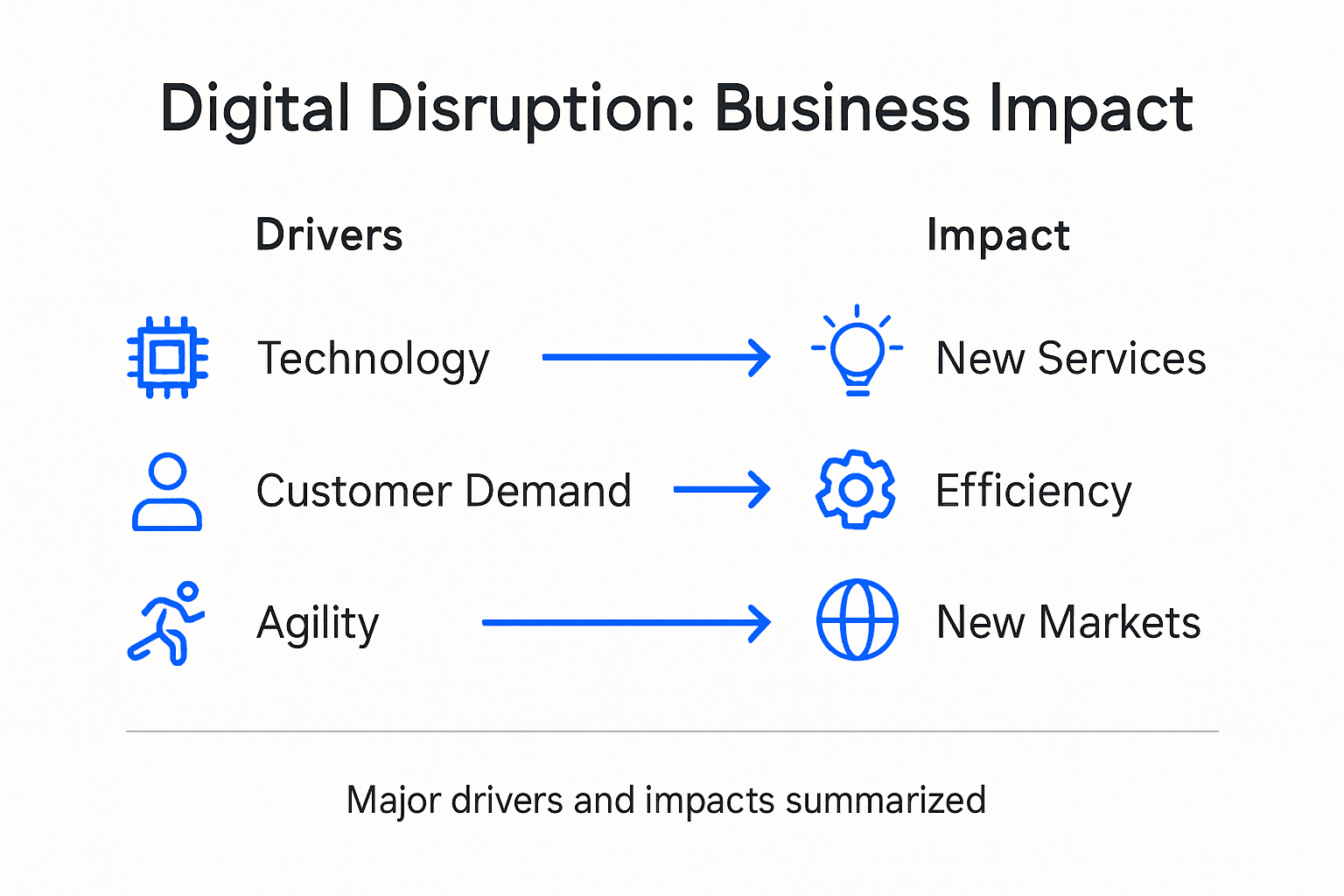
Four primary drivers emerge as fundamental catalysts for digital disruption. Technology adoption stands as the foundational driver, with emerging technologies like artificial intelligence, cloud computing, and advanced analytics creating unprecedented opportunities for innovation. Organizational agility represents the second critical driver, enabling businesses to rapidly respond to technological changes and market dynamics. The third driver, customer demand, reflects shifting consumer expectations for personalized, seamless digital experiences. The fourth driver, ecosystem evolution, highlights how interconnected digital platforms are fundamentally restructuring traditional industry boundaries.
In sectors like construction and healthcare across the Middle East, these drivers manifest uniquely. Construction firms leverage digital tools for project management and predictive maintenance, while healthcare providers implement telemedicine and AI-driven diagnostic systems. Our low-code platform Cortex empowers organizations to navigate these disruptions by providing flexible digital transformation tools that support rapid technological integration and process optimization.
Key characteristics of digital disruption drivers include:
- Rapid technological innovation
- Continuously changing consumer expectations
- Increased global connectivity
- Accelerated knowledge sharing
- Reduced barriers to entry for digital solutions
Pro Tip: Develop a proactive digital disruption strategy by continuously monitoring technological trends, fostering a culture of innovation, and maintaining organizational flexibility to quickly adapt to emerging digital capabilities.
Transformative Impacts on Business Models
Rigorous academic research has mapped the profound transformations occurring in contemporary business models driven by digital technologies. These transformations represent more than technological upgrades, signaling fundamental restructuring of how organizations create, deliver, and capture value. In dynamic markets like Saudi Arabia and UAE, these shifts are particularly pronounced, reshaping competitive landscapes across industries such as construction, healthcare, and financial services.
Digital technologies are driving radical changes in business model architectures through three primary mechanisms. First, value creation models are shifting from product-centric to service-oriented approaches, enabling more personalized and adaptive customer experiences. Second, revenue streams are being reimagined through data monetization, subscription models, and platform-based economic interactions. Third, organizational structures are becoming more fluid, with technology enabling decentralized, collaborative, and agile operational frameworks that transcend traditional hierarchical boundaries.
In sectors like construction and healthcare, these transformative impacts manifest distinctively. Construction firms are transitioning from project-based revenue models to comprehensive digital ecosystem services, while healthcare providers are developing integrated platforms that combine diagnostic, preventive, and treatment services. Our low-code platform Cortex supports these transformations by providing flexible digital tools that enable rapid business model experimentation and optimization.
Key characteristics of transformative business model impacts include:
- Shift from product sales to service ecosystems
- Data as a primary value creation mechanism
- Increased organizational adaptability
- Blurring industry sector boundaries
- Emergence of platform-based economic models
Pro Tip: Design your digital transformation strategy by systematically mapping current business model constraints and proactively identifying emerging technological opportunities for value creation.
Risks, Challenges, and Strategic Opportunities
Contemporary research reveals the complex performance landscape surrounding digital disruption, highlighting both significant risks and unprecedented opportunities for organizations. In dynamic markets like Saudi Arabia and UAE, understanding these nuanced challenges becomes critical for sustainable digital transformation across sectors such as construction, healthcare, and financial services.
Digital disruption presents a dual-faced strategic challenge characterized by three primary risk dimensions. Technological risks encompass cybersecurity vulnerabilities, complex system integrations, and potential technological obsolescence. Organizational risks include workforce skill gaps, cultural resistance to change, and potential productivity disruptions during transition periods. Strategic risks involve potential misalignment between digital investments and core business objectives, potentially leading to substantial financial and competitive disadvantages.
In sectors like construction and healthcare, these risks manifest uniquely. Construction firms face challenges integrating digital tools with traditional project management approaches, while healthcare providers must navigate complex regulatory environments and patient data protection requirements. Our low-code platform Cortex addresses these challenges by providing flexible, adaptable digital transformation tools that enable organizations to mitigate risks while accelerating innovation.
Key strategic opportunities and risk mitigation strategies include:
The table below summarizes major risks of digital disruption and corresponding strategic opportunity for mitigation:
| Risk Category | Example Risk | Strategic Opportunity |
|---|---|---|
| Technological | Cybersecurity vulnerabilities | Strengthen security frameworks |
| Organizational | Workforce skill gaps | Invest in ongoing employee training |
| Strategic | Misaligned tech investments | Align projects with core objectives |
- Proactive technology assessment and roadmapping
- Continuous workforce skills development
- Incremental digital transformation approaches
- Robust cybersecurity and data governance frameworks
- Agile organizational design and culture
Pro Tip: Develop a comprehensive digital risk assessment framework that systematically evaluates technological, organizational, and strategic risks while maintaining strategic flexibility and innovation potential.
Unlock the Power of Digital Disruption with Singleclic
The article highlights the critical drivers and transformative impacts of digital disruption while revealing the risks and challenges organizations face. If your business in Saudi Arabia, UAE, or Egypt struggles with rapid technological change, customer demand shifts, or aligning innovations with core goals, you are not alone. Key pain points include overcoming technological risks, developing organizational agility, and reimagining business models to thrive in evolving markets.
Singleclic understands these challenges deeply. Our expertise in ERP & CRM Implementation, Business Process Automation, and AI & Low-Code Platform Development equips your organization to navigate digital disruption confidently. With our Arabic-enabled low-code platform Cortex, we empower businesses like yours to design agile workflows, reduce skill gaps, and transform customer experiences without heavy coding.
Transform uncertainty into opportunity today by partnering with a trusted regional leader in digital transformation. Visit Singleclic and start optimizing your operations for lasting growth. Don’t wait for disruption to catch you off guard take control with proven innovation solutions now.
Frequently Asked Questions
What are the main drivers of digital disruption?
The primary drivers of digital disruption include technology adoption, organizational agility, customer demand, and ecosystem evolution. These forces reshape how businesses operate and respond to market changes.
How does digital disruption impact business models?
Digital disruption transforms business models by shifting from product-centric approaches to service-oriented models, enabling more personalized customer experiences and integrating new revenue streams like data monetization and subscription services.
What are the risks associated with digital disruption for organizations?
Organizations face technological risks (e.g., cybersecurity issues), organizational risks (e.g., workforce skill gaps), and strategic risks (e.g., misalignment of digital investments with core business objectives) during digital disruption.
How can companies mitigate the risks of digital disruption?
Companies can mitigate risks by developing a comprehensive digital risk assessment framework, investing in ongoing employee training, aligning projects with core objectives, and strengthening cybersecurity measures.