TL;DR:
- Service-oriented architecture (SOA) structures applications as independent, reusable services communicating via standardized protocols. It emphasizes loose coupling, service abstraction, interoperability, and governance to enable scalable, integrated enterprise systems. Effective SOA implementation relies on disciplined planning, clear service contracts, and strong governance, not just technology.
Service-oriented architecture (SOA) is defined as a software design style that structures applications as a collection of discrete, independently accessible services communicating over standardized protocols. Each service represents a self-contained unit of functionality, like retrieving a customer account balance or processing a payment, accessible through a simple interface that hides internal complexity. For IT leaders and business executives in Saudi Arabia and UAE navigating complex digital transformation programs, SOA offers a proven path to flexible, reusable, and integrated enterprise systems. Oracle describes SOA as an enterprise approach to building connected applications through modular business web services, specifically designed to reduce complexity and accelerate response to business demands.
What is service-oriented architecture and its core design principles?
SOA structures software as discrete, remotely accessible services that communicate over standardized protocols, with each service exposing a simple interface that abstracts its internal workings. Think of it as a city of specialized departments: each department does one job well, communicates through official channels, and does not need to know how the others operate internally.
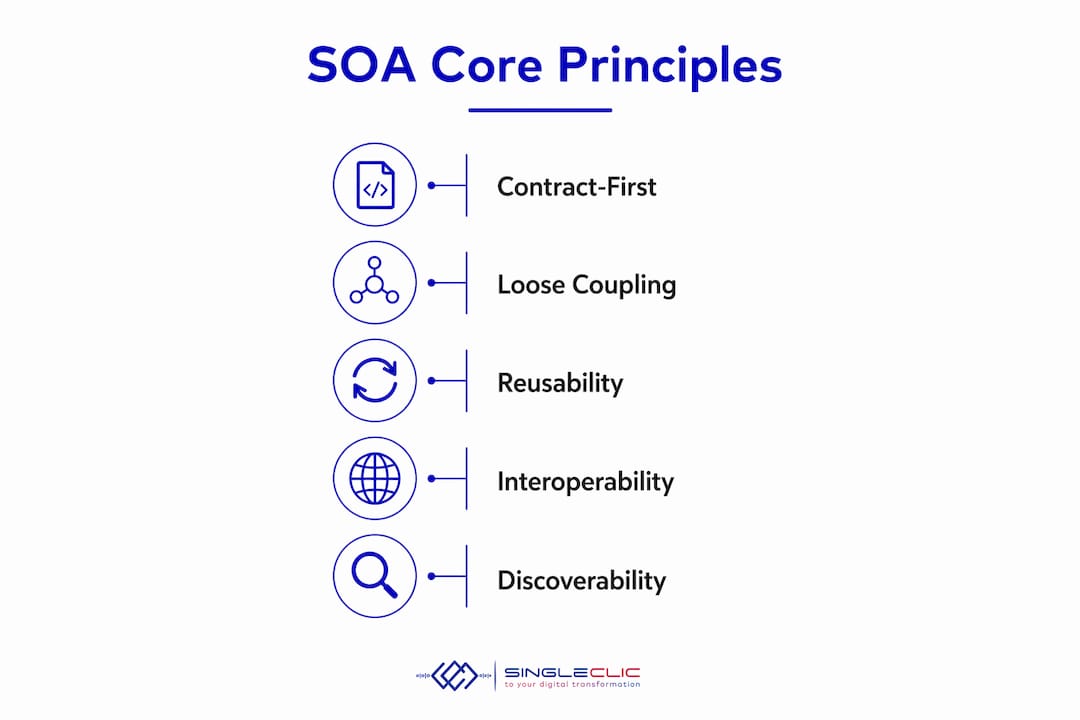
The following principles define how well-designed SOA systems behave:
- Loose coupling. Services minimize dependencies on each other. A change inside one service does not force changes in the services that consume it.
- Service abstraction. Internal logic stays hidden. Consumers interact only with the published interface, not the underlying code.
- Reusability. A single service, such as user authentication, can serve multiple applications simultaneously. Reusing existing services reduces development time and eliminates redundant code.
- Interoperability. Services communicate using shared protocols like SOAP or REST and shared data formats like XML or JSON. This makes technology-agnostic integration possible.
- Service contracts. Each service publishes a formal contract defining its inputs, outputs, and behavior. ISO/IEC 18384-1 standardizes these concepts, specifying that services are logical units with defined outcomes and that consumers need not understand internal structure.
- Governance. Managing service contracts and enforcing standards across the organization keeps the architecture coherent as it grows.
These principles work together to produce systems that scale without becoming brittle. When your authentication service updates its internal logic, every application using it continues to work because the contract stays stable.
Pro Tip: Start every SOA initiative by documenting service contracts before writing a single line of code. Teams that define outcomes and interfaces first avoid the most common trap: building tightly coupled services that look modular on the surface but break together in practice.

How does service-oriented architecture work in practice?
SOA operates by exposing business capabilities as network-accessible services, each with a defined interface that abstracts internal details. When an application needs a capability, it sends a request to the relevant service using a messaging protocol. The service processes the request and returns a response. Neither party needs to know how the other is built internally.
Here is how a typical SOA integration scenario unfolds in an enterprise:
- Service registration. Each service registers itself in a service directory or registry, publishing its contract and endpoint location.
- Service discovery. A consuming application queries the registry to find the correct service for a given task.
- Message exchange. The consumer sends a structured message, often carrying metadata about quality-of-service requirements. QoS and SLA characteristics travel with the message at the protocol layer, not buried inside application code.
- Service composition. Complex business workflows combine multiple services through orchestration. An order fulfillment process, for example, might call inventory, payment, and shipping services in sequence.
- Response and logging. The orchestrating layer collects responses, handles errors, and logs outcomes for governance and auditing.
The table below shows how common enterprise systems map to SOA service layers:
| Business function | Service type | Example protocol |
|---|---|---|
| Customer identity | Authentication service | REST / OAuth 2.0 |
| Financial transactions | Payment processing service | SOAP / WS-Security |
| Inventory management | Data retrieval service | REST / JSON |
| Order orchestration | Composite workflow service | IBM BAW / BPEL |
| Reporting and analytics | Data aggregation service | REST / OData |
Low-code platforms play a growing role in this layer. Tools like Singleclic’s Cortex platform allow organizations to build scalable enterprise apps by visually composing and orchestrating services without writing integration code from scratch. That capability is especially valuable in Saudi Arabia and UAE, where IT teams face pressure to deliver integrations fast across ERP, CRM, and legacy systems simultaneously.
Loose coupling with stable contracts means individual services can evolve independently without breaking consumers. That is the operational promise of SOA, and it is what separates well-governed SOA from a collection of loosely related APIs.
What are the benefits of SOA for enterprises in saudi arabia and UAE?
SOA helps enterprises reduce complexity and respond rapidly to business demands through reusable, modular services. For organizations in Saudi Arabia and UAE, where Vision 2030 and UAE National Agenda programs are driving aggressive digital transformation, that speed and flexibility translates directly into competitive advantage.
The core benefits of adopting SOA at the enterprise level include:
- Faster time to market. Reusing existing services cuts development cycles. A bank in Riyadh adding a new mobile product does not rebuild authentication or KYC from scratch. It calls existing services.
- Legacy system integration. Many Saudi and UAE enterprises run a mix of SAP, Oracle, Microsoft Dynamics 365, and custom-built systems. SOA wraps legacy systems in service interfaces, making them accessible to modern applications without full replacement.
- Cost reduction through reuse. Reusable services eliminate the cost of rebuilding the same functionality across departments. One authentication service replaces five separate login modules.
- Scalability on demand. Individual services scale independently based on load. A government portal in the UAE can scale its document submission service during peak periods without scaling the entire application.
- Improved governance. SOA gives IT leadership visibility into which services exist, who consumes them, and how they perform. That control is critical in regulated sectors like banking and healthcare.
- Low-code acceleration. Platforms like Cortex reduce the time needed to build and connect services. Teams in Saudi Arabia and UAE using ERP integration with low-code report faster delivery and lower integration costs compared to traditional middleware approaches.
The main SOA advantages of loose coupling, reusability, scalability, and interoperability compound over time. Each new service added to a well-governed SOA environment becomes an asset the entire organization can use, not just the team that built it.
SOA vs microservices: what is the real difference?
SOA and microservices are related but distinct architectural approaches, and confusing them leads to poor technology decisions. SOA is broader enterprise architecture, governing service contracts and outcomes at the organizational level. Microservices are finer-grained, independently deployable units focused on small, autonomous functions within a single application boundary.
| Dimension | SOA | Microservices |
|---|---|---|
| Scope | Enterprise-wide integration | Application-level decomposition |
| Service granularity | Coarse-grained business capabilities | Fine-grained technical functions |
| Communication | SOAP, REST, messaging buses | Lightweight REST, gRPC, event streams |
| Governance | Centralized service registry and contracts | Decentralized, team-owned |
| Best suited for | Integrating diverse enterprise systems | Building cloud-native applications |
| Deployment | Often shared infrastructure | Independent containers per service |
SOA governs how an entire organization exposes and consumes capabilities. Microservices govern how a single product team decomposes its application internally. The two are not mutually exclusive. A large enterprise in the UAE might use SOA to integrate Microsoft Dynamics 365, Odoo, and a custom mobile app, while individual product teams within that enterprise build their components using microservices.
Service-oriented computing (SOC) is the broader academic discipline that SOA falls under. SOC covers the theory of computing with services as the fundamental unit. SOA is the practical architectural pattern derived from that theory.
Pro Tip: If your primary challenge is integrating multiple enterprise systems across departments or business units, SOA is the right frame. If your challenge is decomposing a single monolithic application for faster deployment cycles, microservices fit better. Most large organizations in Saudi Arabia and UAE need both.
Best practices for implementing SOA with low-code platforms
Successful SOA implementation requires disciplined planning, not just technical execution. The most common failure mode is treating services as code modules rather than governed business capabilities. Governance over service interfaces is what preserves loose coupling and makes integration reliable over time.
Follow these steps to build a solid SOA foundation:
- Define service contracts first. Document what each service does, what it accepts, and what it returns before any development begins. Contracts are the architecture’s backbone.
- Design for reuse from day one. Ask whether each service could serve three different consumers. If the answer is no, the service is probably too specific and will create coupling problems later.
- Choose protocols that match your integration needs. REST works well for lightweight, stateless interactions. SOAP with WS-Security suits financial and healthcare transactions requiring strict contracts and security.
- Use a low-code platform for orchestration. Platforms like Cortex, IBM BAW, and BonitaSoft let you visually design service workflows, reducing the time to connect ERP, CRM, and custom services. This is particularly valuable for MENA business operations where integration complexity is high and IT resources are stretched.
- Plan QoS and SLA at the messaging layer. QoS characteristics must be specified at the interface and protocol level, not assumed by consumers. Define timeout policies, retry logic, and error handling in the service contract.
- Establish a service registry. Maintain a central catalog of all services, their owners, versions, and consumers. Without this, governance collapses as the service count grows.
- Test services independently. Each service must pass contract compliance tests before integration testing begins. Independent testing is what makes loose coupling real rather than theoretical.
Pro Tip: In Saudi Arabia and UAE enterprise projects, the governance step is where most implementations stall. Assign a service owner for every service, not just a developer. The owner is accountable for the contract, the SLA, and the consumer experience. That accountability is what keeps the architecture healthy.
Key takeaways
SOA delivers lasting enterprise value only when governance of service contracts is treated as a first-class discipline, not an afterthought to technical implementation.
| Point | Details |
|---|---|
| SOA is contract-driven | Define service interfaces and outcomes before development to preserve loose coupling. |
| Reuse reduces cost | Shared services eliminate redundant development across departments and applications. |
| SOA and microservices coexist | Use SOA for enterprise integration and microservices for application-level decomposition. |
| Low-code accelerates delivery | Platforms like Cortex and IBM BAW reduce integration time for SOA environments in Saudi Arabia and UAE. |
| Governance is the differentiator | Assigning service owners and maintaining a service registry separates successful SOA from failed attempts. |
Why governance matters more than technology in SOA
I have worked on SOA programs across Saudi Arabia, UAE, and Egypt, and the pattern is consistent. Organizations that invest heavily in technology selection but treat governance as a documentation exercise end up with what I call “SOA in name only.” They have services, but those services are tightly coupled through shared databases, undocumented assumptions, and informal contracts that break whenever one team makes a change.
The uncomfortable truth about SOA is that the architecture is not primarily a technical challenge. It is an organizational one. Getting a payment team and a customer identity team to agree on a shared service contract requires negotiation, executive sponsorship, and clear ownership. No amount of middleware solves that problem.
What I have seen work in practice, particularly in banking and healthcare clients across the Gulf, is starting small and proving value fast. Pick one high-friction integration point, apply SOA principles rigorously, and measure the outcome. When a hospital in Jeddah can connect its patient registration system to its billing system without a six-month custom development project, that result sells the approach to the rest of the organization better than any architecture diagram.
Low-code platforms like Cortex change the economics of SOA in a meaningful way. When you can build and connect services visually, the barrier to governance drops. Teams spend less time on plumbing and more time on defining outcomes. That shift in focus is exactly what SOA requires to succeed.
My recommendation: treat your first SOA project as a governance pilot, not a technology pilot. The technology will follow.
— Tamer Badr
How Singleclic helps you build soa-ready enterprise systems
Singleclic works with enterprises across Saudi Arabia, UAE, and Egypt to design and deliver integration architectures grounded in SOA principles. Whether you are connecting Microsoft Dynamics 365, Odoo, or legacy systems, Singleclic’s team of 70+ consultants and engineers brings the governance frameworks and technical depth to make it work.
Cortex, Singleclic’s Arabic-enabled low-code platform, is purpose-built for MENA enterprises that need to orchestrate services, automate workflows, and integrate systems without long development cycles. It supports on-premise deployment for banks and government entities, full Arabic UI, and runtime workflow changes without downtime. If you are planning an ERP integration or SOA program, start with the ERP implementation checklist for the Middle East to assess your readiness and map your integration landscape before the first sprint begins.
FAQ
What is the service-oriented architecture definition in simple terms?
SOA is a software design approach that structures applications as a set of independent services, each performing a specific business function and communicating through standardized interfaces. Services hide their internal complexity and can be reused across multiple applications.
How does SOA differ from traditional monolithic architecture?
In a monolithic architecture, all functions are tightly bundled into a single application, making changes risky and scaling difficult. SOA separates those functions into independent services that can be updated, scaled, or replaced without affecting the rest of the system.
What protocols does SOA use for service communication?
SOA commonly uses SOAP with XML for formal, contract-heavy integrations and REST with JSON for lightweight, stateless interactions. The choice depends on the security, reliability, and formality requirements of the integration.
Is SOA still relevant when microservices are available?
SOA remains the right architectural frame for enterprise-wide integration across multiple systems and business units. Microservices address application-level decomposition. Most large enterprises in Saudi Arabia and UAE benefit from applying both approaches at different layers of their architecture.
What is the biggest risk in SOA implementation?
The biggest risk is treating services as code modules rather than governed business capabilities. Without formal service contracts and assigned ownership, services become tightly coupled over time, which defeats the core purpose of the architecture.