TL;DR:
- User adoption refers to the active and repeated use of new technology systems by employees, directly impacting business value. Poor adoption leads to significant financial loss, process fragmentation, and reduced competitiveness, especially in Gulf markets. To improve adoption, organizations should focus on behavioral factors, continuous change management, localized solutions, and strong executive sponsorship.
User adoption is defined as the process by which employees and end users actively and repeatedly use a new technology system, directly determining whether that system delivers its intended business value. For business leaders in Saudi Arabia and UAE, this distinction is not academic. Organizations across the region are investing heavily in ERP platforms like Microsoft Dynamics 365, CRM systems, and low-code tools, yet many see returns fall short of projections. The reason is almost always the same: the technology works, but the people do not use it. Understanding why user adoption matters is the first step toward protecting those investments and driving real operational efficiency.
Why user adoption matters for business outcomes
User adoption is the single most important signal predicting customer renewal, expansion, or churn in any product or platform deployment. That finding from Gainsight reframes adoption from an IT concern into a direct revenue and retention issue. When users stop engaging with a system, the downstream effects compound quickly.
The financial risk is concrete. If adoption reaches only 10%, effectively 90% of the technology investment is lost to human friction. That figure applies directly to ERP and CRM deployments across the Gulf, where multi-million-dollar implementations can sit underutilized because teams revert to spreadsheets or manual workarounds.
Poor adoption also creates invisible operational damage:
- Process fragmentation. Teams build unofficial workarounds that bypass the new system, creating data silos and audit risks.
- Churn acceleration. Adoption stall shows up as renewal risk 6 to 12 months after launch, long after the implementation team has moved on.
- Wasted training spend. Organizations invest in onboarding, then watch usage drop within weeks because adoption was never treated as an ongoing discipline.
- Competitive disadvantage. In markets like Saudi Arabia and UAE, where Vision 2030 and UAE Centennial 2071 are driving rapid digital transformation, lagging adoption means lagging competitiveness.
The data confirms the scale of the problem. Only 45.7% of companies achieved a CRM adoption rate above 90% as of 2018. That number has not improved dramatically since. Low adoption is not a niche problem. It is the default outcome when organizations treat deployment as the finish line.
What psychological factors shape user adoption?
Adoption is fundamentally a behavioral and psychological challenge, not a technical one. Key barriers include identity threat and trust issues, particularly with AI-driven systems where users cannot see how decisions are made. This “black box paradox” is especially relevant as organizations in KSA and UAE deploy AI-powered ERP and automation tools.
The UTAUT2 model, which stands for Unified Theory of Acceptance and Use of Technology, identifies the core factors that drive adoption beyond basic usability. Facilitating conditions and peer norms significantly shape behavioral intention and continued use. In practical terms, this means that if a user’s manager does not use the new system, that user probably will not either. Social influence is a lever, not a side effect.
Three psychological constructs deserve particular attention from change agents:
Perceived usefulness is the user’s belief that the system will actually help them do their job better. If the interface is clunky or the workflow does not match how people actually work, perceived usefulness collapses regardless of the system’s technical capability.
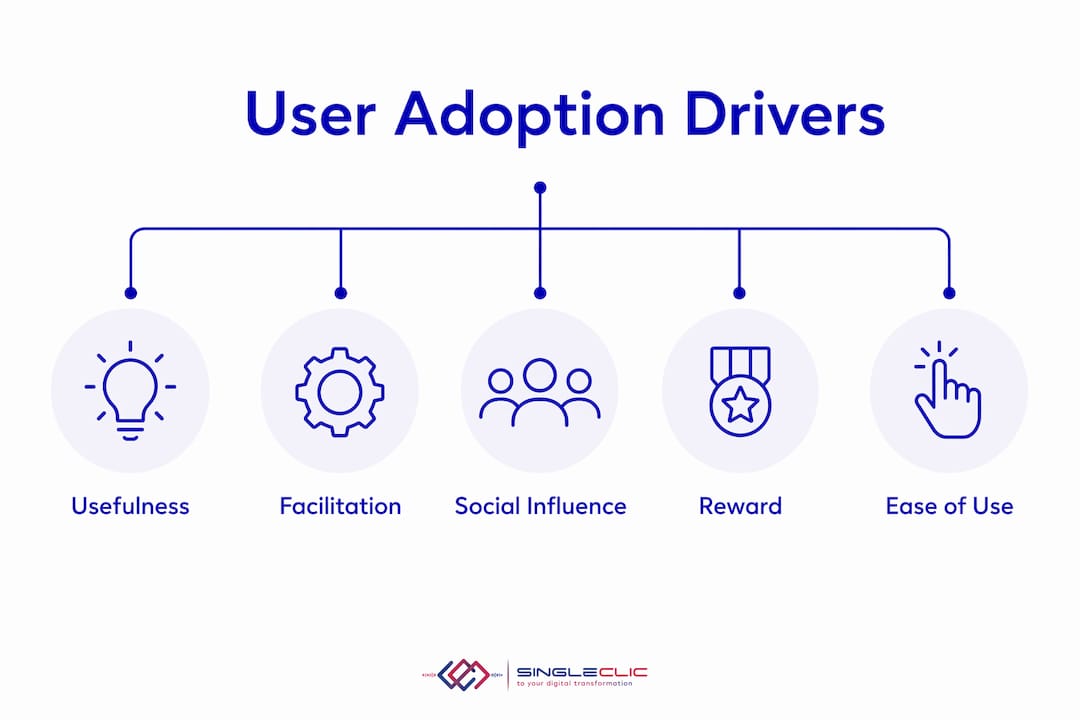
Facilitating conditions refer to the organizational support structures around the technology. This includes IT helpdesk access, Arabic-language interfaces, and clear escalation paths. For organizations in Saudi Arabia deploying on-premise solutions, this factor is especially critical.
Social influence means that adoption spreads through teams the same way behavior spreads through any social group. Early adopters who visibly succeed with the new system pull their colleagues along. Identifying and supporting those internal champions is one of the highest-return activities a change agent can pursue.
Pro Tip: Before your next system rollout, map the informal influence network in each department. The person with the most credibility among peers, not the highest title, is your most valuable adoption champion.
How to improve user adoption: strategies and metrics
Improving adoption requires a structured approach that connects onboarding, ongoing enablement, and measurable outcomes. Behavior change and reliance on new tools are the true measures of adoption success, not training completion rates or go-live dates.
Here is a practical sequence for building an adoption program:
- Define activation points. Identify the specific actions that signal a user has moved from passive access to active use. For a CRM deployment, this might be logging the first five customer interactions. For an ERP module, it might be completing a full procurement cycle without manual override.
- Build role-specific onboarding. Generic training fails because it does not connect to daily workflow. A finance manager in Dubai and a procurement officer in Riyadh need different onboarding paths through the same system.
- Assign adoption ownership. Customer success teams should own adoption signals embedded into health scores. Treating adoption as a pure IT metric misses the outcome linkage that business leadership needs.
- Run adoption sprints. Schedule 30-day focused campaigns on specific features or modules. Measure usage before and after. Repeat quarterly.
- Create feedback loops. Users who feel heard are more likely to persist through friction. Monthly pulse surveys and open channels to the implementation team reduce dropout rates.
The metrics that matter most are organized below:
| Metric | What it measures | Why it matters |
|---|---|---|
| Activation rate | % of users who complete the defined activation action | Shows whether onboarding converts access into real use |
| Feature adoption depth | % of available features used per user role | Reveals underutilized capabilities and training gaps |
| Repeat usage frequency | Average logins or transactions per user per week | Indicates whether the system is embedded in daily workflow |
| Health score | Composite of usage, support tickets, and engagement | Predicts renewal risk and expansion readiness |
| Time to activation | Days from account creation to first activation action | Measures onboarding efficiency |
Adoption measurement should focus on activation points and usage patterns correlated with long-term value. Tracking logins alone tells you nothing about whether the system is actually changing behavior.
Applying adoption principles in KSA and UAE with low-code platforms
Organizations in Saudi Arabia and UAE face adoption challenges that are distinct from global averages. Multilingual workforces, mixed digital literacy levels, and the pace of regulatory change under Vision 2030 all create friction that generic adoption playbooks do not address.

Low-code platforms are proving to be a practical answer to several of these challenges. Singleclic’s Cortex platform, built specifically for MENA enterprises, supports full Arabic UI/UX and allows organizations to modify workflows at runtime without downtime. That flexibility matters enormously for adoption. When users can see their feedback reflected in the system within days rather than months, trust builds quickly. Low-code platforms improve business agility in ways that directly support faster adoption cycles.
Practical steps for leaders in the region:
- Localize before you launch. Arabic interfaces, local date formats, and region-specific compliance fields are not optional extras. They are adoption prerequisites for many users in KSA and UAE.
- Pilot with a high-visibility team. Choose a department whose success will be visible to the rest of the organization. A successful pilot in Emirates Health Services or a government entity in Riyadh creates social proof that accelerates adoption elsewhere.
- Treat change management as a continuous program. Change management failures stem from treating deployment as a checklist rather than driving actual behavior change under workflow pressure. Schedule quarterly adoption reviews, not just post-go-live retrospectives.
- Tie adoption KPIs to leadership scorecards. When department heads are measured on adoption rates, they become active sponsors rather than passive observers.
- Use automation to reduce friction. Automated reminders, guided workflows, and in-app prompts reduce the cognitive load on users and keep them engaged with the system. Building an automated adoption workflow is one of the fastest ways to sustain engagement after the initial launch energy fades.
Pro Tip: In Saudi Arabia and UAE, executive sponsorship is not just helpful. It is the single biggest predictor of adoption success. Secure a named executive champion before the project kicks off, not after the first usage dip.
Key takeaways
User adoption determines whether technology investments generate real business value or become expensive shelfware, making it the most critical factor in any digital transformation program.
| Point | Details |
|---|---|
| Adoption drives ROI | A 10% adoption rate means 90% of the technology investment is effectively lost. |
| Behavioral factors dominate | Trust, perceived usefulness, and social influence shape adoption more than training alone. |
| Metrics must link to outcomes | Track activation rate, feature depth, and health scores, not just login counts. |
| Regional context is non-negotiable | Arabic interfaces, local workflows, and executive sponsorship are adoption prerequisites in KSA and UAE. |
| Adoption is continuous | Adoption stall can appear as renewal risk 6 to 12 months after launch, requiring ongoing management. |
The uncomfortable truth about digital transformation in the middle east
By Tamer Badr
After working on ERP and CRM implementations across Saudi Arabia, UAE, and Egypt for over a decade, I can tell you that the technology almost never fails. The people programs do.
I have seen organizations spend months selecting the right Microsoft Dynamics 365 configuration, negotiate excellent pricing, and then watch adoption flatline within 90 days because no one owned the behavior change piece. The system was perfect. The adoption strategy was an afterthought.
What I have learned is that adoption is not a phase. It is a discipline. The organizations that get it right treat it the same way they treat financial reporting: with regular cadence, clear ownership, and consequences for missing targets. They also invest in tools that reduce friction at the user level, which is exactly why low-code platforms like Cortex have become central to how Singleclic approaches regional deployments.
The other thing I would push back on is the idea that adoption is primarily a training problem. It is not. It is a trust problem. Users need to believe the system will make their work easier, that their feedback will be heard, and that leadership is genuinely committed. When those three conditions exist, adoption follows. When they do not, no amount of training will save the project.
— Tamer Badr
How Singleclic supports technology adoption in saudi arabia and UAE
Singleclic works with business leaders across KSA, UAE, and Egypt to close the gap between technology deployment and real operational results. Whether you are rolling out Microsoft Dynamics 365, an Odoo implementation, or building on the Cortex low-code platform, adoption is built into the delivery model from day one. Start with the ERP implementation checklist designed specifically for Middle East enterprises, or explore CRM adoption best practices tailored for business leaders in Saudi Arabia and UAE. Singleclic’s 70+ consultants and engineers are ready to help you turn technology investments into measurable business outcomes.
FAQ
What is user adoption in enterprise technology?
User adoption is the active, repeated use of a new technology system by organizational employees. It is the measure of whether a deployed system is actually changing behavior and delivering value, not just whether it was installed.
Why does low adoption rate put ROI at risk?
When adoption reaches only 10%, effectively 90% of the technology investment is lost to human friction. The system generates no operational value if users revert to manual processes or workarounds.
What are the main factors affecting user adoption?
The UTAUT2 model identifies perceived usefulness, facilitating conditions, and social influence as the primary drivers. Trust and identity threat are also significant barriers, particularly with AI-driven systems.
How do you measure user adoption success?
Track activation rate, feature adoption depth, repeat usage frequency, and composite health scores. Activation points, which are specific actions that signal real use, are more predictive of long-term value than login counts alone.
How can leaders in saudi arabia and UAE improve adoption rates?
Localize interfaces for Arabic-speaking users, secure named executive sponsors before launch, and treat change management as a continuous program rather than a one-time go-live event. Low-code platforms that support runtime workflow changes also reduce friction and accelerate adoption.