Low-code development is a visual, model-driven approach to building software where most of the application logic is assembled through drag-and-drop interfaces, pre-built components, and configuration rather than hand-written code. Enterprises use it to ship production-grade apps in weeks instead of months, with teams that include both professional developers and business analysts.
Three quick signals to orient your decision:
- Use it when you need to deliver departmental apps, workflow automation, or ERP/CRM integrations faster than a traditional development backlog allows.
- Avoid it when your application requires deep algorithmic customization, highly specialized performance tuning, or a proprietary architecture that no platform connector can reach.
- One caveat: vendor lock-in is a real structural risk. Academic research on low-code in construction confirms that customization limits and lock-in are the most cited limitations alongside the speed gains. Forrester projects the market approaching a multi-billion dollar valuation within the next few years, and Statista’s adoption data shows enterprise uptake accelerating across every major industry.
Key takeaways
Low-code development is most effective when governance, integration depth, and regional fit are treated as first-class requirements alongside platform features — organizations that get these three right consistently outperform those that optimize for speed alone.
| Point | Details |
|---|---|
| Definition and fit | Low-code uses visual, model-driven tools to build production apps faster; best for workflow, portal, and integration use cases. |
| Governance is non-negotiable | Shadow IT, vendor lock-in, and security gaps are the top failure modes; a Center of Excellence prevents all three. |
| AI raises the ceiling | Agentic low-code lets users describe outcomes and have the platform build the app; evaluate explainability and audit controls in your RFP. |
| Market momentum | Forrester projects the low-code market approaching $50 billion by 2028, signaling sustained vendor investment and platform maturity. |
| Singleclic and Cortex | Cortex delivers Arabic-enabled, on-premise low-code with Dynamics 365 and Odoo integration for MENA enterprises across KSA, UAE, and Egypt. |
Table of Contents
- How does low-code development actually work?
- Low-code vs no-code vs traditional development: which fits your project?
- Who builds with low-code, and which enterprise use cases fit best?
- What are the real benefits of low-code, and how do you measure ROI?
- What governance risks should IT leaders plan for?
- How is AI changing low-code, and does it make low-code obsolete?
- How do you choose the right low-code platform for your enterprise?
- Named platforms: what you need to know about the market
- What MENA enterprises need to check before deploying low-code
- What enterprise leaders consistently get wrong about low-code
- Singleclic’s Cortex platform: from POC to production in MENA
- Sources
How does low-code development actually work?
At its core, a low-code platform consists of five interlocking components: a visual IDE (integrated development environment), a data model layer, reusable UI and logic components, connectors to external systems, and a runtime engine that executes the assembled application.
The flow looks like this: a developer or business analyst opens the visual modeler, drags a form component onto a canvas, binds it to a data entity (say, a purchase request record), adds a business rule (approval required above $10,000), connects a REST or native connector to Microsoft Dynamics 365, and deploys to the runtime with a single publish action. AWS describes this model-driven approach as combining drag-and-drop interfaces with extensibility hooks so professional developers can inject custom code precisely where the platform’s visual layer cannot reach.
Those extensibility hooks matter more than most buyers realize. Low-code is not a closed box. Most enterprise-grade platforms expose:
- Custom code hooks: Java, JavaScript, or Python functions that run inside the platform’s execution context.
- API gateways: REST and SOAP endpoints that let the app call or expose services.
- Event listeners: triggers that fire on data changes, schedule, or external webhook, feeding into workflow engines.
- Deployment targets: containerized runtimes (Docker, Kubernetes) or on-premise servers for regulated industries.
Statistic: Forrester’s market analysis projects significant growth in the low-code market, reflecting both platform licensing and the services layer enterprises need to govern and integrate these tools.
A practical example: a healthcare organization needs a patient-intake portal connected to its EHR and CRM. A developer builds the form in the visual IDE (two days), configures the EHR connector (one day), adds role-based access rules (half a day), writes a custom PDF-generation function via a code hook (one day), and deploys to an on-premise runtime for data-residency compliance. Total: under a week. The same scope in traditional development typically spans six to twelve weeks.
Low-code vs no-code vs traditional development: which fits your project?
The coarse rule: no-code fits non-technical users building simple, self-contained apps; low-code fits mixed teams building integrated, production-grade apps; and traditional high-code fits specialized engineering problems where platform abstractions would constrain the solution. Salesforce frames low-code as the middle layer that lets developers and business users collaborate on the same artifact without either group being blocked by the other.
| Axis | No-code | Low-code | High-code |
|---|---|---|---|
| Primary builder | Business user, citizen developer | Business analyst, pro developer | Software engineer |
| Speed to first version | Hours to days | Days to weeks | Weeks to months |
| Customization ceiling | Low | Medium-high | Unlimited |
| Integration depth | Basic (pre-built only) | Deep (connectors + custom APIs) | Unlimited |
| Governance risk | High (shadow IT) | Medium (manageable with CoE) | Low (IT-controlled) |
| Best fit | Simple forms, surveys, dashboards | Enterprise workflows, portals, integrations | Core platforms, algorithms, proprietary systems |
For a prototype or departmental app, no-code or low-code both work; choose based on whether the app will eventually need ERP/CRM integration. For an enterprise system of record, low-code with proper governance is the right call. For a platform migration or proprietary algorithm, high-code remains the only viable path. Comparing these models in depth shows that the decision hinges less on technology preference and more on the integration surface area and long-term ownership model.
Who builds with low-code, and which enterprise use cases fit best?
The primary builders in enterprise low-code programs are business analysts and professional developers working together, with citizen developers handling simpler departmental apps under IT governance. Salesforce’s development guide consistently positions low-code as the layer where these two groups can share a single platform without either becoming a bottleneck.
Common enterprise use cases include:
- Line-of-business workflow apps: approval chains, procurement requests, HR onboarding, leave management.
- Field service applications: inspection forms, asset tracking, work-order management with offline capability.
- Customer and partner portals: self-service interfaces connected to CRM and ERP back ends.
- ERP/CRM integrations: middleware apps that orchestrate data between Dynamics 365, Odoo, SAP, and legacy systems.
- Internal automation: document routing, compliance checklists, audit trails, and reporting dashboards.
- Regulatory and compliance apps: data-collection tools for government reporting, built with on-premise deployment for data residency.
Real-life enterprise use cases show that the highest ROI consistently comes from replacing manual, email-driven approval processes with structured workflow apps that integrate directly into the ERP.
| Role | Builds | Owns | Governs |
|---|---|---|---|
| Citizen developer | Simple forms, dashboards | Departmental app | Business unit manager |
| Business analyst | Workflow logic, data models | Line-of-business app | IT platform owner |
| Professional developer | Integrations, custom code hooks | Enterprise app | IT architecture board |
| Platform owner (IT) | Platform configuration, security policies | Entire low-code environment | CIO / CTO |

Low-code use cases across HR, finance, operations, and field teams illustrate how each role maps to a different delivery pattern and governance requirement.
What are the real benefits of low-code, and how do you measure ROI?
The principal advantages of low-code development are faster time-to-market, reduced dependency on scarce developer talent, tighter collaboration between IT and business teams, and a higher rate of application delivery per engineering dollar spent. G2’s market data identifies speed-to-delivery and citizen-developer enablement as the top two purchase drivers, which aligns with what enterprise buyers consistently report.
Academic research in construction and asset-heavy industries found that low-code practices enable faster, more productive application development and support digitalization goals, even in sectors where operational complexity is high. The same study notes that governance and strategic fit determine whether those gains hold over time.
| KPI | What to measure | Why it matters |
|---|---|---|
| Time-to-market | Calendar days from requirement sign-off to production deploy | Directly reflects delivery acceleration vs. traditional baseline |
| Developer hours saved | Hours per app vs. equivalent hand-coded scope | Quantifies productivity gain for finance case |
| Feature throughput | Features shipped per sprint | Shows whether the platform sustains velocity after initial delivery |
| Defect rate | Bugs per release vs. hand-coded baseline | Validates quality; low-code’s visual layer often reduces logic errors |
| Integration success rate | Percentage of connector calls completing without error | Critical for ERP/CRM-connected apps |
| Platform adoption | Active citizen developers vs. licensed seats | Measures organizational uptake and CoE effectiveness |
Statista’s adoption metrics provide useful benchmarks for sizing a business case, particularly year-over-year adoption rates by industry vertical. For enterprise agility outcomes, this analysis of low-code and business agility shows how faster decision cycles translate into measurable operational improvements.
What governance risks should IT leaders plan for?
The four risks that most commonly derail low-code programs are security gaps, vendor lock-in, scalability ceilings, and shadow IT. Each is manageable with the right governance structure, but none disappears on its own.
Technical trade-offs and failure patterns to watch:
- Shadow IT proliferation: business units build apps outside IT visibility, creating unaudited data flows and compliance exposure.
- Vendor lock-in: proprietary data models and connector formats make platform migration expensive; Wikipedia’s overview of low-code platforms flags this as one of the most cited structural risks.
- Scalability ceiling: some platforms handle hundreds of concurrent users well but degrade under thousands; always test under realistic load.
- Security misconfiguration: role-based access and data-masking rules must be enforced at the platform level, not left to individual app builders.
- Technical debt accumulation: apps built without architecture review become unmaintainable as business rules change.
Governance checklist for IT leaders:
- Establish a Center of Excellence (CoE) with a named platform owner accountable to the CIO.
- Define a tiered app classification: Tier 1 (mission-critical, IT-owned), Tier 2 (departmental, business-owned with IT review), Tier 3 (experimental, sandboxed).
- Require security review and penetration testing before any Tier 1 or Tier 2 app reaches production.
- Enforce lifecycle gates: design review, integration test, UAT sign-off, and a documented rollback plan.
- Mandate connector whitelisting: only pre-approved connectors may access production ERP/CRM data.
- Run quarterly app audits to retire unused apps and flag those with no named owner.
- Define a vendor exit strategy before signing a platform contract: export formats, data portability, and migration tooling.
Security and governance in low-code platforms covers these controls in depth, including role-based access patterns and audit-log requirements for regulated industries.
Pro Tip: The fastest way to prevent shadow IT without slowing delivery is to publish a pre-approved app template library. When business users can start from a governed template rather than a blank canvas, they stay inside the guardrails without feeling constrained. IT maintains control; business teams move fast. Both sides win.
How is AI changing low-code, and does it make low-code obsolete?
AI augments and accelerates low-code rather than replacing it. The more precise claim: generative AI removes the remaining friction points in low-code (writing connector logic, generating test data, drafting business rules) while agentic AI introduces a new capability tier where users describe an outcome and the platform builds the application end-to-end.
Google Cloud’s documentation on AI-assisted low-code describes this shift clearly: the direction of travel is from completion assistants (autocomplete for logic blocks) toward agentic workflows where a user specifies a business outcome and the system handles code generation, connector wiring, and deployment. That changes the role of the builder from implementer to architect and reviewer.
Two distinct AI capability tiers are emerging on enterprise platforms:
- Completion assistants: suggest logic, generate connector configurations, auto-fill data mappings. Available today on most major platforms.
- Agentic low-code: the user describes a process (“build an approval workflow for capital expenditures above $50,000 that routes to the CFO and posts to Dynamics 365”), and the platform generates, tests, and deploys the app. Emerging on leading platforms; selection criteria should now include trust, explainability, and deployment controls alongside feature checklists.
Is low-code dead with AI? No. AI raises the ceiling of what low-code can deliver and lowers the skill floor required to use it. Platforms that integrate AI well will handle more complex apps with smaller teams. Platforms that do not will lose ground. For enterprise buyers, the practical implication is to evaluate AI capability as a first-class criterion in any RFP, not an afterthought. The future of AI automation in low-code platforms outlines what that evaluation looks like in practice.
How do you choose the right low-code platform for your enterprise?
The three non-negotiable platform capabilities for enterprise use are integration depth, governance controls, and extensibility. Every other feature is secondary to these three. A platform that cannot connect to your ERP, cannot enforce role-based access at the data layer, and cannot accept custom code where the visual layer falls short will create more problems than it solves.
Priority checklist:
Must-have:
- Native or certified connectors to your ERP and CRM (Dynamics 365, Odoo, SAP)
- Role-based access control enforced at the platform level, not the app level
- On-premise or private-cloud deployment option for regulated industries
- Audit logging and version control for all app changes
- Custom code extensibility (at minimum: REST API calls and server-side scripting)
- Multi-environment support (dev, test, production) with promotion pipelines
Nice-to-have:
- AI-assisted logic generation and test-case creation
- Multi-region deployment for global enterprises
- Built-in observability (performance dashboards, error tracking)
- Marketplace of pre-built templates and connectors
- Arabic or RTL language support for MENA deployments
Suggested POC test plan:
- Integration test: connect the platform to your primary ERP/CRM and execute a read/write transaction. Measure latency and error handling.
- Scalability test: simulate your expected peak concurrent user load. Confirm the platform does not degrade below acceptable response times.
- Security test: attempt to access data outside your assigned role. Verify that the platform enforces access controls correctly.
- Extensibility test: write a custom function (e.g., a PDF generator or a third-party API call) and deploy it inside the platform. Measure the effort and confirm it works in production.
- Deployment runbook validation: deploy a change from dev to production following the vendor’s documented process. Time it and note any manual steps.
RFP scoring dimensions: technical fit (connectors, extensibility, performance), governance model (access control, audit, lifecycle management), commercial model (per-user vs. per-app pricing, exit clauses), vendor support (SLA, local presence, escalation path), and AI roadmap (current capability vs. committed roadmap).
Practical guidance on low-code vs. no-code selection reinforces that POC tests around integration and scalability are the most reliable way to separate vendor claims from platform reality.
Named platforms: what you need to know about the market
The low-code platform market is heterogeneous. Each major vendor targets a different enterprise profile, and the right fit depends on your existing technology stack, governance requirements, and regional support needs.
- Mendix targets enterprise development teams building complex, multi-channel applications. Its strength is deep integration capability and a strong model-driven development environment suited to IT-led programs.
- OutSystems is positioned for large enterprises that need high-performance, scalable apps with a strong emphasis on developer productivity and DevOps integration.
- IBM brings low-code capability through its automation and process management portfolio, particularly relevant for organizations already running IBM BAW (Business Automation Workflow) or looking to extend existing BPM investments.
- Microsoft Power Platform (Power Apps, Power Automate, Power BI) is the natural choice for organizations already in the Microsoft ecosystem, offering tight integration with Dynamics 365, Azure, and Microsoft 365 with a broad citizen-developer audience.
Regional availability note for UAE and MENA: all four platforms have enterprise support channels available in the region, typically through certified partners. Buyers should confirm local data-center availability for cloud deployments, Arabic UI/UX support, and whether the vendor’s support SLA covers the Gulf time zone. On-premise deployment options vary significantly by vendor and should be validated during the POC.
What MENA enterprises need to check before deploying low-code
Regional experience matters in MENA for reasons that go beyond language. Data residency regulations in Saudi Arabia and the UAE require that certain categories of data remain within national borders. Arabic UI/UX is not a cosmetic feature; it is a functional requirement for government and banking deployments where end users operate exclusively in Arabic. Vendor presence and support SLA coverage in Gulf Standard Time directly affects how quickly production issues get resolved.
Practical checklist for Saudi Arabia, UAE, and Egypt deployments:
- Data residency: confirm whether the platform supports on-premise or in-country cloud deployment; verify compliance with Saudi NDMO and UAE data protection regulations.
- Arabic UI/UX: validate full right-to-left interface support, not just translated labels. Test with actual Arabic-language users during the POC.
- Local compliance: check whether the platform’s audit and access-control features satisfy sector-specific requirements (SAMA for banking, MOH for healthcare, CITC for telecom).
- Vendor support SLA: confirm response times in Gulf Standard Time and whether local escalation contacts exist.
- ERP/CRM integration: validate native connectors to Dynamics 365 and Odoo, which are the dominant ERP platforms across the region.
- On-premise option: required for most government and banking deployments in KSA and UAE.
Singleclic’s Cortex platform was built specifically for these requirements: full Arabic UI/UX, on-premise deployment for banks and government agencies, unlimited users, and deep integration with Dynamics 365 and Odoo. Across 100+ enterprise clients in KSA, UAE, and Egypt, including Emirates Health Services, QNB, AlBaraka, and Emaar Misr, the consistent pattern is that regional fit (language, data residency, local support) determines adoption speed as much as platform features do.
AI-powered low-code development with Cortex in the MENA region covers how Cortex addresses these regional requirements in practice.
What enterprise leaders consistently get wrong about low-code
Three blind spots appear repeatedly when organizations evaluate and deploy low-code platforms, and each one is avoidable.
The first is treating platform selection as a feature comparison exercise. Enterprise leaders spend weeks scoring vendor feature matrices and miss the two questions that actually determine long-term ROI: how does this platform behave when a business rule changes in production, and what does migration look like if we need to leave? Governance and exit strategy deserve as much evaluation time as the feature checklist.
The second blind spot is underestimating the organizational change required. Low-code shifts who builds software. That shift creates friction between IT teams protective of their delivery ownership and business units eager to move faster. Without a clear Center of Excellence model and explicit role definitions, the platform becomes a source of conflict rather than acceleration. How low-code helps IT teams deliver more with fewer resources addresses this tension directly.
The third is delaying governance until after the first apps are in production. By that point, shadow IT patterns are already established and rolling them back requires political capital most IT leaders would rather spend elsewhere.
Three actions you can take in the next 30 to 90 days:
- Run a governance-first POC: before building any app, define your CoE structure, app classification tiers, and connector whitelist. Build the governance model before the first citizen developer touches the platform.
- Test your ERP integration under load: the integration layer is where most enterprise low-code projects fail. Validate it with realistic transaction volumes during the POC, not after go-live.
- Score vendors on exit terms, not just entry features: request data-export formats, migration tooling documentation, and a sample exit scenario from every vendor in your RFP. The vendor’s response tells you more about long-term risk than any feature demo.
Governance plus platform choice determines long-term ROI. Feature checklists tell you what a platform can do on day one. Governance tells you whether it will still be delivering value in year three.
Singleclic’s Cortex platform: from POC to production in MENA
Singleclic addresses the governance, Arabic-language, and ERP/CRM integration requirements discussed throughout this article through Cortex, its Arabic-enabled, on-premise low-code platform built for MENA enterprises, combined with a full delivery practice covering Dynamics 365, Odoo, and IBM BAW integration.
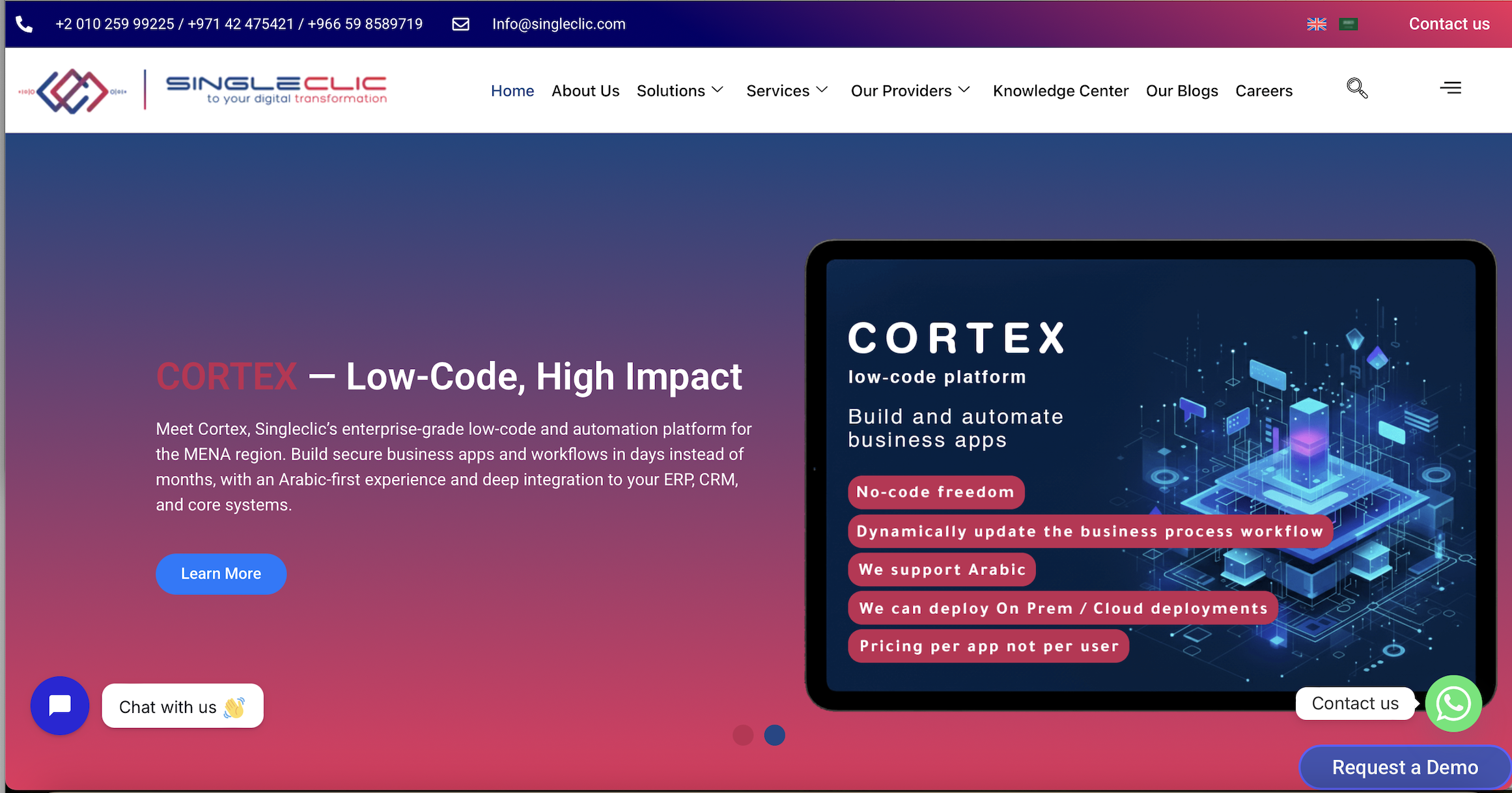
For organizations in KSA, UAE, and Egypt evaluating low-code, Singleclic offers three concrete delivery paths:
- Platform licensing and deployment: Cortex on-premise or private-cloud, with full Arabic UI/UX, unlimited users, and runtime workflow changes without downtime.
- Managed POC: a structured four-to-six-week proof of concept covering integration with your existing ERP/CRM, a representative workflow app, and a governance framework tailored to your sector.
- End-to-end integration delivery: connecting Cortex to Dynamics 365, Odoo, or legacy systems, with Singleclic’s 70+ engineers handling architecture, development, and go-live support.
With 10+ years of regional delivery and clients including Emirates Health Services, QNB, and Emaar Misr, Singleclic brings the sector-specific experience that generic platform vendors cannot. To request a POC or speak with a delivery consultant, visit Singleclic’s low-code and enterprise agility page or contact the team directly through Singleclic.
Sources
The sources below were selected for authority (primary research, major cloud vendors, academic study) and direct relevance to enterprise low-code evaluation.
- Benefits and limitations of using low-code development to support digitalization in the construction industry
- The low-code market could approach $50 billion by 2028
- Low-code and no-code platforms | Statista
- What is low-code? – AWS
Recommended
- How Low-Code Improves Business Agility and Faster Decision-Making | Singleclic
- How Low-Code Boosts Collaboration Between IT and Business Teams | Singleclic
- Low-Code, High Impact: Why Enterprise Teams Are Making It a Strategic Priority | Singleclic
- Why Low-Code Development Is Now Essential for Enterprise Agility | Singleclic