Banking and healthcare leaders in Saudi Arabia and the United Arab Emirates face mounting pressure to break down operational silos and deliver seamless, agile services across complex networks. The move from fragmented software to a digital ecosystem transforms how organizations coordinate, adapt, and create value. This article clarifies key principles and ecosystem types, offering actionable insights that help executives optimize business process automation and drive sustainable growth.
Table of Contents
- Defining Digital Ecosystems And Core Principles
- Types Of Digital Ecosystems In Modern Business
- How Digital Ecosystems Drive Operational Efficiency
- Roles, Risks, And Integration Considerations
Key Takeaways
| Point | Details |
|---|---|
| Digital ecosystems enhance collaboration | They create interconnected networks that drive efficiency and value through shared data and services among participants. |
| Modular and adaptable structures are essential | Successful ecosystems rely on components that function independently while remaining integrated for seamless operation. |
| Multiple ecosystem types serve different strategic goals | Organizations should leverage business, innovation, and platform ecosystems to achieve specific objectives and enhance competitive advantage. |
| Operational efficiency is significantly improved | Digital ecosystems streamline processes, reduce manual tasks, and enable real-time data sharing for faster decision-making. |
Defining Digital Ecosystems And Core Principles
A digital ecosystem is a network of interconnected digital services, platforms, and participants that create value through interaction and collaboration. Unlike isolated software systems, digital ecosystems function as living, adaptive networks where different components work together seamlessly.
Think of it like an organism. Just as a biological ecosystem thrives through relationships between different species, a digital ecosystem depends on multiple platforms, applications, and stakeholders exchanging data and services. When a patient in Dubai Healthcare City accesses their records through multiple integrated systems, that’s a digital ecosystem in action.
Understanding the Foundation
Research on digital ecosystem characteristics reveals several essential principles that define how these networks operate. These principles aren’t theoretical—they directly impact how organizations in KSA and UAE modernize their operations.
The core principles include:
- Modularity: Components function independently yet connect seamlessly to the larger system
- Self-organization: The ecosystem adapts and evolves without requiring constant central control
- Demand-driven interaction: Services and features emerge based on actual participant needs
- Interconnectedness: All elements communicate through standardized interfaces and protocols
- Value creation: The system generates more value collectively than any single component could alone
Digital Innovation vs. Traditional Systems
A traditional banking system operates linearly: customer submits request, system processes it, customer receives response. A digital ecosystem works differently. When QNB or AlBaraka Bank implements a modern digital ecosystem, customers interact with multiple services simultaneously—loan applications, investment tools, payment processing—all functioning together with shared data and insights.
Digital innovation ecosystems represent multidimensional networks where technology acts as the primary driver. These systems transform how organizations handle customer relationships, internal processes, and market responsiveness.

Why This Matters for Healthcare and Banking
Consider a healthcare provider in Riyadh. Without a digital ecosystem, patient data lives in separate silos—electronic records here, billing information there, imaging results somewhere else. Staff waste time searching for information across multiple systems.
With a proper digital ecosystem using platforms like Cortex, our low-code solution designed specifically for MENA enterprises:
- Healthcare providers access complete patient histories instantly
- Billing integrates automatically with patient records
- Referrals move seamlessly between departments
- Decision-making relies on accurate, real-time data
Banking institutions face similar challenges. A loan officer needs customer credit history, account activity, and risk assessment data. A digital ecosystem pulls all this together automatically, reducing approval time from weeks to hours.
A true digital ecosystem doesn’t just connect systems—it creates intelligent networks that anticipate needs and adapt automatically to your organization’s unique requirements.
The difference between a collection of tools and a genuine digital ecosystem comes down to integration depth and intelligence. Systems must communicate, share context, and improve through interaction. This is what separates organizations that merely digitalized from those genuinely optimized.
Pro tip: Start by mapping your existing systems and identifying where data silos create friction—these are your highest-priority integration points for building a functional digital ecosystem.
Types Of Digital Ecosystems In Modern Business
Not all digital ecosystems look the same. Organizations implement different ecosystem types based on their business goals, industry requirements, and competitive pressures. Understanding these variations helps executives in healthcare and banking choose the right architecture for their needs.
The Three Main Types
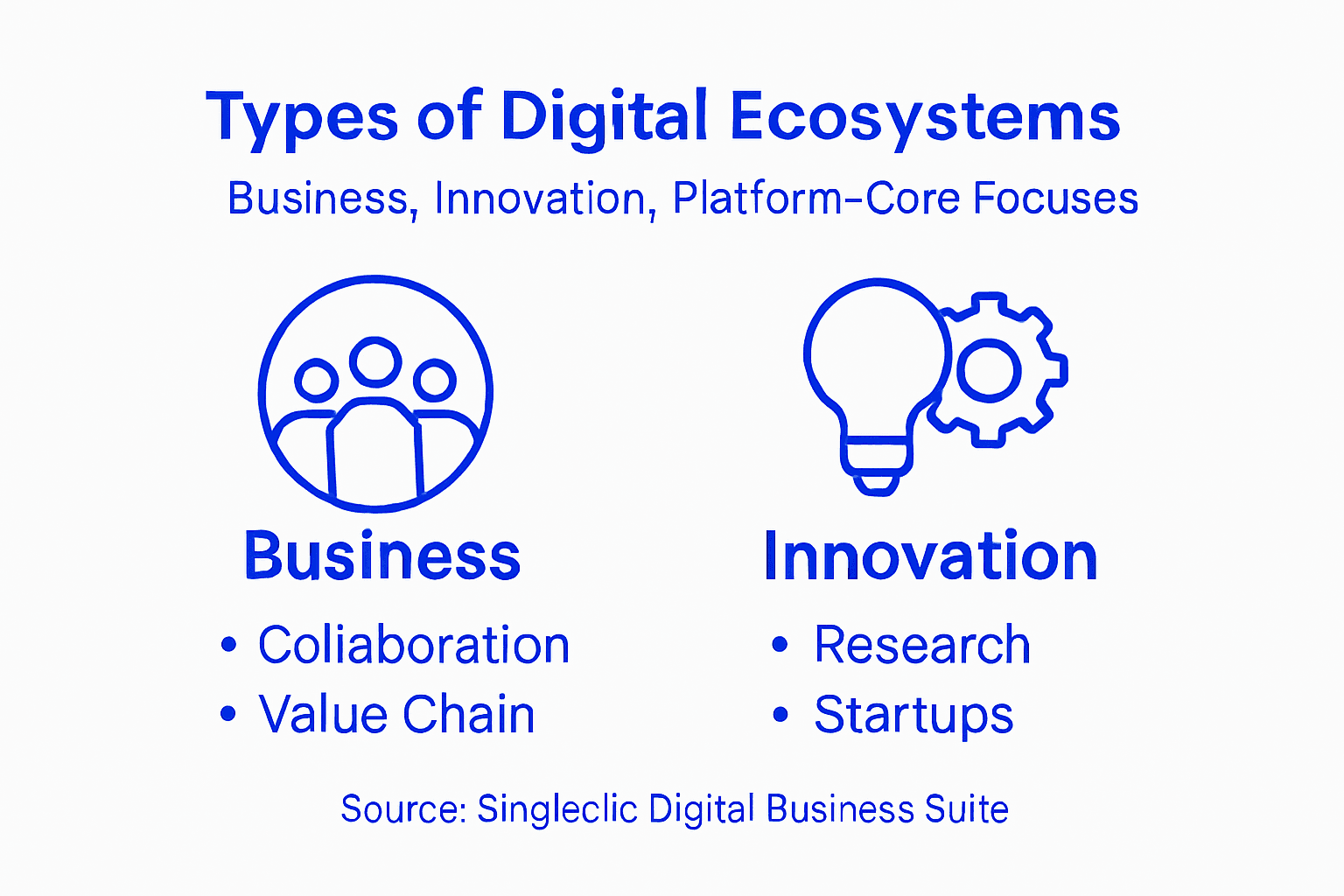
Business, innovation, and platform ecosystems represent the primary categories organizations deploy in modern business. Each type operates differently and serves distinct strategic purposes.
Business ecosystems focus on creating value through collaboration among established organizations. In banking, this looks like a major bank partnering with fintech companies, payment processors, and wealth management firms to deliver comprehensive financial services to customers.
Innovation ecosystems bring together research institutions, startups, and established companies to develop new technologies and business models. Universities in Riyadh and Dubai work alongside private sector companies to create cutting-edge solutions in healthcare technology and financial innovation.
Platform ecosystems operate through digital platforms that connect multiple stakeholder groups. Think of a marketplace where buyers and sellers interact, or a healthcare platform where patients, providers, pharmacies, and insurers all participate through a single interface.
Here’s a summary of the three main digital ecosystem types and their business applications:
| Ecosystem Type | Typical Participants | Strategic Focus | Example Use Case |
|---|---|---|---|
| Business | Corporations, fintechs, suppliers | Collaborative value creation | Partnering for financial products |
| Innovation | Universities, startups, tech firms | Research-driven breakthroughs | Developing healthcare tech solutions |
| Platform | Platform owners, customers, providers | Enabling network effects | Unified patient records access |
How They Differ
The key differences matter for implementation:
- Business ecosystems: Focused on operational efficiency and shared value creation
- Innovation ecosystems: Driven by research, experimentation, and breakthrough development
- Platform ecosystems: Centered on network effects and enabling transactions between groups
A bank in the UAE might use a business ecosystem to streamline loan processing with multiple partners. The same bank could operate a platform ecosystem through a mobile app where customers access loans, investments, and insurance from various providers.
Why Modern Business Demands Multiple Ecosystems
Organizations rarely choose just one type. Digital platforms and business ecosystems work together to enable sustainable business models and facilitate collaboration across complex networks of partners, suppliers, and customers.
A healthcare provider in Saudi Arabia might operate:
- A business ecosystem with pharmacies, labs, and specialists for patient care delivery
- An innovation ecosystem partnering with medical device companies and research centers
- A platform ecosystem where patients book appointments, access records, and communicate with providers
Each ecosystem type serves a specific purpose. Together, they create competitive advantage impossible to achieve alone.
The most successful organizations don’t choose between ecosystem types—they orchestrate multiple ecosystems working in concert to serve customers and drive growth.
When implementing ecosystems using solutions like Cortex, our Arabic-enabled low-code platform, you can design workflows that support all three ecosystem types. The platform enables real-time collaboration, automated processes, and intelligent routing across different participant groups.
Pro tip: Map your current partnerships and value flows to identify which ecosystem type fits each relationship, then prioritize implementation based on where collaboration creates the most customer impact.
How Digital Ecosystems Drive Operational Efficiency
Operational efficiency doesn’t come from having better tools—it comes from having tools that work together intelligently. Digital ecosystems eliminate the friction that slows organizations down, replacing manual handoffs with automated workflows and siloed data with shared intelligence.
Breaking Down Data Silos
Imagine a patient in Dubai seeking treatment. Without an ecosystem, her medical history sits in one system, insurance information in another, and billing in a third. Staff spend hours searching across platforms. With a digital ecosystem, all data flows automatically to authorized users instantly.
Technology-enabled collaboration through integrated platforms reduces manual work, accelerates decision-making, and cuts operational costs. Banks experience similar gains—loan officers access complete customer profiles instantly rather than requesting documents from multiple departments.
How Efficiency Gains Happen
Digital ecosystems drive efficiency through:
- Automated workflows: Tasks move between systems without human intervention
- Real-time data sharing: Information updates instantly across the network
- Reduced manual handoffs: Fewer emails, phone calls, and follow-ups needed
- Intelligent routing: Work goes to the right person automatically
- Faster decision-making: Leaders access complete data when they need it
A healthcare provider in Riyadh using Cortex can route patient referrals automatically to available specialists, update insurance records instantly, and generate billing without staff touching the process between steps.
This table highlights how digital ecosystems drive operational efficiency compared to traditional systems:
| Key Process Area | Traditional Systems | Digital Ecosystems | Business Impact |
|---|---|---|---|
| Data Access | Manual, time-consuming | Automated, instantaneous | Faster service delivery |
| Workflow Routing | Requires staff handoffs | Smart routing by system | Reduction in errors |
| Decision Making | Limited, delayed info | Real-time, comprehensive data | Improved outcomes |
| Collaboration | Disjointed, siloed teams | Integrated workflows | Higher productivity |
AI-Powered Intelligence
Intelligent and interactive ecosystems driven by AI facilitate operational excellence by enabling organizations to adapt quickly, collaborate effectively, and optimize customer-centric operations. AI doesn’t just process faster—it learns from patterns and anticipates needs.
In banking, AI within a digital ecosystem identifies which loan applications need additional review before human staff even sees them. In healthcare, it flags potential drug interactions before prescriptions reach patients.
Measuring the Impact
Organizations typically see results within months:
- Approval times drop by 60-75 percent
- Manual data entry decreases by 80 percent or more
- Staff focus shifts from administrative tasks to strategic work
- Customer satisfaction improves through faster service delivery
A bank in the UAE reduced loan processing from 14 days to 2 days after implementing an integrated digital ecosystem. A healthcare network in Saudi Arabia cut patient registration time from 45 minutes to 5 minutes.
Operational efficiency compounds over time—as your ecosystem matures, continuous automation and AI improvements create exponential gains in productivity and cost reduction.
The key difference between average and exceptional organizations comes down to how seamlessly their systems work together. When systems operate independently, efficiency hits a ceiling. Digital ecosystems remove that ceiling entirely.
Pro tip: Start by identifying your three slowest business processes, then design ecosystem workflows that automate handoffs between departments—this typically delivers the fastest return on investment.
Roles, Risks, And Integration Considerations
Building a digital ecosystem isn’t just a technology project—it’s an organizational restructuring that requires clear roles, risk management, and careful integration planning. Success depends on understanding who does what and preparing for challenges before they emerge.
Defining Ecosystem Roles
Every participant in a digital ecosystem plays a distinct role. The platform orchestrator manages the overall ecosystem, sets rules, and ensures all participants follow standards. In a bank’s digital ecosystem, this might be the CIO or Chief Digital Officer.
Partner organizations deliver specific services within the ecosystem. Insurance companies, investment firms, and payment processors each contribute their expertise while following the platform’s governance rules.
Customers aren’t passive—they actively participate, consuming services and providing data that improves the ecosystem. Their feedback shapes how the platform evolves.
Strategic roles including platform orchestration and partner management require careful definition to enable value co-creation while maintaining ecosystem health. Without clear role definition, coordination breaks down and integration fails.
Critical Risks to Address
Digital ecosystems introduce several risk categories that organizations must manage proactively:
- Data privacy and security: Multiple parties accessing shared data creates exposure
- Member coordination complexity: More participants mean more potential points of failure
- Technology obsolescence: Rapid changes can leave ecosystem components outdated
- Vendor lock-in: Over-reliance on single platforms creates vulnerability
- Competitive pressure: Partners may compete while collaborating
Governance and operational challenges in digital ecosystems include managing heterogeneous participants and evolving technologies. A healthcare provider in Saudi Arabia must ensure patient data stays secure while multiple clinics, pharmacies, and insurers access it simultaneously.
Integration Requirements
Successful integration depends on three factors:
Interoperability means systems can exchange data using common standards. Your Cortex platform enables this through standardized APIs and data formats, allowing seamless connection with existing systems across your organization.
Governance frameworks establish rules that all participants follow—data ownership policies, security requirements, and usage guidelines. Without clear governance, conflicts emerge quickly.
Balancing openness with control requires sophisticated design. You want partners to innovate and add value, but not at the expense of security or stability. The right balance depends on your industry and competitive situation.
A bank in the UAE might allow fintech partners broad access to customer data through APIs while restricting their ability to modify core systems. A healthcare network in Riyadh might grant specialists read-only access to patient records while limiting prescribing capabilities to authorized providers only.
The strongest digital ecosystems balance openness for innovation with governance controls that protect sensitive data and maintain operational integrity.
Integration complexity grows with ecosystem maturity. Early-stage ecosystems require fewer governance rules. Mature ecosystems with dozens of partners demand sophisticated coordination mechanisms and clear escalation procedures for conflicts.
Pro tip: Create a risk register specific to your ecosystem identifying top five threats, their likelihood, potential impact, and mitigation strategies—review and update this quarterly as the ecosystem grows.
Unlock the True Power of Digital Ecosystems with Singleclic
The article highlights the critical challenge of fragmented systems and data silos that slow down healthcare and banking operations across the MENA region. If you are struggling with disjointed workflows, slow decision-making, or difficulty integrating partners and services, you know the value of a resilient digital ecosystem. Singleclic understands these pain points and offers tailored solutions that go beyond basic digitalization to deliver seamless modularity, real-time data sharing, and intelligent automation — key principles explained in the article.
Our low-code platform, Cortex, empowers organizations to create adaptive and interconnected ecosystems, supporting business, innovation, and platform models simultaneously. With extensive expertise in ERP/CRM implementation and enterprise AI, Singleclic helps you automate complex processes while ensuring data privacy, governance, and operational efficiency. Experience how leading banks like QNB and healthcare providers in Riyadh have transformed customer service and internal workflows with our integrated solutions.
Ready to evolve your systems into intelligent digital ecosystems that drive growth and efficiency today?
Explore how Singleclic’s comprehensive digital transformation suite can redefine your business operations. Visit Singleclic now and take the first step toward operational excellence. Discover our industry expertise in Banking Consultancy and Business Process Automation to accelerate your journey.
Frequently Asked Questions
What is a digital ecosystem?
A digital ecosystem is a network of interconnected digital services, platforms, and participants that create value through interaction and collaboration, functioning as adaptive networks rather than isolated systems.
How do digital ecosystems differ from traditional systems?
Digital ecosystems enable simultaneous interactions across multiple services, allowing for shared data and insights, whereas traditional systems operate linearly, requiring sequential processing of requests.
What are the core principles of digital ecosystems?
Core principles include modularity, self-organization, demand-driven interaction, interconnectedness, and value creation which collectively enhance the adaptability and efficiency of operations.
Why are digital ecosystems important for organizations?
Digital ecosystems streamline processes by breaking down data silos, facilitating real-time data sharing, and automating workflows, ultimately driving operational efficiency and improved customer satisfaction.