TL;DR:
- Most organizations still view IT as solely a maintenance function, which hampers their growth opportunities.
- Today, IT is a strategic driver that influences organizational speed, market insights, and execution capabilities.
Most organizations still treat IT as a maintenance function. They measure it by uptime, ticket resolution time, and annual spend. That framing is costing them growth. The role of IT in strategy has shifted fundamentally. IT now determines how fast your organization can move, how well you can read your market, and whether your teams can execute on a plan before conditions change. Yet only 21% of companies have integrated technology deeply into their strategy development. That gap is where competitive advantage is won or lost.
Table of Contents
- Key takeaways
- The role of IT in strategy has fundamentally shifted
- How IT drives alignment, agility, and real business value
- AI, automation, and the future of strategic IT initiatives
- Common pitfalls in integrating IT into corporate strategy
- My take on where IT strategy actually breaks down
- How Singleclic helps you turn IT strategy into execution
- FAQ
Key takeaways
| Point | Details |
|---|---|
| IT is a strategic driver | Technology in corporate strategy is no longer optional. IT shapes speed, growth, and competitive position. |
| Alignment multiplies returns | Business-IT alignment correlates with 4 to 5 times faster time-to-market and stronger investment returns. |
| AI reshapes strategy work | Around 80% of corporate strategist tasks are exposed to AI automation, requiring IT leaders to orchestrate the shift. |
| Failure is still common | 70% of digital transformations fail, mainly from execution gaps, not technology gaps. |
| Low-code accelerates agility | Platforms like Singleclic’s Cortex let teams in Saudi Arabia and UAE build and adjust processes without waiting for development cycles. |
The role of IT in strategy has fundamentally shifted
Not long ago, technology leaders were measured on one thing: keeping the lights on. Infrastructure stability, zero downtime, and cost containment defined IT success. That world is gone.
79% of tech leaders now prioritize driving business outcomes over maintaining IT systems. Deloitte’s 2026 Global Technology Leadership Study describes this as a move from “operators to orchestrators.” The CIO or CTO no longer sits at the back of the room during strategic planning. They sit at the table, shaping market bets and allocating resources.
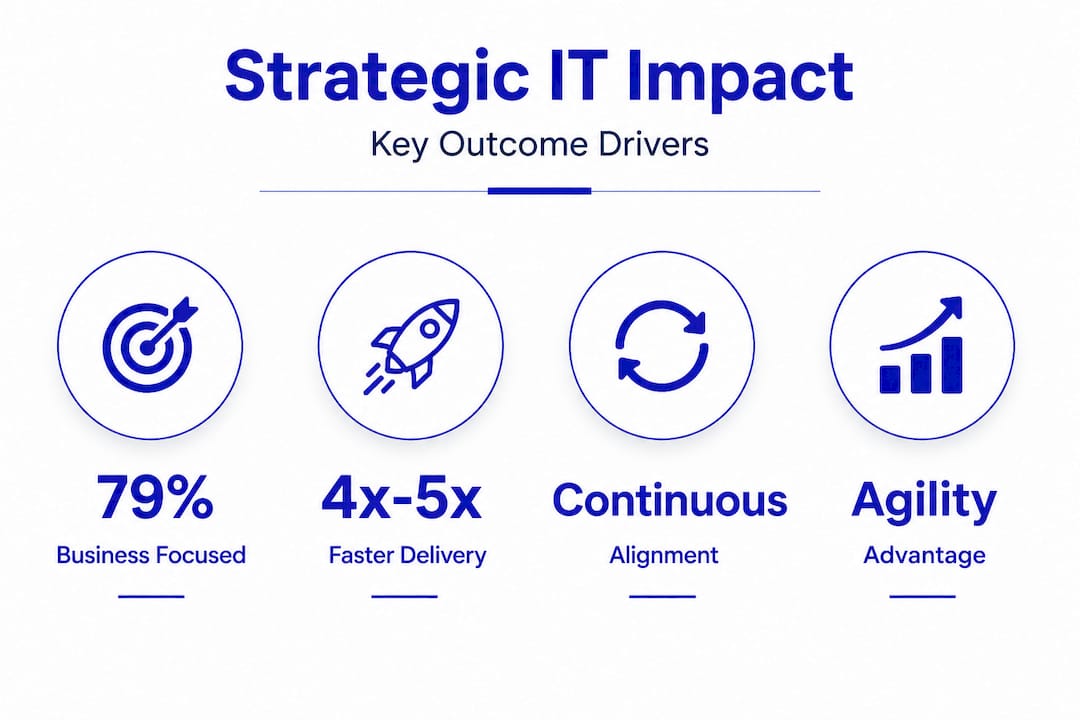
Two-thirds of top-performing companies integrate technology leaders directly into strategic development processes. That is not coincidence. When technology leaders understand the commercial priorities and have authority to align IT capabilities accordingly, strategy becomes executable instead of aspirational.
This shift carries direct relevance for organizations in Saudi Arabia and the UAE. Both markets are pushing hard through Vision 2030 and national AI strategies. Companies in Riyadh, Dubai, and Abu Dhabi that position IT as a core growth lever rather than a cost center are pulling ahead of those still running IT as a shared service. The difference shows up in speed, product quality, and the ability to respond to regulatory or market changes before competitors do.
“Technology is no longer a supporting function. It is the strategy.” — Tobias Günther, Senior Partner, Odgers Berndtson
How IT drives alignment, agility, and real business value
Understanding how IT influences strategy in practice requires looking at three distinct mechanisms: alignment, agility, and innovation. Each operates differently but they reinforce one another.
Alignment starts with shared language
Business-IT alignment is not about IT leaders learning the business. It is about building shared metrics and shared language so that every technical decision traces back to a commercial outcome. When IT and business teams operate on different KPIs, you get wasted budgets and stalled projects. When they operate on the same KPIs, you get faster decisions and clearer accountability.
The practical starting point is capability mapping. Before deciding what technology to buy or build, map the capabilities your business needs to win in its market. IT strategy focused on capabilities rather than a list of projects prevents the common gap between technical implementation and commercial value. A retail bank in the UAE, for example, may need a real-time credit decisioning capability. That is the business need. The technology choices that serve it come second.
The mechanisms that make alignment work consistently include:
- Shared KPIs between IT teams and business unit leaders, reviewed quarterly
- Governance structures that give IT a voice in investment prioritization, not just execution
- A translation layer, whether a business analyst, a product manager, or the CIO themselves, that connects technical constraints to business opportunity
Pro Tip: Run a bi-annual “strategy translation” session where IT leaders present their roadmap in business outcome terms only. No technical jargon. If they cannot connect each initiative to revenue, customer experience, or risk reduction, the initiative belongs under review.
Agility through low-code and faster delivery
IT strategy alignment accelerates when organizations reduce the time between a business decision and its technical implementation. Low-code platforms directly attack that delay. Instead of waiting months for development cycles, business teams can model, test, and deploy process changes in days.

For enterprises in Saudi Arabia and the UAE, where regulatory environments shift quickly and market windows close fast, this speed is not a nice-to-have. It is a competitive requirement. The following table illustrates where low-code creates measurable strategic value compared to traditional development:
| Capability | Traditional development | Low-code platform |
|---|---|---|
| Time to deploy a new workflow | 3 to 6 months | Days to 2 weeks |
| Dependency on development team | High | Low |
| Cost of process iteration | High | Low |
| Arabic language and on-premise support | Varies | Native (e.g., Cortex) |
| Runtime changes without downtime | Rare | Standard |
AI as a strategic lever
AI does not just automate tasks. It changes what is possible strategically. Organizations that have embedded AI into their planning and decision processes can model more scenarios, respond faster to signals, and allocate resources with far greater precision. Understanding how AI drives transformation in IT-led strategy is now a baseline requirement for senior leaders, not an advanced topic.
AI, automation, and the future of strategic IT initiatives
The most significant shift in how IT influences strategy is happening at the intersection of AI and the strategy function itself.
Around 80% of tasks performed by corporate strategists are exposed to moderate or high AI automation. BCG describes the result as decentralized, always-on strategy. Instead of annual planning cycles, organizations can continuously update their strategic direction based on real-time data. IT is the infrastructure that makes that possible.
“AI changes the very fabric of strategy work, enabling decentralized, continuous strategy development, with IT playing a central role in enabling and orchestrating this shift.” — BCG, 2026
For IT leaders, this creates a new set of responsibilities. Consider the steps required to make AI-driven strategy a reality in your organization:
- Establish data infrastructure: Strategy quality depends on data quality. IT must own the architecture that makes decision-relevant data accessible, clean, and trusted.
- Build AI governance frameworks: Without governance, AI-generated insights lead to confident mistakes. IT leaders must define how AI outputs are validated before informing major decisions.
- Enable distributed access: AI tools should reach business unit leaders directly, not sit inside a central IT lab. Deployment architecture determines whether AI actually changes how your people work.
- Align AI initiatives to strategic priorities: Every AI deployment should connect to a stated business objective. IT leaders who let AI projects proliferate without strategic anchors create complexity without value.
- Invest in capability building: AI changes what your teams need to know. IT strategy must include a workforce component, training business leaders to interpret and challenge AI recommendations rather than accept them passively.
For organizations in Saudi Arabia and the UAE, these steps also carry regulatory dimensions. Data residency requirements, sector-specific AI guidelines from financial and healthcare regulators, and government cloud mandates shape how AI can be deployed. IT leaders who understand both the technical and regulatory environment become irreplaceable strategic partners.
Common pitfalls in integrating IT into corporate strategy
Despite the clear case for IT strategy alignment, 70% of digital transformations fail. Most do not fail because the technology did not work. They fail because the strategy connecting technology to business outcomes was poorly constructed or poorly executed.
The most common failure patterns are predictable once you know what to look for:
- Faulty assumptions at the start: 83% of strategies falter due to faulty assumptions. Organizations overestimate adoption speed, underestimate process complexity, or assume that technology deployment equals behavior change. It does not.
- Measuring IT by technical metrics only: When IT success is defined by system uptime or deployment speed rather than business outcomes, the function optimizes for the wrong things. Projects deliver on time but fail to move revenue or efficiency needles.
- Lack of clear ownership: Assigning clear ownership for KPIs tied to IT initiatives significantly improves accountability. When no one owns the outcome, every team owns the excuse.
- Treating IT strategy as a one-time document: Strategy becomes obsolete faster than organizations update it. IT strategy must be a living process with regular review cycles, not a plan filed after an annual offsite.
Pro Tip: Build a “strategic assumption log” alongside any major IT initiative. Document every assumption your strategy rests on. Review it quarterly. When assumptions prove wrong, update the strategy immediately rather than waiting for the annual cycle.
Digital transformation success requires continuous alignment and cultural integration, not technology alone. Organizations that embed agility and accountability into how they govern IT consistently outperform those that rely on periodic planning.
My take on where IT strategy actually breaks down
I have worked with organizations across Saudi Arabia, the UAE, and Egypt on IT-enabled transformation for over a decade. The pattern I see most often is not a technology failure. It is a framing failure.
When leadership treats IT as a cost center to be controlled, the IT function responds accordingly. People optimize for budget protection rather than business impact. Talent prioritizes stability over experimentation. The IT organization becomes genuinely less capable over time because the incentives reward caution, not contribution.
The organizations I have watched succeed share one structural trait. They give IT a seat in strategic decisions before the decisions are made, not after. Not to approve technical feasibility, but to shape commercial thinking. A CIO who understands that a new market entry depends on a specific data integration or localization capability can reframe a six-month timeline as a competitive risk. That conversation changes the decision. That is the importance of IT in planning that most leadership frameworks still underestimate.
I am also skeptical of the view that AI will eventually reduce the need for strong IT leadership. AI makes the quality of your underlying data architecture and governance more important, not less. The organizations that will get the most from AI-driven strategy are the ones whose IT function has spent years building trustworthy data infrastructure and earning business trust. That does not happen automatically. It requires deliberate, sustained investment in IT as a strategic function.
The human judgment involved in translating AI outputs into organizational decisions cannot be automated away. Someone has to know enough about both the business and the technology to ask the right questions of the data, and to push back when the answers look convenient but do not feel right.
— Tamer
How Singleclic helps you turn IT strategy into execution
Reading about IT strategy alignment is useful. Having the tools and partner to execute it is what creates results. Singleclic works with enterprises across Saudi Arabia, the UAE, and Egypt to move organizations from strategy documents to running systems. Cortex, Singleclic’s Arabic-enabled, on-premise low-code platform, lets your teams design, automate, and evolve business processes without waiting on development queues. For organizations that need governance-grade AI deployment or business process automation at enterprise scale, Singleclic brings over 10 years of regional delivery experience, 70+ consultants, and clients including Emirates Health Services, QNB, and Emaar Misr. If your IT strategy needs to become operational capability, Singleclic is built to make that happen.
FAQ
What is the role of IT in corporate strategy?
IT shapes which strategic options are feasible, how fast the organization can execute, and how well it can read and respond to market signals. When integrated properly, IT becomes a direct source of competitive advantage rather than an operational overhead.
How does IT strategy alignment improve business outcomes?
Aligned IT and business strategy produces 4 to 5 times faster time-to-market and reduces decision paralysis by giving both functions shared KPIs and transparent resource allocation processes.
Why do most digital transformation strategies fail?
Most transformations fail due to execution gaps, not technology gaps. Faulty assumptions, unclear ownership, and the absence of continuous alignment between IT and business teams are the leading causes.
How does AI change the strategic IT initiatives of an organization?
AI enables continuous, decentralized strategy by making real-time data analysis and scenario modeling practical at scale. IT leaders must build the governance and infrastructure that turns AI outputs into trustworthy decisions.
How can businesses in Saudi Arabia and UAE benefit from IT strategy integration?
Organizations in Saudi Arabia and the UAE operate in fast-shifting regulatory and market environments where IT-enabled agility directly affects competitive position. Low-code platforms and AI governance frameworks built for MENA contexts give these businesses the speed and compliance posture required to execute on national transformation agendas.