TL;DR:
- Public sector analytics involves collecting, cleaning, and analyzing government data to improve services and policy decisions. It shifts governments from intuition-based to evidence-driven approaches, enhancing efficiency, transparency, and citizen engagement. Key elements include governance, regional platforms like Saudi Adaa and UAE Bayan, citizen feedback, and low-code tools to accelerate deployment and ensure sustainability.
Analytics in the public sector is defined as the systematic collection, cleaning, and analysis of government data to extract insights that improve service delivery, resource allocation, and policy decisions. For public sector professionals in Saudi Arabia and the UAE, this discipline has moved from a back-office function to a strategic priority. Initiatives like Saudi Arabia’s Adaa performance platform and the UAE’s Bayan health data system demonstrate that data-driven decision making is no longer optional. Governments that treat data as infrastructure consistently outperform those that rely on intuition and legacy reporting.
How the role of analytics in public sector transforms government operations
The shift from intuition-based to evidence-based governance is the defining change analytics brings to government agencies. Public sector analytics shifts decision-making from intuition to data-driven approaches, improving efficiency, transparency, and citizen engagement. That means budget allocations, staffing decisions, and service designs are grounded in what the data actually shows, not what senior officials assume.
Operational efficiency gains are direct and measurable. When agencies analyze process data, they identify bottlenecks, eliminate redundant steps, and redirect resources to where demand is highest. The US Citizenship and Immigration Services (USCIS) Office of Data and Analytics is a strong model: it supports senior decision makers with performance analysis, fraud evaluation, and agency-wide business intelligence. This structure separates data strategy from day-to-day operations, which keeps analytics focused on outcomes rather than outputs.
In the Gulf region, Saudi Arabia’s Adaa provides independent quarterly KPI reporting across all public agencies, measuring progress against Vision 2030 targets and collecting citizen feedback through mobile apps. The UAE’s Bayan platform integrates historical and real-time data from public and private entities, featuring over 300 health indicators for analytics-driven planning. Both platforms show that regional governments are investing seriously in analytics infrastructure, not just dashboards.
Key benefits that analytics delivers to government agencies include:
- Fraud detection: AI models flag anomalous patterns in benefits claims and procurement before payments are processed
- Resource targeting: Usage data identifies which services are underutilized and which are overwhelmed, enabling smarter staffing
- Policy evaluation: Before-and-after analysis measures whether a regulation or program actually achieved its intended outcome
- Citizen engagement: Feedback analytics reveal satisfaction gaps and service completion failures in real time
- Transparency: Published performance data builds public trust and creates political accountability
Pro Tip: Before deploying any analytics tool, map your agency’s top five decisions that currently rely on manual judgment. These are your highest-value targets for data-driven improvement, and they give your analytics program a clear mandate from day one.
What does an effective government analytics platform require?
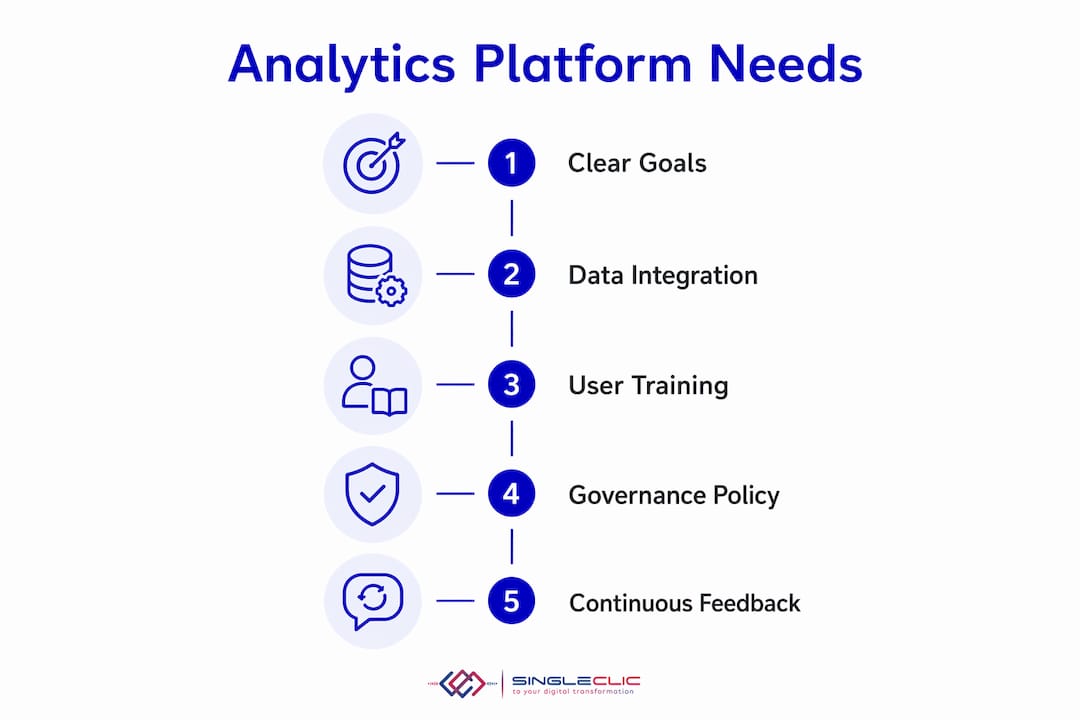
Building a government analytics program that delivers sustained value requires more than purchasing software. The foundation is data collection, cleaning, and integration. Raw government data is often fragmented across ministries, stored in incompatible formats, and riddled with duplicates. Without addressing these issues first, even the most advanced analytics tools produce unreliable outputs.

The tools most commonly deployed in government analytics programs fall into distinct categories, each serving a different function:
| Tool type | Primary function | Government example |
|---|---|---|
| Data visualization and dashboards | Convert raw data into charts and KPI views for executives | UAE Bayan platform, Saudi Adaa |
| AI and machine learning | Predict outcomes, detect fraud, automate data cleaning | USCIS fraud evaluation models |
| Data mining tools | Identify hidden patterns across large datasets | Medicaid savings analysis |
| Low-code platforms | Accelerate dashboard and app creation without heavy coding | Singleclic Cortex for MENA agencies |
| Centralized data catalogs | Eliminate silos and enable cross-agency data sharing | UK government data asset management |
AI and machine learning in government automate data cleaning, identify hidden patterns, predict outcomes, and enable faster public service decisions. The practical implication is that agencies no longer need to wait for annual reports to understand what is happening. Predictive models can flag a surge in service demand weeks before it peaks.
Data silos remain the most persistent obstacle. When the Ministry of Health, the Ministry of Finance, and municipal authorities each maintain separate data systems with no integration layer, cross-agency analytics is impossible. Centralized data catalogs, as mandated by the UK government’s 2026 data asset management policy, solve this by creating a single inventory of all data assets with standardized metadata. Saudi Arabia and the UAE are both moving in this direction, though implementation consistency across agencies varies.
Pro Tip: When selecting a government analytics platform, prioritize tools that support Arabic-language interfaces and on-premise deployment. Both requirements are non-negotiable for most Gulf region public sector organizations.
Why data governance is the foundation of public sector analytics
Data governance is the set of policies, standards, and accountability structures that determine how data is collected, maintained, and used across an organization. Without it, analytics programs produce inconsistent results, lose stakeholder trust, and fail to scale. The UK government’s 2026 data asset management policy treats data as strategic infrastructure, mandating centralized catalogs, minimum quality standards, and data quality action plans to enable AI readiness and cross-government interoperability.
The most effective governance model operates on two layers. The governance layer controls data quality, ownership, and standards. The execution layer delivers analytics insights to decision-makers. Separating these functions prevents the common failure where analysts spend 80% of their time cleaning data instead of generating insights. USCIS applies this dual-layer model explicitly, with dedicated divisions for data strategy and governance running parallel to divisions focused on performance reporting and advanced analytics.
Building a data-driven culture requires organizational enablement efforts, resources to grow analytics skills, and embedding evidence use at all levels of the agency. Technology alone does not change how decisions are made. Leaders in Saudi and UAE government agencies who invest in data literacy training alongside platform deployment see faster adoption and more consistent use of analytics outputs.
Governance best practices relevant to public sector organizations in Saudi Arabia and the UAE include:
- Assign named data stewards in each ministry responsible for quality and lineage
- Establish a cross-agency data standards committee to align indicator definitions before building dashboards
- Publish a data quality action plan with measurable targets reviewed quarterly
- Require all new digital systems to expose data through standardized APIs for integration
- Conduct annual data audits to identify orphaned datasets and eliminate duplication
The importance of data governance for C-level leaders in KSA and UAE cannot be overstated. Governance discipline is what separates a one-time analytics project from a sustainable, agency-wide capability.
How citizen data improves public services in Saudi Arabia and the UAE
Citizen data analytics closes the feedback loop between government service design and actual user experience. Saudi Arabia’s Adaa platform collects citizen feedback through its BEX mobile app, linking satisfaction scores directly to KPI performance data across public agencies. This means a drop in citizen satisfaction in a specific service area triggers a measurable performance review, not just an internal complaint process.
The UAE’s MoHAP Bayan platform integrates historical and real-time data from public and private entities, with interactive dashboards featuring over 300 health indicators. It supports disease monitoring, workforce planning, and SDG tracking with geospatial and trend analysis. The practical result is that health planners can identify underserved communities, predict staffing shortfalls, and allocate resources before a crisis develops rather than after.
Canada’s federal government offers a transferable model. Canada.ca publishes monthly usage data and survey insights to understand citizen interactions and improve service completion rates. Combining page analytics with task success surveys and direct feedback tools gives service designers a complete picture of where citizens struggle and why.
For public sector leaders in Saudi Arabia and the UAE looking to apply citizen data analytics, these steps provide a practical starting point:
- Audit existing feedback channels. Identify every point where citizens currently provide feedback, from call centers to app ratings, and consolidate that data into a single view.
- Define service completion metrics. For each digital service, establish a measurable completion rate and track it monthly against a baseline.
- Integrate usage analytics with satisfaction scores. High usage combined with low satisfaction signals a service that citizens must use but find frustrating. This is your highest-priority improvement target.
- Publish performance data publicly. Transparency creates accountability and encourages agencies to act on findings rather than archive them.
- Create a feedback-to-action protocol. Establish a defined process for how citizen feedback triggers a service review, who owns the response, and within what timeframe.
Combining citizen feedback analytics with operational data gives government agencies the evidence they need to justify service redesigns and budget reallocations to leadership.
Key takeaways
Analytics in the public sector succeeds when technology investment is matched by governance discipline, organizational culture change, and a clear feedback loop connecting citizen data to service improvement decisions.
| Point | Details |
|---|---|
| Analytics shifts decision-making | Government agencies move from intuition to evidence-based decisions using performance data and KPIs. |
| Governance enables scale | A dual-layer model separating data stewardship from analytics execution sustains program quality over time. |
| Regional platforms lead the way | Saudi Adaa and UAE Bayan demonstrate that Gulf governments are building serious analytics infrastructure. |
| Citizen data closes the loop | Combining usage analytics with feedback tools identifies service failures before they escalate. |
| Low-code platforms accelerate deployment | Tools like Singleclic’s Cortex reduce the time and cost of building government dashboards and analytics apps. |
Analytics in the Gulf: what I’ve learned working with public sector organizations
Having worked with government and public sector clients across Saudi Arabia and the UAE for over a decade, the pattern I see most often is this: agencies invest in the technology and skip the governance. They deploy a dashboard, celebrate the launch, and then watch adoption stall within six months because no one agreed on what the numbers actually mean.
The MENA region’s ‘single source of truth’ initiatives, including Bayan, face a specific challenge that technology cannot solve on its own. Agreeing on indicator definitions and measurement cadences across agencies requires political will and sustained coordination. I have seen technically excellent platforms fail because two ministries could not agree on how to define a “resolved service request.”
What actually works is starting with governance before technology. Identify your data owners, define your indicators, and agree on your quality standards before you write a single line of code or configure a single dashboard. Low-code platforms like Singleclic’s Cortex make the technology part faster and cheaper than ever. The hard part has always been the organizational alignment, and no platform solves that for you.
The agencies I have seen succeed in Saudi Arabia and the UAE share one trait: a senior leader who treats data quality as a personal accountability, not an IT problem. When the Director General asks why a KPI is missing or inconsistent, the culture changes fast.
— Tamer
How Singleclic helps public sector organizations deploy analytics faster
Singleclic works directly with government agencies across Saudi Arabia, the UAE, and Egypt to deploy analytics programs that are built to last. Singleclic’s Cortex platform is an Arabic-enabled, on-premise low-code environment that lets your teams build dashboards, automate data workflows, and integrate legacy systems without extensive coding resources. For agencies managing sensitive citizen data, on-premise deployment is a requirement, not a preference. Cortex meets that requirement while supporting real-time process optimization and runtime workflow changes without downtime. If you are planning an analytics or ERP integration project, the ERP implementation checklist for the Middle East is a practical starting point. You can also explore how smart automation accelerates public sector operational performance across the region.
FAQ
What is the role of analytics in the public sector?
Analytics in the public sector refers to the systematic use of data collection, analysis, and reporting to improve government decisions, allocate resources efficiently, and enhance citizen services. It covers everything from KPI dashboards to AI-driven fraud detection.
How does analytics improve public policy decisions?
Analytics replaces assumption-based policy design with evidence drawn from real service usage, citizen feedback, and outcome data. Platforms like Saudi Adaa and UAE Bayan give policymakers measurable performance data tied directly to national targets.
What are the biggest challenges in government analytics?
Data silos, inconsistent indicator definitions, and weak governance structures are the three most common barriers. The UK government’s 2026 data asset management policy addresses these through centralized catalogs and mandatory quality standards.
How can Saudi and UAE agencies use citizen data to improve services?
Agencies can combine usage analytics, task success surveys, and mobile feedback apps to identify where citizens struggle with digital services. Publishing this data publicly, as Canada.ca does monthly, creates accountability and drives faster service improvements.
What tools do government agencies use for analytics?
Common tools include data visualization platforms, AI and machine learning models, centralized data catalogs, and low-code platforms. For MENA agencies, Arabic-enabled and on-premise options like Singleclic’s Cortex platform address both language and data sovereignty requirements.