More than 60 percent of government agencies in Saudi Arabia and the United Arab Emirates are now prioritizing citizen-centered CRM solutions, following successful american public sector models. Efficient service delivery has become a top concern as demand for transparency and responsiveness grows. With digital transformation accelerating, CIOs and IT managers have new opportunities to deploy advanced CRM platforms that directly enhance public engagement while improving operational performance.
Table of Contents
- Defining CRM In Citizen Services Context
- Common CRM Types For Public Sector Use
- Core Features Enabling Effective Citizen Interaction
- Digital Transformation Through Government CRM Adoption
- Risks, Challenges, And Best Practices
Key Takeaways
| Point | Details |
|---|---|
| Importance of Citizen-Centric CRM | CRM in public services prioritizes citizen needs, transforming government interactions and enhancing service delivery. |
| Diverse CRM Types Available | Different CRM types, such as Case Management and Engagement CRM, address specific government service requirements and improve efficiency. |
| Core Features Enhance Interaction | Key features like multi-channel access and real-time feedback improve citizen engagement and service responsiveness. |
| Navigating Implementation Challenges | Successful CRM adoption requires addressing technological complexity and data privacy concerns while engaging stakeholders effectively. |
Defining CRM in Citizen Services Context
Customer Relationship Management (CRM) in the public sector represents a strategic approach to transforming government interactions with citizens, moving beyond traditional administrative processes. Citizen relationship management (CzRM) fundamentally shifts government services by placing citizens’ needs at the center of service design and delivery.
In the context of public services, CRM is not simply a technological solution but a comprehensive framework for understanding and responding to citizen expectations. Government agencies across Saudi Arabia and the United Arab Emirates are increasingly recognizing CRM as a critical tool for digital transformation. The approach involves systematically collecting, analyzing, and leveraging citizen data to create more personalized, efficient, and responsive public services.
Public sector CRM platforms like NYC311 demonstrate how governments can bridge communication gaps by offering low-barrier interaction channels between citizens and administrative bodies. These systems enable governments to categorize citizen needs, track service requests, and develop more targeted engagement strategies. Our low-code platform Cortex, specifically designed for MENA enterprises, can help organizations implement such sophisticated CRM solutions with ease.
Key components of CRM in citizen services typically include:
- Centralized citizen data management
- Multi-channel communication platforms
- Service request tracking
- Personalized communication workflows
- Performance analytics and reporting
Pro tip: When implementing a CRM system for public services, prioritize citizen privacy and data protection regulations specific to your regional government framework.
Common CRM Types for Public Sector Use
Citizen Relationship Management (CRM) encompasses multiple specialized types designed to address unique government service requirements. Public sector CRM involves holistic concepts adapted from private sector models, focusing on service delivery and digital government interactions.
Government agencies in Saudi Arabia and the United Arab Emirates typically utilize several distinctive CRM types tailored to their administrative needs. These include case management systems, service request platforms, and comprehensive citizen engagement tools. Each type serves a specific purpose in streamlining government-citizen interactions and enhancing public service efficiency.
The primary CRM types for public sector deployment include:
-
Case Management CRM
- Tracks complex citizen interactions
- Manages multi-step administrative processes
- Provides comprehensive documentation
-
Service Request CRM
- Handles citizen service submissions
- Enables real-time request tracking
- Facilitates quick resolution workflows
-
Engagement CRM
- Supports multi-channel communication
- Collects citizen feedback
- Develops personalized citizen profiles
-
Reporting and Analytics CRM
- Generates performance insights
- Tracks service delivery metrics
- Supports strategic decision making
Our CRM implementation strategies for government sectors help organizations select and customize the most appropriate CRM type for their specific operational requirements.
Here’s a comparison of different CRM types and their strategic impact in government services:
| CRM Type | Main Purpose | Typical Government Benefit | Example Application |
|---|---|---|---|
| Case Management | Track citizen issues | Improves response consistency | Welfare claim processing |
| Service Request | Manage service submissions | Speeds up request resolution | Municipal permit requests |
| Engagement | Facilitate two-way communication | Boosts citizen satisfaction | Public feedback platforms |
| Reporting & Analytics | Analyze service data | Guides better policy decisions | Annual performance reports |
Pro tip: Select a CRM solution that offers flexibility, scalability, and robust security features to accommodate evolving government service delivery models.
Core Features Enabling Effective Citizen Interaction
Effective citizen relationship management requires sophisticated features that transform how governments interact with their constituents, creating more responsive and personalized public service experiences. Modern CRM systems in Saudi Arabia and the United Arab Emirates are increasingly designed to meet complex citizen engagement needs.

The core features that enable meaningful citizen interactions are multifaceted, combining technological capabilities with strategic communication approaches. These features go beyond traditional administrative tools, focusing on creating seamless, user-centric experiences that build trust and enhance civic participation.
Key features of advanced citizen interaction CRM systems include:
-
Citizen Segmentation
- Categorizes citizens by service needs
- Enables targeted communication
- Supports personalized service delivery
-
Multi-Channel Access
- Supports digital, mobile, and in-person interactions
- Provides consistent experience across platforms
- Ensures accessibility for diverse citizen groups
-
Real-Time Feedback Mechanisms
- Captures immediate citizen responses
- Allows rapid service improvements
- Demonstrates governmental responsiveness
-
Personalization Engines
- Creates individual citizen profiles
- Tracks service history
- Anticipates potential citizen requirements
Our CRM implementation strategies help organizations design comprehensive citizen interaction platforms that transform traditional government-citizen relationships.
See how CRM features drive effective citizen engagement in the public sector:
| Feature | What It Enables | Result for Citizens |
|---|---|---|
| Segmentation | Tailored service offers | More relevant communications |
| Multi-Channel Access | Convenience across platforms | Easy access to services |
| Real-Time Feedback | Immediate response handling | Quick improvements to services |
| Personalization Engine | Individualized profiles | Services anticipate needs |
Pro tip: Prioritize CRM solutions that offer robust data privacy protections and transparent citizen consent mechanisms to build long-term trust.
Digital Transformation Through Government CRM Adoption
Digital transformation in government represents a comprehensive reimagining of public service delivery through advanced technological integration, fundamentally restructuring how agencies interact with citizens across Saudi Arabia and the United Arab Emirates. This transformation goes beyond simple technological upgrades, creating entirely new paradigms of public sector engagement and service models.
Government digital transformation driven by CRM adoption impacts both internal processes and external citizen interactions, enabling unprecedented levels of operational agility and responsiveness. By leveraging sophisticated CRM technologies, government agencies can develop more intuitive, accessible, and personalized service frameworks that dramatically improve citizen experience and administrative efficiency.
Key components of digital transformation through CRM adoption include:
-
Technological Infrastructure
- Cloud-based service platforms
- Integrated data management systems
- Scalable digital architectures
-
Artificial Intelligence Enhancements
- Predictive service modeling
- Automated citizen interaction channels
- Intelligent routing of service requests
-
Data-Driven Decision Making
- Real-time performance analytics
- Comprehensive citizen feedback mechanisms
- Strategic resource allocation
-
Operational Transparency
- Clear service tracking
- Accessible government information
- Streamlined communication protocols
Our digital transformation strategies help government agencies design comprehensive technological ecosystems that redefine public service delivery standards.
Pro tip: Implement incremental digital transformation strategies that balance technological innovation with existing operational capabilities to minimize disruption and maximize adoption.
Risks, Challenges, and Best Practices
CRM implementation in government sectors involves navigating complex technological, organizational, and ethical challenges that require strategic planning and comprehensive risk management. Public sector organizations in Saudi Arabia and the United Arab Emirates must carefully balance technological innovation with robust governance frameworks to ensure successful digital transformation.
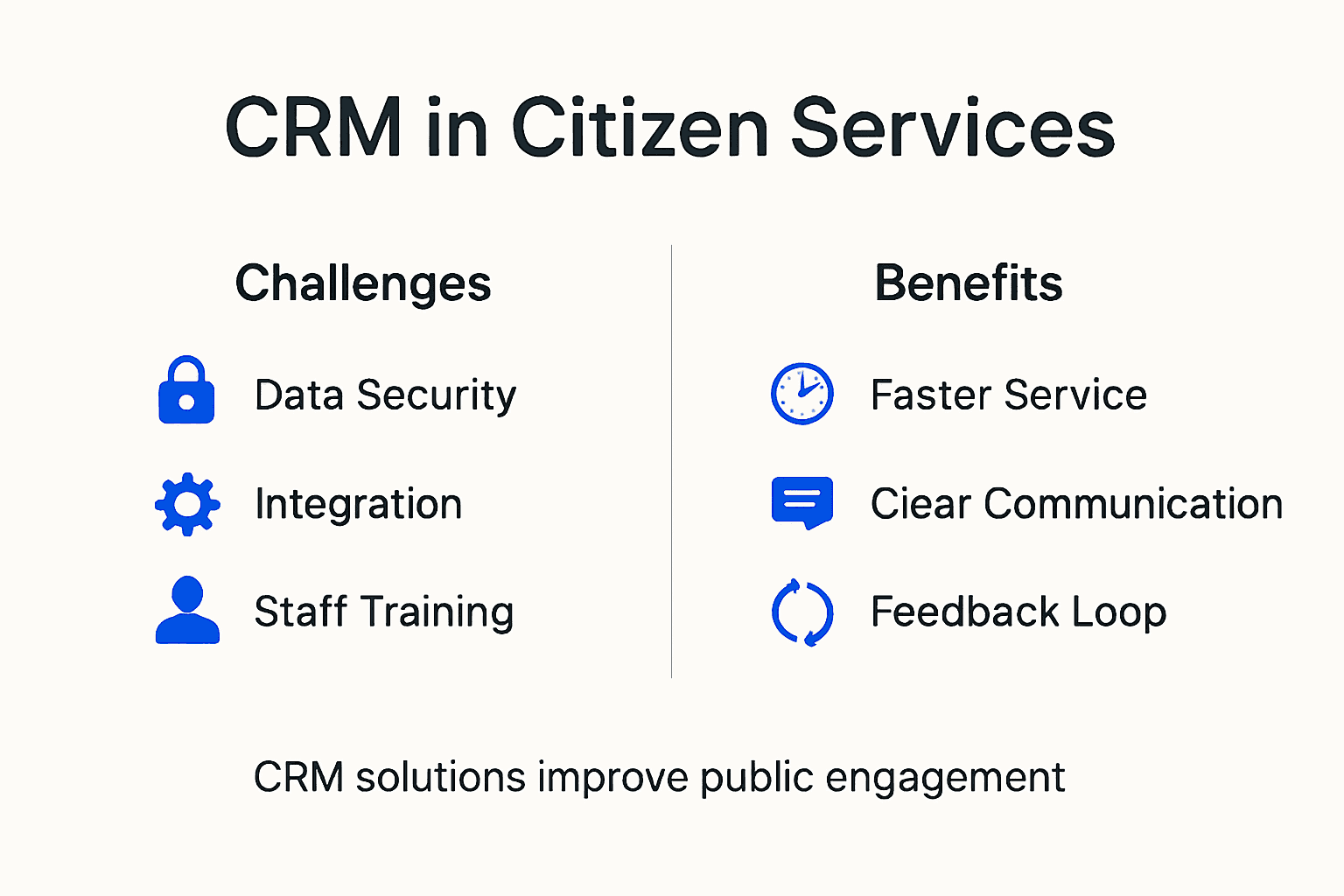
Critical success factors for CRM adoption extend beyond technological capabilities, demanding alignment of people, processes, and strategic leadership. Understanding potential risks and implementing proactive mitigation strategies becomes crucial for sustainable digital service delivery.
Key risks and challenges in government CRM implementation include:
-
Technological Complexity
- Legacy system integration
- Interoperability barriers
- Infrastructure compatibility
-
Data Privacy Concerns
- Citizen information protection
- Compliance with regional regulations
- Secure data management protocols
-
Organizational Resistance
- Cultural adaptation challenges
- Employee skill gap
- Change management barriers
-
Security Vulnerabilities
- Cybersecurity threats
- Authentication mechanisms
- Unauthorized data access prevention
Best practices for mitigating these challenges involve:
- Comprehensive stakeholder engagement
- Phased implementation strategies
- Continuous staff training
- Robust governance frameworks
Our digital transformation strategies help government agencies design comprehensive risk management approaches that address technological and organizational challenges effectively.
Pro tip: Develop a holistic change management strategy that includes continuous staff training, transparent communication, and incremental technological integration to minimize resistance and maximize CRM adoption.
Unlock the Full Potential of CRM in Citizen Services with Singleclic
The article highlights critical challenges public sector organizations face in Saudi Arabia and the United Arab Emirates around citizen relationship management including data privacy concerns, complex service requests, and the need for multi-channel engagement. Governments aim to deliver personalized, transparent, and efficient services while overcoming technological and organizational resistance. If you are seeking to transform public engagement through advanced CRM systems that enable real-time feedback, segmentation, and intelligent service workflows, you need a trusted partner who truly understands these unique challenges.
Singleclic is your regional expert in digital transformation and CRM implementation specifically designed for government and public sector demands. With our Arabic-enabled low-code platform Cortex, robust AI integrations, and hands-on experience across KSA, UAE, and Egypt, we empower agencies to streamline citizen interactions securely and at scale. Our solutions prioritize privacy compliance and operational agility, ensuring your transition toward optimized government services is smooth and impactful.
Transform your citizen engagement journey today with tailored CRM solutions built for your needs.
Discover how our CRM implementation strategies can elevate public sector services
Explore our comprehensive digital transformation services designed for governments
Visit Singleclic now to start optimizing your government-citizen relationships with confidence.
Frequently Asked Questions
What is the role of CRM in citizen services?
CRM in citizen services transforms public engagement by placing citizens’ needs at the center of service design and delivery, allowing government agencies to respond effectively to citizen expectations.
How can CRM improve communication between citizens and government agencies?
CRM systems facilitate multi-channel communication and create low-barrier interaction channels, making it easier for citizens to communicate their needs and for governments to respond promptly.
What are the key components of a CRM system used in public services?
Key components include centralized citizen data management, multi-channel communication platforms, service request tracking, personalized communication workflows, and performance analytics.
What challenges might government agencies face when implementing CRM systems?
Challenges can include technological complexity, data privacy concerns, organizational resistance, and security vulnerabilities. Addressing these requires strategic planning and risk management.
Recommended
- Benefits of CRM in Public Service Delivery | Singleclic
- CRM Implementation for Government and Public Sector: A Strategic Move Towards Digital Transformation | Singleclic
- Integration Between CRM and Citizen Portals: Empowering Governments with Seamless Digital Services | Singleclic
- How to Customize CRM for Public Sector Needs | Singleclic