TL;DR:
- Structured process improvement can reduce waste by over 30% and boost productivity.
- Leadership commitment and proper readiness are crucial for successful operational transformation.
- Continuous KPI monitoring and a strong improvement culture sustain long-term gains.
Regional enterprises in Saudi Arabia and the UAE face growing pressure to do more with less. Rising competition, regulatory demands, and Vision 2030 expectations leave little tolerance for operational drag. Yet many organizations still rely on fragmented workflows, manual approvals, and siloed data that quietly erode margins. The good news: structured process improvement steps consistently deliver 30%+ waste reduction and measurable productivity gains across industries. This guide gives C-level leaders in KSA and UAE a practical, step-by-step roadmap, grounded in regional benchmarks and proven methodology, to drive real operational transformation and lasting ROI.
Table of Contents
- Why process improvement matters in KSA and UAE enterprises
- preparing for process improvement: foundations and readiness
- Step-by-step process improvement: from mapping to pilot
- monitoring, scaling, and embedding process improvement
- A fresh perspective: why technology is only half the battle
- Next steps: accelerate process improvement with expert partners
- frequently asked questions
Key Takeaways
| Point | Details |
|---|---|
| Map and assess first | Start by documenting processes and identifying gaps for maximum impact. |
| Pilot for low-risk gains | Test improvements in phases to minimize risk and scale what works. |
| Track measurable KPIs | Use metrics like cycle time and cost per transaction to prove efficiency. |
| Prioritize culture, not just tech | Lasting results require a culture of continuous improvement and leadership commitment. |
Why process improvement matters in KSA and UAE enterprises
Operational excellence is no longer optional for enterprises competing in this region. Vision 2030 in Saudi Arabia and the UAE’s National Strategy for Industry both demand that organizations run leaner, faster, and smarter. The enterprises that thrive are those treating process improvement not as a one-time fix, but as a continuous competitive advantage.
The regional data makes a compelling case. Emirates Global AluminiumI (EGA) achieved a $100M+ business impact through structured enterprise AI and process transformation, recording productivity increases ranging from 12% to 106% across targeted workflows. Meanwhile, 20 to 40% efficiency gains are achievable at organizations like Abu-dhabi National Oil Company (more commonly known as the regional energy giant) when improvement programs focus on measurable KPIs and phased pilot testing. The pattern is clear: organizations that apply disciplined process improvement frameworks outperform those that rely on ad-hoc fixes.
Here is a snapshot of what regional enterprises are achieving:
| Organization | Area improved | Result achieved | Method used |
|---|---|---|---|
| Emirates Global AluminiumI (EGA) | Production & AI workflows | $100M+ impact, 12-106% productivity gain | Enterprise AI + process redesign |
| Abu-dhabi National Oil Company | HR and operations | 20-40% efficiency improvement | KPI-driven phased pilots |
| KSA manufacturing sector | Supply chain | 30-40% cost savings | BPM + automation |
The most common operational pain points that structured process improvement addresses include:
- Manual approval bottlenecks that slow procurement and finance cycles
- Data silos between ERP, CRM, and legacy systems causing reporting errors
- SOP (Standard Operating procedure) non-compliance that creates audit risk
- High rework rates in project delivery and service fulfillment
- Low process visibility that prevents leadership from making timely decisions
Understanding the digital transformation benefits available today helps leaders connect process improvement directly to revenue and risk outcomes. You can also align your roadmap with the top digital trends 2026 shaping enterprise strategy across KSA and UAE.
preparing for process improvement: foundations and readiness
With the benefits clear, the next step is preparing your organization for process improvement. Many improvement initiatives stall not because of poor tools, but because the groundwork was skipped. Executive sponsorship is the single most critical success factor. Without visible commitment from the C-suite, middle management resistance will quietly kill momentum.
Before launching any improvement program, conduct a readiness assessment across four dimensions:
- Leadership alignment: Do your top leaders share a common definition of “good” outcomes?
- Process documentation: Are your current workflows mapped, even informally?
- Technology infrastructure: Do your ERP and automation platforms support real-time data capture?
- Change capability: Does your organization have experience managing structured transitions?
Two well-proven frameworks help guide this phase. Define, measure, analyze, improve, and control (known as the D M A I C framework) provides a rigorous statistical approach suited to complex, high-volume processes. The lean methodology focuses on eliminating waste and is faster to deploy for organizations new to structured improvement. Here is how they compare:

| Framework | Best for | Time to value | Key tools |
|---|---|---|---|
| Six-sigma/DMAIC | High-complexity, data-rich processes | 3-12 months | Control charts, regression analysis |
| lean | Speed, waste reduction, manufacturing | 1-6 months | Value stream mapping, 5S |
| hybrid DMAIC + lean | Large enterprise transformation | 3-9 months | Combined toolset |
Start with process mapping and gap analysis using a DMAIC and lean hybrid to identify and prioritize the highest-impact areas first. This avoids the common trap of improving low-value processes while critical bottlenecks remain untouched.
Review the key steps for process management to build your readiness checklist, and explore these process improvement tips designed specifically for C-level success in enterprise environments.
Pro tip: Do not underestimate upskilling. Your frontline managers and process owners need structured training on improvement tools before the program launches. Organizations that invest in change management training before kickoff report significantly faster adoption and fewer rollback incidents.
Step-by-step process improvement: from mapping to pilot
With solid foundations, you can move into practical implementation. Here is how to execute process improvement, step by step, in a way that is both rigorous and realistic for large regional enterprises.
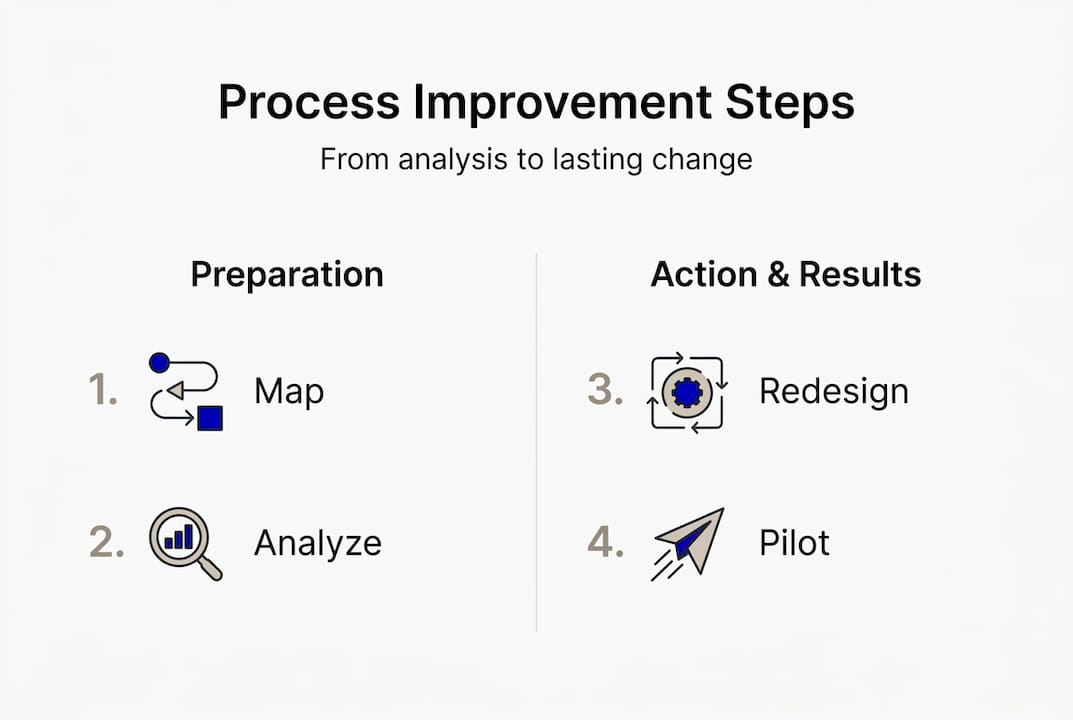
- Document current processes. Map every step, decision point, and handoff in your target process using a visual flowchart or process modeling tool. Include the people, systems, and timelines involved.
- analyze for waste and gaps. Use your DMAIC or lean framework to identify delays, duplication, and errors. Ask where time is lost and where compliance breaks down.
- prioritize by impact. Not every gap deserves equal attention. Score issues by their cost, frequency, and risk level to focus resources where the return is highest.
- redesign the improved process. Draft the future-state workflow. Include automation touchpoints, approval logic, and system integrations. Keep redesigns simple and validated by frontline staff.
- run a pilot. Test the redesigned process in one business unit or geography before scaling. Define success metrics upfront.
- monitor KPIs closely. Track cycle time, error rates, and cost per transaction during and after the pilot to measure real change.
- embed and scale. Once the pilot proves value, formalize the new process through SOPs, system configuration, and training, then roll out across the organization.
These standard process improvement steps, from mapping to embedding, represent the backbone of successful transformation programs globally and regionally.
“The organizations that achieve the most from process improvement are those that treat every pilot as a learning lab, not just a test. The data from a well-run pilot tells you not only whether the redesign works, but exactly where to adjust before scaling.” — tamer badr, CEO, singleclic
Change champions matter enormously at step four and five. These are frontline employees who believe in the redesign, communicate it to peers, and surface early problems before they become systemic. Pro tip: identify your change champions during the readiness phase, not after the pilot has already launched.
Use our operations digitization guide for practical workflow tools, and review the digital innovation workflow framework to align your pilot structure with broader business optimization goals.
monitoring, scaling, and embedding process improvement
Having piloted improvements, your focus shifts toward measurement, scaling, and culture change. This is where many programs quietly lose momentum. The pilot succeeds, leadership celebrates, and then the new process slowly drifts back to old habits without consistent reinforcement.
Avoiding that drift requires disciplined KPI tracking from day one of your pilot. Monitor KPIs like cycle time and error rates and embed a kaizen (continuous improvement) culture to lock in sustainable gains. Here are the KPIs that matter most for large enterprises:
| KPI | What it measures | Target benchmark |
|---|---|---|
| cycle time | Speed from process start to completion | 20-40% reduction from baseline |
| error rate | % of transactions requiring rework | Below 2% |
| cost per transaction | Total cost per processed unit | 15-30% reduction |
| SOP compliance rate | % of steps completed per standard | Above 95% |
| throughput | Volume processed per time period | 15-25% increase |
Beyond numbers, building a kaizen culture means making improvement everyone’s job, not just a project team’s mandate. Best practices include:
- Monthly process review meetings led by business unit heads, not just IT
- Recognition programs for staff who surface and fix process problems
- Visual management boards that display real-time KPI performance for teams
- Regular retrospectives after every scaling phase to capture lessons learned
Common mistakes to avoid: scaling too fast before pilot results are statistically significant, skipping SOP updates after process changes, and failing to retrain staff whose roles shift due to automation. Review the digital transformation must-haves to ensure your monitoring and scaling infrastructure is enterprise-ready before you expand.
A fresh perspective: why technology is only half the battle
Here is something many technology vendors will not tell you: the majority of process improvement failures we see at singleclic are not caused by bad software. They are caused by leadership that goes quiet after the kickoff meeting.
We have worked with enterprises across KSA and UAE for over a decade, and the pattern is consistent. Organizations that invest heavily in leadership-driven transformation but under-invest in people, incentives, and visible accountability rarely sustain their gains past the first year. The tool works. The culture does not follow.
The C-level leaders who drive lasting change do something specific: they personally attend the first process review meeting after a pilot, they publicly recognize early adopters, and they are willing to revise their own decisions when process data contradicts assumptions. That kind of visible sponsorship signals to every layer of the organization that improvement is a strategic priority, not a project with an end date.
Technology accelerates what good culture already enables. Without the culture, even the best ERP or automation platform becomes expensive shelf-wear.
Next steps: accelerate process improvement with expert partners
The framework covered in this guide gives you a clear path from diagnosing operational inefficiency to embedding lasting improvement across your enterprise. But knowing the steps and executing them at scale are two different challenges.
At singleclic, we partner with C-level leaders across KSA, UAE, and Egypt to design and deliver process improvement programs that combine the right methodology with the right technology. Whether you need guidance through our business process automation guide, want to explore AI process automation solutions that accelerate your roadmap, or are evaluating ERP for business operations to unify your workflows, our team of 70+ consultants is ready to support your next move. Contact us to request a tailored assessment for your organization.
frequently asked questions
What are the basic steps of process improvement?
The core improvement steps are mapping the current process, analyzing gaps, prioritizing focus areas, redesigning for improvement, piloting changes, monitoring KPIs, and embedding continuous improvement across the organization.
How can C-level executives ensure process improvement success?
Leaders must provide sustained sponsorship, set measurable goals, align cross-functional teams, and foster a culture of continuous learning. Executive sponsorship and active upskilling are particularly vital for organizations aligning with Vision 2030 mandates.
What results can KSA and UAE enterprises expect from process improvement?
Benchmark data from regional programs shows 12 to 106% productivity increases, 30 to 40% cost savings, and measurable compliance improvements are all achievable with structured, phased programs.
Which KPIs matter most for process improvement in large enterprises?
The highest-value KPIs are cycle time, error rates, cost per transaction, SOP compliance rate, and throughput, as these most directly reflect operational health and improvement impact.
Recommended
- Top business process improvement tips for C-level success
- Enterprise Project Planning How To Optimize Operations Easily
- Operations Digitization Process: Streamline Your Enterprise | Singleclic
- Digital Innovation Workflow for Business Optimization
- How to upgrade business IT for operational efficiency – IT Start