TL;DR:
- Many MENA organizations adopt multi-cloud strategies to meet regulatory, resilience, and digital transformation needs. Effective implementation requires deliberate planning, unified governance, and skilled talent, as poorly managed multi-cloud increases operational risks. Success depends on clear use cases, mature governance frameworks, and aligning cloud choices with specific business outcomes.
Most enterprise leaders assume cloud strategy boils down to picking one major provider and staying loyal. That assumption is costing organizations in the KSA, UAE, and Egypt significant money, flexibility, and compliance standing. As multi-cloud strategy grows more sophisticated — spanning AWS, Microsoft Azure, and Google Cloud simultaneously — CIOs and CTOs across the region are being asked to navigate vendor relationships, data residency laws, and digital transformation mandates all at once. This guide gives you a clear-eyed view of what multi-cloud actually means, why it matters for your region, and how to approach it without falling into the traps most organizations hit.
Table of Contents
- Understanding the multi-cloud strategy concept
- Why MENA enterprises are exploring multi-cloud: Drivers and context
- Benefits and risks: The multi-cloud value equation
- Best practices for successful multi-cloud implementation
- The uncomfortable truth about multi-cloud in the MENA region
- Next steps: Unlock value from cloud and process modernization
- Frequently asked questions
Key Takeaways
| Point | Details |
|---|---|
| Multi-cloud defined | Multi-cloud means purposefully using more than one public cloud provider to balance features, cost, and resilience. |
| MENA adoption drivers | Digital transformation and strict data laws are pushing KSA, UAE, and Egypt enterprises to multi-cloud solutions. |
| Key benefits and risks | While multi-cloud can cut costs and boost uptime, over 50% of efforts fall short due to higher complexity. |
| Best practice governance | Unified governance and clear policy frameworks are essential for successful, secure multi-cloud deployments. |
| Consider before adopting | Multi-cloud isn’t for everyone—consider team maturity, compliance needs, and operational readiness before committing. |
Understanding the multi-cloud strategy concept
One cloud rarely fits all workloads. That is the honest starting point. A multi-cloud strategy means deliberately choosing more than one public cloud provider to host different workloads, applications, or data sets, each matched to the provider that handles it best. It is not accidental sprawl. It is intentional architecture.
In practice, an organization might run AI and machine learning workloads on one provider’s infrastructure while hosting its enterprise resource planning system on another and storing regulated health or financial data on a sovereign cloud. Each decision reflects a specific technical or business requirement. The key word is deliberate. Organizations that drift into using multiple clouds without a strategy tend to create the exact complexity and cost problems they were trying to avoid.
“Multi-cloud strategy involves using multiple cloud providers — such as AWS, Azure, and GCP — to host workloads, leveraging best-of-breed services, avoiding vendor lock-in, and enhancing resilience,” according to AWS Prescriptive Guidance.
The components that make a multi-cloud strategy functional include:
- Workload mapping: Identifying which applications or data sets belong on which provider based on performance, compliance, and cost criteria
- Governance layer: Policies and frameworks that apply consistently across all cloud environments regardless of provider
- Orchestration tools: Platforms that enable centralized visibility and control, preventing silos from forming
- Identity and access management: Unified security policies that do not break down at provider boundaries
- Cost management: Tagging standards and usage monitoring across all environments to prevent runaway spending
Understanding the difference between hybrid versus multi-cloud is also essential before committing to a direction. Hybrid combines private and public environments. Multi-cloud operates across multiple public providers. They solve different problems, and mixing them up at the planning stage leads to misaligned investment.
Why MENA enterprises are exploring multi-cloud: Drivers and context
The push toward multi-cloud in the KSA, UAE, and Egypt is not purely technology-driven. Regulatory pressure, national digital strategies, and operational resilience requirements are making it a strategic necessity for many organizations.
Data residency laws are the most immediate forcing function. In Saudi Arabia, the Personal Data Protection Law (PDPL) and the National Cybersecurity Authority (NCA) requirements mean that certain data categories must remain within the Kingdom’s borders. The UAE has the Telecommunications and Digital Government Regulatory Authority (TDRA) framework. Egypt has its own data governance obligations under evolving national legislation. As these regulations tighten, organizations cannot rely on a single global hyperscaler alone if that provider lacks sufficient local infrastructure or sovereign cloud options.
Multi-cloud allows digital strategy essentials in MENA to align with these requirements by combining sovereign or local cloud options for regulated data with the full capabilities of global hyperscalers for innovation workloads. As the GCC multi-cloud strategy landscape shows, organizations in this region use multi-cloud specifically to balance data residency compliance while still tapping into advanced AI and analytics services.
The strategic imperatives go deeper than compliance. Vision 2030 in Saudi Arabia demands a level of digital capability in healthcare, finance, government, and logistics that no single provider can fully deliver. Egypt’s cloud services market tells a similar growth story.
| Regional driver | Impact on cloud strategy | Key regulation or initiative |
|---|---|---|
| Data residency laws | Forces sovereign or local cloud for regulated data | PDPL (KSA), TDRA (UAE) |
| Vision 2030 (Saudi) | Accelerates demand for AI, analytics, and digital services | National transformation programs |
| Egypt digital growth | 12.56% CAGR by 2031 in cloud services | Digital Egypt initiative |
| Vendor lock-in risk | Pushes enterprises toward multi-provider models | Commercial and operational resilience |
| Business continuity | Demands geographic and provider redundancy | Risk management frameworks |
Pro Tip: If your organization operates across multiple MENA countries, map your data types to each country’s residency requirements before selecting cloud providers. This single step will eliminate a large portion of compliance risk before it becomes a legal problem.
You can also align this analysis with digital trends for MENA leaders to see how cloud decisions fit within the broader technology landscape for 2026. The regional picture is clear: multi-cloud is not optional for many enterprises. It is a structured response to real market conditions.
Benefits and risks: The multi-cloud value equation
Multi-cloud offers real advantages. It also introduces real complexity. CIOs who treat it purely as an opportunity without modeling the risks tend to run into serious operational problems within 12 to 18 months of adoption.

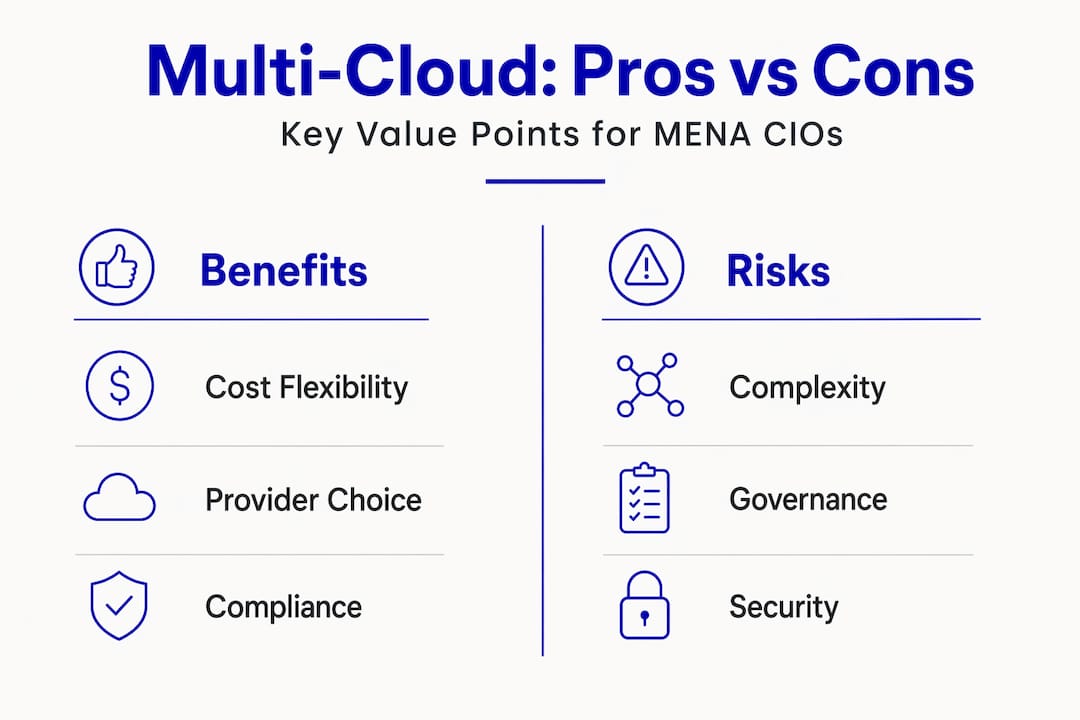
The benefits are well documented. Multi-cloud cost optimization through rightsizing, commitment discounts, and resource scheduling has delivered 25 to 42 percent cost reductions in documented case studies. Beyond cost, multi-cloud provides negotiating leverage with vendors, which is often underestimated. When a single provider knows you have no alternative, pricing power shifts entirely to them. With two or more providers, that dynamic changes.
Here is a structured comparison:
| Factor | Multi-cloud | Single-cloud |
|---|---|---|
| Cost flexibility | Higher, with selective optimization | Simpler but limited leverage |
| Resilience | Strong, provider-level redundancy | Dependent on one provider’s SLAs |
| Compliance | Adaptable to multi-country requirements | May lack local infrastructure options |
| Operational complexity | Significantly higher | Much lower |
| Vendor leverage | Strong | Weak |
| Talent requirements | Specialist skills across platforms | Focused, easier to build |
| Time to value | Slower, requires governance maturity | Faster for early-stage organizations |
The risks deserve equal attention. Gartner predicts that more than 50 percent of organizations will fail to realize multi-cloud benefits by 2029 due to interoperability issues and lack of strategic clarity. That is not a marginal failure rate. It reflects how many enterprises treat multi-cloud as a goal rather than a tool.
The top risks to plan for include:
- Integration complexity: Moving data and workloads between providers is expensive and technically difficult without standardized APIs and data formats
- Security gaps: Each provider has its own security model. Without unified identity management and policy enforcement, gaps form at the boundaries
- Skill deficits: Operating multi-cloud requires certified expertise across all platforms in use. Most teams are not staffed for this at launch
- Cost sprawl: Without consistent tagging and centralized cost management, multi-cloud billing can exceed single-cloud costs within months
- Governance inconsistency: Policies applied differently across providers create compliance exposure, especially under PDPL and NCA requirements
Organizations exploring digital disruption in MENA tend to underestimate how much internal governance maturity is required before multi-cloud pays off. The solutions that drive ROI are almost always the ones built on a clear operating model, not just a multi-provider contract.
Best practices for successful multi-cloud implementation
The organizations that succeed with multi-cloud share one trait: they treat governance as the foundation, not an afterthought. Here is a structured approach based on what works in practice.
-
Define your use cases first. Do not select providers until you know what specific business problem each cloud will solve. AI and analytics, regulated data storage, and enterprise applications each have different provider strengths. Start there.
-
Build a unified governance framework. Key methodologies include policy as code, consistent resource tagging, and centralized management platforms such as Anthos or Azure Arc. These tools apply governance uniformly across all providers, which is the only way to prevent silos from forming.
-
Establish tagging standards before day one. Every resource across every provider should be tagged by environment, cost center, application, and owner. This single discipline enables cost visibility, security audits, and compliance reporting at scale.
-
Centralize identity and access management. A unified identity layer prevents the credential sprawl that creates security vulnerabilities. Federated identity across providers is a non-negotiable baseline.
-
Monitor continuously with provider-agnostic tools. Single-provider monitoring tools create blind spots. Invest in cloud-agnostic observability platforms that give your operations team a unified view.
-
Plan for compliance from the start. The digital compliance guide for GCC and Egypt outlines the specific regulatory considerations you need to embed into your cloud architecture decisions, not retrofit after deployment.
Pro Tip: Run a 90-day pilot on a single use case before scaling multi-cloud across your organization. Choose a workload with clear performance and cost metrics so you can validate your governance model and team readiness before the stakes get higher.
Ongoing cloud security practices and disciplined approaches to securing data across distributed environments are not optional layers. They are the operational foundation that determines whether your multi-cloud investment pays off or creates new risk exposure.
The uncomfortable truth about multi-cloud in the MENA region
Having worked with enterprise clients across KSA, UAE, and Egypt through complex technology transformations, we have observed a consistent pattern: organizations that struggle most with multi-cloud are not struggling because the technology is bad. They are struggling because they adopted multi-cloud before they had the internal capability to manage it.
The governance maturity required to run multi-cloud well is genuinely high. Unified policy frameworks, consistent tagging, centralized cost management, cross-platform security expertise. These are not capabilities most enterprise IT teams build quickly. And in the MENA region, where certified cloud talent is competitive and expensive, the talent gap makes the operational challenge even harder.
Here is the uncomfortable part. Multi-cloud sometimes gets adopted for the wrong reasons. Vendor diversity sounds strategically sophisticated. It signals to boards and steering committees that the organization is not dependent on one provider. But if the underlying motivation is political rather than technical, the complexity costs far outweigh the strategic narrative value.
Tamer Badr, founder of Singleclic, puts it plainly: “We tell clients that multi-cloud is a solution to a specific set of problems. If you do not have those problems, a well-executed single-cloud strategy will outperform a poorly governed multi-cloud environment every time. The question is always ‘what business outcome are you solving for?’ not ‘how many providers can we use?’”
The AWS guidance on multi-cloud complexity is direct: multi-cloud increases complexity, security risks, and operational costs, and is suitable primarily for mature teams with specific needs such as regulatory separation. For organizations in the GCC that must separate sovereign data from public cloud workloads, that need is real and justified. But for organizations chasing flexibility without clear constraints, the real tradeoffs in 2026 show that single-cloud is often more operationally sound and less expensive.
The best MENA CIOs we have worked with approach multi-cloud the same way they approach capital investment: a clear business case, a defined ROI model, and a realistic assessment of their team’s readiness. They also invest in talent development before the go-live date, not after. And they build cloud security for resilience into the architecture from day one rather than treating it as a phase-two project.
The bottom line is that multi-cloud can be transformative for the right organization. But it requires honest internal assessment, not just vendor enthusiasm.
Next steps: Unlock value from cloud and process modernization
Multi-cloud strategy does not exist in isolation. The organizations that extract the most value from it are the ones that pair cloud architecture decisions with intelligent process automation, ERP modernization, and AI-driven workflows.
At Singleclic, we work with enterprise leaders across KSA, UAE, and Egypt to connect cloud strategy with operational outcomes. From ERP and CRM implementations to business process automation and agentic AI, we help you build the systems that make cloud investment pay off in practice. Whether you are mapping your first governance framework or scaling across providers, our consultants bring over 10 years of regional delivery experience to every engagement. Explore our business process automation guide for C-level leaders, or see how AI-driven process automation is transforming operations for enterprises like yours across the region.
Frequently asked questions
What is the main difference between multi-cloud and hybrid cloud?
Multi-cloud means using two or more public cloud providers for different workloads, while hybrid cloud combines a private on-premise or dedicated environment with one or more public clouds. They address different architectural and compliance needs.
What compliance challenges are unique to the KSA, UAE, and Egypt for multi-cloud?
These regions require strict data residency adherence under NCA, PDPL, and TDRA frameworks, which means regulated data must often stay within national borders, driving the need for sovereign cloud or hybrid approaches alongside global hyperscalers.
What is the biggest risk of moving to multi-cloud?
The primary risk is operational complexity combined with weak interoperability governance. Gartner projects more than 50 percent of organizations will fail to realize multi-cloud benefits by 2029, specifically because of these gaps.
Can multi-cloud actually reduce costs in MENA markets?
Yes, when managed with strong cost governance, multi-cloud delivers real savings through tailored provider selection and negotiated discounts. Documented case studies show reductions of 25 to 42 percent in operational cloud costs for well-governed deployments.
Is multi-cloud only for large enterprises, or can mid-sized companies benefit?
Large enterprises benefit most given the governance overhead involved, but mature mid-sized organizations with specific regulatory requirements or resilience mandates can gain value. The AWS guidance recommends it only for teams with the operational maturity to manage the added complexity effectively.