SWIFT MT is the older, field-based message format for payments. ISO 20022 is the richer, XML-based standard that replaced it for cross-border bank-to-bank payments. SWIFT ended the coexistence period on 22 November 2025. Banks now exchange cross-border payment instructions in ISO 20022 only. If you run finance, treasury or IT at a UAE or Saudi organization, the practical question is no longer which format is better. It is whether your ERP, treasury and reconciliation processes can send, receive and use the richer data that now reaches your bank. Our team at Singleclic builds that integration layer on Microsoft Dynamics 365 and on the Cortex low-code platform.
TL;DR
- SWIFT MT is a legacy format of numbered messages with fixed text fields. ISO 20022 (called MX on the SWIFT network) uses structured XML with dedicated data elements.
- After 22 November 2025, cross-border payment instructions between financial institutions must be exchanged in ISO 20022. Unmigrated MT messages may be rejected or carry contingency-processing charges from January 2026.
- The Central Bank of the UAE (CBUAE) tells UAE financial institutions to assess system compatibility, upgrade, train staff and run both formats during the transition.
- For a corporate, the work sits in ERP payment files, bank statements, reconciliation and address data, not in the SWIFT network itself.
Table of Contents
- What each standard is
- ISO 20022 vs SWIFT MT at a glance
- Why the data difference matters to your finance team
- How MT messages map to ISO 20022
- Where the UAE stands
- What to check in your ERP, treasury and reconciliation
- Use cases for UAE and Saudi organizations
- How Singleclic helps
- Our perspective
- Article details
- FAQ
- Sources
What each standard is
SWIFT MT messages are “message text” formats. Under the CBUAE Rulebook, MT 1xx messages cover customer-initiated payments and MT 2xx messages cover settlements between institutions. Two names you will hear most are MT103 (a customer credit transfer) and MT202 (a bank-to-bank transfer).
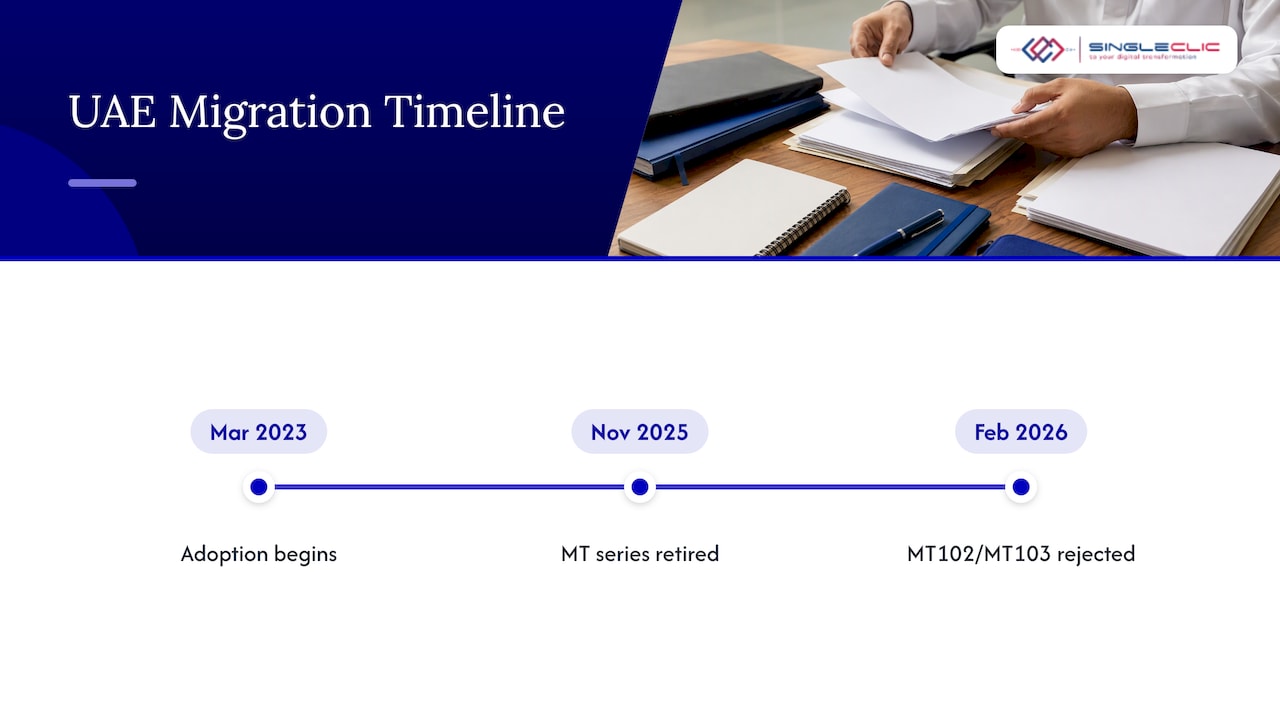
ISO 20022 is an open global standard. SWIFT describes it as built on a three-layer methodology: a business model dictionary, logical messages and a syntax. The SWIFT community decided in 2018 to adopt it for cross-border payments, with migration starting in March 2023. Those same SWIFT pages note that other domains, such as corporate-to-bank, trade finance and Forex, continue to use MT/FIN standards. So the change is real but not total, and you should confirm with your bank which of your flows are affected.
The two are related rather than rival. ISO 20022 is the data model. MX is the name for ISO 20022 messages travelling on the SWIFT network. MT is the format they replace for payment instructions.
ISO 20022 vs SWIFT MT at a glance
| Criterion | SWIFT MT | ISO 20022 (MX) |
|---|---|---|
| Format | Field-based text, numbered messages | Function-specific, hierarchical, machine-readable XML |
| Party data | Name and address as four lines of 35 characters | Separate elements for name, building number, street, town and country code |
| Ultimate parties | No dedicated fields for ultimate debtor or creditor | Dedicated ultimate debtor and ultimate creditor fields |
| Remittance information | Limited free text | Can travel inside the payment message |
| Screening | Text parsing, more false positives | Structured data can make automated screening more efficient |
| Naming | Originator, Beneficiary | Debtor, Creditor |
The party-data and ultimate-party rows come from SWIFT’s own migration study. The format row comes from SWIFT’s business-case guide, which also notes that these differences require changes to data repositories, operational processes and user interfaces.
Why the data difference matters to your finance team
Names and addresses stop being truncated
An MT message holds a name and address in four lines of 35 characters. A long legal entity name, a free-zone address or an Arabic-to-Latin transliteration quickly runs out of space. ISO 20022 gives each part its own element, so nothing has to be cut. SWIFT’s study also says ISO 20022 supports “payment on behalf of” (POBO) scenarios, where a group treasury pays for a subsidiary, which MT cannot carry without truncation. That matters for any holding company in the UAE or Saudi Arabia that runs a payment factory.
Remittance details travel with the money
A white paper from a large US bank explains that MT messages combine data as a continuous line of text that can truncate important information, while MX messages carry unique fields in a standardized way. Remittance information can also travel inside the payment message. For supply chain and accounts payable teams, that means invoice references can reach the receiving party intact, which supports automatic matching.
Screening and compliance get better input
SWIFT’s guide says structured data can give better insight into transaction purpose and enhance screening, compliance and AML processes. Structured party fields also give your own sanctions and AML checks cleaner input than free text.
Addresses are changing too
A bank update for the SWIFT release effective 22 November 2025 introduces a Hybrid Postal Address: country and town name are mandatory, postcode is recommended, and there are up to two address lines of 70 characters. The same update says purely unstructured address use (three lines of 35 characters) is to be discontinued from November 2026. If your vendor and customer master data stores addresses in one free-text block, that is the first thing to clean up.
How MT messages map to ISO 20022
Searchers often ask what pain, pacs and camt mean. They are the message families:
- pain messages are payment initiation, sent from a corporate to its bank.
- pacs messages are interbank clearing and settlement.
- camt messages are cash management and reporting: statements, advices and investigations.
A bank mapping guide, updated March 2025, and SWIFT’s end-of-coexistence guide give the following equivalents:
| MT message | Purpose | ISO 20022 message |
|---|---|---|
| MT101 | Customer payment request | pain.001 |
| MT103 | Customer credit transfer | pacs.008 |
| MT202 | Bank-to-bank transfer | pacs.009 |
| MT202 COV | Cover payment for an MT103 | pacs.009 COV |
| MT940 / MT950 | End-of-day statement | camt.053 |
| MT941 / MT942 | Intraday report | camt.052 |
| MT900 / MT910 | Debit and credit confirmation | camt.054 |
The CBUAE Rulebook gives the same pairing for the two headline messages: PACS008 is the equivalent of the customer credit transfer and PACS009 of the financial institution credit transfer. Two details are worth knowing. MT102 and MT203 are unsupported in the CBPR+ usage guidelines (the SWIFT rules for cross-border ISO 20022 payments) because they contain multiple transactions. Each transaction may be sent separately as an MT103 or MT202. And pacs.004, a return message, is new, with no direct MT predecessor.
For the unfamiliar field names, the practical translation is: field 50 (ordering customer) maps to the debtor, field 59 (beneficiary) maps to the creditor, field 70 (remittance) maps to the remittance information element, and the unique end-to-end transaction reference, the UETR, sits in its own element.
Where the UAE stands
The CBUAE Rulebook Annex 3, in force from 7 November 2025, states that adoption ran from March 2023 to November 2025, after which SWIFT retires the MT 1xx, 2xx and 9xx series. A migration guide from an international bank also lists the UAE on its HVPS+ migration list, covering high-value payment systems.
A bank FAQ updated in February 2026 adds two points leaders should hear. MT payment instructions such as MT102 and MT103 are now rejected and not delivered on the cross-border FI-to-FI channel. And corporates and institutions not connected to SWIFT are not currently required to migrate. In other words, your bank carries the compliance obligation on the network. Your obligation is to keep your own payment files, statements and data compatible with what the bank now offers.
For Saudi organizations, the same SWIFT cutover applies to any cross-border payment that passes through a SWIFT-connected bank. Check the domestic clearing rules with your bank for local payments.
What to check in your ERP, treasury and reconciliation
A bank-published readiness checklist advises setting up a programme team with an accountable executive, completing payments-infrastructure impact assessments across front, middle and back office, evaluating AML and cyber impact, and preparing ERP systems to support richer payment information in statements and reconciliation. It also suggests considering migrating payment upload files to pain.001.009 and adopting camt.054 payment advices.
Another bank’s corporate guide describes treasury payments and cash reporting moving from MT101, MT940 and MT942 to pain and camt messages, with translation available in flow for key formats. Translation buys time. It does not give you the richer data.
A working checklist for a CFO, CIO or treasury head:
- Map every payment flow. List which flows use MT101, MT940 or MT942 today, and which your bank has already moved.
- Audit master data. Check that vendor and customer records hold structured addresses (town and country at minimum) and full legal names.
- Review payment file formats. Confirm your ERP can produce pain.001 and consume camt.052, camt.053 and camt.054.
- Rework reconciliation rules. Richer remittance data can replace manual matching, but only if your rules read the new fields.
- Check screening and AML tooling. Structured fields should feed your sanctions workflows.
- Plan for exceptions. Rejected or repaired payments need an owner and a workflow, not an email chain.
- Agree testing with your bank. Run parallel flows during the transition and train AP and treasury staff.
If you run Dynamics 365, the integration points are well defined. Our article on SWIFT integration and Dynamics 365 electronic reporting traps on Azure in MENA covers where these projects go wrong.
Use cases for UAE and Saudi organizations
- Group treasury and POBO. A holding company pays suppliers on behalf of several subsidiaries. Dedicated ultimate-party fields let the real payer and payee remain visible.
- Accounts payable in construction and real estate. Large supplier payments carry invoice references in the message, so reconciliation can run with fewer manual steps.
- Healthcare and government payers. High payment volumes and audit requirements benefit from structured, searchable payment data.
- Banks and fintechs. Mapping legacy MT workflows to pacs, pain and camt flows is a process-orchestration job as much as a messaging one. See our view on how BPM is moving the banking industry forward and on open APIs in banking.
- Compliance teams. Cleaner party data supports screening. Our guide to compliance-by-design process automation in regulated industries shows how to build those controls into workflows.
How Singleclic helps
ISO 20022 readiness is an integration and process problem: bank files, ERP payment runs, approvals, reconciliation and exception handling have to work together. Singleclic delivers Microsoft Dynamics 365 implementation, integration, customization and support, and our Cortex low-code platform is built to connect approvals, ERP, CRM, data, legacy systems and workflows. Cortex supports on-premise deployment for banks and governments, full Arabic UI and runtime workflow changes without downtime. Our clients include QNB, AlBaraka, Emirates Health Services and Dubai Healthcare City. For financial institutions, our fintech solutions page outlines the wider offer.
If you want to review how your ERP and treasury flows will handle structured payment data, talk to us through the Singleclic services page.
Our perspective
Most leaders ask us whether ISO 20022 is a banking problem or a business problem. In our experience of ERP and process work across Saudi Arabia, the UAE and Egypt, the standard itself is the easy part. The hard part is that payment data now arrives richer than the processes built around it.
We would treat this as a chance to fix the whole payment chain: clean master data, one approval workflow, automated reconciliation and a clear owner for every exception. That is where Dynamics 365 integration and a platform like Cortex earn their place, because they connect the bank, the ERP and the approvals in one governed flow, and they can be changed as bank requirements change.
Our advice: start with the flows that carry the most value and the most reconciliation effort, then extend.
Tamer Badr
Article details
- SEO title: ISO 20022 vs SWIFT MT: what changes for UAE businesses
- Slug: iso-20022-vs-swift-mt
- Primary keyword: ISO 20022 vs SWIFT MT
- Secondary keywords: SWIFT MT vs ISO 20022, MT103 to pacs.008, pain pacs camt messages, ISO 20022 migration UAE, ERP payment integration
- Pillar cluster: Business process automation in regulated industries (banking and fintech)
- Related reading: business case for process automation in regulated industries, from branches to apps: banking’s digital shift
FAQ
What is the main difference between ISO 20022 and SWIFT MT?
MT is a legacy, field-based text format with limited space for names, addresses and remittance details. ISO 20022 is structured XML with separate elements for each data point. The result is richer, more precise payment data that systems can read without parsing free text.
Is SWIFT MT still used after November 2025?
For cross-border payment instructions between financial institutions, no. SWIFT’s coexistence period ended on 22 November 2025, and unmigrated MT messages may be rejected or incur charges. SWIFT’s standards pages note that other domains, such as corporate-to-bank, trade finance and Forex, continue on MT/FIN, so ask your bank which of your flows are affected.
What do MT103 and MT202 become in ISO 20022?
MT103, the customer credit transfer, maps to pacs.008. MT202, the bank-to-bank transfer, maps to pacs.009. The CBUAE Rulebook states this equivalence for UAE institutions.
Does my company have to migrate to ISO 20022?
The network obligation sits with banks. A bank FAQ states that corporates not connected to SWIFT are not currently required to migrate. Your bank may still move your payment files and statements to pain and camt formats, so your ERP should be ready to produce and read them.
What should a UAE company fix first?
Start with address and party master data, because structured addresses are required in ISO 20022 messages and unstructured use is scheduled to end from November 2026. Then review payment file formats and reconciliation rules against pain.001 and camt statements.
Sources
- ISO 20022 for financial institutions: Navigating the end of coexistence, SWIFT
- A guide to building your business case for ISO 20022, SWIFT
- SWIFT ISO 20022 Migration Study
- Cross-Border Payments, CBUAE Rulebook
- Annex 3: Transition from SWIFT to the ISO 20022 Payment Standard, CBUAE Rulebook
- ISO 20022 Migration FAQ, Citi
- Migration to ISO 20022 mapping guide, J.P. Morgan
- ISO 20022 Update: Cash Messages, BNY
- ISO 20022 migration for Financial Institutions, Standard Chartered
- ISO 20022 migration for Corporate clients, Standard Chartered
- ISO 20022 Readiness checklist, NatWest
- ISO 20022 payments white paper, Wells Fargo via Faster Payments Council